

Electric-car owners in Minnesota will begin 2026 facing a materially higher registration bill: the state’s new law raises the minimum annual surcharge for fully electric vehicles to $150 for registrations starting January 1, 2026 (and establishes a new minimum $75 surcharge for plug‑in hybrid electric vehicles), while preserving the existing vehicle‑value based registration tax that can push the total bill even higher for newer, more expensive EVs.
Minnesota lawmakers adopted the surcharge changes as part of the 2025 budget and transportation package. The new rules change how the state treats zero‑emission vehicles (ZEVs) and plug‑in hybrids when it comes to annual registration charges. The reform creates a two‑part system for EV owners:
The law also instructs that receipts from these surcharges be deposited into the state’s highway funding account used for road maintenance and other transportation projects.
The state already uses a year‑by‑year percentage schedule for registration taxes (100% of MSRP in the first year, 95% in year two, 90% in year three, and so on down to 10% in year ten, then a fixed small amount thereafter). That means value‑based EV surcharges fall as vehicles age, unless the statutory minimum remains the binding floor.
Lawmakers also baked in indexing and future adjustments into the law: upcoming adjustments tie future surcharge changes to movements in the gasoline excise tax, allowing the EV surcharge to track the state’s traditional fuel tax over time.
The collected funds are directed into Minnesota’s highway user distribution account, where they will join other transportation revenue streams used for pavement maintenance, bridge repairs, and other infrastructure priorities.
Two recurring political themes framed debate:
Minnesota policymakers have recognized this mismatch and included a plan to begin taxing electricity used at public fast chargers in 2027 to better approximate a per‑mile user fee. Under that proposal, operators of public fast chargers would remit a small per‑kilowatt‑hour fee, with revenue split into transportation funding accounts.
Two structural issues undercut the public‑charger tax idea as a comprehensive fix:
The immediate fiscal impact is clear — owners of newer and more expensive electric cars will pay substantially more at registration than before — but the policy’s ultimate success depends on a range of moving parts: how many EVs the state expects to register going forward, whether state and utility incentives offset higher operating costs enough to keep adoption on track, and whether the planned kWh tax and any future changes better align payments with miles driven.
Numbers cited in media coverage for Minnesota’s EV population vary between sources, and estimates of the state’s registered EVs differ significantly depending on the dataset and date used; readers should treat specific headcounts as estimates that evolve rapidly with market adoption. Likewise, national incentive programs and federal tax credits have changed recently, narrowing or altering the availability of purchase credits — those shifts materially change the net economics of EV ownership and are an essential factor for potential buyers to consider.
Minnesota has set a new baseline for how midwestern states can reconcile transportation funding and electrification; the next several years will show whether that balance sustains infrastructure needs without stalling the EV transition the state has otherwise promoted.
Source: PCMag UK Happy New Year? EV Registration Fees Will Double in This State on Jan. 1
 Background / Overview
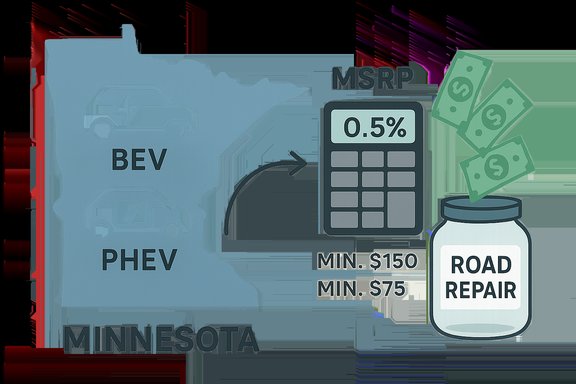
Minnesota lawmakers adopted the surcharge changes as part of the 2025 budget and transportation package. The new rules change how the state treats zero‑emission vehicles (ZEVs) and plug‑in hybrids when it comes to annual registration charges. The reform creates a two‑part system for EV owners:- a baseline, surcharge assessed specifically on battery electric vehicles (BEVs) and plug‑in hybrid electric vehicles (PHEVs), and
- the existing registration tax (a vehicle‑value based levy applied to all passenger vehicles) that remains in force and continues to rise and fall by vehicle age under Minnesota’s established scale.
The law also instructs that receipts from these surcharges be deposited into the state’s highway funding account used for road maintenance and other transportation projects.
What exactly changed (law and mechanics)
New surcharge schedule and timing
The statute introduces a minimum surcharge for BEVs and PHEVs tied to precise registration start dates:- For battery electric vehicles (BEVs): the surcharge is now calculated so that the minimum amount is $150 for registration periods beginning on or after January 1, 2026 and through June 30, 2027. Beginning July 1, 2027 the minimum drops to $100.
- For plug‑in hybrid electric vehicles (PHEVs): the minimum surcharge is $75 for registration periods beginning on or after January 1, 2026 and through June 30, 2027, dropping to $50 for registration periods beginning July 1, 2027 and after.
How the surcharge is calculated (the formula)
The EV surcharge is the greater of:- the statutory minimum (listed above), or
- a formulaic amount based on the vehicle’s Manufacturer’s Suggested Retail Price (MSRP) and the vehicle’s year‑of‑life depreciation percentage.
- 0.5% of the vehicle’s MSRP, multiplied by the percentage assigned to the vehicle’s year of life (the same year‑of‑life percentages Minnesota already uses to compute the general registration tax).
The state already uses a year‑by‑year percentage schedule for registration taxes (100% of MSRP in the first year, 95% in year two, 90% in year three, and so on down to 10% in year ten, then a fixed small amount thereafter). That means value‑based EV surcharges fall as vehicles age, unless the statutory minimum remains the binding floor.
Example: how a $50,000 EV would be charged
A simple illustration shows why the law will hit many newer EV buyers harder:- 0.5% of a $50,000 MSRP = $250.
- If the vehicle is in its first year (100% factor), the computed surcharge equals $250, which is greater than the $150 minimum — so the owner pays $250 for the surcharge component.
- Add the standard registration tax (also calculated from MSRP and year) and any other county or wheelage taxes, and the total registration bill exceeds the surcharge alone.
Why the state changed the rules: the policy rationale
State officials framed the change as an effort to recoup revenue lost as drivers shift from gasoline to electricity. Historically, gas taxes have been the principal user‑fee source for road and bridge funding. Because electric cars do not purchase gasoline, they do not contribute to that revenue stream even as they use — and given higher curb weight, may accelerate wear on — the public road network.Lawmakers also baked in indexing and future adjustments into the law: upcoming adjustments tie future surcharge changes to movements in the gasoline excise tax, allowing the EV surcharge to track the state’s traditional fuel tax over time.
The collected funds are directed into Minnesota’s highway user distribution account, where they will join other transportation revenue streams used for pavement maintenance, bridge repairs, and other infrastructure priorities.
Where this sits in the national picture
- EV registration surcharges are now commonplace. A majority of U.S. states levy some form of higher annual registration fee for electric or plug‑in vehicles, with amounts typically ranging from roughly $50 to a few hundred dollars annually depending on the state and vehicle type.
- States use several approaches: flat annual surcharges, value‑based surcharges tied to MSRP, mileage‑based pilot programs, and taxes on electricity delivered at public chargers. Minnesota’s approach combines a minimum flat floor with a value‑sensitive formula — effectively blending the flat and value approaches.
Immediate impacts: who pays more and by how much
Direct financial effects
- Owners of newer, high‑MSRP BEVs will see the biggest increases. Using the formula above, a brand‑new car with a $50,000 MSRP faces a surcharge of roughly $250 before the standard registration tax — more than three times the former $75 minimum surcharge that applied in some earlier versions of Minnesota law.
- Many plug‑in hybrid owners — who previously were often exempt — now face a new surcharge (minimum $75 initially). That pulls a previously untaxed segment into the road‑user funding pool.
- For older BEVs, particularly those beyond their first few model‑years, the value‑based calculation will fall with age and may quickly revert to the new minimum floor (or, conversely, the floor may be above the calculated value).
Distributional features and equity concerns
- The surcharges are regressive in intent but mixed in practice: on one hand, a flat surcharge hits lower‑income owners proportionally harder as a share of income; on the other hand the value‑sensitive formula means wealthy purchasers of high‑end EVs pay larger amounts. The hybrid floor plus value formula attempts to apply a progressive tilt to wealthier buyers by making MSRP matter, but still leaves a flat element that bites the least well‑off drivers.
- Urban vs rural: rural drivers tend to drive longer distances and may have less access to public charging infrastructure. A flat surcharge does not capture per‑mile road usage, so rural drivers who rely on long‑distance travel may still contribute less in net fuel taxes relative to their road usage if they charge mostly at home and pay the flat surcharge. Conversely, urban drivers who rarely drive long distances but own costly EVs could pay more because of MSRP.
- Fleet and commercial impacts: companies that own or lease large numbers of EVs will see their occupational cost of electrification rise; this may affect fleet electrification timelines unless employers factor the surcharge into TCO (total cost of ownership) models.
The politics and pushback
Electrification advocates and industry groups called the surcharges “punitive” during debate, arguing the policy risks stalling EV adoption and undermining climate goals. State officials countered that sustainable transportation funding requires broad responsibility from all road users, including EV owners.Two recurring political themes framed debate:
- fairness versus simplicity (flat fees are easy administratively but may misprice road use), and
- revenue sufficiency versus incentives (how to preserve incentives for EV adoption while replacing declining fuel tax receipts).
The “home‑charging” problem and the planned electricity levy
One of the most discussed criticisms is that flat surcharges do not mirror actual road use the way gasoline taxes do. Gas taxes charge per unit of fuel consumed — which correlates to miles driven. A flat annual fee breaks that link.Minnesota policymakers have recognized this mismatch and included a plan to begin taxing electricity used at public fast chargers in 2027 to better approximate a per‑mile user fee. Under that proposal, operators of public fast chargers would remit a small per‑kilowatt‑hour fee, with revenue split into transportation funding accounts.
Two structural issues undercut the public‑charger tax idea as a comprehensive fix:
- Most EV charging is done at home or workplace locations — estimates and studies commonly show a majority of charging events and energy delivered occur at private residences and workplace chargers, with public fast charging making up a small share of overall kWh delivered. That means a tax on public charging will not capture the majority of electricity used by EVs and may mainly influence the cost of longer trips rather than everyday driving.
- Metering and administrative complexity: taxing kWh at chargers requires accurate metering, collection by station operators, and compliance systems — all of which add administrative costs and compliance burdens that may be passed through to consumers.
Alternatives not chosen (and why they matter)
Minnesota’s law reflects a choice among several options states have been weighing as EV adoption proceeds. Alternatives include:- Mileage‑based user fees (road‑usage charges). These track miles driven and are arguably the fairest proxy for road wear and use. Pilots have been run in many states, but they face privacy concerns, technical complexity, and political resistance.
- Higher general registration taxes for all vehicles (not EV‑specific), which treats all vehicles equally but fails to calibrate for lower marginal road‑user externalities per dollar of fuel tax forgone.
- Weight‑based fees (higher charges for heavier vehicles). EVs tend to be heavier due to batteries, so weight fees can more directly address wear and tear. However, they can also penalize electric models serving essential functions.
- Continued reliance on gas taxes with gradual phase‑ins of EV user charges — the Minnesota approach favors a combination of a surcharge and a later per‑kWh tax at public chargers.
Interaction with state and federal EV incentives
Minnesota’s surcharge law exists at the same time many states offer purchase incentives and the federal government has, in recent years, shifted the structure and timing of its Clean Vehicle Credit.- State incentives: some states still offer point‑of‑purchase rebates or tax credits that offset part of an EV’s higher upfront price. Those programs vary widely in generosity and eligibility; Minnesota’s own consumer rebate programs have run in pilot mode and may not fully offset the new registration surcharges.
- Federal credits: in 2025 the federal Clean Vehicle Credit underwent major rule changes and time limits that materially affect buyers’ calculus for when to purchase an EV and how much government assistance they can expect to capture. Those changes have narrowed the window for federal purchase subsidies and altered qualification rules for specific models, which complicates net‑cost estimates for Minnesota buyers.
Practical guidance for Minnesota drivers
- If you own or are buying an EV, calculate the surcharge using the MSRP and the vehicle’s model‑year factor; compare the floor to the MSRP formula to estimate your surcharge.
- Factor the new surcharge into your TCO analysis alongside expected fuel/charging costs, insurance, maintenance, and any state or utility incentives.
- If you rely heavily on public fast charging (e.g., for frequent long trips), watch for the coming per‑kWh tax that will affect the price of fast‑charging sessions.
- Consider timing if possible: phased minima mean the surcharge floor changes in mid‑2027; depending on registration period timing and vehicle model year, small differences in registration start date could change the first year’s surcharge.
Critical analysis: strengths, weaknesses and risks
Notable strengths
- Immediate revenue: the surcharge delivers an immediately collectible and administratively straightforward revenue stream to replace some gas tax receipts lost to electrification.
- Simplicity and predictability: the combination of a minimum floor and an MSRP‑based fallback is simple enough for DMV systems to administer and predictable enough for budgeting in the near term.
- Partial progressivity: tying the formula to MSRP means higher‑priced EVs pay more in line with vehicle value, which aligns with distributing payment responsibility to wealthier purchasers.
Key weaknesses and risks
- Misalignment with road use: the surcharge disconnects payments from actual miles driven. Owners who drive very little still pay the same floor as those who drive often, and those who drive heavily but charge mostly at home escape per‑kWh taxes on public chargers.
- Equity concerns: a flat fee element can be regressive for low‑income owners; if incentives are not sufficient or well‑targeted, the surcharge may make EV ownership less accessible to budget‑constrained buyers.
- Market signal risk: increasing registration costs and new caps on federal credits have the potential to slow consumer EV adoption, especially in price‑sensitive segments where registration fees are a material cost. That undermines broader climate and public‑health goals tied to electrification.
- Administrative complexity later: the planned kWh tax on public fast charging introduces compliance demands and raises the prospect of higher costs for long‑distance travel — potentially disincentivizing road trips in EVs unless offset by broader charging infrastructure and cost controls.
Political and behavioral uncertainty
The law assumes political tolerance for new recurring charges on EV owners. That tolerance may erode if owners perceive the fees as punitive or if other states pursue different mixes of taxes and incentives, producing a patchwork of rules across borders that complicates interstate travel and fleet management.Looking ahead: policy design and recommendations
If the stated goal is to maintain stable, fair funding for roads while preserving momentum on EV adoption and climate objectives, policymakers should consider a multi‑pronged path forward:- Pilot and scale voluntary mileage‑based user fees with strong privacy protections and opt‑in supervisory rules. These better align payment with road use and can phase in as EV market share grows.
- Use tiered surcharges or income‑targeted rebates to reduce regressivity, for example by exempting low‑income owners or offering offsets for households that choose used EVs.
- Combine vehicle surcharges with targeted incentives for charging and grid modernization — to encourage off‑peak charging and to minimize peak load impacts while keeping charging affordable.
- Monitor data closely: collect robust statistics on where and when EVs charge, how many miles owners drive, and the actual revenue gap created by EVs so adjustments are evidence‑based.
- Coordinate regionally: adjacent states could adopt harmonized approaches to avoid cross‑border distortions and to simplify compliance for long‑distance EV travel and fleets.
Final takeaways
Minnesota’s new EV surcharge law crystallizes a difficult tradeoff: raise steady revenue for an ailing road fund or keep powerful financial incentives for vehicle electrification. The state chose the former with a hybrid approach that blends a flat floor with a value‑sensitive formula, and it layered on a later public‑charger electricity tax to chase some per‑mile alignment.The immediate fiscal impact is clear — owners of newer and more expensive electric cars will pay substantially more at registration than before — but the policy’s ultimate success depends on a range of moving parts: how many EVs the state expects to register going forward, whether state and utility incentives offset higher operating costs enough to keep adoption on track, and whether the planned kWh tax and any future changes better align payments with miles driven.
Numbers cited in media coverage for Minnesota’s EV population vary between sources, and estimates of the state’s registered EVs differ significantly depending on the dataset and date used; readers should treat specific headcounts as estimates that evolve rapidly with market adoption. Likewise, national incentive programs and federal tax credits have changed recently, narrowing or altering the availability of purchase credits — those shifts materially change the net economics of EV ownership and are an essential factor for potential buyers to consider.
Minnesota has set a new baseline for how midwestern states can reconcile transportation funding and electrification; the next several years will show whether that balance sustains infrastructure needs without stalling the EV transition the state has otherwise promoted.
Source: PCMag UK Happy New Year? EV Registration Fees Will Double in This State on Jan. 1
