

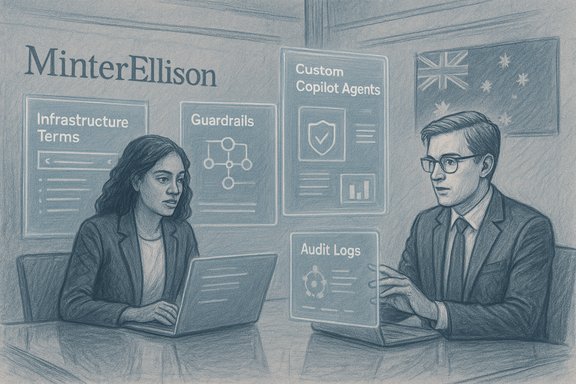
Kiara Morris and Jett Potter — two early‑career lawyers at MinterEllison — are emblematic of a broader shift in law firms: juniors are using Microsoft Copilot and custom AI agents not just to speed up routine work, but to rehearse courtroom questions, shape partner‑level briefings, and earn visibility in strategic discussions, reshaping career trajectories while forcing firms to redesign training, governance and procurement.
MinterEllison, one of Australia’s largest law firms, has openly embraced Microsoft 365 Copilot across practice groups, pairing tenant‑aware Copilot features with internal agents and a structured training program. The firm set explicit adoption goals, rolled Copilot licences through a Digital Academy, and built tenant‑hosted guardrails to manage data and provenance — a playbook now being watched closely by peer firms. Why this matters: law practice is inherently document‑heavy and deadline driven. Automating repetitive drafting, briefing and summarisation can reclaim hours per knowledge worker and shift human effort to higher‑value tasks such as advocacy, negotiation and strategy. But the legal profession’s duties around confidentiality, accuracy and provenance mean adoption must be governed, auditable and human‑centred.
Core governance elements firms must secure:
Academic and vendor research on Copilot‑style tools also support the human‑in‑the‑loop model: productivity improves markedly on structured tasks, but accuracy gaps remain on complex, open‑ended legal analysis — reinforcing the need for mandatory verification and continuous QA.
Yet the gains come with non‑negotiable responsibilities. The profession’s ethical duties, real examples of AI‑fabricated authorities and the operational challenges of governance mean firms must adopt a rigorous, measurable, human‑centred approach: pilot carefully, enforce mandatory verification, demand contractual auditability, and redesign training so automation augments rather than replaces experiential learning.
For IT leaders and practice partners building an AI roadmap, the lesson is pragmatic and urgent: enable early‑career lawyers to use AI as a rehearsal room and productivity multiplier — but protect clients, preserve learning pathways, and instrument every step with auditable controls. The firms that get this balance right will win both client trust and the next generation of legal talent.
Source: Microsoft Source How two early in career lawyers are shaping MinterEllison’s use of AI - Source Asia
 Background / Overview
MinterEllison, one of Australia’s largest law firms, has openly embraced Microsoft 365 Copilot across practice groups, pairing tenant‑aware Copilot features with internal agents and a structured training program. The firm set explicit adoption goals, rolled Copilot licences through a Digital Academy, and built tenant‑hosted guardrails to manage data and provenance — a playbook now being watched closely by peer firms. Why this matters: law practice is inherently document‑heavy and deadline driven. Automating repetitive drafting, briefing and summarisation can reclaim hours per knowledge worker and shift human effort to higher‑value tasks such as advocacy, negotiation and strategy. But the legal profession’s duties around confidentiality, accuracy and provenance mean adoption must be governed, auditable and human‑centred.How two early‑career lawyers are using AI in practice
Kiara Morris: the AI “rehearsal room”
Kiara uses the Researcher agent in Copilot to accelerate technical and legal research for infrastructure and construction matters. Faced with unfamiliar engineering terminology and an upcoming first court appearance, she runs drafts through Copilot to anticipate opposing‑counsel questions and to surface local case examples relevant to Western Australia. That practice helps her pre‑answer potential lines of attack and arrive at court more confident. Key day‑to‑day uses Kiara reports:- Rapidly surfacing technical context (engineering terms, standards) to inform legal advice.
- Running client‑perspective probes on drafts to find gaps and defensive arguments.
- Producing annotated research that she can validate before escalating to seniors.
Jett Potter: building agents and accelerating visibility
Jett, on MinterEllison’s AI advisory team, builds custom Copilot agents that mimic partner‑level thinking and incorporate prior partner feedback. He uses agents to improve structure and tone in briefing decks, run multiple feedback rounds automatically, and create short AI training modules used in client workshops. The outcome: faster polish on deliverables and earlier invitations into strategic discussions with partners. Jett’s concrete advantages:- He can prototype AI training programs and sell them to clients.
- He gains access to partner conversations earlier because he brings AI‑native solutions and tangible demos.
- He reduces iteration time on drafts, using agents to bake in partner feedback before human reviews.
The productivity story — what the numbers say, and where to be cautious
MinterEllison and Microsoft‑reported pilot numbers are striking: a majority of users report saving 2–5 hours per day, with a notable minority claiming gains of 5+ hours daily; user satisfaction metrics in early reports were high. The firm has also publicly highlighted programs (like a Digital Academy and rotation of Copilot licences) intended to accelerate uptake. Critical analysis of those metrics:- Self‑reported gains are directional, not definitive. Early rollout surveys from vendors and piloting firms routinely show large time‑savings; independent, longitudinal audits are required to verify sustained firm‑wide productivity and billable‑hour impacts.
- Context matters. Savings-size varies by role, practice area and the specific Copilot agent used. Work that is structured and repetitive (transcripts, email triage, routine memos) sees larger, more reliable gains than highly discretionary legal analysis.
- Measurement pitfalls: metrics based on “hours saved” can be gamed if not tied to specific KPIs like turnaround time, error rate on first drafts, or partner review time.
Training, career progression and the “new” junior journey
Early visibility and new skills
AI fluency has become a career accelerant. A Microsoft‑sponsored CTRL+Career survey referenced in firm materials showed a large share of early‑career professionals reporting increased visibility at work because of their AI skills, and that senior leaders actively sought their input. Those dynamics are reflected in Kiara and Jett’s experience: juniors are being invited into higher‑level strategic discussions because they bring practical AI expertise.The learning paradox
Despite the visibility boost, many early‑career lawyers report they feel they are learning substantive content less thoroughly compared with pre‑AI workflows. Nearly half of respondents in the internal survey context reported a sense that AI shortcuts reduce deep learning, even though most (over 90%) felt confident in their ability to critically assess AI outputs. This suggests firms must intentionally design curricula that pair AI tools with verification practice and reflective learning.What successful training programs do differently
- Teach prompt hygiene and hallucination detection as core skills.
- Require competency demonstrations (sample verified research, annotated prompts) before a lawyer may sign off on AI‑assisted outputs.
- Pair routine, AI‑assisted tasks with rotational assignments that preserve exposure to courtroom advocacy and first‑principles problem solving.
Governance, security and professional obligations
Generative AI introduces several discrete risks to legal practice: hallucinated authorities, inadvertent disclosure of privileged matter data, and contractual or regulatory exposure if vendors retain inputs for model training. MinterEllison’s approach combines tenant grounding, internal bespoke services in Azure, mandatory human sign‑offs, and role‑based training — an example of “pilot, govern, verify, scale.”Core governance elements firms must secure:
- Tenant grounding and access controls so Copilot only reads documents the user is authorized to view.
- Audit trails and exportable logs documenting prompts, responses and agent actions for eDiscovery and compliance.
- Contractual guarantees: no‑retrain clauses or verifiable opt‑outs for using matter data to tune vendor models.
- Mandatory verification processes: checklists, mandatory human sign‑offs and competency gates for anyone who files or publishes AI‑assisted legal work.
- Courts in multiple jurisdictions have sanctioned filings that contained fabricated AI‑generated citations. That reality makes human verification not just best practice, but an ethical imperative.
- Vendor assurances alone are insufficient; firms must insist on contractual auditability and operational controls before enabling AI on live matters.
Practical checklist for IT leaders and practice heads
- Establish a cross‑functional governance team (partners, IT/security, procurement, KM, HR).
- Pilot a single high‑value, low‑risk workflow (meeting summaries, transcript digestion) and define KPIs (turnaround, errors, partner review time).
- Confirm vendor capabilities and contract terms: exportable logs, no‑retrain clauses, deletion guarantees, SOC2/ISO attestations.
- Configure Microsoft controls: Conditional Access, Endpoint DLP, Purview sensitivity labels, tenant‑grounded Copilot.
- Build role‑based training and competency gates that include hallucination detection and prompt design.
- Require human sign‑off for any outward‑facing or filed work and document the verification steps.
Strengths observed at MinterEllison — what other firms can realistically expect
- Speed on routine tasks: meeting prep, email triage and first‑draft memos shrink substantially when Copilot and Researcher are used as drafting partners. Early internal metrics show significant time savings among cohorts piloting the technology.
- Democratization of expertise: juniors gain earlier exposure to high‑value analysis by using AI to produce polished starting points and to rehearse arguments. This flattens the advice pipeline and improves access to partner‑level thinking.
- New internal roles: AI advisory teams, prompt engineers and AI auditors become internal career paths, increasing retention and creating visible, high‑value contributions for early‑career staff.
Risks and the hidden costs
- Deskilling risk: if routine drafting is fully automated without redesigning training, juniors lose opportunities to internalize legal reasoning. Firms must pair automation with learning pathways.
- False confidence: staff may overestimate their ability to detect hallucinations. Training must include real‑world failure modes and mandatory verification workflows.
- Vendor lock‑in and upgrade fragility: heavy reliance on a single cloud stack simplifies integration but raises switching costs and upgrade complexity for customizations. Evaluate long‑term flexibility.
- Regulatory and client expectation shifts: clients will increasingly ask where and how AI is used; firms should prepare transparency reports and client‑facing policies.
Wider industry context and independent perspectives
The MinterEllison example aligns with broader trends: law firms and corporate legal teams report rapid experimentation with generative AI, with larger firms often moving first because they have the IT scale and procurement leverage to negotiate stronger contractual protections. Independent legal‑tech reporting shows high frequency of ad‑hoc AI use but more limited institution‑level, auditable deployments — underlining the gap between experimentation and governed, production use.Academic and vendor research on Copilot‑style tools also support the human‑in‑the‑loop model: productivity improves markedly on structured tasks, but accuracy gaps remain on complex, open‑ended legal analysis — reinforcing the need for mandatory verification and continuous QA.
How firms should measure success (concrete metrics)
- Average partner review time per document (pre‑AI vs post‑AI).
- Turnaround time for first draft advice and client‑facing deliverables.
- Error rate and post‑submission corrections tied to AI‑assisted documents.
- Training outcomes: percentage of juniors who pass a verification competency within 90 days.
- Usage + governance compliance: percent of AI actions with exportable logs and signed verification checklists.
Conclusion — a balanced verdict for WindowsForum readers
MinterEllison’s practical embrace of Microsoft Copilot and custom tenant agents demonstrates the real productivity potential of generative AI in law: juniors can rehearse courtroom arguments and learn faster; advisers like Jett can scale partner feedback; senior leaders gain faster decision support. The payoff is tangible — measured in hours reclaimed and new career visibility for early‑career staff.Yet the gains come with non‑negotiable responsibilities. The profession’s ethical duties, real examples of AI‑fabricated authorities and the operational challenges of governance mean firms must adopt a rigorous, measurable, human‑centred approach: pilot carefully, enforce mandatory verification, demand contractual auditability, and redesign training so automation augments rather than replaces experiential learning.
For IT leaders and practice partners building an AI roadmap, the lesson is pragmatic and urgent: enable early‑career lawyers to use AI as a rehearsal room and productivity multiplier — but protect clients, preserve learning pathways, and instrument every step with auditable controls. The firms that get this balance right will win both client trust and the next generation of legal talent.
Source: Microsoft Source How two early in career lawyers are shaping MinterEllison’s use of AI - Source Asia
