
 Miro Is Selling the Antidote to Private-Chat Productivity
The most interesting thing about Miro’s Canvas 26 announcements is not any single feature. It is the diagnosis underneath them: enterprise AI has been deployed as if productivity were an individual sport.
That was a reasonable first phase. Give employees access to ChatGPT, Claude, Copilot, Gemini, or a coding assistant, and many of them will draft faster, summarize faster, prototype faster, and decide what to ignore faster. The problem arrives when those faster individual outputs collide with the slower rituals of actual company work: meetings, handoffs, approvals, design reviews, Jira tickets, GitHub issues, Figma files, documents, security reviews, and the understated horror of “Can someone explain why we made that decision?”
Miro’s bet is that the missing layer is the shared surface. In its framing, the private AI chat window is a productivity cul-de-sac. It helps the person sitting in front of it, but the intermediate reasoning, discarded alternatives, source material, decisions, and next actions often remain trapped in a personal thread.
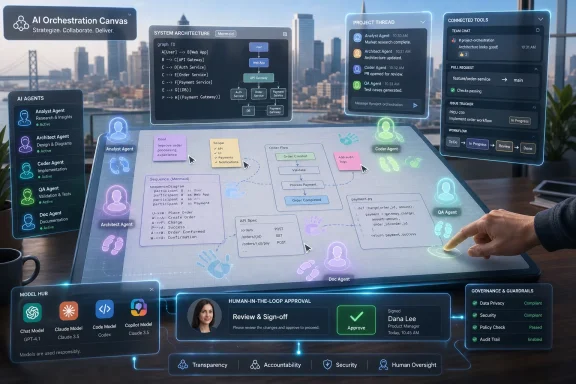
That is the gap Miro wants to occupy. The company is positioning the canvas as the place where human-to-human collaboration, human-to-agent workflows, and agent-to-agent processes converge. This is a bolder claim than “we added AI to whiteboarding,” because it turns Miro from a collaboration app into a proposed coordination layer for AI-era work.
There is a real need here. Teams are already suffering from a new kind of fragmentation, one that looks productive from the outside because everyone is generating more artifacts. The danger is that AI does not reduce organizational entropy; it accelerates it.
The Canvas Becomes a Place Where Agents Can Leave Fingerprints
The headline technical move is that Miro’s canvas is now readable and writable by third-party agents. In plain English, external AI systems can create, modify, and respond to work on a Miro board instead of merely producing text that someone must manually paste into a workspace.
That matters because the boundary between “AI output” and “team artifact” has been awkward. A model may generate a strategy memo, a product flow, a requirements outline, or a code diagram, but the artifact often enters the collaborative process as a dead object. Someone copies it into a document, screenshots it into a deck, or pastes it into a ticket, and from that moment onward the context starts to decay.
Miro’s expanded support for the Model Context Protocol, including board creation, tool creation, frames, comments, shapes, and code blocks, is an attempt to make the canvas more legible to agents. Add Mermaid diagrams, Markdown, and HTML widgets, and Miro starts to look less like a digital whiteboard and more like an agent-addressable workspace.
That is a subtle but important shift. For years, whiteboards have been where teams visualize what software systems, business processes, and customer journeys might become. Now Miro wants those visualizations to be not just explanatory but operational: a surface agents can read from, write to, and use as shared context.
The risk is obvious. If agents can write to the canvas, the canvas can become noisy faster than ever. Anyone who has watched a well-intentioned automation spray duplicate tickets across a project tracker understands the governance problem. Miro’s challenge is to make machine participation feel like collaboration rather than vandalism at scale.
Connectors Are the Real Product, Not the Plumbing
Miro’s new Connectors are easy to undersell as integration plumbing. They link Sidekicks and Flows to tools such as Slack, Atlassian, Granola, GitHub, and others, while also allowing Miro to appear natively inside ChatGPT, Claude, and Microsoft Copilot. But in enterprise software, plumbing often becomes strategy.
The reason is simple: work does not live in one system. Conversations happen in Slack or Teams. Code lands in GitHub. Product work gets tracked in Jira. Meeting memory increasingly comes from AI notetakers such as Granola. Strategy is drafted in documents, argued over in decks, and half-remembered in chat.
Miro’s argument is that the canvas can become the connective tissue among these systems. Not the system of record for everything, necessarily, but the system of shared understanding. That distinction matters. Jira may know the status of a ticket, GitHub may know the state of a pull request, and Slack may know the emotional weather of a project. None of them automatically knows whether the team agrees on what it is building.
That is where a canvas has a plausible advantage. Spatial work is good at showing relationships. It can put user needs next to design decisions, architecture constraints next to roadmap tradeoffs, and meeting notes next to action items. The question is whether Miro can preserve that advantage once AI agents begin generating the boards.
In the best case, Connectors mean a team can pull live context into a shared space, debate it, change it, and push decisions back out to operational tools. In the worst case, they create another dashboard layer that everyone admires during planning week and ignores by Friday.
Sidekicks Move From Helpful Assistant to Persistent Coworker
Miro’s Sidekicks update is the most visibly “agentic” part of the announcement. The assistant is no longer positioned merely as a prompt-response tool. It can understand intent, break ambiguous requests into steps, ask clarifying questions, and generate full board content from a single prompt.
That includes documents, diagrams, Kanban boards, sticky notes, and frames. In the language of modern AI product design, Miro is trying to move Sidekicks from text generator to work generator. It is not just answering the user; it is assembling the collaborative environment in which the team will work.
Persistent memory raises the stakes. If Sidekicks can remember prior context and continue from where they left off, Miro becomes more than a place to create one-off AI artifacts. It becomes a workspace where the AI participant accumulates project understanding over time.
That is valuable, but it also brings the usual enterprise anxieties. What is remembered? Who can see it? Can memory be scoped to a board, a project, a team, or an organization? What happens when a consultant, contractor, or departing employee has influenced the remembered context? In AI products, memory is never just convenience. It is governance with a friendly interface.
Voice interaction is similarly double-edged. The ability to talk naturally to a Sidekick could make ideation feel less like prompt engineering and more like collaboration. But voice also changes the social dynamics of meetings. If the AI agent is listening, summarizing, and generating board content, teams will need new norms for when the machine is a participant, a recorder, or merely a tool.
Flows Turn the Canvas Into a Workflow Engine
Flows is Miro’s attempt to move beyond “AI helps me make a thing” toward “AI helps the team repeat a process.” The updated Flows can extend beyond the canvas through Connectors, pulling in meeting transcripts, creating tasks in project trackers, and surfacing Kanban views across connected systems.
This is where Miro’s vision becomes more operational. A whiteboard is traditionally a pre-work or mid-work artifact. Teams use it to brainstorm, plan, map, or review. Then the real work moves elsewhere.
Flows tries to keep the canvas involved after the workshop ends. If meeting notes can become action items, if brainstorm clusters can become project tasks, if a planning board can update downstream systems, then the canvas stops being a museum of prior thinking. It becomes part of the workflow.
The inclusion of human-in-the-loop approval is important. It signals that Miro understands the difference between automation and delegation. Enterprise teams do not merely want AI to do things quickly; they want to know when a person has blessed the transition from suggestion to action.
That distinction will matter most in regulated, security-sensitive, or highly cross-functional environments. Automatically generating a task is one thing. Automatically changing the direction of a product, altering a customer commitment, or triggering development work is another. The future of AI workflow tools will be less about whether they can act and more about whether organizations trust the checkpoints around those actions.
Prototypes Reveal the Product-Development Ambition
Miro Prototypes may sound like a narrower update, but it exposes the larger commercial ambition behind Canvas 26. The company is not merely aiming at brainstorming. It wants to sit closer to the product-development lifecycle.
The updated Prototypes can pull context from Claude Code, import screenshots or Figma files to generate editable multi-screen flows, apply brand styling from a URL, create multiple variants at once, and export to coding agents or Figma for handoff. That is an aggressive move toward the messy middle between idea and implementation.
For product teams, that middle is where speed often dies. A product manager describes a feature. A designer interprets it. An engineer challenges the feasibility. A stakeholder asks whether it matches brand expectations. Someone produces a mockup, someone else produces a requirements doc, and the team discovers two weeks later that half the assumptions were different.
Miro’s proposition is that AI can compress that loop, but only if the output remains visible to the whole team. A prototype generated in isolation may impress the person who asked for it. A prototype generated on a shared canvas can become a negotiation object.
That distinction is crucial. The value of a prototype is not just that it exists; it is that people can argue with it. They can point to a screen, reject a flow, notice a missing state, or connect a design choice to a customer problem. Miro’s best case is not AI replacing those conversations, but AI making them happen earlier.
The Competitive Terrain Is Bigger Than Whiteboards
Miro is entering a fight that will not be confined to digital whiteboarding. The company’s Canvas 26 story overlaps with Microsoft 365 Copilot, Atlassian Intelligence, Figma’s AI direction, Notion, Slack, Google Workspace, GitHub Copilot, and the broader universe of agentic workflow startups.
That makes Miro’s positioning both sensible and precarious. Sensible, because no single operational system owns the whole messy problem of alignment. Precarious, because every major platform vendor wants to claim the same connective role.
Microsoft has obvious distribution advantages in enterprise collaboration. Atlassian owns deep territory in software and project management. GitHub owns developer workflow. Figma owns a great deal of design collaboration. Slack and Teams own the conversation layer. The AI model providers themselves increasingly want their chat surfaces to become work hubs.
Miro’s counterargument is that a canvas is uniquely suited to cross-functional ambiguity. A spreadsheet wants rows and columns. A ticket tracker wants states and owners. A chat app wants chronological conversation. A canvas can hold ambiguity without immediately forcing it into a rigid structure.
That is a real advantage in the early stages of work. But Miro’s challenge is to prove that the canvas can remain useful after ambiguity turns into execution. If it becomes only the place where ideas are arranged before being re-entered into “real” systems, the AI workspace story will stall. If it becomes the place where agents, humans, and systems keep context synchronized, Miro has a much larger opening.
The Enterprise Buyer Will Ask the Boring Questions First
For all the futuristic language around agents, the enterprise test will be mundane. IT leaders will ask about permissions, data residency, auditability, model providers, retention, admin controls, and how much of this costs after the initial enthusiasm fades.
That is not cynicism. It is the difference between a compelling demo and an operational platform. If an AI agent can read a Miro board that contains roadmap plans, customer research, architecture diagrams, or incident reviews, then access control becomes central. If the agent can write to that board, change frames, generate tasks, or push information into other systems, audit trails become central.
Miro will also have to navigate the tension between openness and control. Expanded MCP support is attractive precisely because it lets third-party agents participate. But every integration surface expands the possible attack surface, the compliance surface, and the administrative burden.
The governance story will matter especially for WindowsForum.com’s core readership: sysadmins, IT pros, developers, and security-minded power users. These are the people who get called when an executive wants the shiny new AI tool and a compliance officer wants to know where the data goes. They will not be satisfied by “the canvas is collaborative.” They will want to know who can connect what, what data leaves the tenant, what logs exist, and how quickly access can be revoked.
That does not make Miro’s strategy wrong. It makes the implementation decisive. The companies that win enterprise AI collaboration will be the ones that make powerful capabilities feel administratively boring.
The Real Enemy Is Not the Silo, but the Unreviewed Output
Miro’s language emphasizes silos, and for good reason. AI work trapped in private chat windows is hard to reuse, hard to govern, and hard to align. But the deeper enemy may be unreviewed output.
A private AI chat is not dangerous merely because it is private. It is dangerous because its conclusions can travel into the organization without the reasoning, constraints, or uncertainties attached. A polished paragraph becomes a strategy. A generated user story becomes a sprint item. A plausible architecture diagram becomes the basis for an estimate. The artifact looks finished before the team has done the work of judgment.
A shared canvas can help because it slows the eye in the right places. It lets teams see alternatives side by side. It makes dependencies visible. It gives humans a place to annotate, challenge, cluster, and reject.
But shared surfaces do not automatically create shared understanding. Any collaboration tool can become theater. A board full of AI-generated sticky notes can be just as misleading as a private chatbot transcript if nobody owns the decision-making process.
That is why Miro’s human-in-the-loop language matters. The future of AI collaboration should not be “the agent made a board, so the team is aligned.” It should be “the agent made the assumptions visible, and the team decided what to do with them.”
AI Productivity Needs a Meeting With Reality
The productivity debate around generative AI has often been too individualistic. It asks whether a worker can draft faster, code faster, summarize faster, or research faster. Those are useful measurements, but companies do not ship individual speed. They ship coordinated output.
This is where Miro’s thesis has bite. A developer who uses AI to produce more code can still be blocked by unclear requirements. A product manager who uses AI to generate a better brief can still lose alignment with design. A sales team that uses AI to summarize customer feedback can still fail to feed the right signals into the roadmap. Productivity gains evaporate when handoffs remain broken.
The implication is uncomfortable for AI vendors. The next phase of enterprise AI may be less glamorous than model demos. It will involve permissions, schemas, connectors, workflow states, review loops, and records of decision. It will involve making sure that AI-generated work lands somewhere useful and remains inspectable after the wow moment.
Miro is trying to place itself at that landing zone. Its history as a visual collaboration tool gives it credibility with teams that already use boards to manage ambiguity. Its challenge is that AI raises the volume, velocity, and risk of that ambiguity.
If Miro succeeds, the canvas becomes a kind of organizational workbench. If it fails, it becomes another tab where AI-generated content accumulates faster than teams can interpret it.
The Canvas 26 Bet Comes Down to Execution
The concrete shape of Miro’s announcement is now clear, and it is more coherent than the average “we added AI” product cycle. The company has a diagnosis, a platform surface, agent access, automation, integrations, and a product-development story.
Still, coherence is not adoption. Teams will have to decide whether Miro is where they want AI-mediated collaboration to happen. That decision will depend less on keynote demos than on whether the daily experience reduces friction.
- Miro’s central claim is that private AI chats improve individual throughput but often fail to improve organizational alignment.
- The new AI-readable and writable canvas gives third-party agents a way to participate directly in shared boards.
- Expanded MCP support and agent-friendly formats make Miro more accessible to external AI systems and coding workflows.
- Sidekicks are being pushed toward persistent, intent-aware AI collaborators that can generate full board content and continue work over time.
- Flows and Connectors are designed to move decisions between the canvas and operational tools such as Slack, Atlassian, GitHub, and meeting-transcript systems.
- The enterprise test will be governance, trust, and whether AI-generated collaboration artifacts remain useful after the first meeting ends.
The bigger story is that Miro is betting against the idea that AI productivity can be solved one worker at a time. That is the right bet, or at least the more mature one. The next phase of AI adoption will be judged not by how many impressive things individuals can generate, but by whether teams can turn those things into decisions, software, products, and accountable work. If Miro can make the canvas the place where that transformation happens, Canvas 26 may look less like a feature launch and more like the moment the company declared war on the private prompt box.
