

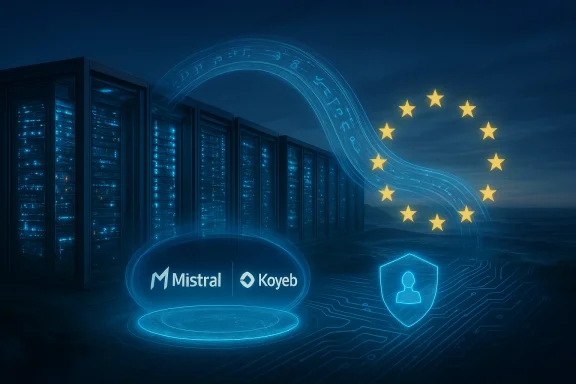
Mistral AI’s acquisition of Koyeb is more than a typical startup buyout — it’s a deliberate, fast-moving step toward assembling a full-stack AI infrastructure that combines model development, sovereign compute, and serverless deployment under one roof. The deal, announced February 17, 2026, folds Koyeb’s serverless platform and engineering team into Mistral’s expanding Mistral Compute initiative and signals the company’s first acquisition as it races to own both the brains and the plumbing of large-scale generative AI.
Multiple outlets reported the acquisition the same day: Mistral’s announcement and Koyeb’s own blog post were amplified by technology press and wire services. Reuters, SiliconANGLE, Sifted, and other trade media corroborated the core facts and emphasized that the deal marks Mistral’s first acquisition as it shifts from pure-model development toward a broader infrastructure and cloud play.
That said, the practical outcome hinges on execution. Integration complexity, hardware supply dynamics, and competitive responses from hyperscalers are real headwinds. Mistral must move quickly to convert the acquisition into measurable improvements in product reliability, performance, and enterprise readiness — while communicating what changes for Koyeb users during the transition.
In short: this is a smart strategic bolt-on that accelerates Mistral’s full‑stack ambitions. Expect an iterative rollout, close attention to SLA and security hardening, and a period of market jockeying as Mistral demonstrates whether a European model-plus-cloud champion is a viable long-term alternative to the global hyperscalers.
What to watch next
Source: Intellectia AI https://intellectia.ai/news/stock/mistral-ai-acquires-koyeb-to-accelerate-cloud-computing-strategy/
 Background
The parties and the headlines
Mistral AI — the Paris-born LLM developer that has rapidly grown into one of Europe’s best-funded AI companies — has announced that it will acquire Koyeb, a French serverless cloud startup founded by former Scaleway executives. Financial terms were not disclosed, and the completion of the transaction is subject to customary closing conditions. The Koyeb engineering team is slated to join Mistral in the coming weeks, and the Koyeb platform will operate while gradually becoming a core component of Mistral Compute.Multiple outlets reported the acquisition the same day: Mistral’s announcement and Koyeb’s own blog post were amplified by technology press and wire services. Reuters, SiliconANGLE, Sifted, and other trade media corroborated the core facts and emphasized that the deal marks Mistral’s first acquisition as it shifts from pure-model development toward a broader infrastructure and cloud play.
How this fits with Mistral’s recent moves
Mistral has been explicit about building not only open-source and commercial LLMs but the compute layer to run them. Over the last 12–18 months the company launched Mistral Compute, announced major investments in data-center capacity (notably a €1.2 billion / $1.4 billion commitment in Sweden), and publicly discussed partnerships and hardware plans that would give it tens of thousands of high-performance GPUs to power training and inference. The Koyeb acquisition dovetails with those investments: it brings serverless deployment, fast inference scaling, and sandboxing primitives that Mistral can integrate into its AI cloud offering.What Koyeb Brings: product, people, and operational know-how
A serverless AI platform built for latency-sensitive workloads
Koyeb’s value proposition is a lightweight, serverless developer platform that abstracts away infrastructure management while enabling low-latency inference and autoscaling for AI applications. The startup emphasized features such as GPU-backed serverless instances, sub-second scale-to-zero and auto-scaling, multi-region deployments, and a sandbox capability designed for running agentic workloads safely. These are not trivial engineering features — they address real operational pain points for teams deploying interactive or agent-based AI at scale.- Key Koyeb capabilities
- Serverless GPU and CPU instance types that automatically scale to demand.
- Fast "wake-up" and relaunch times to reduce the latency impact of scale-to-zero strategies.
- Sandboxes that isolate agentic workloads for security and resource control.
- Worldwide deployment points with multi-region failover for resilience.
Talent and culture: small team, high-impact skillset
News reports and Koyeb’s own announcement indicate that the entire Koyeb team will join Mistral. Press coverage has reported the team size in slightly different ways (outlets reported figures such as 13–16 employees), which is typical in early reporting on small-acquisition deals; the precise headcount is less material than the concentrated expertise being acquired — serverless platform engineering, GPU orchestration, and multi-cloud deployments. Mistral’s statement indicates the Koyeb team will be embedded in Mistral’s engineering organization to accelerate Mistral Compute.Strategic rationale: Why Mistral bought Koyeb
1) Faster, more integrated path to a sovereign AI cloud
Mistral has positioned itself as a European champion for sovereign AI infrastructure: designs, models, and compute co-located to minimize reliance on U.S. hyperscalers. Building sovereign compute requires not only racks and GPUs, but deployment tooling, serverless control planes, autoscaling systems, and security sandboxing. Koyeb’s platform accelerates Mistral’s ability to deliver developer-facing features on Mistral Compute without building the stack from scratch. The acquisition shortens time-to-market for features that enterprise customers increasingly demand — low-latency inference, controlled sandboxed agents, and global deployment control with European data residency.2) Better GPU utilization and inference economics
Serverless platforms that intelligently scale inference and sandboxed workloads can significantly improve GPU utilization by multiplexing workloads and reducing waste from idle capacity. Mistral has announced ambitious data-center investments (including a major commitment in Sweden) and a fleet of GPUs; improving utilization through software layers is essential to making those capital investments economically viable. Koyeb’s autoscaling and scale-to-zero mechanisms give Mistral levers to optimize operational costs while delivering responsive inference at scale.3) Product synergies: sandboxes, agents, and enterprise features
Koyeb’s sandbox functionality aligns with Mistral’s interest in agentic workloads (code-generation agents, multi-step workflows, and sandboxed model evaluation). Bringing sandbox orchestration closer to the model provider allows Mistral to offer end-to-end solutions — model + runtime + secure execution environments — that are attractive to enterprises worried about safety and governance. Koyeb’s pattern for agent isolation maps neatly onto Mistral’s product roadmap.Technical implications: what engineers and SREs should care about
Scale-to-zero vs. cold-start tradeoffs
Serverless for AI pushes SREs to balance cost and latency. Koyeb’s engineering promises sub-second and sub-200 ms landing times for reactivated workloads are a major competitive advantage if they hold under production load. Mistral must now integrate those mechanisms into Mistral Compute without introducing regressions in multi-tenant isolation, GPU scheduler fairness, or network performance. Ensuring consistent latency across heterogeneous hardware (NVIDIA Vera Rubin / Blackwell and other accelerators) will demand tight tuning.Sandboxing agents: security and observability
Sandboxes let agents run arbitrary code while limiting security exposure. The challenge for Mistral is to integrate sandbox telemetry, policy enforcement, and resource quotas into a model provider’s stack while ensuring that agent execution remains auditable and compliant with enterprise controls (e.g., data leakage prevention, audit logs for GDPR). Koyeb’s sandbox design is a starting point, but scaling it for thousand‑node agent bursts requires robust policy engines and hardened isolation.GPU orchestration, multi-architecture support, and cost controls
Koyeb has experimented with varied accelerators (including Tenstorrent in 2025 to show hardware-agnostic support). For Mistral, the platform-level orchestration must support not just NVIDIA GPUs but future accelerators and on-premise deployments. That means integrating heterogeneous scheduling, memory management, and different device drivers into a cohesive control plane. The payoff is flexibility and potential cost arbitrage; the risk is increased complexity and longer integration cycles.Market impact and competition
Competing in an ecosystem dominated by hyperscalers
Mistral’s strategy — build models and the underlying cloud to host them — puts it in direct competition with major cloud providers (AWS, Microsoft Azure, Google Cloud) as well as specialist AI-cloud players (CoreWeave, Lambda Labs, CoreWeave-style providers). Those incumbents already offer GPU-based serverless inference, managed model serving, and enterprise SLAs. Mistral’s differentiator is a European, sovereign-first, vertically integrated proposition that bundles proprietary models and tailored infrastructure. Whether that differentiator is sufficient to displace or meaningfully compete with hyperscalers will depend on execution and customer adoption.Where Mistral could gain quick traction
- European enterprises and public sector organizations that prioritize data residency and regulatory alignment.
- Developers and startups seeking model-hosting with lower friction and a strong open‑source relationship.
- Workloads where sandboxing and agent orchestration are required for safety and isolation — e.g., regulated verticals such as finance, healthcare, and telco.
The acquisition as a statement to investors and partners
M&A sends signals: this is Mistral’s first acquisition and it confirms the company intends to vertically integrate. Investors and hardware partners can interpret the move as commitment to long-term capital deployment (data centers) plus immediate productization of deployment primitives (Koyeb). For ecosystem partners (ISVs, systems integrators), it signals an appetite for packaged vertical solutions rather than purely model-centric licensing.Risks, dependencies, and the unknowns
Integration risk and engineering debt
Integrating a small startup into a fast-growing scaleup can introduce friction: API mismatches, organizational differences, and divergent product roadmaps. Mistral must reconcile Koyeb’s multi-cloud, lightweight abstractions with the company’s own Mistral Compute design decisions, data governance controls, and enterprise SLAs. If not managed clearly, the acquisition could create parallel stacks that lengthen time-to-value rather than shorten it.Supply chain and hardware dependency
Mistral’s ambitions rely on access to advanced GPUs. The company has publicly negotiated large hardware commitments and is participating in broader European GPU deployments, but global GPU supply chains remain competitive. Any delays or procurement constraints for high-end accelerators would impact capacity plans and cost forecasts. Mistral’s investment in Swedish data centers and partnerships with NVIDIA and local data-center operators mitigates some risk but doesn’t eliminate vendor dependency.Regulatory and data-sovereignty complexity
Mistral’s sovereign positioning is a market advantage in Europe, but it also invites extra scrutiny. Hosting and processing sensitive data for European customers triggers GDPR compliance, potential national security reviews, and contractual audits. The Koyeb team’s experience with regional deployments helps, but Mistral must ensure compliance automation and robust contractual frameworks as it brings on enterprise customers.Financial transparency and undisclosed terms
The acquisition’s financial terms were not disclosed publicly. That is common for early-stage deals, but it means outside observers can’t readily assess the acquisition’s capital efficiency: was this an inexpensive talent-and-tech buy, or did it include material consideration? Ambiguity over terms complicates market reaction analysis and investor modeling. Reporters cited varying numbers for Mistral’s valuation and investment rounds; readers should treat such figures cautiously until formal filings or company disclosures appear.Analysis: strengths, realistic expectations, and potential outcomes
Notable strengths
- Tightly aligned product fit. Koyeb’s serverless and sandboxed inference aligns directly with Mistral’s infrastructure needs; integration can yield tangible product improvements quickly.
- Speed-to-market. Acquiring a mature deployment platform reduces the time and engineering cycles required to rollout advanced developer features on Mistral Compute.
- European sovereignty narrative. The combined story — models developed in Europe, compute provisioned in Europe, and an integrated stack — resonates with customers seeking alternatives to U.S.-based hyperscalers. The €1.2B Sweden data-center commitment underscores that narrative.
Where expectations should be tempered
- Operational complexity. Turning a startup platform into a hardened enterprise cloud service at hyperscaler scale is non-trivial and will require time, capital, and incremental hires. Expect a phased rollout and a period where features are gradually hardened.
- Competitive pressure. Hyperscalers and specialist AI cloud providers are already offering feature sets that overlap with Koyeb’s. Mistral must either compete on price/performance or differentiate on sovereignty and model-infrastructure integration to capture meaningful share.
- Vendor and hardware dependency. The economics of owning GPUs depend on utilization and supply — software improvements can increase utilization, but hardware costs remain a dominant factor.
Tactical checklist: what Mistral should do next (and what customers should watch)
- Publish a clear integration roadmap
- Customers need timelines for when Koyeb features will be integrated into Mistral Compute and which plans or SLAs will change. Transparency reduces churn risk.
- Validate scale-to-zero and cold-start performance under production loads
- Independent benchmarks and SLOs for cold-start latency are critical. If Mistral can demonstrate sub-200 ms relaunches at scale, that becomes a compelling operational differentiator.
- Harden sandboxing for regulated verticals
- Enhance observability, audit trails, and privacy-preserving controls for sandboxed agents so banks, healthcare providers, and public-sector customers can adopt with confidence.
- Continue multi-accelerator support and open integrations
- Preserve Koyeb’s hardware-agnostic approach to avoid lock-in and to future-proof the platform as new accelerators enter the market.
- Clarify commercial terms for existing Koyeb customers
- Mistral should communicate billing, roadmap, data transfer, and SLA implications explicitly to avoid customer churn during the transition.
What this acquisition means for the broader European AI ecosystem
Mistral’s purchase of Koyeb is emblematic of a maturing European AI ecosystem that is moving from proof-of-concept model releases toward production-grade, sovereign infrastructure. The timing aligns with big infrastructure bets — notably Mistral’s commitment to Swedish data-center capacity and the industry-wide push to increase Blackwell-class GPU availability in Europe. If Mistral executes, it could catalyze a regional stack that bundles local compute, local models, and developer-friendly runtimes. That combination may attract enterprises that value data residency and regulatory alignment over raw price/performance offered by offshore hyperscalers. However, such a shift requires sustained capital, robust operational execution, and clear product-market fit.Final verdict: pragmatic optimism with caveats
This acquisition is strategically sensible. Mistral needed deployment primitives and operational expertise to make Mistral Compute more than a marketing name — Koyeb supplies a working serverless stack, sandboxing for agent workloads, and a team that knows how to deploy low-latency inference across regions. For customers and engineers, the upside is tangible: simpler deployments, lower operational friction, and tighter integration between models and runtime.That said, the practical outcome hinges on execution. Integration complexity, hardware supply dynamics, and competitive responses from hyperscalers are real headwinds. Mistral must move quickly to convert the acquisition into measurable improvements in product reliability, performance, and enterprise readiness — while communicating what changes for Koyeb users during the transition.
In short: this is a smart strategic bolt-on that accelerates Mistral’s full‑stack ambitions. Expect an iterative rollout, close attention to SLA and security hardening, and a period of market jockeying as Mistral demonstrates whether a European model-plus-cloud champion is a viable long-term alternative to the global hyperscalers.
What to watch next
- Public benchmarks and SLOs for Koyeb features under Mistral’s banner (latency, cold start, concurrency).
- Announcements about how Koyeb’s sandboxing is integrated into Mistral Compute product tiers.
- Any regulatory or contractual disclosures tied to the Sweden data-center rollout and how that capacity is offered commercially.
- Clarification on financial terms and headcount integration if and when Mistral files public statements or investor updates.
Source: Intellectia AI https://intellectia.ai/news/stock/mistral-ai-acquires-koyeb-to-accelerate-cloud-computing-strategy/
