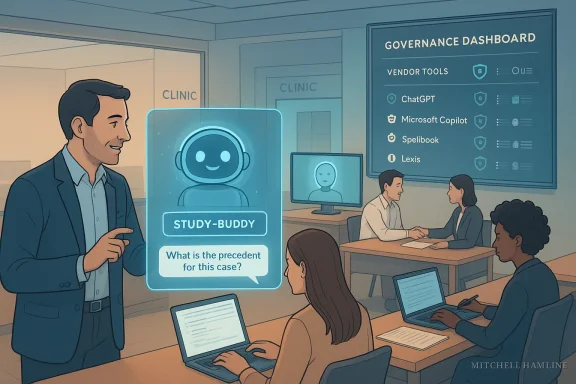
Mitchell Hamline School of Law is quietly rewriting the playbook for legal education by embedding artificial intelligence into the everyday work of students — from Socratic-style “study buddy” chatbots that simulate courtroom questioning to licensed access for contract-drafting assistants — while formalizing oversight through an institutional AI Task Group.
Mitchell Hamline has long promoted practice-oriented legal education, investing in clinics, blended-learning options, and hands-on coursework that put students into real-world legal workflows. That institutional DNA now shapes how the school is experimenting with generative AI and legal-specific machine learning tools to build practical skills and AI literacy.
The school’s public brief in early February 2026 describes multiple, coordinated efforts: professor-built “study buddy” chatbots for Socratic dialogue; Mediation Clinic simulations that use chatbot opponents; faculty-led seminars on legal, ethical, and policy implications; and licensed classroom access to commercial legal-AI products such as Spellbook alongside mainstream generative assistants like ChatGPT and Microsoft Copilot. The initiative is presented as an intentional effort to graduate practice-ready attorneys who can work with AI — not be replaced by it.
The stakes are high. Employers now expect new hires to be productive quickly and to leverage tooling that multiplies human output. Law schools that ignore AI risk graduating students who are uncompetitive in modern practice environments. Conversely, a thoughtful integration of AI can raise baseline outcomes by enabling students to iterate faster and focus on higher-order judgment. Mitchell Hamline frames its strategy around both access and employability — particularly for first-generation students who may benefit from AI-driven study supports.
That stance flips a common pedagogical assumption: rather than imposing a technological “tabula rasa” phase, Mitchell Hamline trains students to treat AI as a collaborator whose outputs require forensic evaluation, source-checking, and human insight. The school couples AI-enabled assignments with assessments that measure students’ ability to improve AI drafts, craft precise prompts, and explain the rationale behind edits — skills that are highly transferable to modern legal workplaces.
Academic integrity policies must evolve. Clear rules should distinguish acceptable AI-assisted drafting (where students disclose prompts and edits) from misconduct (passing off an AI product as the student’s unaided work). Evaluation rubrics should incorporate how students refine AI outputs and demonstrate judgment, not merely whether they used a tool. These are pragmatic policy details that will likely become standard across law schools in the next several academic cycles.
Law.com and Minnesota Lawyer have both highlighted Professor Duhl’s course redesign as emblematic of how legal education is beginning to normalize AI classroom use: early exposure, iterative drafting, and evaluation frameworks that reward editing and critical engagement with AI outputs. Those articles underscore a larger shift: law schools are moving from ban and police to train and validate.
However, the program raises legitimate concerns that require continuous, transparent handling. Adaptive governance must move faster than pilot cycles: vendor contracts need scrutiny for data protections, faculty development programs must expand so that more instructors can design responsible AI assignments, and the school must publish outcome data so other institutions can learn. Without transparent metrics and rigorous evaluation, early enthusiasm risks outpacing evidence.
Finally, while tools like Spellbook and mainstream generative assistants are valuable, they also centralize influence in for-profit vendors. Academic institutions must balance pedagogical advantages with the long-term costs and potential constraints associated with commercial AI ecosystems. Procurement strategies, diversified tooling, and open-source alternatives are all sensible hedges.
For employers: graduates schooled in AI-augmented workflows can contribute earlier to drafting, due diligence, and negotiation tasks. Employers should partner with law schools to define the practical competencies they value and to offer feedback loops that inform curricular adjustments. The win-win is clear when law schools produce graduates who need less on-the-job training to be effective members of modern legal teams.
The program’s success will depend on transparent outcome metrics, robust vendor governance, and ongoing faculty development. If Mitchell Hamline can sustain the balance between innovation and rigor, it will provide a replicable model for training the next generation of lawyers: practitioners who can think like lawyers and work like technologists, using AI to magnify human judgment rather than obscure it.
Source: StreetInsider Mitchell Hamline School of Law leverages AI for student learning
 Background
Mitchell Hamline has long promoted practice-oriented legal education, investing in clinics, blended-learning options, and hands-on coursework that put students into real-world legal workflows. That institutional DNA now shapes how the school is experimenting with generative AI and legal-specific machine learning tools to build practical skills and AI literacy. The school’s public brief in early February 2026 describes multiple, coordinated efforts: professor-built “study buddy” chatbots for Socratic dialogue; Mediation Clinic simulations that use chatbot opponents; faculty-led seminars on legal, ethical, and policy implications; and licensed classroom access to commercial legal-AI products such as Spellbook alongside mainstream generative assistants like ChatGPT and Microsoft Copilot. The initiative is presented as an intentional effort to graduate practice-ready attorneys who can work with AI — not be replaced by it.
Why this matters: AI is changing how lawyers work — and must be taught
Law practice has historically emphasized legal analysis, writing, research, negotiation, and advocacy. The rapid rollout of generative AI in 2023–2026 introduced tools that can accelerate those same tasks — sometimes dramatically — by producing first drafts, surfacing arguments, and suggesting contract clause languages. As a result, legal education faces a two-part challenge: teach core legal skills while also giving graduates the ability to use AI responsibly and effectively. Mitchell Hamline’s program is a concrete response to that challenge.The stakes are high. Employers now expect new hires to be productive quickly and to leverage tooling that multiplies human output. Law schools that ignore AI risk graduating students who are uncompetitive in modern practice environments. Conversely, a thoughtful integration of AI can raise baseline outcomes by enabling students to iterate faster and focus on higher-order judgment. Mitchell Hamline frames its strategy around both access and employability — particularly for first-generation students who may benefit from AI-driven study supports.
Implementation: what Mitchell Hamline is doing in practice
Study buddy chatbots and Socratic simulation
Faculty have developed “study buddy” chatbots designed to hold Socratic-style conversations with students, forcing them to articulate reasoning, confront counterarguments, and refine legal analysis in a low-stakes environment. These bots are not simply answer machines; they are configured to prompt follow-up questions, challenge inferences, and simulate the rapid back-and-forth of classroom questioning. The school reports early uptake from students who find the virtual practice nonjudgmental and helpful for building confidence.Clinic-level AI use: from housing chatbots to mediated simulations
Mitchell Hamline’s history with chatbots stretches back to a 2019 Housing Justice Chatbot-Building Clinic, where students built simple decision-tree bots to guide tenants on housing rights and next steps. That clinic’s public documentation shows the program’s practical, access-to-justice roots and explains how basic chatbots can convert legal information into actionable guidance for the public. Today’s efforts build on that foundation, applying more advanced models and integrations in clinics — for example, using live chatbot-simulated disputants in the Mediation Clinic to let students practice facilitation and negotiation under realistic pressures.Classroom integration and vendor tooling
Mitchell Hamline reports that students are using a mix of general-purpose generative AI (ChatGPT, Microsoft Copilot) and specialized legal platforms (Lexis, Westlaw, Bloomberg Law), with licensed access to Spellbook for contract drafting exercises. Faculty such as Professor Gregory Duhl have publicly described reimagining courses (notably Contracts) to allow students to produce AI-assisted first drafts and then evaluate and improve them — teaching both technical prompt design and judgment about what AI gets wrong or misses. These classroom experiments blend traditional evaluation (closed-book oral exams, bar-prep standards) with new assessments focused on how students use AI and the editorial value they add.Governance: the AI Task Group
To avoid ad hoc adoption, the institution created a cross-functional AI Task Group to examine uses across departments and ensure alignment with educational goals, ethical principles, and operational needs. That group’s remit includes curricular integration, vendor risk assessment, student support, and policy development — an acknowledgement that technology adoption requires governance as much as pedagogy.Pedagogical philosophy: augmenting judgment, not bypassing learning
A central argument from Mitchell Hamline faculty is that AI should augment legal education rather than supplant it. Professor Gregory Duhl, who has been featured in legal-education reporting for his approach, rejects the idea that students must first perform tasks without AI before being taught to use it. Instead, Duhl’s model integrates AI early — giving students the chance to create AI first drafts and then critique and improve them, thereby sharpening legal judgment in the context of tool-assisted drafting and analysis. His approach also uses AI-driven Socratic simulations to scale in-class engagement so every student can practice simultaneously.That stance flips a common pedagogical assumption: rather than imposing a technological “tabula rasa” phase, Mitchell Hamline trains students to treat AI as a collaborator whose outputs require forensic evaluation, source-checking, and human insight. The school couples AI-enabled assignments with assessments that measure students’ ability to improve AI drafts, craft precise prompts, and explain the rationale behind edits — skills that are highly transferable to modern legal workplaces.
Tools and vendors: what students actually touch
- General-purpose generative assistants: ChatGPT and Microsoft Copilot are used for brainstorming, drafting, and interactive Socratic practice. These models provide conversational interfaces and rapid draft generation.
- Legal research platforms with AI features: Lexis, Westlaw, and Bloomberg Law provide precedent search, citator work, and research acceleration with AI-enhanced discovery.
- Contract drafting AI: Spellbook is being licensed for contract drafting exercises; academic and classroom licensing programs have been publicized by both vendors and educators. Faculty scholarship also describes integrating Spellbook into Contracts coursework.
Strengths: what Mitchell Hamline gets right
1. Practice orientation aligned with real employer expectations
Mitchell Hamline’s emphasis on clinics and skills courses means AI is introduced where students already learn practice workflows. That contextual integration increases transferability to post-graduate work.2. Early, supervised exposure reduces fear and misuse
Students frequently hear about AI misuse in legal contexts; structured pedagogical exposure — with faculty oversight — reduces misuse by teaching how and when AI should be used. The school’s approach channels curiosity into competency-building rather than prohibition.3. Governance to institutionalize safe practices
An AI Task Group indicates the administration is thinking beyond classroom pilots. Cross-functional governance is essential to manage vendor risk, privacy, data security, accessibility, and academic integrity.4. Building on proven history
Mitchell Hamline’s earlier chatbot clinic (2019) demonstrates the school is not new to tech-enabled access-to-justice innovations, which strengthens institutional capacity to scale more advanced AI responsibly.Risks and weak points to watch
No program is without hazard. Mitchell Hamline’s model is promising, but several risk categories require continuous mitigation.A. Overreliance and skill atrophy
If students lean on AI to produce analysis before they’ve internalized legal reasoning, the risk is that foundational skills weaken. The school’s countermeasure — closed-book oral exams and barring AI in certain assessments — helps, but faculty must vigilantly calibrate the balance between assisted and unaided learning.B. Model errors, hallucinations, and legal accuracy
Generative models are prone to confidently presenting incorrect facts or invented citations. Teaching students how to verify outputs — including secondary-source provenance and primary authority checking — must be nonnegotiable. This technical literacy extends from prompt engineering to forensic validation.C. Bias and fairness
AI models encode biases present in their training data. In a legal context, that can mean producing guidance that systematically disadvantages certain groups or misrepresents statutory/regulatory frameworks in marginalized jurisdictions. Clinics that serve vulnerable clients must adopt review protocols to detect and remediate biased outputs.D. Data privacy and ethical exposure
Using vendor-hosted AI can create data residency and confidentiality concerns. Students and clinics handling sensitive client information must be taught to sanitize inputs and use secure, contractually vetted platforms when real client data is involved. Institutional governance must coordinate with legal counsel and IT to set technical and contractual safeguards.E. Vendor lock-in and long-term cost
Licensing commercial legal-AI platforms provides power but also exposes the school to vendor pricing changes and potential lock-in. A prudent procurement and pedagogy strategy includes vendor diversity, contingency curricular designs, and a plan for sustainability.Ethics, academic integrity, and bar readiness
Mitchell Hamline stresses that while AI is integrated into assignments, students will still be assessed in settings that require independent mastery — closed-book oral exams and bar-prep standards are retained. That dual approach recognizes the bar exam and many early-career practice situations remain AI-free, so students must know core law unaided while also learning to collaborate with AI in routine work.Academic integrity policies must evolve. Clear rules should distinguish acceptable AI-assisted drafting (where students disclose prompts and edits) from misconduct (passing off an AI product as the student’s unaided work). Evaluation rubrics should incorporate how students refine AI outputs and demonstrate judgment, not merely whether they used a tool. These are pragmatic policy details that will likely become standard across law schools in the next several academic cycles.
Comparing Mitchell Hamline’s approach with broader trends
Mitchell Hamline is not alone: other institutions have launched AI-focused modules, and organizations like Wickard and curricular pilots at multiple law schools have created AI bootcamps and showcases. Yet Mitchell Hamline’s approach stands out for its clinical continuity (housing chatbot clinic origin), faculty-led course redesigns, and administrative governance. This combination of pedagogy, practice, and policy is the template many observers have recommended for responsible AI adoption in legal education.Law.com and Minnesota Lawyer have both highlighted Professor Duhl’s course redesign as emblematic of how legal education is beginning to normalize AI classroom use: early exposure, iterative drafting, and evaluation frameworks that reward editing and critical engagement with AI outputs. Those articles underscore a larger shift: law schools are moving from ban and police to train and validate.
Practical recommendations for other law schools
From Mitchell Hamline’s early work, other schools can adopt practical steps to replicate benefits while managing risks:- Start with use cases tied to existing clinical or skills courses; don’t bolt AI onto unrelated lectures.
- Establish a cross-functional AI governance body that includes faculty, IT, libraries, clinics, and legal counsel.
- License specialized legal-AI for classroom use while teaching students to distinguish vendor outputs from primary-source authority.
- Build assessment models that reward students for improving AI drafts and for documenting the prompt/refinement process.
- Implement privacy and data-handling protocols for clinical use, including sanitized datasets for in-class exercises.
Measuring success: how to know this approach works
Meaningful evaluation should track multiple metrics over time:- Competency improvements in drafting and research performance (pre/post assignments).
- Employer feedback on new graduates’ readiness to use AI effectively.
- Bar passage and licensure outcomes to ensure foundational knowledge remains strong.
- Client outcomes and error rates in clinics that deploy AI-assisted tools.
- Student confidence and ethical reasoning about AI applications.
Critical analysis: balancing innovation with prudence
Mitchell Hamline’s initiative is strategically coherent: it leverages the school’s longstanding experiential pedagogy, adapts existing clinics into AI experiments, and pairs classroom innovation with institutional governance. That integrated approach minimizes some common pitfalls (siloed pilots, inconsistent policy, vendor overreach) and positions the institution as a practical laboratory for legal pedagogy in the AI era.However, the program raises legitimate concerns that require continuous, transparent handling. Adaptive governance must move faster than pilot cycles: vendor contracts need scrutiny for data protections, faculty development programs must expand so that more instructors can design responsible AI assignments, and the school must publish outcome data so other institutions can learn. Without transparent metrics and rigorous evaluation, early enthusiasm risks outpacing evidence.
Finally, while tools like Spellbook and mainstream generative assistants are valuable, they also centralize influence in for-profit vendors. Academic institutions must balance pedagogical advantages with the long-term costs and potential constraints associated with commercial AI ecosystems. Procurement strategies, diversified tooling, and open-source alternatives are all sensible hedges.
What this means for students and employers
For students: learning to work alongside AI is an employability asset. Students who can demonstrate prompt design, critical editing of AI outputs, and ethical judgement about tool use will be attractive to firms that increasingly treat AI as a multiplier. But students should also expect to retain strong unaided knowledge — bar exams and many courtroom settings still require human recall and reasoning.For employers: graduates schooled in AI-augmented workflows can contribute earlier to drafting, due diligence, and negotiation tasks. Employers should partner with law schools to define the practical competencies they value and to offer feedback loops that inform curricular adjustments. The win-win is clear when law schools produce graduates who need less on-the-job training to be effective members of modern legal teams.
Conclusion
Mitchell Hamline’s calibrated rollout of AI into legal education — combining Socratic chatbots, licensed contract-drafting platforms, clinic simulations, and institutional governance — offers a pragmatic template for law schools wrestling with the twin imperatives of preserving core legal skills and preparing students for an AI-enabled profession. The school’s approach recognizes that technology is not an add-on, but a structural force requiring pedagogical redesign, ethical grounding, and operational controls.The program’s success will depend on transparent outcome metrics, robust vendor governance, and ongoing faculty development. If Mitchell Hamline can sustain the balance between innovation and rigor, it will provide a replicable model for training the next generation of lawyers: practitioners who can think like lawyers and work like technologists, using AI to magnify human judgment rather than obscure it.
Source: StreetInsider Mitchell Hamline School of Law leverages AI for student learning