

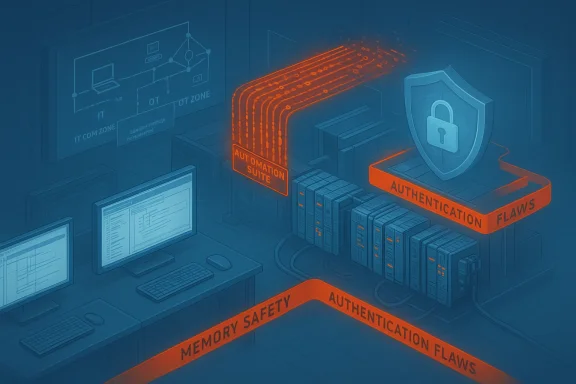
Festo’s automation stack has once again been thrust into the spotlight after a coordinated disclosure identified a large set of serious vulnerabilities in the way CODESYS is packaged and delivered with the Festo Automation Suite. The consolidated advisory—republished in CSAF form and summarized by national and vendor security teams—identifies multiple memory-safety flaws, privilege and authentication failures, insecure defaults, and a broad attack surface that together create realistic paths for remote code execution, denial-of-service, information disclosure, and unauthorized control in industrial environments. Operators running affected combinations of Festo Automation Suite and embedded CODESYS versions must treat this as a high-priority operational risk: mitigate exposure immediately, validate your deployment topology, and apply vendor-recommended updates or compensating controls without delay.
CODESYS is one of the most widely used IEC 61131-3 automation toolchains: its Development System (IDE) and runtime components are embedded, repackaged, or shipped alongside many OEM automation suites—including Festo’s Automation Suite—to enable programming, commissioning, and runtime behavior on controllers and engineering workstations. Because CODESYS spans both the engineering workstation (the IDE) and the devices that run control logic (the runtime), vulnerabilities in any CODESYS component frequently translate into meaningful operational risk for factories, labs, and teaching setups.
Festo’s Automation Suite bundles automation engineering tools, device configuration utilities, and CODESYS components in a single integrated package for system integrators, educational facilities, and manufacturing customers. The recent advisory specifically calls out how certain combinations of Festo Automation Suite releases together with particular CODESYS Development System versions create an exploitable product surface. The practical upshot: even if a specific controller’s firmware is patched, delivering CODESYS inside a management suite can introduce additional, unexpected vulnerabilities when insecure defaults or older integration packages are included.
The disclosure affecting CODESYS when packaged within Festo Automation Suite is another clear reminder: toolchains matter as much as controllers. The engineering environment is an attacker’s shortest path to the physical process; reducing that risk requires both rapid tactical remediation and sustained programmatic changes in procurement, packaging, and operational discipline. If you operate Festo Automation Suite in any capacity, begin the inventory-and-containment steps now, coordinate with vendor support to confirm fixed versions for your exact SKUs, and treat follow-up code and configuration hygiene as a continuing priority.
Source: CISA CODESYS in Festo Automation Suite | CISA
 Background / Overview
CODESYS is one of the most widely used IEC 61131-3 automation toolchains: its Development System (IDE) and runtime components are embedded, repackaged, or shipped alongside many OEM automation suites—including Festo’s Automation Suite—to enable programming, commissioning, and runtime behavior on controllers and engineering workstations. Because CODESYS spans both the engineering workstation (the IDE) and the devices that run control logic (the runtime), vulnerabilities in any CODESYS component frequently translate into meaningful operational risk for factories, labs, and teaching setups.Festo’s Automation Suite bundles automation engineering tools, device configuration utilities, and CODESYS components in a single integrated package for system integrators, educational facilities, and manufacturing customers. The recent advisory specifically calls out how certain combinations of Festo Automation Suite releases together with particular CODESYS Development System versions create an exploitable product surface. The practical upshot: even if a specific controller’s firmware is patched, delivering CODESYS inside a management suite can introduce additional, unexpected vulnerabilities when insecure defaults or older integration packages are included.
What was disclosed (technical summary)
The consolidated disclosure describes a long list of defects spanning many common categories of programmatic and configuration weaknesses. At a high level, the issues include:- Memory-safety defects: stack/heap-based buffer overflows, out-of-bounds reads/writes, buffer copy without size checks, use-after-free and null-pointer dereferences. These permit crashes and, in some cases, arbitrary code execution.
- Authentication/authorization failures: missing authentication for critical functions, incorrect permission assignments, and improper privilege management. These can allow unauthorized web-page actions, control operations, or privilege escalation.
- Input handling and injection: improper input validation, OS command injection opportunities, cross-site scripting (XSS), path traversal and pathname restriction weaknesses. These increase the risk of control-plane manipulation via web UI or file-parsing vectors.
- Cryptography and integrity problems: use of weak or broken cryptographic algorithms, insufficient signature verification, and use of password hashes with low computational effort. These threaten confidentiality and allow credential or firmware tampering.
- Resource and process management faults: uncontrolled recursion, uncontrolled resource consumption, missing resource release, and improper shutdown handling that can lead to DoS or degraded availability.
- Configuration and packaging issues: unsafe defaults, unprotected transport of credentials, inclusion of vulnerable third-party components (for example, Wibu CodeMeter runtime issues noted in related Festo advisories), and untrusted search paths that can be abused by local attackers or supply-chain threats.
Who is affected and why this matters
- Sector impact: The advisory explicitly calls out Critical Manufacturing as a primary sector of concern, and Festo’s hardware and software are used globally across education, labs, factory automation, and machine builders. The combination of industry footprint and the severity of the flaws elevates the practical risk.
- Geographic scope: Deployments worldwide are potentially affected wherever the product combinations exist; Festo supplies its Automation Suite to customers across Europe, the Americas, and Asia.
- Severity: The coordinated disclosure aggregates high-impact vulnerability types—RCE-capable memory errors, improper authentication, and insecure defaults—making the overall risk profile high for systems exposed to an attacker with network access. Several related CODESYS/Festo advisories in recent years have been scored with critical CVSS values and republished by national teams, indicating consistent seriousness across incidents.
Verified facts and cross-references
To ensure accuracy I cross-checked the consolidated CSAF summary and vendor disclosures against independent advisories and vendor notices:- CERT@VDE’s advisory (VDE-2025-108) republished the consolidated findings and confirms Festo’s internal advisory tag FSA-202601. CERT@VDE’s bulletin explains that starting with Festo Automation Suite 2.8.0.138 the suite is distributed only with a connector to CODESYS rather than bundling the IDE, and enumerates the affected combinations reported to the vendor. This confirms the packaging/pack-in vector is an important factor in exposure.
- Festo’s own advisory materials and product notices (public support PDF and vendor advisories republished under FSA-* identifiers) document affected SKUs and recommend mitigations including updates to newer Automation Suite builds and guidance on managing CODESYS separately. Festo’s documentation also underscores the operational trade-offs: some mitigations (for instance, removing internet exposure and enforcing local access control) could impact remote commissioning workflows.
- CODESYS Group security advisories for related components (installer, gateway, visualization and update toolkits) have repeatedly noted integrity and input-validation defects in the ecosystem, showing that some of the same root causes—legacy code, insufficient sanitization, and complex third-party integrations—appear across multiple vendors embedding CODESYS. These advisories provide helpful details on patched versions and recommended upgrade paths for the CODESYS components themselves.
Immediate operational mitigation checklist
If you operate or support Festo Automation Suite in any environment with production controllers or engineering workstations, follow these steps now—ordered by practicality and risk reduction effectiveness:- Inventory (first 24 hours): Identify all instances of Festo Automation Suite, the precise product build numbers (including subcomponents), and the CODESYS Development System versions bundled or used on engineering workstations. Log controller families and firmware versions that were provisioned/commissioned using the impacted suites.
- Why: this establishes blast radius, and determines which controllers or engineering stations may hold vulnerable runtime or project files.
- Network isolation: Immediately ensure that affected engineering stations and controller management ports are not reachable from the public internet. Move affected systems behind firewalls or VLANs and restrict management interfaces to specific admin subnets or jump hosts. If remote access is required, implement a hardened VPN or an out-of-band management path and strictly restrict source endpoints to known, managed hosts.
- Apply vendor fixes or configuration changes: Where Festo publishes specific patched Automation Suite builds (for example, the move to delivering the suite with only a connector starting with 2.8.0.138), follow the vendor update path. If Festo provides explicit replacement builds or workarounds, schedule installation during a maintenance window—after appropriate change control and backups. If a direct vendor patch is not available for a specific SKU, follow the documented mitigations (e.g., disable vulnerable services, remove bundled CODESYS, enforce local authentication).
- Harden engineering workstations: Treat any Windows or workstation images that had the embedded CODESYS package as potentially contaminated. Apply OS hardening, patch the underlying OS and CODESYS components to versions listed by CODESYS vendor advisories, and scan workstation images for suspicious files or unauthorized packages. If in doubt, rebuild the image from a known-good source and re-install only the minimal tools needed for commissioning.
- Credential and certificate hygiene: Rotate any credentials or keys that may have been used by exposed services, including any CodeMeter or license-persistence artifacts. Replace certificates used for management channels where possible and force re-issuance of any long-lived tokens.
- Monitor and detect: Deploy or tune IDS/IPS signatures to watch for exploitation attempts that map to the disclosed categories (specially-crafted file parsing, anomalous binary uploads, or abnormal process spawning on engineering hosts). Increase logging and centralize event retention for at least 90 days for forensics if needed.
- Coordinate with vendor support: Open tickets with Festo support (reference FSA-202601 or the vendor advisory name), and with CODESYS if runtime components are implicated. Share your inventory and ask for definitive guidance on which combinations are fixed, unsupported, or require removal of embedded components.
Medium-term remediation and resilience recommendations
- Adopt the connector-only model: Where feasible, move to a model where the automation suite provides a connector and CODESYS is deployed and updated independently. This reduces coupling between suite upgrades and runtime security fixes—and it aligns with the approach Festo began using in later builds where the suite ships as a connector rather than bundling the full IDE.
- Segmentation by function: Implement strict segmentation between engineering networks, control networks, and IT. Engineering workstations should not host general-purpose user browsing or email access. Use jump hosts for remote engineering sessions and apply least-privilege access policies.
- Formalize supply-chain validation: Add steps to your procurement and deployment lifecycle that insist on vendor-provided SBOMs (Software Bill Of Materials), signed packages, and reproducible builds for embedded engineering components. Knowing which third-party components (e.g., CodeMeter) are bundled makes triage faster when new disclosures arrive.
- Project file sanitation: Establish strict controls around exchange and storage of CODESYS project files (.project, .projectarchive, etc.). Treat project files arriving from external parties as untrusted input—scan them on air-gapped or sandboxed systems before importing into live engineering environments. ﹘this reduces the risk of a tainted project spreading malicious payloads to multiple controllers.
- Operational playbooks: Update incident response playbooks to include ICS-specific containment—such as controller freeze procedures and safe reboot sequences—and ensure engineering staff and OT operators run tabletop exercises that simulate a compromise originating from engineering-tooling components.
Detection and forensic indicators
Operators should look for the following signs that could indicate exploitation or attempted exploitation of the classes of vulnerabilities listed in the advisory:- Unexpected or unexplained crashes of engineering tools or controller runtimes, especially during project upload or debug sessions (possible buffer overflow / use-after-free indicators).
- New or unexpected processes spawned by the engineering UI, or service restarts of licensing/CodeMeter services.
- Web UI anomalies: unauthorized changes to web pages, pages returning different HTML/CSS indicating XSS or CLI injection, or unauthorized function calls via uncontrolled web endpoints.
- Unusual outbound network connections from engineering stations—particularly to unknown hosts or IPs—within minutes of importing or compiling a project.
Why vendors and customers keep seeing CODESYS-related advisories
There are a few structural reasons this pattern persists:- Ecosystem complexity: CODESYS is modular and extensible, and many vendors repackage or embed only parts of the ecosystem. Variations in packaging create inconsistent patching paths and obscure the exact inventory of runtime components in field units.
- Legacy code and deep integration: Portions of the runtime and gateway code date back many years, and memory-safety issues remain a common class of defects in large C/C++ codebases that must interact with heterogeneous device stacks.
- Operational constraints: OT environments often tolerate insecure defaults for the sake of ease-of-use during commissioning, training, or remote troubleshooting. That operational friction can leave dangerous defaults enabled in production.
- Supply-chain bundling: OEMs packaging third-party components into their installers may unintentionally distribute older versions; without robust SBOM and update discipline, operators can run outdated stacks despite vendor patches existing for upstream components.
Risks and limitations of mitigation
- Patching in OT environments is never a zero-risk operation. Replacing the automation suite or the CODESYS runtime requires careful change control, project backups, and coordination with production windows. Perform an impact analysis that includes the cost of downtime and the risk of unsuccessful migrations.
- In some cases, vendor guidance may be to remove or disable specific features rather than supply a full patch immediately. Such mitigations can impair functionality: for instance, disabling remote-code-upload features affects how updates are deployed. Plan compensating processes (secure physical media workflows, for example) where needed.
- Detection gaps remain for bespoke or proprietary exploit chains. Not all memory-safety exploits produce obvious logs, and skilled adversaries can hide persistence in engineering artifacts. Maintain a high index of suspicion for anomalous behavior even after patches are applied.
Actionable checklist for system integrators and OT managers
- Immediately identify and isolate any engineering workstations or servers that were provisioned with Festo Automation Suite bundles prior to version 2.8.0.138 (or any other specific version numbers cited by the vendor for your SKU). Treat these hosts as higher risk until validated patched builds are installed.
- Coordinate a prioritized remediation plan:
- Stage 1: Inventory and isolate (24–72 hours).
- Stage 2: Apply vendor patches or move to connector-only distribution and upgrade CODESYS to recommended fixed releases (1–4 weeks, depending on change windows).
- Stage 3: Rebuild affected engineering workstation images and rotate credentials (1–2 weeks after patching).
- Stage 4: Monitor for three months with enhanced logging and threat hunting (ongoing).
- If you supply controllers or services to multiple customers, notify end-customers promptly, share mitigations, and coordinate firmware or software rollouts centrally to avoid fragmented responses.
Final assessment: strengths, remaining risks, and recommended posture
Strengths in the current ecosystem:- Vendors and national CSIRTs are coordinating disclosure and republishing consolidated CSAF bundles, which helps operators respond with clear inventories and mitigation steps. CERT@VDE and Festo’s advisories illustrate improved information sharing compared with historical ad-hoc disclosures.
- CODESYS Group continues to publish advisories and incremental fixes for installer and gateway components—providing a route to remediation for many of the upstream defects that propagate into OEM packages.
- The widespread, cross-vendor embedding of CODESYS means that even diligent patching by one OEM may leave other OEM products vulnerable for months. The diversity of affected products widens the attack surface and complicates coordinated mitigation across plants and vendors.
- Operator practices that allow bundled or deprecated engineering toolchains to persist in production are a long-term problem; without disciplined lifecycle management and SBOM-driven governance, these classes of advisories will continue to recur.
- Treat toolchain packaging as a first-class security control. Require vendors to supply SBOMs and signed packages; prefer distribution models that decouple the engineering suite from embedded runtimes.
- Bolster network segmentation and jump-host workflows to ensure engineering workstations cannot be used as unchallenged pivot points into control networks.
- Invest in detection capability tailored to engineering workflows: anomalous project files, unexpected file I/O on controllers, and outbound telemetry from engineering tools should generate high-fidelity alerts.
The disclosure affecting CODESYS when packaged within Festo Automation Suite is another clear reminder: toolchains matter as much as controllers. The engineering environment is an attacker’s shortest path to the physical process; reducing that risk requires both rapid tactical remediation and sustained programmatic changes in procurement, packaging, and operational discipline. If you operate Festo Automation Suite in any capacity, begin the inventory-and-containment steps now, coordinate with vendor support to confirm fixed versions for your exact SKUs, and treat follow-up code and configuration hygiene as a continuing priority.
Source: CISA CODESYS in Festo Automation Suite | CISA
