

A denial-of-service condition in widely used Go library implementations of Git can be induced by a malicious Git server that sends specially crafted replies — an attacker-controlled server can exhaust memory or other resources on go-git clients, causing processes and dependent services to stall or crash until patched or restarted.
The go-git library provides a pure-Go implementation of Git primitives, object storage, and transport that many applications embed to perform repository operations programmatically. It is used in command-line tools, CI/CD systems, source-management utilities, and self-hosted services that choose a Go dependency rather than shelling out to the upstream Git client. In late 2023 the project and third-party trackers documented a high-severity denial-of-service issue, tracked as CVE-2023-49568, that allows a malicious Git server to send responses crafted to trigger uncontrolled resource consumption in affected go-git clients.
This vulnerability is implementation-specific: it affects go-git versions before v5.11.0, and does not apply to the upstream git CLI. Applications that use only go-git’s in-memory filesystem mode are also reported as not being affected by this particular issue. The vulnerability was scored with a CVSS v3.1 base score of 7.5 (High) for its strong availability impact and low exploitation complexity. (advisories.gitlab.com
Our community archive has tracked a string of Go-related availability issues dating back several years — many stem from parsing, input validation, or resource-accounting mistakes in libraries that process network or external data. Those historical threads offer useful context for why go-git’s vulnerability should be treated as an urgent patching priority rather than a hypothetical edge case.
Technical trackers classify the weakness under CWE-20 (Improper Input Validation) and related classes for resource consumption, reflecting the fact that the root problem is insufficient limits and accounting when consuming network-supplied content. Several vulnerability databases and vendor advisories confirm this behavioral description and the attack vector being network-exposed.
For organizations that rely on a mix of public and internal Git servers, the most realistic risk scenarios are:
Over time, the go-git project and downstream vendors continued to investigate adjacent behaviors and harden parsing and resource-accounting in later releases; additional advisories in 2024–2025 documented similar problem classes and produced subsequent updates and CVE entries for related but distinct issues. This iterative remediation pattern is common for complex parsing and client-server protocols where multiple code paths handle external data.
Denial-of-service vulnerabilities that arise from protocol parsing are deceptively simple to introduce and can cause outsized operational disruption. CVE-2023-49568 is a clear reminder that libraries which implement well-known protocols must be written with conservative, explicit bounds on resource consumption and with an expectation of hostile input. For operators and developers, the takeaway is straightforward: verify your dependency versions, apply the vendor-published fixes, and adopt layered mitigations — doing so eliminates the immediate exposure and significantly reduces the likelihood that a later parser-related issue will become an incident.
Source: MSRC Security Update Guide - Microsoft Security Response Center
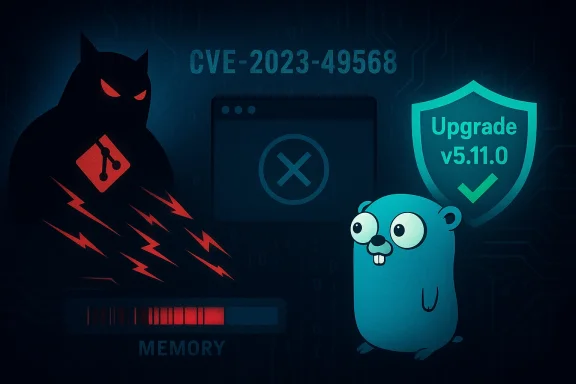 Background / Overview
The go-git library provides a pure-Go implementation of Git primitives, object storage, and transport that many applications embed to perform repository operations programmatically. It is used in command-line tools, CI/CD systems, source-management utilities, and self-hosted services that choose a Go dependency rather than shelling out to the upstream Git client. In late 2023 the project and third-party trackers documented a high-severity denial-of-service issue, tracked as CVE-2023-49568, that allows a malicious Git server to send responses crafted to trigger uncontrolled resource consumption in affected go-git clients.This vulnerability is implementation-specific: it affects go-git versions before v5.11.0, and does not apply to the upstream git CLI. Applications that use only go-git’s in-memory filesystem mode are also reported as not being affected by this particular issue. The vulnerability was scored with a CVSS v3.1 base score of 7.5 (High) for its strong availability impact and low exploitation complexity. (advisories.gitlab.com
Our community archive has tracked a string of Go-related availability issues dating back several years — many stem from parsing, input validation, or resource-accounting mistakes in libraries that process network or external data. Those historical threads offer useful context for why go-git’s vulnerability should be treated as an urgent patching priority rather than a hypothetical edge case.
What exactly is CVE-2023-49568?
The technical essence
At its core, CVE-2023-49568 is an improper input validation / uncontrolled resource consumption problem in the go-git client code that parses and handles Git server replies. A malicious server can craft replies that force the client into extreme memory or processing consumption patterns — for example, by providing reply structures that bypass or trigger pathological growth in data structures, repeated allocations, or unbounded loops in parsing routines. The result: the client process reaches resource exhaustion and becomes unresponsive or crashes, denying availability to services or users that rely on it.Technical trackers classify the weakness under CWE-20 (Improper Input Validation) and related classes for resource consumption, reflecting the fact that the root problem is insufficient limits and accounting when consuming network-supplied content. Several vulnerability databases and vendor advisories confirm this behavioral description and the attack vector being network-exposed.
Measurable severity
Key measurable attributes are:- CVSS v3.1 base score: 7.5 (High).
- Attack vector: Network (remote attacker can exploit over network connections).
- Privileges required: None — no authentication is needed to attempt exploitation.
- Impact: Availability only; confidentiality and integrity are not reported as affected.
- Affected versions: All go-git releases prior to v5.11.0.
Who and what is affected?
Packages and deployments at risk
- Affected library versions: go-git versions from the v4 line through releases earlier than v5.11.0. Distributions and downstream packages that vendor these versions are also affected.
- Applications: Any service or utility that imports and uses the vulnerable go-git API and that contacts untrusted Git servers. That includes self-hosted code-introspection tools, custom deployment agents, Git-backed configuration management utilities, and some CI runners that embed go-git.
- Not affected: The upstream Git CLI (git) is not impacted by this go-git implementation flaw. Additionally, applications that exclusively use go-git’s in-memory filesystem mode were reported as not affected by this specific issue in vendor advisories. However, caveats apply — other code paths might still be vulnerable if the library is used differently.
Practical blast radius
Because go-git is commonly embedded as a library rather than run as a standalone server, exploitation affects the hosting application’s process and any users or services depending on it. That means the operational blast radius can be far larger than a single workstation — a single vulnerable CI service instance that fetches from an attacker-controlled or compromised Git server could bring down a whole CI pipeline or block deployments.For organizations that rely on a mix of public and internal Git servers, the most realistic risk scenarios are:
- An attacker operating a malicious Git server that lures clients (e.g., via a crafted dependency URL or misconfigured CI job).
- A legitimate server that has been compromised and starts returning malformed replies.
- A man-in-the-middle that can manipulate server replies for connections without appropriate transport protections (though network-layer protections can raise the bar).
How the vulnerability was discovered and disclosed
The original report for CVE-2023-49568 was responsibly disclosed to the go-git maintainers and recorded in project security advisories late in 2023. GitHub’s advisory and third-party vulnerability trackers subsequently cataloged the issue and recommended an immediate upgrade to the patched release. Public vulnerability databases aggregated the metadata and severity scoring. The go-git project issued a specific fix and flagged the affected versions in its advisory.Over time, the go-git project and downstream vendors continued to investigate adjacent behaviors and harden parsing and resource-accounting in later releases; additional advisories in 2024–2025 documented similar problem classes and produced subsequent updates and CVE entries for related but distinct issues. This iterative remediation pattern is common for complex parsing and client-server protocols where multiple code paths handle external data.
Confirmed fixes and recommended version(s)
- The vendor advisory and several authoritative trackers indicate that the primary fix for CVE-2023-49568 was included in go-git v5.11.0. Users of grafted or vendor-pinned code should upgrade to v5.11.0 or later to remediate the specific CVE.
- Note: subsequent, related advisories have been published (for example, a later advisory in 2025 referenced a DoS variant patched in v5.13.0). Operators should not treat v5.11 as the end of the storyalease available in your ecosystem (and reviewing the changelog for related fixes) is the prudent approach.
Exploitation scenarios and practical risk analysis
Attack patterns
A remote attacker typically needs to accomplish one of the following to exploit the issue:- Operate a malicious Git server or a service that proxies Git responses.
- Trick a vulnerable client into connecting to that server (for example, via a dependency URL, a misconfigured remote, or social engineering).
- Cause the server to return the crafted reply payload that drives the client into resource exhaustion.
Real-world impact examples
- A CI runner embedding go-git clones a repository at job start. If the runner is pointed to an attacker-controlled server, the job process can be driven to crash or hang, stalling pipelines across teams.
- An internal admin tool that validates remote repositories for onboarding could be taken offline by contacting a malicious mirror.
- A multi-tenant service that uses go-git to fetch user-supplied repositories could see one malicious user impact the service availability for other tenants.
Mitigation and remediation guidance
Immediate operational steps you can take:- Upgrade the library
- Primary remediation is to upgrade any usage of go-git to v5.11.0 or later. If possible, adopt the most recent stable release in the v5 line or later to get fixes for later, related issues as well.
- Harden remote trust
- Restrict which Git hosts your tooling is allowed to contact. Use allowlists for remotes in CI/CD configurations, service account restrictions, or per-job pinning of trusted servers.
- Use network protections
- Ensure transport encryption and integrity (e.g., HTTPS/TLS, SSH) and monitor for unexpected server certificate changes. While TLS does not nullify the risk of a compromised server it raises the bar for man-in-the-middle manipulations.
- Limit resource exposure
- Run processes with constrained resource caps (memory, CPU, ephemeral disk) and timeouts. Operating-system-level cgroups, container memory limits, and process supervisors can help prevent total host degradation even if a process is targeted.
- Prefer in-memory mode for high-risk flows (with caution)
- Vendor advisories note that certain in-memory-only usage patterns of go-git were not affected by this specific issue; if your workflow allows it, consider restricting usage to those safer APIs. But do not treat this as a universal fix: in-memory usage changes the attack surface and may be impractical for many applications.
- Audit and patch vendor packages
- If you vendor or vendor-patch go-git in your repositories, ensure the patch is applied to the vendored tree and that CI builds pick up the patched version. Distribution packages used by your OS may lag — verify with maintainers.
- Monitor for exploitation
- Log and alert on abnormal resource consumption during Git operations and on repeated remote failures. Correlate anomalies with the origin of the remote host to detect malicious patterns early.
- Apply defense-in-depth
- Combine the above with standard supply-chain controls: SCA (software composition analysis), dependency scanning, and runtime protections to reduce the time between detection and remediation.
Patching deployment checklist
- Inventory all projects that import go-git (run codebase scans and dependency reports).
- Verify the go-git version in each codebase and in vendor directories or lockfiles.
- Plan upgrades to the minimum patched release (v5.11.0) or the latest stable release if feasible.
- Run full test cycles in staging environments to confirm behavior and to detect any API changes or regressions.
- Deploy to production with phased rollouts and keep post-deploy monitoring active for resource anomalies.
- If immediate upgrade is impossible, implement host-level resource limits and restrict network access to trusted Git servers as a temporary mitigation.
Longer-term hardening and developer guidance
- Audit parsing and protocol handling code: Teams that maintain Git-related code should perform focused audits on parsing routines and any code that accepts remote-controlled structure sizes and counts. Look specifically for unchecked loops, unchecked integer arithmetic, and unbounded container growth.
- Adopt resource accounting patterns: Libraries should apply explicit bouniuts (e.g., maximum number of objects, maximum buffer sizes, and throttle counters for repeated metadata segments). This is the precise class of fix that addresses CWE-770/400-style weaknesses.
- Encourage responsible disclosure: The go-git project’s security process demonstrates the value of private disclosure followed by coordinated patching and advisories. Organizations that discover issues should follow similar paths to reduce windows of public exposure.
- Continuous dependency visibility: Embed SCA tooling into CI to get immediate alerts when a new advisory affects one of your components. Many vendors and registries now expose advisories and automated alerts; integrate them into triage workflows to shorten detection-to-remediation time.
What to watch for after patching
- Regression in behavior: After upgrading, confirm that cloning, fetching, and other operations behave identically under expected loads and that performance is not adversely impacted.
- Related advisories: The parsing and resource-accounting domain often yields follow-on vulnerabilities. Keep an eye on project advisories for follow-up CVEs or tightened fixes; for example, later advisories in 2025 referenced adjacent DoS variants that were fixed in later v5.x releases. Upgrading only to the minimum patched release may be insufficient if your environment is also exposed to related issues.
- Downstream package lag: Distribution packages (OS-level packages or third-party vendor bundles) may not be updated immediately. Track the status of those packages if you depend on prebuilt binaries or vendor-specific distributions.
Responsible disclosure and community reactions
The go-git maintainers have published security advisories alongside the fixes and have credited researchers who reported the issues. Public vulnerability databases and national CERTs cataloged the CVE and issued guidance consistent with vendor recommendations. Community discussion has focused on the recurring theme that protocol-parsing code must be defensive-by-default — a lesson re-learned every time a format-parsing DoS emerges. Our forum’s archives reflect this steady stream of parsing-related incidents and the practical work needed to operationally mitigate them.Practical example: a safe upgrade plan for a small team
- Run a dependency scan across your repositories to list all modules that import go-git.
- For each repository:
- Check go.mod or vendor tree for the go-git version.
- If version < ch to update the dependency to v5.11.0 (or later).
- Run unit and integration tests locally and in CI. Pay particular attention to tests that exercise repository cloning, fetches, and file-system interactions.
- Deploy to a canary environment and run synthetic workloads that clone and fetch from both trusted and untrusted mirrors (the latter in a controlled, isolated testbed).
- If no issues are observed, roll out to production progressively and monitor for process crashes or abnormal memory use.
Final assessment — strengths, risks, and recommended posture
- Strengths
- The vulnerability was responsibly disclosed and fixed upstream; a clear remediation (upgrade to v5.11.0 or later) is available. Vendor advisories and public trackers provide consistent guidance and severity scoring, enabling fast triage.
- Risks
- The vulnerability’s attack vector is network-exposed and requires no authentication, meaning any client that contacts an attacker-controlled Git server is at risk. The practical risk is amplified for automated tools that routinely pull repositories from third-party endpoints. Distribution lag and vendored code can delay remediation in production. Additional related parsing/resource-accounting issues have historically followed — so a one-time upgrade may not be sufficient to achieve long-term resilience.
- Recommended posture
- Patch promptly to a fixed go-git release (v5.11.0 or later), apply defense-in-depth (restrict remote trust, apply resource limits), and integrate dependency-scanning into your deployment pipeline. Monitor for additional advisories from the go-git project and the wider vulnerability ecosystem. Where possible, isolate Git-originated processing into processes that run under strict resource limits to prevent a single vulnerable client from bringing down broader infrastructure.
Denial-of-service vulnerabilities that arise from protocol parsing are deceptively simple to introduce and can cause outsized operational disruption. CVE-2023-49568 is a clear reminder that libraries which implement well-known protocols must be written with conservative, explicit bounds on resource consumption and with an expectation of hostile input. For operators and developers, the takeaway is straightforward: verify your dependency versions, apply the vendor-published fixes, and adopt layered mitigations — doing so eliminates the immediate exposure and significantly reduces the likelihood that a later parser-related issue will become an incident.
Source: MSRC Security Update Guide - Microsoft Security Response Center
