

Oracle’s MySQL Server contains a denial-of-service weakness in the Server: Optimizer component (tracked as CVE-2024-21171) that can be triggered remotely by a low‑privilege, network‑connected MySQL account to cause the server to hang or repeatedly crash, producing a complete loss of availability for affected instances.
MySQL remains one of the most widely deployed relational database engines across web applications, cloud services, and enterprise stacks. The query optimizer is a central component: it parses, rewrites and plans execution for SQL statements so the server executes queries efficiently. A reliability or logic error deep in the optimizer can therefore impact the entire server process, not just a single connection or session.
Oracle included CVE-2024-21171 in its July 2024 Critical Patch Update, listing affected releases as MySQL 8.0.37 and earlier and MySQL 8.4.0 and earlier. The vendor-assigned severity and the synthesized CVSS rating identify availability as the main impact vector: CVSS v3.1 Base Score 6.5 — AV:N/AC:L/PR:L/UI:N/S:U/C:N/I:N/A:H.
Independent vulnerability databases repeat the same basic facts: the bug is network-reachable, low complexity to trigger, and requires low privileges in the MySQL sense (a valid database account, not full host-level access). Several downstream advisories (distributors and cloud vendors) have adopted that description and set their own priority/patch guidance accordingly.
While the numeric CVSS rating (6.5) classifies the issue as medium in the formal scoring system, real-world impact for production systems can be severe because availability loss at the database layer often cascades into application‑level outages. The operational advice is straightforward: assume the worst with respect to availability and act quickly to apply fixes and defensive controls.
For many organizations the practical steps are: inventory your MySQL instances, verify versions, patch to vendor-provided releases or apply distribution-provided updates, and deploy compensating network and privilege restrictions while patching progresses. If you see repeated crashes that correlate with database queries, treat that as an operational emergency and isolate the offending client while you patch.
The broader MySQL ecosystem has seen multiple optimizer/InnoDB/DDL DoS issues over time; treat this CVE as another reminder that database service stability and the principle of least privilege are central to maintaining application availability. Community and vendor advisory threads show these issues recur and are handled as urgent by DBAs and distributors alike.
If you need a tailored remediation timeline or an operations checklist specific to your cloud or distribution (for example, package names or exact fixed package versions for Debian, Ubuntu, Red Hat, AWS Linux variants, or container images), collect your environment inventory and proceed with vendor-specific patching guidance — but treat the remediation as a priority.
Source: MSRC Security Update Guide - Microsoft Security Response Center
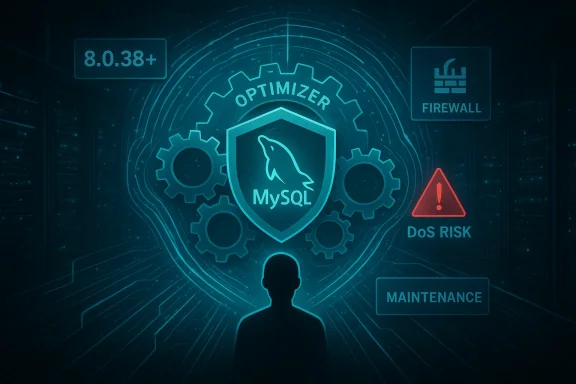 Background / Overview
MySQL remains one of the most widely deployed relational database engines across web applications, cloud services, and enterprise stacks. The query optimizer is a central component: it parses, rewrites and plans execution for SQL statements so the server executes queries efficiently. A reliability or logic error deep in the optimizer can therefore impact the entire server process, not just a single connection or session.Oracle included CVE-2024-21171 in its July 2024 Critical Patch Update, listing affected releases as MySQL 8.0.37 and earlier and MySQL 8.4.0 and earlier. The vendor-assigned severity and the synthesized CVSS rating identify availability as the main impact vector: CVSS v3.1 Base Score 6.5 — AV:N/AC:L/PR:L/UI:N/S:U/C:N/I:N/A:H.
Independent vulnerability databases repeat the same basic facts: the bug is network-reachable, low complexity to trigger, and requires low privileges in the MySQL sense (a valid database account, not full host-level access). Several downstream advisories (distributors and cloud vendors) have adopted that description and set their own priority/patch guidance accordingly.
What the advisory actually says (verified)
- Affected component: MySQL Server — Optimizer.
- Affected upstream versions: 8.0.37 and prior; 8.4.0 and prior.
- Attack vector: network (attacker must be able to connect to the MySQL service).
- Privileges required: PR:L — an attacker needs a valid, low‑privilege MySQL account (not necessarily DBA/SUPER).
- Impact: Availability — repeated crashes or hangs of the mysqld process leading to denial of service; no confirmed C or I impact in the main advisory.
- Score and vector (CVSS v3.1): 6.5 (AV:N/AC:L/PR:L/UI:N/S:U/C:N/I:N/A:H).
Technical analysis — how to interpret the risk
1) “Low‑privilege” privilege is relative
In CVSS terms, PR:L means any MySQL account that is not administrative can be sufficient to trigger the bug. That’s important operationally: many applications use database accounts with moderately broad privileges, and those accounts are often reachable from application tiers, containers, or orchestrated pods. The result: an attacker who compromises an application account or an operator script could weaponize that access to take the entire database server offline. Oracle’s advisory and public trackers make this explicit.2) Availability-only impact in the public record
All publicly published descriptions tie the core impact to availability — crashes or hangs — and list no direct confidentiality or integrity impacts for CVE-2024-21171. That does not mean other follow-on risks do not exist (see “operational risk” below), but the immediate technical bug is to crash or freeze mysqld.3) Trigger surface: network + SQL
The flaw lives in the query optimizer. Attackers must send crafted SQL (or invoke behavior that exercises the vulnerable optimizer path) over one of MySQL’s protocols. In practice, that means the vulnerability is reachable via any component that can connect to the database: application servers, management tools, replication endpoints, or automated jobs. Distributor advisories and NVD all emphasize that multiple protocols / clients are potentially vectors.4) Exploit availability and public proof-of-concept (PoC)
At the time of verification, there is no widely circulated, reliable public PoC for CVE-2024-21171 and there was no confirmed evidence of large-scale exploitation in the wild when the advisories were published. Multiple vulnerability trackers and intelligence feeds indicate that Oracle’s CPU provided fixes and that vendor and distribution vendors coordinated remediation. However, given the nature of optimizer bugs (many past optimizer flaws have had working PoCs published later), we treat proof-of-concept existence as a moving target and recommend operators assume weaponization is possible.Operational risk — why this matters to your environment
- If your application uses a long-lived connection pool to an exposed MySQL endpoint, a compromised app server can send crafted queries and repeatedly crash the server. That can produce an operational outage across multiple services and require manual intervention to recover.
- Shared hosting or multi-tenant environments where database accounts are issued to different teams increase the blast radius. A single compromised tenant account might be able to disrupt other tenants if mysqld is single‑instance.
- Managed database services and packaged distributions often lag upstream. Some vendors listed “pending fix” or “no fix planned” for older OS-provided MySQL packages; operators with distro-provided MySQL packages must follow their distribution’s advisory timeline.
- The optimizer’s code paths are shared by many features; historically, similar optimizer/DDL/InnoDB issues have recurred in MySQL across CPU cycles. Community and vendor threads documenting optimizer DoS vulnerabilities in later years make the pattern clear: these are not one-off problems. Administrators should treat optimizer-related CVEs as high operational risk even if the CVSS value is medium.
Detection and indicators of compromise (IoC)
No definitive exploit signature exists in public advisories, so detection focuses on operational signals and logs:- Repeated mysqld crashes or signals in the error log (e.g., “mysqld got signal 6”, “Got signal 11”) closely following queries from a specific account or client address. Monitor and correlate crash timestamps with connection logs.
- Sudden, reproducible hangs triggered by a known query pattern when executed against a staging copy may indicate the same vulnerable path. Test in an isolated environment — never run suspicious payloads against production.
- Unusual query sequences from accounts that should not perform complex DDL/DML or optimizer‑heavy queries. Audit account behavior and set alerting for unexpected privilege usage.
Mitigation and remediation — an actionable checklist
Immediate remediation should be treated as a priority for production systems that match the advisory’s affected versions.- Patch or upgrade first (recommended)
- Upgrade to the vendor-fixed releases as provided in Oracle’s July 2024 CPU or to a later, supported MySQL release where the issue is fixed. For many 8.0-based environments, downstream and packaging vendors recommended or rolled out 8.0.38 or later as the patched baseline; Chainguard and other packagers flagged 8.0.38+ as the corrected upstream baseline. Check your distribution and MySQL variant for the exact fixed package.
- For 8.4-series users, apply the vendor-specific 8.4 patch that incorporates the fix (follow Oracle’s and your platform’s guidance).
- If you cannot patch immediately, apply compensating controls
- Restrict network reachability to the MySQL port: use firewall rules or host-level network policies to allow only trusted app servers, management IPs, and replica hosts to connect. This reduces attacker access to the MySQL protocol.
- Enforce least privilege on database accounts: remove unnecessary privileges from application accounts; separate duties so application-level accounts cannot perform admin-level operations. Consider use of defense-in-depth such as stored-procedure whitelists or query firewalls where available.
- Disable remote access for maintenance accounts and root if not required; bind mysqld to internal-only interfaces when possible.
- For containerized or orchestrated environments, ensure network policies (e.g., Kubernetes NetworkPolicy) restrict lateral access to the DB service.
- Operational hardening and monitoring
- Configure alerting for repeated mysqld restarts, process crashes, or core dumps. Automate incident response to isolate the affected instance and fail over to a healthy replica if available.
- Maintain frequent backups and test restore procedures. A sustained attack might require recovery from a known-good snapshot.
- If you run read replicas or failover clusters, verify that your replication topology allows quick promotion and that replicas are on patched versions before failover. Unpatched replicas can be taken down by the same attack sequence.
- Vendor and distribution coordination
- Track your Linux distribution or cloud provider’s advisory: many distros and managed services publish their own fix timelines and package revisions (some show “pending fix” for older platforms). Follow those advisories for coordinated patching.
Step-by-step emergency playbook (for DBAs)
- Identify all MySQL instances running 8.0.37 or earlier, or 8.4.0 or earlier. Export a list of versions and their network exposure.
- If the instance is exposed to untrusted networks, immediately restrict access to known management/app hosts via firewall rules or security groups.
- Apply vendor-provided patches to test instances first, then to production following change control and maintenance windows. If patching is delayed, consider taking the instance offline during off-hours until it can be patched.
- Review and rotate any credentials belonging to service accounts that have network access to MySQL; narrow privileges where possible.
- Enable enhanced logging and alerting for crashes and unusual queries; keep crash dumps for post-incident triage.
- If you detect repeated crashes correlated to a particular account or client, revoke or rotate that account, isolate the host, and escalate to incident response.
Broader context — MySQL optimizer and availability CVEs as a pattern
CVE-2024-21171 is not an isolated event: over successive CPU cycles, Oracle and downstream distributors have repeatedly addressed optimizer, InnoDB, DDL and stored-procedure related DoS and stability issues. The community and vendor forum records show similar vulnerabilities surfacing later as well, often with similar exploitation patterns (authenticated or post‑compromise query sequences causing crashes). That historical pattern elevates the operational impact of any optimizer CVE because, once abused, the attacker’s ability to repeatedly crash the server becomes an easy operational denial-of-service tool for an attacker who holds database credentials. See community posts and internal security discussions where MySQL optimizer DoS CVEs were treated as urgent.For cloud and managed-service operators
- If you use a managed MySQL offering (Cloud SQL, RDS/Aurora, Azure Database for MySQL, etc.), check your provider’s maintenance advisories and apply the provider’s patch window or forced patch actions. Providers often backport fixes or perform maintenance on behalf of customers; check the provider’s status and change logs.
- For containerized MySQL images, update your image tags to a fixed upstream/packager version (for example, community packagers flagged 8.0.38+ or specific rebuilds that include the CPU). Rebuilding and redeploying images that incorporate patched MySQL builds is the recommended remediation path for containerized workloads.
What this CVE does not prove — cautionary notes
- The published advisory describes availability impact only; there is no public evidence in the advisories that CVE-2024-21171 allows data leakage or remote code execution. Treat claims of additional impact with skepticism until a reliable technical analysis or vendor update confirms them.
- Lack of a public PoC is not proof that exploitation is impossible. Optimizer-induced crashes are historically straightforward to craft once the vulnerable path is understood; threat actors with DB credentials or insider access could write automated scripts that exercise the path. Assume operational weaponization is possible.
Recommendations (short list)
- Patch to the vendor-fixed MySQL release as soon as practically possible. Oracle published the fix in its July 2024 CPU; many downstream package maintainers released patched packages or guidance referencing 8.0.38 or equivalent.
- Restrict access to MySQL over the network; implement firewall rules, bind-address, and network policies to limit who can connect.
- Enforce least-privilege database accounts; audit application and service accounts and remove privileges not required for normal operation.
- Harden monitoring: alert on mysqld crashes, repeated restarts, and unusual query volumes or patterns. Preserve crash dumps for forensic analysis.
- For managed services and packaged distributions, follow the vendor/distributor advisory — don’t assume every environment has the same patch timeline. Some packaging ecosystems may lag upstream.
Final assessment
CVE-2024-21171 is an operationally important availability vulnerability: it can be exploited by a low‑privileged database account over the network to crash or hang mysqld, and it affects widely used MySQL release lines (8.0.37 and earlier; 8.4.0 and earlier). The technical details in Oracle’s CPU and multiple independent trackers are consistent: prioritize patching, reduce network exposure, and harden account privileges.While the numeric CVSS rating (6.5) classifies the issue as medium in the formal scoring system, real-world impact for production systems can be severe because availability loss at the database layer often cascades into application‑level outages. The operational advice is straightforward: assume the worst with respect to availability and act quickly to apply fixes and defensive controls.
For many organizations the practical steps are: inventory your MySQL instances, verify versions, patch to vendor-provided releases or apply distribution-provided updates, and deploy compensating network and privilege restrictions while patching progresses. If you see repeated crashes that correlate with database queries, treat that as an operational emergency and isolate the offending client while you patch.
The broader MySQL ecosystem has seen multiple optimizer/InnoDB/DDL DoS issues over time; treat this CVE as another reminder that database service stability and the principle of least privilege are central to maintaining application availability. Community and vendor advisory threads show these issues recur and are handled as urgent by DBAs and distributors alike.
If you need a tailored remediation timeline or an operations checklist specific to your cloud or distribution (for example, package names or exact fixed package versions for Debian, Ubuntu, Red Hat, AWS Linux variants, or container images), collect your environment inventory and proceed with vendor-specific patching guidance — but treat the remediation as a priority.
Source: MSRC Security Update Guide - Microsoft Security Response Center
