

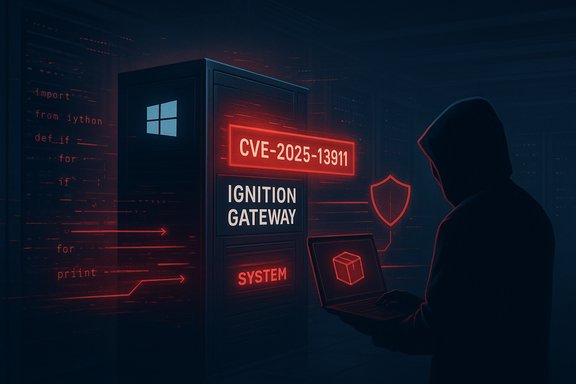
Inductive Automation’s Ignition platform is the subject of a fresh, high‑impact advisory that warns an authenticated administrator can upload a malicious project containing Python scripts (Jython) which the Ignition Gateway executes with the Gateway service account privileges — and on Windows that often means SYSTEM‑level code execution. The coordinating advisory assigns the issue CVE‑2025‑13911, scores it at CVSS 6.4 (Execution with Unnecessary Privileges / CWE‑250), and calls out Ignition 8.1.x and 8.3.x as known affected release families. This is not an abstract programming flaw: in practical terms the chain is straightforward — a privileged upload of a crafted exchange/project file that includes executable scripts can yield immediate, persistent, system‑level control of the host running the Gateway. The advisory and vendor guidance emphasize immediate mitigation: limit network exposure, treat administration credentials conservatively, and apply vendor hardening recommendations.
Ignition is a widely deployed industrial automation platform used for SCADA, HMI, data acquisition and edge automation work. It installs a Gateway service that hosts projects, scripting, OPC UA connectivity, and runtime modules; on Windows the Gateway is installed and managed as a service, and scripts executed by the Gateway run in the Gateway process context. Inductive Automation documents how the Gateway runs as a service and how scripting is processed inside the Gateway environment. This advisory sits inside a familiar and recurring ICS pattern: engineering or admin functions that accept user‑supplied project artifacts (exchange packages, project bundles) and execute code during import or runtime. Past public disclosures and vendor commentary show Ignition’s exchange/import path has been a vector for code execution when untrusted packages are accepted with privileged context; Inductive Automation itself has previously explained how authenticated import of exchange packages can execute Jython scripts and has proposed UX mitigations (warnings and import safeguards) to reduce accidental risk. Why Windows admins should care: many Ignition Gateways, designer tools, and engineering workstations live in or near Windows environments. A compromised Gateway that runs as a Windows service with elevated rights is an escalation vector into Windows domain resources, backups, historian servers, and jump hosts — all high‑value targets for attackers seeking lateral movement or persistence.
Practical verification step for operators: check Inductive Automation’s official Trust Portal / Support pages for a KB entry referencing CVE‑2025‑13911 and confirm the exact fixed version or mitigation steps. If the vendor has not yet published a patch, use the mitigation checklist above while monitoring vendor channels for updates.
The defensible course is straightforward and immediate: treat any external exchange package as hostile until scanned and sandboxed, reduce the privilege of the Gateway service account, restrict who can import projects, and enforce network and egress controls around Gateways while coordinating a tested vendor patch deployment. These steps reduce the attack surface substantially even before a final vendor fix is applied. Inductive Automation’s previous advisories and documentation confirm the import/execute model and provide a starting point for hardening; CISA‑style ICS mitigations remain a sensible baseline for most environments. Organizations should treat this as an operational priority for any Windows hosts that run Ignition Gateways or integrate with Ignition projects — the combination of privileged execution context and widely shared project files makes the practical risk higher than a simple metric like “authentication required” might imply.
Source: CISA Inductive Automation Ignition | CISA
 Background / Overview
Ignition is a widely deployed industrial automation platform used for SCADA, HMI, data acquisition and edge automation work. It installs a Gateway service that hosts projects, scripting, OPC UA connectivity, and runtime modules; on Windows the Gateway is installed and managed as a service, and scripts executed by the Gateway run in the Gateway process context. Inductive Automation documents how the Gateway runs as a service and how scripting is processed inside the Gateway environment. This advisory sits inside a familiar and recurring ICS pattern: engineering or admin functions that accept user‑supplied project artifacts (exchange packages, project bundles) and execute code during import or runtime. Past public disclosures and vendor commentary show Ignition’s exchange/import path has been a vector for code execution when untrusted packages are accepted with privileged context; Inductive Automation itself has previously explained how authenticated import of exchange packages can execute Jython scripts and has proposed UX mitigations (warnings and import safeguards) to reduce accidental risk. Why Windows admins should care: many Ignition Gateways, designer tools, and engineering workstations live in or near Windows environments. A compromised Gateway that runs as a Windows service with elevated rights is an escalation vector into Windows domain resources, backups, historian servers, and jump hosts — all high‑value targets for attackers seeking lateral movement or persistence.What the advisory says — concise technical summary
- A privileged Ignition administrator account can upload an exchange/project file that contains embedded Python/Jython scripts.
- Ignition’s scripting environment lacks sufficient import restrictions and security controls to stop dangerous libraries or bind‑shell / reverse shell code patterns from being executed during import or by background scripts.
- The Gateway process executes those scripts in the service account context. On many Windows deployments the service runs as Local System or an account with equivalent privileges; therefore a successful exploit could execute code at the SYSTEM level.
- A successful chain — authenticated project upload → script execution as Gateway service → OS‑level actions — yields immediate, persistent control and can be used to install backdoors, alter automation logic, or exfiltrate sensitive project data.
- Inductive Automation lists affected lines as Ignition 8.1.x and 8.3.x in the advisory package; the coordinating body assigned CVE‑2025‑13911 and a CVSS v3.1 base score of 6.4 (medium) — reflecting the required authentication precondition but high impact on confidentiality, integrity and availability.
Technical analysis — how exploitation works in practice
The attack surface: exchange packages and scripts
Ignition projects and exchange packages can include scripts and resource files that the Gateway may execute or evaluate during import, initialisation, or when project tags and scheduled tasks run. If an attacker has administrator credentials (or can trick an admin to import a package), the imported scripts run in the Gateway’s process. Historically, Ignition’s import mechanism and scripting runtime were designed to give integrators flexible, programmatic control — which also makes trusted input a security boundary. Inductive Automation’s own guidance acknowledges that import of external exchange packages is a mechanism that can run arbitrary Jython scripts and must be treated as sensitive.Service context and privilege amplification
On Windows installations the Ignition Gateway typically runs as a Windows service. By default, many installations run under the Local System or another high‑privilege account unless administrators explicitly change it to a less‑privileged service account. Scripts executing in the Gateway therefore inherit the service account privileges; if that account is Local System, that equates to full OS control. Community and vendor documentation show scripts run in the Gateway context and that administrators can change the service logon account, reinforcing the practical risk when the service is left with system privileges.Example exploitation patterns
- Bind/reverse shell loaded by Jython: script opens a listener or reverse connects, then spawns interactive OS shells — executed under the Gateway service account.
- DLL or native tool deployment: script drops a signed or unsigned binary into Program Files or system directories, schedules a task, or registers a service.
- Configuration and credential theft: script reads local credential stores, database connections, or project content and exfiltrates data over outbound connections.
Scope and affected versions
According to the coordinated advisory, the affected product families are Ignition 8.1.x and 8.3.x (the advisory lists those release lines as “known_affected”). As with many ICS disclosures, exact subbuild numbers and vendor patch milestones will matter — operators must verify the exact build string on their Gateways and consult the vendor’s trusted download/KB pages for an authoritative fixed version. Inductive Automation maintains release notes and security‑hardening guidance that should be followed when confirming remediation targets. Caveat on public trackers and timelines: coordinated advisories sometimes assign CVE identifiers and publish advisories before all public registries (NVD, MITRE) or vendor KB pages are synchronized. When cross‑checking, prioritize the vendor PSIRT advisory and the coordinating authority (CISA) advisory as the canonical record for affected versions and immediate mitigation steps.Why Windows administrators must prioritize this
- Engineering and Gateway hosts are often Windows servers or VMs that are integrated into Active Directory, backup systems and SIEMs; system‑level compromise on such a host is a direct path to enterprise credentials and file shares.
- Many Ignition deployments use the Gateway to reach or provision downstream Windows‑hosted services (database backups, historian exports, scheduled tasks). A system‑level compromise can be used to harvest tokens, pivot to jump hosts, or manipulate backups.
- The prerequisite for exploitation — an authenticated administrator import — narrows but does not remove risk: supply‑chain exchanges, partner/contractor uploads, social engineering or stolen admin credentials are realistic vectors in modern engineering workflows.
- Finally, the remediation window is operationally sensitive: upgrading the Gateway or changing service accounts requires maintenance windows and careful testing, so defenders must apply compensating controls while scheduling updates.
Immediate mitigations — what to do now (operational checklist)
Apply the following in order of priority. These are practical, Windows‑centric actions that reduce exposure while you validate vendor fixes and schedule patches.- Inventory and isolate
- Identify all Ignition Gateways and record exact version/build strings. Prioritize those in production or reachable from less‑trusted networks.
- If any Gateway is reachable from the Internet or from broad corporate networks, block access at the perimeter immediately and place the Gateway behind a hardened jump host or bastion.
- Harden the Gateway service account
- Change the Ignition Windows service to run under a dedicated least‑privilege domain account, not Local System, unless business processes demand otherwise. Where possible, give that service account the minimum file/DB permissions it needs.
- Document and enforce the service account change as part of change control; test in a staging environment before rolling to production. Vendor docs show the Gateway runs as a Windows service and that the logon account is configurable.
- Lock down import channels and file handling
- Disable or restrict Exchange/Import for external packages where practical.
- Require that any exchange package comes from a secure, signed channel. Enforce checksum or signature verification for project files.
- Where third‑party imports are required, quarantine and inspect packages in a sandboxed, isolated environment first.
- Principle of least privilege for admin accounts
- Limit the number of accounts that can perform project imports and ensure admin accounts use MFA and strong passwords.
- Rotate admin credentials and audit prior import activity to identify unexpected uploads.
- Network egress controls and monitoring
- Block uncommon outbound ports from the Gateway host to reduce risk of reverse shells or exfiltration.
- Monitor for new outbound connections from the Gateway host (unexpected 443, 8080, SSH, or custom ports) and alert on process‑spawn anomalies from the Gateway process.
- Apply vendor hardening guidance and patches
- Check Inductive Automation’s Trust Portal or support pages for published fixes and advisories; validate fixed build numbers and schedule patching in a controlled maintenance window.
- Inductive Automation has previously responded to similar import/RCE problems and published UX and hardening guidance; follow their security hardening recommendations during the update.
- Incident readiness
- Prepare to isolate and forensically image impacted Gateway hosts if suspicious activity is detected.
- Preserve logs and exported projects for offline analysis.
Detection and hunting guidance for defenders
- Host telemetry: monitor the Ignition process for unexpected child processes, writes to Program Files, or creation of scheduled tasks and new Windows services.
- Network telemetry: detect anomalous outbound connections initiated by the Gateway host, especially unusual ports, repeated DNS lookups, or outbound SSH/HTTPS sessions to untrusted hosts.
- File system indicators: watch for new or modified project files in the Gateway data directories or files appearing under system paths that previously weren’t used by Ignition.
- Audit logs: review the Gateway’s administrator audit trail for recent imports/exchanges, especially uploads performed by admin accounts outside normal maintenance windows.
- EDR rules: implement behavioral EDR rules for process injection, in‑memory execution, and suspicious script execution originating from the Ignition process.
Vendor response, disclosure timeline and verification notes
Inductive Automation has historically published support articles and advisories explaining how import/exchange packages can execute Jython scripts and has recommended UX warnings and import safeguards to reduce accidental import of untrusted code. Their prior responses demonstrate an awareness of the import‑execution model and a willingness to harden UX and documentation. CISA’s advisory model for ICS vulnerabilities is consistent: they publish high‑impact advisories that list affected products, technical summaries, and mitigations; defenders should treat vendor PSIRT and the CISA advisory as primary authoritative sources for affected version strings and recommended fixes. Many coordinated disclosures also precede NVD enrichment; if a CVE appears in a CISA advisory but is not yet populated in NVD/CNA, rely on the advisory and vendor statements for triage and remediation.Practical verification step for operators: check Inductive Automation’s official Trust Portal / Support pages for a KB entry referencing CVE‑2025‑13911 and confirm the exact fixed version or mitigation steps. If the vendor has not yet published a patch, use the mitigation checklist above while monitoring vendor channels for updates.
Critical analysis — strengths, gaps and residual risk
Strengths in the advisory and vendor posture
- Transparency: coordinating a CVE and a public ICS advisory raises awareness quickly in the operator community and gives defenders an authoritative canonical reference.
- Actionable mitigations: the advisory emphasizes practical network, account and import hygiene measures that are feasible to implement quickly.
- Historical vendor context: Inductive Automation has already documented import risks and provided guidance before — that institutional knowledge reduces ambiguity during remediation.
Gaps and remaining concerns
- Reliance on authentication: because this issue requires an authenticated admin for the upload vector, defenders may deprioritize it relative to pre‑auth remote RCE bugs; however, the high impact of SYSTEM‑level execution means the attack is still high priority where admin accounts are numerous or remote admin workflows exist.
- Vendor patch cadence and operational testing: industrial deployments often require long maintenance windows; delays in patching leave a prolonged exposure window and make compensating controls critical.
- Supply‑chain and contractor processes: many organizations routinely accept project files from vendors and integrators — supply‑chain hygiene for signed artifacts is still a weak link in many environments.
Attackers’ likely focus
- Credential harvesting and lateral movement: attackers will attempt to steal or phish administrator credentials to perform the import.
- Targeted supply‑chain manipulation: bespoke malicious exchange packages distributed through vendor/contractor channels will be attractive for targeted attacks against critical infrastructure.
Practical remediations checklist for Windows operations teams (short form)
- Immediately block inbound access to any publicly reachable Ignition Gateway; require jump hosts for remote access.
- Change Ignition Windows service from Local System to a hardened, least‑privilege service account where operationally possible, and restrict that account’s rights.
- Quarantine and sandbox all third‑party exchange packages; do not import packages directly on production Gateways.
- Enforce MFA + tight audit for all administrator accounts capable of importing projects.
- Apply vendor patches as soon as validated; coordinate maintenance with OT stakeholders to test compatibility.
- Deploy monitoring: EDR for process behavior, firewall rules for outbound connections, SIEM alerts on admin import events and unexpected Gateway activity.
Conclusion
CVE‑2025‑13911 is a textbook example of how necessary convenience in industrial tooling — importable projects and flexible scripting — can become a powerful attack surface when combined with elevated service privileges on Windows. The vulnerability class is neither novel nor subtle: the chain is authenticated admin upload → script execution → code run as service account. What makes this advisory urgent is the common real‑world configuration where the Ignition Gateway runs as a high‑privilege Windows service and where engineering workflows permit exchange packages from third parties.The defensible course is straightforward and immediate: treat any external exchange package as hostile until scanned and sandboxed, reduce the privilege of the Gateway service account, restrict who can import projects, and enforce network and egress controls around Gateways while coordinating a tested vendor patch deployment. These steps reduce the attack surface substantially even before a final vendor fix is applied. Inductive Automation’s previous advisories and documentation confirm the import/execute model and provide a starting point for hardening; CISA‑style ICS mitigations remain a sensible baseline for most environments. Organizations should treat this as an operational priority for any Windows hosts that run Ignition Gateways or integrate with Ignition projects — the combination of privileged execution context and widely shared project files makes the practical risk higher than a simple metric like “authentication required” might imply.
Source: CISA Inductive Automation Ignition | CISA
