

The United States’ cybersecurity apparatus has raised the alarm: edge devices that have reached end-of-support (EOS) are being actively hunted and exploited by nation‑state actors, and organizations must act now to reduce their exposure. This is not theoretical guidance — a joint fact sheet from federal partners highlights the real-world campaign against EOS load balancers, firewalls, routers, VPN gateways and other perimeter appliances, and CISA’s newly issued Binding Operational Directive (BOD 26‑02) gives U.S. Federal Civilian Executive Branch agencies a strict lifecycle and removal timetable to eliminate these risks. ps://www.csoonline.com/article/4128748/cisa-gives-federal-agencies-18-months-to-purge-unsupported-edge-devices.html)
Edge devices — defined here as devices that sit at the boundary between an internal network and external environments (including the public internet) — are attractive targets because they provide broad visibility and privileged access to networks. When such devices are end-of-support (EOS) — meaning the vendor no longer issues security patches, firmware updates, or software hotfixes — they become long-lived, predictable attack surfaces with unresolved CVEs that attackers can weaponize. The joint government fact sheet makes this clear: natiot EOS edge devices to gain footholds, maintain persistence, and pivot into internal systems.
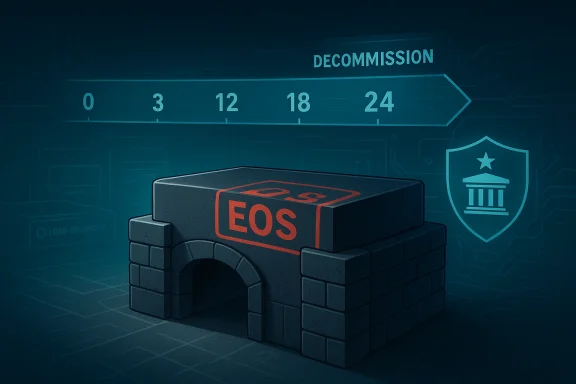
In February 2026 CISA formalized this urgency with Binding Operational Directive 26‑02 (BOD 26‑02), titled “Mitigating Risk From End‑of‑Support Edge Devices.” The directive sets explicit, time‑boxed requirements for federal civilian agencies: immediate updates where possible, a three‑month inventory window, decommissioning of already‑EOS devices within 12 months, full phase‑out within 18 months, and establishment of continuous discovery processes within 24 months. Multiple independent reporting outlets, security communities, and affected-sector advisories have corroborated these timelines and the directive’s emphasis on lifecycle management.
Why the escalation? Observed intrusion campaigns — including those tracked in high‑profile advisories about state‑sponsored groups — have repeatedly leveraged unpatched, internet‑exposed appliances (Fortinet, Citrix, SOHO routers, and others) as initial access vectors. Agencies cite a spike in these campaigns and the unacceptable systemic risk posed when critical perimeter infrastructure remains unsupported. CISA has made clear: EOS devices should not sit on federal networks, and private organizations would be wise to adopt similar discipline.
Edge devices are the chokepoints of network trust: when they are unsupported, they become attack bridges. Treat them as critical, time‑sensitive assets, and the chance of a successful, high‑impact intrusion because of an EOS appliance will fall dramatically.
Conclusion
CISA’s BOD 26‑02 and the joint fact sheet from federal partners are an operational wake‑up call: unsupported edge appliances are actively being exploited by sophisticated actors, and lifecycle discipline is the single most effective remedy. Inventory what you have, prioritize what matters, patch where possible, isolate when necessary, and replace as soon as your testing and procurement pipelines allow. The directive sets federal deadlines — but for any organization that relies on internet‑facing infrastructure, the right time to act was yesterday and the time to act definitively is now.
Source: CISA Reducing the Attack Surface for End-of-Support Edge Devices | CISA
 Background / Overview
Edge devices — defined here as devices that sit at the boundary between an internal network and external environments (including the public internet) — are attractive targets because they provide broad visibility and privileged access to networks. When such devices are end-of-support (EOS) — meaning the vendor no longer issues security patches, firmware updates, or software hotfixes — they become long-lived, predictable attack surfaces with unresolved CVEs that attackers can weaponize. The joint government fact sheet makes this clear: natiot EOS edge devices to gain footholds, maintain persistence, and pivot into internal systems.In February 2026 CISA formalized this urgency with Binding Operational Directive 26‑02 (BOD 26‑02), titled “Mitigating Risk From End‑of‑Support Edge Devices.” The directive sets explicit, time‑boxed requirements for federal civilian agencies: immediate updates where possible, a three‑month inventory window, decommissioning of already‑EOS devices within 12 months, full phase‑out within 18 months, and establishment of continuous discovery processes within 24 months. Multiple independent reporting outlets, security communities, and affected-sector advisories have corroborated these timelines and the directive’s emphasis on lifecycle management.
Why the escalation? Observed intrusion campaigns — including those tracked in high‑profile advisories about state‑sponsored groups — have repeatedly leveraged unpatched, internet‑exposed appliances (Fortinet, Citrix, SOHO routers, and others) as initial access vectors. Agencies cite a spike in these campaigns and the unacceptable systemic risk posed when critical perimeter infrastructure remains unsupported. CISA has made clear: EOS devices should not sit on federal networks, and private organizations would be wise to adopt similar discipline.
What “End‑of‑Support” Actually Means — and Why It Matters
EOS is a precise operational condition, not a vague “old device” label.- An edge device is EOS when the original vendor no longer monitors it for defects or issues security updates (including CVE patches, firmware/security updates, and hotfixes).
- EOS devices continue to operate, but without the ongoing vulnerability remediation that modern threat actors rely upon to craft and scale exploitation.
- Edge appliances (routers, fs, load balancers, WAFs, SD‑WAN devices, network security appliances, and many IoT/OT gateways) are uniquely valuable targets because they frequently integrate with identity systems, expose management interfaces, and sit in a place attackers can use to pivot.
Evidence of Active Exploitation by Nation‑State Actors
The advisory landscape shows patterns that validate CISA’s urgency:- Government advisories documenting campaigns (for example, operations attributed to state‑sponsored groups) explicitly call out exploitation of internet‑facing appliances and perimeter devices as vectors for initial compromise and long‑term persistence. Those advisories urge patching and lifecycle planning as mitigations.
- Incident response cases and forensic reporting show adversaries successfully leveraging unpatched appliances (including VPN and firewall CVEs) to get initial access and then move laterally. Security industry reporting and CISA’s BOD both reference “widespread exploitation campaigns” against EOS edge devices.
What BOD 26‑02 Requires (Practical Takeaways)
BOD 26‑02 gives agencies a structured set of actions and deadlines. The timeline and required behaviors reported across government and trusted media are consistent and actionable:- Immediate: Update vendor‑supported edge devices that are running EOS software to a supported vendor version where doing so will not break mission critical operations.
- 3 months: Inventory all devices included on CISA’s EOS Edge Device List and submit required reporting. (CISA has indicated it will provide a preliminary EOS list—agencies must verify and report.)
- 12 months: Decommission devices with EOS dates on or before the 12‑month deadline; begin replacement with vendor‑supported alternatives.
- 18 months: Complete decommission of all identified EOS edge devices within scope.
- 24 months: Establish continuous discovery and lifecycle management processes to ensure devices do not reach EOS while still in production without action.
Practical Mitigations — an Operational Playbook
Below is an actionable playbook organized by immediate, short‑term (30–90 days), and medium/longer term actions. These steps reflect the joint fact sheet recommendations and the technical realities reported by incident responders.Immediate (within days)
- Inventory and discovery
- Run network scans and asset discovery tools to find internet‑exposed and management‑interface devices. Don’t assume your CMDB is complete. Use both active and passive discovery techniques.
- Isolate and contain
- If an edge device is EOS and publicly exposed, move it behind more restrictive perimeter controls immediately (block inbound management ports at the firewall, use IP allow‑lists, or remove NAT/port‑forwarding).
- Apply safe updates
- Where a vendor‑supported update exists and will not break operations, apply it immediately. Test in a staging environment when possible.
- Lock down management planes
- Force MFA on all admin interfaces; limit management access to jump hosts, VPNs, or bastion boxes with strong logging and EDR on those hosts.
Short term (30–90 days)
- Replace high‑risk, EOS, internet‑exposed devices first (public management interfaces, devices with known exploited CVEs, devices integrated with identity or logging).
- Harden configurations using vendor hardening guides and CIS/industry benchmarks.
- Implement egress allow‑lists for edge devices where possible to limit unexpected outbound traffic and reduce exfiltration channels.
- Deploy network detection and monitoring tuned to device management protocols and anomalous configuration changes; increase log retention and centralize logs for correlation.
Medium to long term (3–24 months)
- Procurement and lifecycle policy: require vendors to publish secure‑by‑default settings, clear end‑of‑support calendars, PSIRT responsiveness, and signed firmware update mechanisms.
- Continuous discovery: implement automated discovery and tracking so devices approaching EOS are flagged at least 12 months before EoS dates and scheduled for replacement.
- Architectural changes: move to managed, vendor‑supported cloud or virtualized edge appliances where lifecycle management and patching can be centrally controlled.
- Test and incident readiness: validate rollback plans, maintain known‑good backups of device configs, and rehearse incident scenarios that include compromised edge devices.
Prioritization Framework — Who Gets Replaced First?
When budgets and swap windows are constrained, prioritize by a simple risk matrix:- Tier 1 (highest priority)
- EOS devices with internet‑facing management interfaces
- Devices tied to identity systems, logging/alerting or MFA
- Devices with public, known‑exploited CVEs
- Tier 2
- EOS devices that are internet‑facing but behind additional controls
- Devices hosting critical VPN termination or B2B connectivity
- Tier 3
- Internal EOS devices without external exposure, but with critical data access
Technical Tradeoffs and Risks — What to Watch For
Replacing or patching edge infrastructure is operationally sensitive. Expect friction and planatibility and uptime: firmware or software upgrades can change packet handling, routing, or SSL/TLS behaviors. Always test in a maintenance window and have rollback plans.- Vendor ESU and third‑party micropatching: some vendors or third parties offer paid extended support or “micropatches” (temporary code modifications) for EOS software. These can be stopgaps, but they introduce supply‑chain and trust concerns and are not substitutes for supported replacements. Validate SLAs, code signing, and audit trails before adoption.
- False sense of security: isolating a device may reduce remote risk but won’t remediate a device already compromised. If compromise is suspected, treat the device as potentially compromised, collect forensics, and rebuild from known‑good images.
- Procurement cycles: hardware refresh cycles are long for many organizations (especially in critical infrastructure). Use contractual requirements to enforce secure lifecycle commitments in future purchases.
Detection and Incident Response Guidance for EOS Edge Devices
If you suspect an EOS edge device has been targeted or compromised, follow a prioritized incident response workflow:- Contain: Immediately isolate the device from external networks; block management ports and vendor maintenance tunnels.
- Preserve: Capture configuration dumps, running processes, and volatile memory if possible; preserve network packet captures for the suspected window.
- Investigate: Correlate logs from jump hosts and management systems; look for unexpected configuration pushes, unknown accounts, or out‑of‑hours access patterns.
- Eradicate: Replace device firmware with a vendor‑supported image when possible, or replace hardware entirely if compromise is confirmed. Rotate all credentials and keys that might have been exposed.
- Recover: Bring replacement devices online behind hardened access controls and proofed configurations.
- Report: Follow regulatory and sector reporting requirements; federal agencies must report per BOD requirements.
Procurement, Supply Chain, and Policy — Hardening Future Buys
This is an operational and contractual problem as much as a technical one. Buyers must insist on vendor behaviors that reduce future EOS risk:- Signed, verifiable firmware updates with an auditable update pipeline
- Transparent end‑of‑support timelines and advance notice of EoS
- Secure default configurations and documented hardening guidance
- Clear PSIRT processes, coordinated vulnerability disclosure, and patch SLAs
- Contractual clauses for continued security support (or clear migration options) post‑warranty
Cross‑Checks and Verification of Key Claims
- BOD 26‑02’s deadlines and action items have been reported consistently across multiple independent industry outlets and security communities; these reports align with CISA’s public statements about the directive and with the joint fact sheet urging mitigation of EOS edge device risk.
- The operational risk from nation‑state actors exploiting EOS appliances is corroborated by government advisories describing campaigns that used unpatched appliances for persistence and lateral movement. The advisory material and incident reporting validate the threat narrative that motivated BOD 26‑02.
- Windows lifecycle context (as an adjacent verification point): Microsoft’s official lifecycle pages confirm major product end‑of‑support dates (for example, Windows 10’s end of support fell in October 2025), illustrating how EOS events are predictable and should be baked into lifecycle planning. This provides a helpful analog for appliance lifecycle behavior.
Quick, Pragmatic Checklist (For IT Teams)
- Inventory: discover all edge devices (automated scans + manual validation).
- Prioritize: rank devices by external exposure and business criticality.
- Patch: apply vendor‑supported updates where safe and available.
- Isolate: shut down public management interfaces, restrict egress, and segment networks.
- Replace: schedule rapid replacement for Tier 1 EOS devices; procure supported alternatives.
- Monitor: increase logging, deploy IDS rules tuned to edge device management protocols, and centralize log collection.
- Contract: update procurement language to require secure lifecycles and PSIRT responsiveness.
- Test: validate upgrades in test environments; maintain rollback plans and tested backups.
- Incident readiness: prepare incident playbooks that assume edge device compromise and include forensic capture steps.
Strengths and Limits of the Directive and Recommended Approach
Strengths- The directive addresses a concrete, observed exploitation vector: it forces lifecycle discipline where long‑term technical debt accumulated.
- The time‑boxed deadlines create a measurable program of work for agencies and shine a light on an otherwise neglected class of assets.
- Operational complexity: replacing enterprise‑grade edge appliances is disruptive — upgrades can alter traffic patterns, SSL handling, or HA behaviors.
- Vendor and procurement friction: procurement cycles and budgets may not align with the directive’s timelines, especially in infrastructure‑heavy organizations.
- Partial mitigations risk: temporary workarounds (micropatching, isolation) reduce risk but do not eliminate the long‑term need to replace EOS devices. Treat these measures as stopgaps only.
Final Assessment — What WindowsForum Readers Should Do Next
This is a systemic, programmatic issue thnt, engineering, and security operations. For IT and security teams, the right posture is:- Assume a device will be targeted if it is internet‑exposed and unsupported.
- Move quickly to inventory, prioritize, and remove or replace the riskiest devices.
- Build lifecycle assurance into procurement and operations so you never again end up with unmanaged EOS infrastructure at the perimeter.
Edge devices are the chokepoints of network trust: when they are unsupported, they become attack bridges. Treat them as critical, time‑sensitive assets, and the chance of a successful, high‑impact intrusion because of an EOS appliance will fall dramatically.
Conclusion
CISA’s BOD 26‑02 and the joint fact sheet from federal partners are an operational wake‑up call: unsupported edge appliances are actively being exploited by sophisticated actors, and lifecycle discipline is the single most effective remedy. Inventory what you have, prioritize what matters, patch where possible, isolate when necessary, and replace as soon as your testing and procurement pipelines allow. The directive sets federal deadlines — but for any organization that relies on internet‑facing infrastructure, the right time to act was yesterday and the time to act definitively is now.
Source: CISA Reducing the Attack Surface for End-of-Support Edge Devices | CISA
