

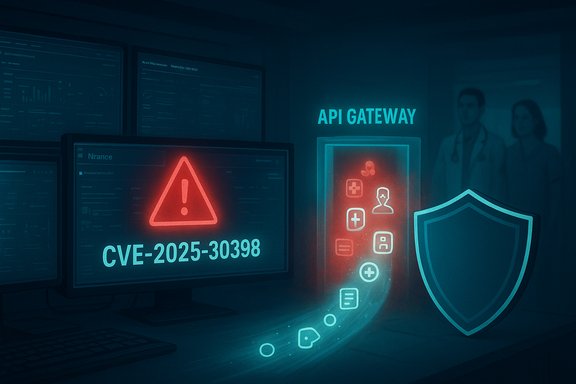
A missing authorization flaw in Nuance PowerScribe 360 — tracked as CVE‑2025‑30398 — exposes a dangerous intersection of radiology workflow software and patient privacy: unauthenticated API calls to PowerScribe’s web interfaces can disclose sensitive data over the network, earning a high CVSS score and urgent attention from security teams in healthcare organizations. Patches were distributed as part of Microsoft's recent security updates, but the underlying risk profile and practical mitigation steps demand immediate, measured action from hospitals, imaging centers, and IT teams that operate PowerScribe 360 servers or integrate with the platform.
PowerScribe 360 is a widely deployed radiology reporting and communications platform used by thousands of healthcare organizations worldwide. It combines speech‑recognition driven reporting, structured templates, integrations with PACS/EHR systems, and REST/web service APIs that allow third‑party tools and local integrations to exchange report, patient, and imaging metadata in real time. Because it routinely handles Protected Health Information (PHI) — including names, dates of birth, medical record numbers, imaging findings, and clinical notes — any vulnerability that allows unauthenticated access to its data flows is especially consequential.
In May 2025, the security community cataloged CVE‑2025‑30398 as an information disclosure vulnerability affecting Nuance PowerScribe 360. The issue is described as a missing authorization condition: specific HTTP/API endpoints did not correctly enforce access controls, enabling an unauthenticated actor to retrieve information that should normally require authorization. The weakness received a CVSS 3.1 base score of 8.1, reflecting its high impact on confidentiality when successfully exploited.
There is some variance in assessments by third parties about the likelihood of exploitation: certain analyses flagged the issue among “critical” entries and highlighted the potential for exploitation without complex preconditions, while vendor guidance emphasized whether operational exposure to Internet‑facing or broadly accessible management interfaces was present. In practice, the likelihood of successful exploitation in a given environment will depend heavily on the network exposure and segmentation of the PowerScribe installation.
Caveat: the precise internal endpoint names or request parameters involved in the disclosure are not publicly documented by the vendor in detail. That kind of detail is usually withheld to reduce the risk of opportunistic exploitation until customers have applied fixes.
The vulnerability’s high CVSS score is warranted: the combination of network exposure, low attack complexity, and the sensitivity of radiology data make this a priority for healthcare IT teams. The immediate, practical items are straightforward — apply the vendor patch, restrict network exposure, instrument detection, and rotate credentials — yet the strategic lesson is more profound: healthcare organizations must treat clinical application APIs with the same rigor as traditional enterprise systems, including segmentation, least privilege, and continuous testing of authentication and authorization controls.
Finally, while public reporting did not, at the time of disclosure, present a flood of confirmed exploit incidents tied to this CVE, the absence of public attacks should not be taken as comfort. Fast, proactive remediation and layered compensating controls are the right course of action to protect patients, providers, and institutions from the tangible risks this information disclosure vulnerability represents.
Source: MSRC Security Update Guide - Microsoft Security Response Center
 Background
PowerScribe 360 is a widely deployed radiology reporting and communications platform used by thousands of healthcare organizations worldwide. It combines speech‑recognition driven reporting, structured templates, integrations with PACS/EHR systems, and REST/web service APIs that allow third‑party tools and local integrations to exchange report, patient, and imaging metadata in real time. Because it routinely handles Protected Health Information (PHI) — including names, dates of birth, medical record numbers, imaging findings, and clinical notes — any vulnerability that allows unauthenticated access to its data flows is especially consequential.In May 2025, the security community cataloged CVE‑2025‑30398 as an information disclosure vulnerability affecting Nuance PowerScribe 360. The issue is described as a missing authorization condition: specific HTTP/API endpoints did not correctly enforce access controls, enabling an unauthenticated actor to retrieve information that should normally require authorization. The weakness received a CVSS 3.1 base score of 8.1, reflecting its high impact on confidentiality when successfully exploited.
What the vulnerability actually is
Missing authorization in a network‑facing API
At a technical level, CVE‑2025‑30398 stems from an authorization/control enforcement failure in PowerScribe 360’s web API layer. The product exposes endpoints intended to be accessed only by authorized services or authenticated users; however, one or more of those endpoints failed to verify that the requestor had privileges to obtain the requested resource. As a result:- An unauthenticated remote actor can issue an HTTP API request to the affected endpoint(s).
- The server responds with data that should have been protected by authentication and access checks.
- The exposed information can include patient identifiers and other sensitive report fields, depending on the server configuration and the data returned by the endpoint.
Attack vector and complexity
The vulnerability can be triggered remotely over the network: an attacker needs only to reach the PowerScribe 360 API (for example, over a management network, DMZ, or any improperly exposed interface) and send a crafted HTTP request to the affected endpoint. Microsoft’s published assessment assigned the vulnerability an attack complexity of Low, meaning the steps required to trigger the bug are straightforward for an attacker with network access to the endpoint.There is some variance in assessments by third parties about the likelihood of exploitation: certain analyses flagged the issue among “critical” entries and highlighted the potential for exploitation without complex preconditions, while vendor guidance emphasized whether operational exposure to Internet‑facing or broadly accessible management interfaces was present. In practice, the likelihood of successful exploitation in a given environment will depend heavily on the network exposure and segmentation of the PowerScribe installation.
Potential data exposure
Because PowerScribe 360 stores and transits radiology reports and related metadata, the types of information at risk include:- Patient identifiers: name, MRN, date of birth, contact details.
- Clinical content: radiology impressions, findings, exam descriptions, clinical history.
- Administrative metadata: accession numbers, ordering/referring physician, study timestamps.
- Potentially linked resources or references (for example, links to images or prior reports), depending on how integrations are configured.
Timeline and patching status
- The vulnerability was publicly documented as part of Microsoft’s coordinated update activity during the 2025 Patch Tuesday cycle. The issue was assigned CVE‑2025‑30398 and included in the consolidated set of fixes released that month.
- Microsoft’s assessment included the CVSS score (8.1) and described the root cause as missing authorization on a PowerScribe API, enabling unauthenticated disclosure.
- Multiple security vendors and incident response teams published analyses and Patch Tuesday roundups referencing the CVE and recommending immediate application of the supplied updates.
Caveat: the precise internal endpoint names or request parameters involved in the disclosure are not publicly documented by the vendor in detail. That kind of detail is usually withheld to reduce the risk of opportunistic exploitation until customers have applied fixes.
Why this matters to healthcare providers
High value of the data at risk
Radiology reports are rich with confidential medical information. Unlike single‑field data leaks (e.g., a single password), disclosure of radiology reports can reveal chronic conditions, injury details, or other clinically sensitive facts. That makes the asset value of a compromised PowerScribe server extremely high for opportunistic attackers and targeted actors alike.Operational exposure and integration complexity
PowerScribe instances are often integrated with PACS, EHRs, and various clinical systems. Complex integrations increase the attack surface and create multiple network hops where API calls can be intercepted or abused. Many deployments use multi‑tenant or multi‑site configurations, and some connect to cloud services; any configuration misstep that exposes management endpoints to non‑trusted networks significantly increases risk.Regulatory and legal risk
Uncontrolled disclosure of PHI can trigger mandatory breach reporting, regulatory investigations, and potential fines under HIPAA and equivalent laws in other jurisdictions. Healthcare organizations must therefore treat this as both a cybersecurity and compliance incident, with appropriate triage and documentation.Detection, indicators, and monitoring
Organizations should assume that detection coverage for this particular flaw will be limited unless they specifically instrument for API abuse. Recommended immediate detection controls:- Review web server and API access logs for anomalous requests to PowerScribe endpoints, focusing on:
- Unauthenticated requests that return 200/OK responses with payloads containing patient identifiers.
- High volumes of requests from a single source or repeated access patterns (enumeration).
- Requests from unexpected external IP addresses, or internal IPs that do not map to known integration endpoints.
- Enable and collect detailed audit logging on PowerScribe 360 components where possible, especially any admin portal, API gateway, or report retrieval endpoints.
- Check network firewall and proxy logs for inbound connections to PowerScribe hosts from untrusted networks.
- Use EDR and SIEM rules to flag outgoing transfers of large volumes of report text or PHI from the PowerScribe host, which could indicate exfiltration.
- Deploy or update IDS/IPS/WAF rules supplied by security vendors — many vendors released signatures or detection rules in coordination with the Patch Tuesday release cycle.
Immediate mitigation and remediation checklist
- Apply vendor patches immediately
- Deploy the PowerScribe 360 security update provided by the vendor or included in Microsoft’s update bundles. Prioritize staging/test then production rollout according to your change management procedures, but expedite deployment in environments that expose the PowerScribe API to broader networks.
- Isolate and harden network access
- Restrict API access to trusted subnets only and enforce restrictive ACLs and firewall rules.
- Ensure that management interfaces are not Internet‑facing. If they are, remove direct exposure or require VPN/zero‑trust controls.
- Implement compensating controls where patching is delayed
- Place an API gateway, WAF, or reverse proxy in front of PowerScribe and enforce strict authentication/authorization checks at the gateway level.
- Create deny/allow rules for any suspicious or unknown HTTP methods and endpoints.
- Audit integrations and credentials
- Verify that all service accounts and API credentials follow least‑privilege principles and rotate secrets where practical.
- Identify and document every third‑party integration that touches the PowerScribe API.
- Monitor and hunt for suspicious access
- Search logs for anomalous GET/POST requests to endpoints returning PHI, unusual user agents, or rapid enumeration patterns.
- Engage forensic and incident response resources if evidence of unauthorized disclosure is found.
- Notify and follow compliance obligations
- If an actual data disclosure is confirmed, follow legal and regulatory notification requirements and coordinate with privacy/compliance teams.
- Validate backups and recovery processes
- Ensure that critical PowerScribe configuration and data backups are intact and that a tested rollback plan exists in case a patch causes operational issues.
Long‑term hardening and supply‑chain considerations
- Segmentation: Put radiology systems (PACS, PowerScribe, reporting servers) on a dedicated VLAN with strict egress/ingress filters. Treat them as high‑value assets and reduce lateral movement risk.
- Zero trust for APIs: Introduce mutual TLS, strong API authentication, JWT validation, and centralized authorization proxies for all machine‑to‑machine calls.
- Third‑party assurance: Demand security posture evidence and timely CVE response SLAs from vendors. Where products are tightly integrated, require vendor architectural guidance for secure deployment.
- Vulnerability management: Include commercial/clinical devices and specialty healthcare applications in vulnerability scanning and patch management with prioritized scheduling for high‑severity issues that affect PHI.
- Pen testing and red teaming: Periodically test API access controls and authorization checks with authenticated and unauthenticated test cases to ensure protections remain effective after upgrades or configuration changes.
What defenders should not assume
- Do not assume that because a system is behind a VPN it is safe: compromised VPN credentials, weak authentication, or misconfigured network rules can still expose the affected API.
- Do not assume trivial exploitability means active exploitation: high impact combined with low complexity makes for a tempting target, but public reports have not confirmed widespread exploitation of this specific CVE at the time of disclosure. Nonetheless, the absence of evidence is not evidence of absence — healthcare remains a frequent target for opportunistic and targeted attacks, so conservative patching is required.
- Do not assume that generic network blocking is sufficient: if integrations require legitimate cross‑network API calls (for example, to EHRs or AI services), blocking must be carefully planned to avoid disruption. Use a layered approach (patch + WAF + strict ACLs) where possible.
Risk analysis: who stands to gain, and what the likely outcomes are
- Opportunistic attackers and data brokers: PHI has real resale value. An unauthenticated disclosure that returns report text and identifiers can be rapidly monetized.
- Targeted criminals and extortionists: Attackers could selectively exfiltrate sensitive records for targeted extortion, reputational damage, or to supplement social engineering against clinicians and administrators.
- State‑affiliated actors: While the vulnerability is not an RCE, its low complexity and the strategic value of large medical datasets could make healthcare imaging systems an attractive target for intelligence or influence operations.
- Insiders or misconfigured third parties: Misconfiguration or inadequate access control by integrating partners could inadvertently expose endpoints; attackers often probe such misconfigurations for lateral access.
Communication and operational playbook for affected organizations
- Triage and scope: Identify all PowerScribe 360 instances and variants in your estate within the first 24 hours. Classify exposures (Internet‑facing, DMZ‑accessible, internal only).
- Patch and test: Plan for expedited testing of the vendor security update in staging and aim for full production deployment as soon as safely possible.
- Visibility and coordination: Involve clinical leadership, privacy/compliance, legal, and communications teams early. Craft patient/provider communication templates and regulatory reporting lines in the event exfiltration is confirmed.
- Post‑patch validation: After applying updates, perform log review and active testing (in a controlled manner) to confirm that previously vulnerable endpoints no longer return protected data to unauthenticated requests.
- Supplier engagement: If integrated third parties have been provided access to your PowerScribe instance, notify them and require proof of patching/controls if they manage or route API traffic.
Closing assessment
CVE‑2025‑30398 is a textbook example of how authorization failures in clinical integration points create outsized risk. The technical root cause is conceptually simple — endpoints responding to calls without enforcing authorization — but the operational consequences are complex because radiology platforms house high‑value PHI and are deeply embedded in clinical workflows.The vulnerability’s high CVSS score is warranted: the combination of network exposure, low attack complexity, and the sensitivity of radiology data make this a priority for healthcare IT teams. The immediate, practical items are straightforward — apply the vendor patch, restrict network exposure, instrument detection, and rotate credentials — yet the strategic lesson is more profound: healthcare organizations must treat clinical application APIs with the same rigor as traditional enterprise systems, including segmentation, least privilege, and continuous testing of authentication and authorization controls.
Finally, while public reporting did not, at the time of disclosure, present a flood of confirmed exploit incidents tied to this CVE, the absence of public attacks should not be taken as comfort. Fast, proactive remediation and layered compensating controls are the right course of action to protect patients, providers, and institutions from the tangible risks this information disclosure vulnerability represents.
Source: MSRC Security Update Guide - Microsoft Security Response Center
