

Companies that still run critical workloads on systems designed for a slower, pre-cloud world are paying a hidden tax in agility, security and cash — and Microsoft Azure, together with Microsoft’s modern identity and security stack, is positioned as a practical path off that treadmill if organisations plan carefully and treat modernisation as a continuous business change rather than a one-off migration.
Legacy applications and technical debt are no longer just IT problems; they are board-level economics. Industry analysis and vendor-neutral research converge on one clear point: a large share of technology budgets is consumed simply keeping old systems alive. Estimates vary by methodology and scope, but market analysts have warned that a substantial proportion of enterprise IT spend — commonly cited around the 40% mark — goes to servicing technical debt and legacy maintenance rather than funding innovation. This dynamic is one of the core drivers pushing organisations to adopt cloud-first and hybrid architectures. At the same time, McKinsey’s recent work on technology economics shows that companies taking a disciplined, product-oriented approach to modernisation and adopting AI-enabled engineering practices can materially increase the financial return of their technology investments. In scenarios modelled by McKinsey, firms that adopt the right operating changes and invest intentionally in the technology core can achieve several times the EBITDA lift from their enterprise technology spend over a multi-year horizon. Those gains are driven by faster delivery, lower run costs, and by unlocking new revenue‑generating use cases. Microsoft’s Azure platform has been a frequent destination for organisations seeking that step change. Azure’s portfolio — from identity (Microsoft Entra ID) through integration (Logic Apps), serverless compute (Azure Functions), managed web hosting (Azure App Service) and cloud-native security (Microsoft Defender for Cloud) — provides a practical set of building blocks for iterative modernisation while supporting hybrid footprints and regulatory requirements. Azure also publishes an extensive catalogue of compliance certifications, a signal that many regulated organisations find useful when evaluating cloud adoption risk.
Source: ITWeb Modernising business applications with Microsoft
 Background / Overview
Legacy applications and technical debt are no longer just IT problems; they are board-level economics. Industry analysis and vendor-neutral research converge on one clear point: a large share of technology budgets is consumed simply keeping old systems alive. Estimates vary by methodology and scope, but market analysts have warned that a substantial proportion of enterprise IT spend — commonly cited around the 40% mark — goes to servicing technical debt and legacy maintenance rather than funding innovation. This dynamic is one of the core drivers pushing organisations to adopt cloud-first and hybrid architectures. At the same time, McKinsey’s recent work on technology economics shows that companies taking a disciplined, product-oriented approach to modernisation and adopting AI-enabled engineering practices can materially increase the financial return of their technology investments. In scenarios modelled by McKinsey, firms that adopt the right operating changes and invest intentionally in the technology core can achieve several times the EBITDA lift from their enterprise technology spend over a multi-year horizon. Those gains are driven by faster delivery, lower run costs, and by unlocking new revenue‑generating use cases. Microsoft’s Azure platform has been a frequent destination for organisations seeking that step change. Azure’s portfolio — from identity (Microsoft Entra ID) through integration (Logic Apps), serverless compute (Azure Functions), managed web hosting (Azure App Service) and cloud-native security (Microsoft Defender for Cloud) — provides a practical set of building blocks for iterative modernisation while supporting hybrid footprints and regulatory requirements. Azure also publishes an extensive catalogue of compliance certifications, a signal that many regulated organisations find useful when evaluating cloud adoption risk. Modernisation at scale: three pragmatic approaches
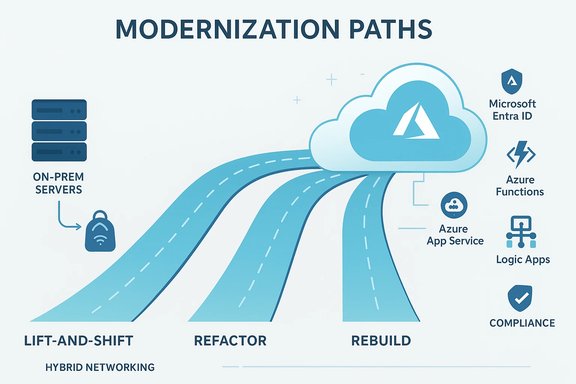
Christo Greeff’s framing in the ITWeb piece mirrors how most experienced delivery teams present the options: three distinct routes exist for getting legacy workloads onto a modern platform — and each has trade-offs in time, cost and long-term value.1. Lift-and-shift (rehost)
Lift-and-shift means moving virtual machines, containers or whole application stacks into Azure with minimal code changes. It is the fastest, lowest-friction path and often the most appropriate first step when businesses need immediate infrastructure cost reductions, hardware decommissioning and predictable low-disruption migrations.- Benefits:
- Fast time-to-value on infrastructure cost savings and data-centre consolidation.
- Minimal code or architecture changes reduce short-term risk.
- Supports phased migration strategies and buys time to plan re-architectures.
- Limitations:
- Limited improvements in agility, testing cadence, and developer productivity.
- You carry operational debt into the cloud if you don’t follow up with optimisation.
2. Refactor (re-platform)
Refactoring moves parts of an application to platform services — for example, replacing custom background jobs with Azure Functions, moving APIs into Azure App Service, or containerising workloads for better scalability and observability. Refactor is iterative: you modernise where it yields the most value first.- When to choose refactor:
- You want targeted performance, cost and manageability wins without a full redesign.
- You wish to adopt platform PaaS/managed services (App Service, Functions) to reduce operational overhead.
3. Rebuild (re-architect)
Rebuilding means re‑architecting for microservices, API-first designs, event-driven patterns and advanced automation pipelines. It’s the most future-proof approach but also the most resource-intensive. When done right, it enables continuous delivery, better scalability and direct support for AI-driven extensions.- Advantages:
- Enables product-oriented teams, microservices and agentic workflows that scale engineering productivity.
- Opens the door for production-grade AI integrations and advanced automation.
- Delivers the largest long-term reduction in technical debt and maintenance overhead.
- Drawbacks:
- Requires higher upfront investment, change management, and longer time-to-benefit.
Why Azure is a credible platform for incremental modernisation
Azure’s breadth matters when a transformation spans identity, integration, compute and security.- Microsoft Entra ID (formerly Azure AD) is the enterprise identity layer used to centralise access across on-prem and cloud estates. The service supports conditional access, passwordless, MFA and federation scenarios that companies need when shifting to hybrid models. Entra ID is a renamed product but continues to provide the same APIs and developer experience as the previous Azure AD.
- Azure Logic Apps provides low-code orchestration with a large library of connectors, enabling integration and process automation without a heavyweight integration platform — a common accelerator when automating manual processes. Logic Apps also supports connectors to AI services including Azure OpenAI for natural-language tasks.
- Azure Functions is a mature serverless platform for event-driven compute that teams commonly use to replace bespoke, always-on background workers and scheduled jobs; it enables pay‑per‑use economics and elastic scaling. Azure App Service is a managed PaaS for hosting web apps and APIs with integrated CI/CD, security and scaling features that reduce the burden on operations teams. Both are practical building blocks in refactor strategies.
- Microsoft Defender for Cloud (formerly Azure Security Center) provides posture management and workload protection across hybrid and multicloud environments; it enables teams to centralise security telemetry and embed DevSecOps practices. Defender for Cloud’s capabilities are useful when organisations are coordinating patching, misconfiguration management and incident response across on-prem and cloud systems.
- Compliance: Microsoft publicly documents that Azure is certified for more than 90 compliance offerings across jurisdictions and industries — an important factor for regulated sectors assessing cloud risk and legal obligations.
ROI claims and hard‑numbers: what the evidence says
Modernisation sells on value; executives demand credible numbers. Two themes matter: the cost of doing nothing, and the upside of disciplined modernisation.- Cost of doing nothing. Multiple analyst write-ups and industry studies converge on the same warning: technical debt and legacy maintenance consume a large share of IT budgets. While headline numbers vary by survey and scope, a commonly quoted figure is that approximately 30–40% of IT budgets are absorbed by legacy maintenance and technical debt — a projection Gartner and other industry commentators have publicly flagged in recent years. The important nuance is that methodology differs (some measures count only maintenance activities, others include operations and compliance), so each organisation should instrument its own cost‑base rather than rely exclusively on external averages.
- The upside of modernisation. McKinsey’s portfolio of research shows that companies adopting a product operating model, investing in the right tech platforms and using AI-enabled engineering practices can materially boost the financial return on technology investments. In modelling scenarios, McKinsey demonstrates that reorganising investment toward the technology core and adopting product operating models can increase EBITDA lift from technology programs by multiples over several years — in their later analysis they describe scenarios where disciplined adopters can achieve up to three times the EBITDA lift from their technology investments under an “agentic AI” operating model. Those are scenario‑based, aggregated findings — useful for benchmarking and financial planning but not a guaranteed outcome for every implementation.
Real-world example: automation and the limits of single anecdote claims
The ITWeb piece quotes a Mint Group client example where an insurance quotation process was reduced from “48 hours to five minutes” using Azure Logic Apps and OpenAI. If accurate, that is a material outcome: it compresses turnaround time by orders of magnitude and reassigns skilled time to higher‑value activity.- Verification note: this specific reduction is a vendor-supplied customer anecdote presented in a webinar and article. Public documentation of the exact project scope, baseline metrics, dataset used, or implementation details (for independent audit) is not available in the public domain at the time of writing; therefore the specific 48‑hour → 5‑minute claim should be treated as a reported customer benefit rather than a universally reproducible result. Organisations should ask vendors for a short case study that includes metrics, scope, and the assumptions used for measurement before treating such outcomes as baseline forecasts for their own programmes. Anecdotal wins are valuable but must be validated in your environment. (This example is flagged as unverifiable from public sources.
Security, compliance and hybrid reality
Modernisation is not just about speed — it’s also an opportunity to reset the security posture.- Identity-first security. Centralising identity and access with Microsoft Entra ID allows organisations to implement Zero Trust primitives (conditional access, MFA, device posture) consistently across cloud and on-premises resources. This reduces the attack surface created by multiple disconnected identity silos.
- Continuous posture management. Defender for Cloud brings CSPM and CWPP capabilities, helping teams find misconfigurations and prioritise remediation. Embedding security earlier in the modernisation lifecycle (DevSecOps) reduces rework and the chance of risky misconfigurations going to production.
- Compliance mapping. Azure’s compliance catalogue and blueprints can accelerate meeting regulatory needs — but: compliance certifications are not a substitute for architecture and process controls. Certifications tell you which controls Microsoft implements; customers still retain responsibility for their data, application logic and operational controls. Always conduct a control-mapping exercise and verify shared-responsibility boundaries.
A practical, risk‑aware roadmap for IT leaders
Modernisation succeeds when technical execution is aligned with commercial and organisational change. Use this condensed, sequential roadmap as an executable playbook.- Assess (30–60 days)
- Inventory: document applications, dependencies, data flows and owners.
- Measure: establish baseline KPIs (run cost, MTTR, feature cycle time, security posture).
- Classify: tag apps by business criticality, regulatory needs and cloud-readiness.
- Prioritise a domain pilot (90–180 days)
- Pick an end-to-end domain with measurable business value (e.g., quotes, claims, billing).
- Choose the right approach: lift‑and‑shift to secure immediate cost savings, refactor for targeted performance, or rebuild if you need to unlock new product capabilities.
- Build a landing zone & FinOps foundation
- Implement an Azure landing zone with identity, networking, role-based access and cost controls.
- Put FinOps and tagging policies in place to monitor spend and reveal unit costs. McKinsey and practitioners emphasise FinOps as foundational to controlling AI and cloud spending.
- Automate CI/CD and testing
- Move to automated pipelines, infrastructure-as-code and policy-as-code to reduce lead time and human error.
- Measure, iterate, scale
- Capture success metrics and operational improvements.
- Translate technical KPIs into business outcomes (revenue, cost avoided, customer satisfaction).
- Expand to adjacent domains using the same playbook.
- Govern & sustain
- Embed change management and training.
- Make modernisation a continuous business practice, not a single project.
Common risks and how to mitigate them
- Vendor lock-in and architectural fragility: adopt patterns that separate business logic from provider-specific services where long-term portability is a real requirement. Use well-documented APIs, container boundaries, and abstraction layers where appropriate.
- Cloud cost inflation: uncontrolled cloud consumption can quickly erase expected savings. Implement FinOps guardrails, chargeback/showback and automated scaling policies from day one.
- Data residency and compliance gaps: compliance certifications help, but confirm data residency, encryption, and audit capabilities for the specific workloads and regions you require.
- People and process risk: modernisation fails more often from organisational resistance than technical hurdles. Invest in training, role redesign and lived change management to secure adoption.
- Security misconfigurations: automate security posture checks, include IaC scanning in pipelines, and adopt Defender for Cloud or equivalent posture tooling to avoid drift.
Vendor and procurement checklist for Azure-based modernisation
- Ask for a clear statement of work that ties technical milestones to business metrics (cost saving, time reduction, revenue uplift).
- Request a compact, auditable case study with baseline and post-migration metrics for any quoted ROI (for example, the insurance automation case above).
- Confirm shared responsibility mapping for compliance and data protection.
- Demand FinOps transparency: tagging, cost allocation and reporting must be part of the delivery.
- Prioritise knowledge transfer and enablement rather than a pure lift-and-run managed service: the goal is sustained capability inside your organisation.
Final analysis — strengths, trade-offs and closing judgement
Modernising business applications on Microsoft Azure is a pragmatic, widely supported route to convert maintenance spend into measurable business outcomes. The platform’s breadth — identity via Microsoft Entra ID, serverless compute (Azure Functions), integration (Logic Apps), PaaS hosting (App Service) and a focused cloud security portfolio (Microsoft Defender for Cloud) — gives delivery teams the practical tools to choose a phased approach that balances risk and reward. Strengths to capitalise on:- Hybrid-first, enterprise-friendly tooling that supports gradual transitions.
- Strong compliance footprint that helps regulated industries reduce audit friction.
- A mature ecosystem of PaaS and serverless primitives that accelerate refactor programmes.
- Headlines about percentage-of-budget and dramatic ROI improvements are directionally useful but must be validated in each organisation’s telemetry and cost base; third-party studies (Gartner, McKinsey) provide useful context but not a substitute for an internal baseline.
- Anecdotal client outcomes can be spectacular but require documented baselines and reproducible steps before being used as a project forecast.
- Without FinOps, automated pipelines and continuous governance, cloud migrations can inflate costs and create new operational headaches.
Source: ITWeb Modernising business applications with Microsoft
