

Monster Crown: Sin Eater launched on April 30, 2026, for Xbox Series X|S, PlayStation 5, Nintendo Switch, and Windows PC, bringing Studio Aurum’s darker monster-taming RPG sequel to modern consoles at a $24.99 digital price point. That plain fact matters because this is not merely another retro-styled creature collector arriving in Pokémon’s long shadow. Sin Eater is trying to prove that the indie monster-taming scene can compete less by scale than by authorship. Its bet is that players will forgive familiar bones if the flesh is strange enough.
The easiest read of Monster Crown: Sin Eater is also the laziest one: pixel art, turn-based battles, tamable monsters, provincial travel, and a party-building loop that immediately invites comparison to early Pokémon. The game does not hide those influences, and pretending otherwise would do it no favors. This is an indie RPG that knows exactly which cartridge-era memories it is pressing on.
But influence is not the same as imitation, and Sin Eater’s strongest early argument is tonal. Instead of chasing the breezy fantasy of childhood adventure, it opens with family danger, political hierarchy, coercive authority, and a brother whose ambitions have consequences. The result is still approachable, but it is not weightless.
That distinction is crucial for a genre that often confuses comfort with safety. Monster-taming games have always carried darker implications just beneath the surface: capture, obedience, breeding, combat, hierarchy. Sin Eater chooses to make some of that discomfort textual rather than accidental, and that gives its retro trappings a sharper edge.
The game’s early setup is not subtle. A young protagonist, Asur, is pulled from farm life into a larger struggle involving Lord Taishukutem and the Four Heavenly Kings after his brother Dyeus is arrested. The shape is familiar, but the mood is more oppressive than celebratory.
On Xbox, Monster Crown: Sin Eater has to sell itself in a storefront where the average player may not know the history of the first Monster Crown, the development handoff, or the Kickstarter-era lineage of the series. It has to communicate quickly: this is a darker, more systems-heavy monster RPG, not a mascot clone. That is a harder sell than nostalgia, but it is also a more durable one.
The lack of Xbox Play Anywhere and Game Pass support also frames the purchase differently. This is not a frictionless curiosity that players will sample because it appeared in a subscription carousel. It is a $24.99 buy-in, which means the game must persuade players that its mechanics and atmosphere are worth choosing over the enormous backlog sitting one tile away.
That is not automatically bad. Subscription visibility can rescue smaller games, but it can also flatten them into disposable weekend experiments. Sin Eater’s design seems built for players willing to settle in, learn systems, and treat party construction as a long-term project.
That handoff matters because indie sequels are rarely just content expansions. They are arguments about what the first game should have been if time, tools, money, and team structure had been different. Sin Eater’s new engine, larger team, and broader platform plan suggest a sequel trying to professionalize without sanding away the eccentricity that made the first game interesting.
That is a delicate balance. Too much polish, and the project risks becoming a competent but anonymous genre entry. Too little, and it inherits the first game’s baggage without earning new trust.
The early response around Sin Eater points to the right kind of ambition: better environments, more deliberate pacing, and a deeper fusion-and-breeding system. The concern, as always with this genre, is whether the systems remain legible once the novelty wears off. Monster collecting can become spreadsheet work faster than most genres, and the best games in the space know when to hide the math behind emotion.
The Crown Nation’s environments are pitched as textured, colorful, and handcrafted, and that matters because monster-taming games are fundamentally about place. The monsters need ecology. The towns need mood. The roads between them need enough friction and mystery to make the next encounter feel discovered rather than dispensed.
The strongest praise from early play impressions centers on the way music and art combine to make ordinary spaces feel worth lingering in. That is not a small achievement. Many retro RPGs treat towns as shops with roofs; the good ones understand that a village theme, a palette shift, and a few strange NPC lines can change the temperature of the entire adventure.
Sin Eater appears to understand that atmosphere is not decoration. It is the glue that keeps a player moving when the combat loop is still forming and the monster roster is still unfamiliar.
That matters because this genre is made of loops. You leave town, battle, tame, return, heal, adjust, repeat. Music decides whether that loop feels like ritual or chore.
The comparison to classic JRPG composers is inevitable, but the useful point is not whether Sin Eater reaches those heights. It is that the game appears to treat music as structural, not ornamental. If a village theme can make exploration feel necessary rather than perfunctory, the soundtrack is doing design work.
That is especially important for a game whose story leans darker. Pixel art can make grim material feel abstract, even cute, unless the soundscape reinforces the stakes. A good score can make a tyrant feel present before the player ever reaches the throne room.
The idea is simple. Effective attacks and resilient defensive moments build synergy, which can then be spent to “crown” an attack into a stronger version. It is a mechanic that rewards momentum, but not only aggression. Surviving pressure can become part of the comeback arc.
That kind of system is useful because turn-based monster battles often suffer from flat pacing. Once type matchups and level differences become clear, many encounters are solved before they are finished. A charged super-attack system gives the player something to anticipate inside the fight rather than only before it.
The risk is balance. If crowned attacks become mandatory, the mechanic becomes another meter to optimize. If they are too weak, they become decorative. The sweet spot is exactly what early impressions describe: a lifesaver when underleveled, a tension builder when the battle is close, and a reward for understanding the matchup rather than merely grinding.
Breeding and fusion operate as two different philosophies of attachment. Breeding is slower and safer, preserving the parent monsters while producing an egg that inherits attributes. Fusion is faster and more dangerous, sacrificing two monsters to create something new at an averaged level.
That choice is more interesting than a simple crafting recipe because it puts sentiment and optimization in conflict. If you love a monster, do you keep it? If you want power, do you consume it? If the outcome is uncertain, do you gamble with a favorite?
That is where Sin Eater’s darker tone and its mechanics start to align. A game about hierarchy, domination, and fate should make the player uncomfortable about power. Fusion does that quietly, through a menu, which is often where RPGs reveal their real worldview.
Freedom, however, is only valuable if the world can absorb it. Open structure in a monster RPG can create meaningful self-direction, but it can also expose uneven pacing, difficulty spikes, or regions that feel interchangeable. The central-spire design gives Sin Eater a strong organizing metaphor; the question is whether each province justifies the choice to go there first.
This is where the writing may become the difference-maker. If each region carries distinct conflicts, characters, and moral pressure, then non-linear travel becomes narrative authorship. If the regions mostly differ by monster table and tileset, the freedom becomes cosmetic.
Early impressions suggest the story has enough bite to avoid that trap, at least in its first several hours. The conversations are described as intense, the family dynamic more charged than expected, and the altercations strong enough to shake off the “by the numbers” assumption. For a game this visually nostalgic, that is a meaningful victory.
But the comparison becomes useless when it reduces every design choice to resemblance. Sin Eater is not competing with Pokémon on budget, brand power, animation scale, or cultural saturation. It is competing on the things Pokémon often avoids: stranger writing, riskier systems, harsher tone, and mechanical consequence.
That gives Sin Eater a path, but not a free pass. Indie games that wear influence openly still need discipline. A darker story is not automatically a better story, and a deeper breeding system is not automatically a better RPG. Complexity only matters if it creates decisions players can feel.
The more interesting comparison is not whether Sin Eater is “like Pokémon.” It is whether Sin Eater understands what Pokémon made frictionless and chooses, deliberately, to restore some of that friction.
Sin Eater’s broader console launch raises expectations. Xbox Series X|S and PlayStation 5 players are not necessarily expecting blockbuster production values from a $24.99 indie, but they do expect stability, readable UI, clean controller support, and a combat flow that does not feel like it escaped early access. The same goes for Switch players, who have learned to be skeptical of ambitious 2D RPGs that overpromise performance or polish.
There are already signs that the developers are paying attention to quality-of-life issues, including post-launch balance discussion and experience-share adjustments. That responsiveness is encouraging, but it also underlines the point: games like this live in the patch notes as much as in the launch trailer.
For Windows and Xbox players, this is part of a larger indie reality. The most interesting systems-heavy games are often not finished in the cultural sense on release day. They arrive, gather community feedback, and harden into their best selves over weeks or months.
The strongest pitch is not “Pokémon, but darker.” That phrase may be useful shorthand, but it also undersells the game’s systems and overpromises tonal novelty. The better pitch is more specific: a pixel-art monster-taming RPG about rebellion and consequence, built around crossbreeding, fusion, and a flexible provincial world.
That pitch will not reach everyone. Some players want comfort food from this genre, and Sin Eater’s edge may read as melodrama. Others want mechanical depth but may bounce off retro presentation. The game’s job is not to erase those divides; it is to be clear enough that the right players find it.
In that sense, the Windows Central-style enthusiasm around its early hours is valuable but incomplete. Five or six hours can reveal tone, music, and initial combat feel. It cannot fully prove whether a 1,000-monster promise remains satisfying after the twentieth fusion experiment.
Sin Eater’s systems are built for that challenge. Breeding creates anticipation. Fusion creates risk. Crowned attacks create battle drama. Open province order creates ownership. The soundtrack and pixel art create mood. Each of those pieces gives the player a reason to continue.
But the pieces also have to reinforce one another. If breeding is too slow, fusion too opaque, battles too uneven, or narrative beats too far apart, the loop can collapse into obligation. The genre’s magic depends on the feeling that the next route, egg, monster, or fight might change your plan.
The early evidence suggests Sin Eater has that spark. Whether it has the endurance is the longer test.
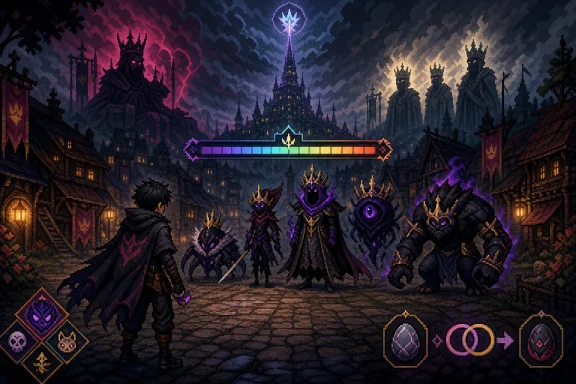 Sin Eater Understands That Nostalgia Is a Starting Point, Not a Defense
The easiest read of Monster Crown: Sin Eater is also the laziest one: pixel art, turn-based battles, tamable monsters, provincial travel, and a party-building loop that immediately invites comparison to early Pokémon. The game does not hide those influences, and pretending otherwise would do it no favors. This is an indie RPG that knows exactly which cartridge-era memories it is pressing on.But influence is not the same as imitation, and Sin Eater’s strongest early argument is tonal. Instead of chasing the breezy fantasy of childhood adventure, it opens with family danger, political hierarchy, coercive authority, and a brother whose ambitions have consequences. The result is still approachable, but it is not weightless.
That distinction is crucial for a genre that often confuses comfort with safety. Monster-taming games have always carried darker implications just beneath the surface: capture, obedience, breeding, combat, hierarchy. Sin Eater chooses to make some of that discomfort textual rather than accidental, and that gives its retro trappings a sharper edge.
The game’s early setup is not subtle. A young protagonist, Asur, is pulled from farm life into a larger struggle involving Lord Taishukutem and the Four Heavenly Kings after his brother Dyeus is arrested. The shape is familiar, but the mood is more oppressive than celebratory.
The Xbox Release Gives a Niche RPG a Bigger Test
There is a reason the Xbox Series X|S version matters beyond platform bookkeeping. Indie RPGs often live or die by whether they can escape the Steam discovery churn, where every week brings another creature collector, roguelite, deckbuilder, or farming sim with beautiful pixel art and a dense systems pitch. A console release forces the pitch to become cleaner.On Xbox, Monster Crown: Sin Eater has to sell itself in a storefront where the average player may not know the history of the first Monster Crown, the development handoff, or the Kickstarter-era lineage of the series. It has to communicate quickly: this is a darker, more systems-heavy monster RPG, not a mascot clone. That is a harder sell than nostalgia, but it is also a more durable one.
The lack of Xbox Play Anywhere and Game Pass support also frames the purchase differently. This is not a frictionless curiosity that players will sample because it appeared in a subscription carousel. It is a $24.99 buy-in, which means the game must persuade players that its mechanics and atmosphere are worth choosing over the enormous backlog sitting one tile away.
That is not automatically bad. Subscription visibility can rescue smaller games, but it can also flatten them into disposable weekend experiments. Sin Eater’s design seems built for players willing to settle in, learn systems, and treat party construction as a long-term project.
Studio Aurum Is Selling Authorship After Inheritance
The development story gives Sin Eater a second layer of scrutiny. The original Monster Crown was closely associated with creator Jason Walsh and developed a reputation as an ambitious, rough-edged monster-taming RPG with a darker sensibility. Sin Eater arrives with Studio Aurum carrying the lineage forward, in partnership with Walsh, but not simply repeating the same production context.That handoff matters because indie sequels are rarely just content expansions. They are arguments about what the first game should have been if time, tools, money, and team structure had been different. Sin Eater’s new engine, larger team, and broader platform plan suggest a sequel trying to professionalize without sanding away the eccentricity that made the first game interesting.
That is a delicate balance. Too much polish, and the project risks becoming a competent but anonymous genre entry. Too little, and it inherits the first game’s baggage without earning new trust.
The early response around Sin Eater points to the right kind of ambition: better environments, more deliberate pacing, and a deeper fusion-and-breeding system. The concern, as always with this genre, is whether the systems remain legible once the novelty wears off. Monster collecting can become spreadsheet work faster than most genres, and the best games in the space know when to hide the math behind emotion.
The Pixel Art Does More Than Signal “Indie”
Pixel art has become so common in indie games that it can now function as camouflage. A project can look tasteful, nostalgic, and low-budget all at once, even before it proves whether its art direction has a point. Sin Eater’s visual identity works when it stops asking players to remember old handheld RPGs and starts making its own world feel particular.The Crown Nation’s environments are pitched as textured, colorful, and handcrafted, and that matters because monster-taming games are fundamentally about place. The monsters need ecology. The towns need mood. The roads between them need enough friction and mystery to make the next encounter feel discovered rather than dispensed.
The strongest praise from early play impressions centers on the way music and art combine to make ordinary spaces feel worth lingering in. That is not a small achievement. Many retro RPGs treat towns as shops with roofs; the good ones understand that a village theme, a palette shift, and a few strange NPC lines can change the temperature of the entire adventure.
Sin Eater appears to understand that atmosphere is not decoration. It is the glue that keeps a player moving when the combat loop is still forming and the monster roster is still unfamiliar.
The Soundtrack Carries the Emotional Debt of the Genre
Monster-taming games have a peculiar musical burden. Their soundtracks must support repetition without becoming wallpaper, and they must make small journeys feel grand without exhausting the player every time a route begins. Sin Eater’s soundtrack, credited in coverage to Joscha Beab and elsewhere associated with the broader sound team, seems to be one of the game’s clearest early strengths.That matters because this genre is made of loops. You leave town, battle, tame, return, heal, adjust, repeat. Music decides whether that loop feels like ritual or chore.
The comparison to classic JRPG composers is inevitable, but the useful point is not whether Sin Eater reaches those heights. It is that the game appears to treat music as structural, not ornamental. If a village theme can make exploration feel necessary rather than perfunctory, the soundtrack is doing design work.
That is especially important for a game whose story leans darker. Pixel art can make grim material feel abstract, even cute, unless the soundscape reinforces the stakes. A good score can make a tyrant feel present before the player ever reaches the throne room.
The Battle System Adds Drama Without Rewriting the Rulebook
Sin Eater’s combat is not trying to burn down the turn-based RPG. It still uses familiar command choices: attack, defend, items, and tactical monster management. The innovation is more modest but potentially more meaningful: the Synergy Bar.The idea is simple. Effective attacks and resilient defensive moments build synergy, which can then be spent to “crown” an attack into a stronger version. It is a mechanic that rewards momentum, but not only aggression. Surviving pressure can become part of the comeback arc.
That kind of system is useful because turn-based monster battles often suffer from flat pacing. Once type matchups and level differences become clear, many encounters are solved before they are finished. A charged super-attack system gives the player something to anticipate inside the fight rather than only before it.
The risk is balance. If crowned attacks become mandatory, the mechanic becomes another meter to optimize. If they are too weak, they become decorative. The sweet spot is exactly what early impressions describe: a lifesaver when underleveled, a tension builder when the battle is close, and a reward for understanding the matchup rather than merely grinding.
Fusion Is the Game’s Real Thesis
The monster count is the headline, but fusion is the argument. Sin Eater promises more than 1,000 unique monster variations through crossbreeding and fusion, and that promise cuts directly to what separates creature collectors from ordinary RPGs. The player is not just assembling a party; the player is authoring one.Breeding and fusion operate as two different philosophies of attachment. Breeding is slower and safer, preserving the parent monsters while producing an egg that inherits attributes. Fusion is faster and more dangerous, sacrificing two monsters to create something new at an averaged level.
That choice is more interesting than a simple crafting recipe because it puts sentiment and optimization in conflict. If you love a monster, do you keep it? If you want power, do you consume it? If the outcome is uncertain, do you gamble with a favorite?
That is where Sin Eater’s darker tone and its mechanics start to align. A game about hierarchy, domination, and fate should make the player uncomfortable about power. Fusion does that quietly, through a menu, which is often where RPGs reveal their real worldview.
The Open Structure Gives Freedom, Then Demands Commitment
After the opening province, Sin Eater lets players travel toward a central spire that connects the world’s provinces. That structure is smart because it resists the gym-route rigidity that has defined so many monster-taming games. It tells the player, at least in principle, that this is your campaign rather than a guided museum tour.Freedom, however, is only valuable if the world can absorb it. Open structure in a monster RPG can create meaningful self-direction, but it can also expose uneven pacing, difficulty spikes, or regions that feel interchangeable. The central-spire design gives Sin Eater a strong organizing metaphor; the question is whether each province justifies the choice to go there first.
This is where the writing may become the difference-maker. If each region carries distinct conflicts, characters, and moral pressure, then non-linear travel becomes narrative authorship. If the regions mostly differ by monster table and tileset, the freedom becomes cosmetic.
Early impressions suggest the story has enough bite to avoid that trap, at least in its first several hours. The conversations are described as intense, the family dynamic more charged than expected, and the altercations strong enough to shake off the “by the numbers” assumption. For a game this visually nostalgic, that is a meaningful victory.
The Pokémon Comparison Is Both Useful and Exhausting
Every monster-taming RPG must pass through the Pokémon comparison chamber, and there is no point pretending Sin Eater can avoid it. Pokémon remains the genre’s grammar. Players understand catching, typing, party slots, evolution, gyms, rivals, and regions because Nintendo and Game Freak made those ideas globally legible.But the comparison becomes useless when it reduces every design choice to resemblance. Sin Eater is not competing with Pokémon on budget, brand power, animation scale, or cultural saturation. It is competing on the things Pokémon often avoids: stranger writing, riskier systems, harsher tone, and mechanical consequence.
That gives Sin Eater a path, but not a free pass. Indie games that wear influence openly still need discipline. A darker story is not automatically a better story, and a deeper breeding system is not automatically a better RPG. Complexity only matters if it creates decisions players can feel.
The more interesting comparison is not whether Sin Eater is “like Pokémon.” It is whether Sin Eater understands what Pokémon made frictionless and chooses, deliberately, to restore some of that friction.
The Rough Edges May Decide Whether the Audience Expands
The original Monster Crown attracted players who were willing to tolerate ambition in exchange for novelty. That bargain is common in indie RPGs, and sometimes it is fair. But sequels do not get judged by the same curve forever.Sin Eater’s broader console launch raises expectations. Xbox Series X|S and PlayStation 5 players are not necessarily expecting blockbuster production values from a $24.99 indie, but they do expect stability, readable UI, clean controller support, and a combat flow that does not feel like it escaped early access. The same goes for Switch players, who have learned to be skeptical of ambitious 2D RPGs that overpromise performance or polish.
There are already signs that the developers are paying attention to quality-of-life issues, including post-launch balance discussion and experience-share adjustments. That responsiveness is encouraging, but it also underlines the point: games like this live in the patch notes as much as in the launch trailer.
For Windows and Xbox players, this is part of a larger indie reality. The most interesting systems-heavy games are often not finished in the cultural sense on release day. They arrive, gather community feedback, and harden into their best selves over weeks or months.
The Price Makes Sense, but the Pitch Has to Be Honest
At $24.99, Sin Eater sits in a tricky but reasonable band. It is cheaper than a major publisher release, more expensive than an impulse-buy curiosity, and squarely priced against other indie RPGs that promise dozens of hours. That means the marketing cannot rely only on charm.The strongest pitch is not “Pokémon, but darker.” That phrase may be useful shorthand, but it also undersells the game’s systems and overpromises tonal novelty. The better pitch is more specific: a pixel-art monster-taming RPG about rebellion and consequence, built around crossbreeding, fusion, and a flexible provincial world.
That pitch will not reach everyone. Some players want comfort food from this genre, and Sin Eater’s edge may read as melodrama. Others want mechanical depth but may bounce off retro presentation. The game’s job is not to erase those divides; it is to be clear enough that the right players find it.
In that sense, the Windows Central-style enthusiasm around its early hours is valuable but incomplete. Five or six hours can reveal tone, music, and initial combat feel. It cannot fully prove whether a 1,000-monster promise remains satisfying after the twentieth fusion experiment.
The Real Competition Is the Player’s Patience
Modern players are drowning in excellent games, and indie RPGs face a brutal attention economy. A monster-taming game cannot assume that players will grind because grinding used to be normal. It has to earn repetition with discovery, pacing, and visible growth.Sin Eater’s systems are built for that challenge. Breeding creates anticipation. Fusion creates risk. Crowned attacks create battle drama. Open province order creates ownership. The soundtrack and pixel art create mood. Each of those pieces gives the player a reason to continue.
But the pieces also have to reinforce one another. If breeding is too slow, fusion too opaque, battles too uneven, or narrative beats too far apart, the loop can collapse into obligation. The genre’s magic depends on the feeling that the next route, egg, monster, or fight might change your plan.
The early evidence suggests Sin Eater has that spark. Whether it has the endurance is the longer test.
The Crown Nation’s Bargain Is Clearer Than Its Marketing
For players deciding whether to jump in now, Sin Eater’s appeal is specific rather than universal. It is not the cleanest possible entry point into monster taming, and it is not trying to be the safest. Its value lies in the way it makes familiar genre actions feel a little more consequential.- Monster Crown: Sin Eater is available on Xbox Series X|S, PlayStation 5, Nintendo Switch, and Windows PC, with storefronts listing an April 30, 2026 launch rather than the earlier date repeated in some coverage.
- The game is not on Xbox Game Pass and does not support Xbox Play Anywhere, so Xbox players should treat it as a direct purchase rather than a subscription sample.
- Its strongest identity is not simply retro monster catching, but the combination of darker storytelling, pixel-art worldbuilding, and a fusion system that asks players to trade attachment for power.
- The Synergy Bar gives turn-based battles a useful layer of momentum, especially when crowned attacks turn close fights into comeback opportunities.
- The promise of more than 1,000 monster variations is compelling, but the long-term success of that system depends on transparency, balance, and whether experimentation stays fun after the novelty fades.
- Players who want a cozy Pokémon-like may find Sin Eater sharper than expected, while players who want a stranger, more authored creature collector are probably the audience Studio Aurum is chasing.
References
- Primary source: Windows Central
Published: 2026-06-13T21:16:07.511829
'Monster Crown: Sin Eater' is more than a simple Xbox Pokémon clone | Windows Central
Another creature collection title that's more than a simple Pokémon love letter.www.windowscentral.com - Related coverage: store.steampowered.com
Monster Crown: Sin Eater on Steam
Hand-craft your team of perfect Monsters and wage a one-man war against fate and the world in the Crown Nation! With a True Crossbreeding system, every Monster is entirely your own!store.steampowered.com
- Related coverage: monstercrown.wiki.gg
Monster Crown: Sin Eater - Monster Crown Wiki
Monster Crown: Sin Eater (Originally teased as Monster Crown NEXT and then formally announced as Monster Crown 2: Sin Eater) is a top-down Monster Taming Role-Playing Game developed by Studio Aurum for PC and Nintendo Switch, and published for XBOX Series X|S and PlayStation 5 by Red Art Games...monstercrown.wiki.gg - Related coverage: xbox.com
Buy Monster Crown: Sin Eater | Xbox
Hand-craft your team and wage a one-man war against fate and the world in the Crown Nation! With a True Crossbreeding system, every Monster is your own!www.xbox.com - Related coverage: gematsu.com
Monster Crown: Sin Eater - Gematsu
Monster Crown: Sin Eater is a turn-based role-playing video game developed and published by Studio Aurum. About Explore the beautiful…www.gematsu.com - Related coverage: nintendo.com
Monster Crown: Sin Eater for Nintendo Switch - Nintendo Official Site
Buy Monster Crown: Sin Eater and shop other great Nintendo products online at the official Nintendo Store.www.nintendo.com
- Related coverage: ntower.de
Monster Crown: Sin Eater – Die pixelige Monsterjagd geht Ende des Monats an den Start - ntower - Dein Nintendo-Onlinemagazin
Monster Crown: Sin Eater ist der neueste Streich von Studio Aurum und der nächste Ableger der nunmehr zweiteiligen „Monster Crown“-Reihe.…www.ntower.de - Related coverage: releases.com
Monster Crown: Sin Eater Release Dates
Check out all the release dates for the Xbox Series X, Switch, PC & PlayStation 5 versions of the game Monster Crown: Sin Eater. Watch the latest trailers, view images, and track the game's progress to stay updated on its release dates.www.releases.com - Related coverage: pushsquare.com
- Related coverage: savepointgaming.co
Monster Crown: Sin Eater Arrives End April With 1,000+ Monster Sprites & Branching Story Choices | SavePoint Gaming
Monster Crown: Sin Eater launches April 30, featuring branching choices and a True Crossbreeding system for players to experiment with.savepointgaming.co