

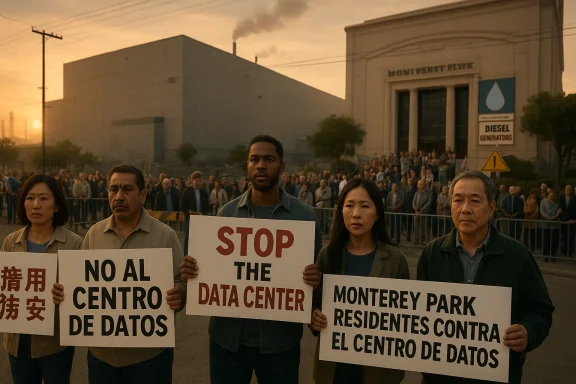
The Monterey Park data center fight has become more than a local zoning dispute. It is now a case study in how organized residents, multilingual outreach, and environmental skepticism can slow — and possibly stop — a major infrastructure project that would have placed a massive, power-hungry facility in the middle of a densely populated California community. The clash also lands at exactly the moment when data centers have become one of the fastest-growing and most controversial categories of development in the United States, with utilities, tech firms, and neighbors all wrestling over who should bear the costs.
The core story is straightforward: residents in Monterey Park, California, successfully forced a pause on a proposed data center, and city leaders are now weighing a more permanent prohibition. That alone would be notable, but the broader significance is bigger. The proposal became a lightning rod because it combined several of the most contentious issues in modern local politics: energy demand, water use, air pollution, diesel backup generators, neighborhood quality of life, and the sense that a multinational industry was asking a community to absorb the burdens of the digital economy.
What made this campaign stand out was its organization. Opposition reportedly spread across English, Chinese, and Spanish, reflecting the city’s multicultural makeup and helping the effort move beyond a narrow activist circle. In practical terms, that matters a great deal. Data center developers often count on projects being too technical, too fast-moving, or too economically attractive for ordinary residents to understand in time. Monterey Park suggests the opposite: when residents get clear information, translate it into the languages people actually use at home, and connect it to local harms, the politics can flip quickly.
The timing is also important. Goldman Sachs has projected that global data center power demand could rise sharply by 2030, and other research organizations have warned that the sector may consume a materially larger share of U.S. electricity in the coming years. EESI has noted that nearly 5,500 data centers were operating in the U.S. as of March 2025, and that the sector’s electricity demand could keep climbing steeply. That means local governments are increasingly being asked to decide whether these projects are the right fit for their communities, especially where the economic upside is uncertain and the infrastructure downside is immediate.
The Monterey Park project also illustrates a political shift. For years, data centers were often treated as neutral infrastructure — invisible, necessary, and largely uncontroversial. That view is fading. Communities are now connecting these projects to concrete impacts: generator emissions, transmission buildouts, noisy cooling systems, strain on the grid, and pressure on water systems. In California, where energy prices and environmental politics are already highly charged, those concerns have an especially sharp edge.
Historically, data centers tended to cluster where power was cheap, land was available, and regulation was manageable. Northern Virginia became the classic example, but similar hubs have emerged in Texas, Arizona, Georgia, and parts of the Midwest. The result is a geography of concentration, where a small number of communities absorb a very large share of the environmental and grid burdens. EESI has described the scale plainly: thousands of facilities nationwide, with data center electricity demand and water use rising as workloads grow.
The rise of AI has accelerated everything. Goldman Sachs has said data center power demand is expected to jump sharply by 2030, while the International Energy Agency has warned that data centers, AI, and crypto together are a major new source of electricity demand growth. That is why the discussion has shifted from “internet warehouses” to something much more consequential: a competition for scarce power, water, and permitting capacity.
Monterey Park is a useful case because it sits at the intersection of those trends. It is a dense, multicultural city east of Los Angeles, not a remote industrial park. That matters because community opposition is often strongest when a project’s footprint is out of scale with the surrounding neighborhood. A facility described as the size of four football fields does not sound benign when residents are already worried about air quality, traffic, heat, and utility costs.
The project’s reported need for diesel generators intensified the backlash. Even if the main facility were to use grid electricity, backup generation can still raise red flags because it signals both local pollution and a willingness to rely on combustion assets for reliability. In California, where asthma, air quality, and climate politics are recurring public issues, that is a potent combination.
According to the reporting referenced in the story, activists gathered thousands of signatures and framed the issue as a shared community defense rather than a niche environmental fight. That distinction is critical. Local campaigns can fail when they sound like the narrow concerns of one group. They succeed when they are presented as a public-interest question affecting families, seniors, workers, and small businesses alike.
Multilingual messaging also likely mattered enormously. English, Chinese, and Spanish outreach signals more than translation; it signals respect. In a city with major Asian and Hispanic populations, that kind of outreach can build trust and reduce the gap between civic institutions and residents. It also makes it harder for proponents to dismiss opposition as coming from only one slice of the community.
For local residents, that translates into a practical fear: if a new facility arrives, will the grid be able to support it without higher rates, new transmission lines, or reliability tradeoffs? That question is especially uncomfortable in California, where ratepayer politics are already fraught and where the public is acutely sensitive to utility costs. Even if a project promises economic benefits, those benefits can be overshadowed by the possibility of passing infrastructure costs to households.
The mix of fuels matters too. Goldman Sachs has said renewables may cover only part of the surge, and the IEA has observed that natural gas remains a major share of the power mix serving data centers. That means many of these facilities are not simply “digital”; they are deeply tied to conventional energy systems, with all the emissions implications that entails.
That context helps explain why Monterey Park residents reacted strongly to the reported use of 14 diesel generators. Backup generation is often the easiest part of a data center project to overlook in glossy renderings, but it can be among the most alarming in public hearings. Diesel engines bring emissions, noise, and the unmistakable impression that the facility will need to protect itself by burning fuel locally.
Air quality matters especially in California. Communities already dealing with freeway pollution, urban heat, and regional smog are less likely to tolerate a project that adds another layer of combustion-related harm. Even if generators are only for emergencies, residents know that “emergency-only” systems can still become symbols of a project’s true environmental cost.
Indiana is a telling example. The state has become a hot zone for development, but local resistance has reportedly stopped some projects while others are still in dispute. That kind of split-screen politics is becoming common: states court investment, but towns and counties question whether they want the burden. The result is a standoff between macroeconomic ambition and micro-level governance.
The backlash is also ideologically diverse. Some opponents are environmentally motivated, others are budget hawks, and still others distrust big tech or local politicians. That makes the movement harder to dismiss. A coalition that includes suburban homeowners, rural landowners, labor skeptics, environmental advocates, and budget-conscious voters is harder for developers to outmaneuver than a single-issue protest.
But the economics are uneven. The number of permanent jobs is often far smaller than residents expect, and the local fiscal benefits can be overshadowed by infrastructure costs or tax abatements. The question, then, is not whether data centers contribute economically — they do — but whether the contribution is proportionate to the public burden. That is the exact calculation Monterey Park residents forced their officials to confront.
The conflict also reveals a deeper tension in American development policy. Communities are being asked to host facilities that serve a global digital economy, yet the benefits are often local and immediate only in a narrow fiscal sense. In other words, the public gets the footprint, while the upside is distributed across cloud customers, shareholders, and distant firms.
Multilingual outreach also signals a democratic maturity that many communities lack. When residents receive information in the languages they actually use, they are more likely to participate and less likely to feel that decisions are being made around them rather than with them. That kind of inclusion is not just politically smart; it is institutionally necessary in diverse cities.
The story also underscores how local activism can outperform corporate messaging when the issue is concrete and immediate. A developer may have capital and consultants, but residents have proximity and legitimacy. If a neighborhood believes a project will change its air, noise, and utility costs, no amount of abstract branding fully erases that reality.
What happens next will also depend on whether the industry responds with genuine concessions. That could mean smaller footprints, better transparency, stronger emissions controls, less reliance on diesel backup, and clearer community benefit agreements. Without those changes, the opposition that emerged in Monterey Park will probably keep spreading, because the underlying concerns are not going away.
Source: The Cool Down Local residents orchestrate impressive takedown of massive data center project
 Overview
The core story is straightforward: residents in Monterey Park, California, successfully forced a pause on a proposed data center, and city leaders are now weighing a more permanent prohibition. That alone would be notable, but the broader significance is bigger. The proposal became a lightning rod because it combined several of the most contentious issues in modern local politics: energy demand, water use, air pollution, diesel backup generators, neighborhood quality of life, and the sense that a multinational industry was asking a community to absorb the burdens of the digital economy.What made this campaign stand out was its organization. Opposition reportedly spread across English, Chinese, and Spanish, reflecting the city’s multicultural makeup and helping the effort move beyond a narrow activist circle. In practical terms, that matters a great deal. Data center developers often count on projects being too technical, too fast-moving, or too economically attractive for ordinary residents to understand in time. Monterey Park suggests the opposite: when residents get clear information, translate it into the languages people actually use at home, and connect it to local harms, the politics can flip quickly.
The timing is also important. Goldman Sachs has projected that global data center power demand could rise sharply by 2030, and other research organizations have warned that the sector may consume a materially larger share of U.S. electricity in the coming years. EESI has noted that nearly 5,500 data centers were operating in the U.S. as of March 2025, and that the sector’s electricity demand could keep climbing steeply. That means local governments are increasingly being asked to decide whether these projects are the right fit for their communities, especially where the economic upside is uncertain and the infrastructure downside is immediate.
The Monterey Park project also illustrates a political shift. For years, data centers were often treated as neutral infrastructure — invisible, necessary, and largely uncontroversial. That view is fading. Communities are now connecting these projects to concrete impacts: generator emissions, transmission buildouts, noisy cooling systems, strain on the grid, and pressure on water systems. In California, where energy prices and environmental politics are already highly charged, those concerns have an especially sharp edge.
Why this local fight matters
This is not just a single-city dispute. It reflects a national pattern in which local residents are becoming more sophisticated opponents of industrial-scale digital infrastructure. As more communities learn what data centers require, they are also learning what leverage they have. The Monterey Park effort shows that the old assumption — that a data center is too “clean” or too “technical” to stop — no longer holds.- It is a fight over land use, but also over industrial policy by stealth.
- It is a fight over emissions, but also over who pays for grid growth.
- It is a fight over local democracy, because residents want a real say before construction starts.
- It is a fight over whether a neighborhood should become a support system for cloud computing.
Background
Data centers sit at the center of modern digital life. They power everything from online search and streaming video to enterprise software and artificial intelligence. That makes them easy to justify in abstract terms, because very few people want to give up the services they enable. Yet the physical reality is far less abstract: giant buildings filled with servers, electrical equipment, cooling systems, backup generators, and often substantial water demand.Historically, data centers tended to cluster where power was cheap, land was available, and regulation was manageable. Northern Virginia became the classic example, but similar hubs have emerged in Texas, Arizona, Georgia, and parts of the Midwest. The result is a geography of concentration, where a small number of communities absorb a very large share of the environmental and grid burdens. EESI has described the scale plainly: thousands of facilities nationwide, with data center electricity demand and water use rising as workloads grow.
The rise of AI has accelerated everything. Goldman Sachs has said data center power demand is expected to jump sharply by 2030, while the International Energy Agency has warned that data centers, AI, and crypto together are a major new source of electricity demand growth. That is why the discussion has shifted from “internet warehouses” to something much more consequential: a competition for scarce power, water, and permitting capacity.
Monterey Park is a useful case because it sits at the intersection of those trends. It is a dense, multicultural city east of Los Angeles, not a remote industrial park. That matters because community opposition is often strongest when a project’s footprint is out of scale with the surrounding neighborhood. A facility described as the size of four football fields does not sound benign when residents are already worried about air quality, traffic, heat, and utility costs.
The project’s reported need for diesel generators intensified the backlash. Even if the main facility were to use grid electricity, backup generation can still raise red flags because it signals both local pollution and a willingness to rely on combustion assets for reliability. In California, where asthma, air quality, and climate politics are recurring public issues, that is a potent combination.
The changing politics of “essential” infrastructure
Data centers used to benefit from an aura of inevitability. Today, that aura is wearing thin. Residents increasingly ask whether the public benefits justify the local costs, and whether the jobs and tax revenue are substantial enough to compensate for the burden. Pew Research has found Americans are paying closer attention to how data centers affect the environment, energy costs, quality of life, jobs, and tax revenue.- Older assumptions about data centers are being challenged.
- Local opposition is becoming more organized and data-driven.
- Communities are demanding transparency about electricity and water use.
- Developers are being forced to defend projects in public, not just in planning documents.
The Monterey Park Playbook
The Monterey Park coalition appears to have done something many local campaigns struggle to accomplish: it turned technical concerns into a broad civic narrative. Residents did not need to become engineers to understand the stakes. They needed to understand that a massive facility could bring noise, emissions, utility strain, and a long-term change in neighborhood character. That message seems to have resonated quickly.According to the reporting referenced in the story, activists gathered thousands of signatures and framed the issue as a shared community defense rather than a niche environmental fight. That distinction is critical. Local campaigns can fail when they sound like the narrow concerns of one group. They succeed when they are presented as a public-interest question affecting families, seniors, workers, and small businesses alike.
Multilingual messaging also likely mattered enormously. English, Chinese, and Spanish outreach signals more than translation; it signals respect. In a city with major Asian and Hispanic populations, that kind of outreach can build trust and reduce the gap between civic institutions and residents. It also makes it harder for proponents to dismiss opposition as coming from only one slice of the community.
Communication as strategy
The best local campaigns are not just reactive. They frame the issue early, repeatedly, and in plain language. That seems to have happened here, and it likely helped residents connect the project’s technical features to everyday concerns like noise and air quality. Once that connection is made, a data center is no longer a spreadsheet problem — it becomes a neighborhood problem.- Clear translation expands the coalition.
- Simple framing beats jargon-heavy planning language.
- Resident-led campaigns can move faster than corporate outreach.
- Shared concerns create political durability.
The power of visible participation
Large turnout also changes the psychology of city hall. When thousands of residents show up or sign on, elected officials can no longer treat the issue as hypothetical. They have to calculate the political risk of approval against the political cost of saying no. In a city like Monterey Park, where local identity and civic cohesion matter, that pressure can be decisive.- Public numbers matter.
- Multilingual turnouts signal broad legitimacy.
- Repetition helps normalize resistance.
- Elected officials tend to move when the room is crowded.
Energy Demand and Grid Strain
The reason data centers are attracting so much backlash is simple: they are energy intensive, and the growth curve is steep. Goldman Sachs has estimated data center power demand could rise by 175% by 2030 from 2023 levels, a projection that has become widely cited because it captures the scale of the AI-driven buildout. EESI, meanwhile, has warned that data center electricity demand could reach levels that meaningfully reshape the U.S. power mix.For local residents, that translates into a practical fear: if a new facility arrives, will the grid be able to support it without higher rates, new transmission lines, or reliability tradeoffs? That question is especially uncomfortable in California, where ratepayer politics are already fraught and where the public is acutely sensitive to utility costs. Even if a project promises economic benefits, those benefits can be overshadowed by the possibility of passing infrastructure costs to households.
The mix of fuels matters too. Goldman Sachs has said renewables may cover only part of the surge, and the IEA has observed that natural gas remains a major share of the power mix serving data centers. That means many of these facilities are not simply “digital”; they are deeply tied to conventional energy systems, with all the emissions implications that entails.
Why power demand is such a flashpoint
The issue is not just absolute electricity use. It is also the speed of growth, because utilities and regulators need time to plan transmission, generation, and distribution upgrades. When a project arrives faster than those systems can adapt, the public sees congestion, delays, and cost increases before it sees any promised upside.- Grid expansion takes years, not months.
- Ratepayers often absorb a portion of infrastructure costs.
- Reliability concerns make communities wary of concentrated load.
- AI growth is making forecasts more aggressive, not less.
What consumers actually feel
Residents do not need a load forecast to know when bills are rising or when the grid feels stressed. That is why data center debates are increasingly winning public attention. The more directly people connect a giant facility to their monthly expenses and neighborhood noise, the harder it becomes for developers to sell the project as a clean economic win.Water, Air, and Generator Emissions
One of the strongest reasons for opposition is that data centers are not just electricity users; they are also significant water users and local pollution sources. EESI has said that a large data center can consume up to five million gallons a day, depending on design and usage. In the case of Northern Virginia, reporting has pointed to roughly 2 billion gallons of water consumed in 2023, illustrating just how material the footprint can become when many facilities cluster together.That context helps explain why Monterey Park residents reacted strongly to the reported use of 14 diesel generators. Backup generation is often the easiest part of a data center project to overlook in glossy renderings, but it can be among the most alarming in public hearings. Diesel engines bring emissions, noise, and the unmistakable impression that the facility will need to protect itself by burning fuel locally.
Air quality matters especially in California. Communities already dealing with freeway pollution, urban heat, and regional smog are less likely to tolerate a project that adds another layer of combustion-related harm. Even if generators are only for emergencies, residents know that “emergency-only” systems can still become symbols of a project’s true environmental cost.
The local burden is not evenly distributed
The environmental tradeoffs of digital infrastructure are often invisible to the users benefiting from the services. A person streaming a show or training an AI model rarely thinks about water withdrawal, stack emissions, or neighborhood noise. But the communities hosting the facility experience those costs immediately and continuously.- Water demand is a political issue in drought-prone regions.
- Diesel generators raise health and climate concerns.
- Noise pollution can alter quality of life even without constant emissions.
- Localized harm often falls on communities that had little role in the decision.
Hidden infrastructure, visible consequences
The contradiction is that data centers are marketed as clean, sleek, and cloud-like, yet they require very physical systems to function. Once residents understand that disconnect, opposition can broaden rapidly. The Monterey Park case shows how quickly a supposedly “invisible” facility becomes visible when neighbors ask the right questions.The National Backlash
Monterey Park is part of a larger wave. Reporting cited in the original story points to local opposition blocking or delaying multiple data center projects across the country. Data Center Watch has reported substantial project losses tied to community resistance, and that pattern suggests a genuine political shift rather than a one-off event. The industry is running into a more skeptical public, more assertive local councils, and a better-informed electorate.Indiana is a telling example. The state has become a hot zone for development, but local resistance has reportedly stopped some projects while others are still in dispute. That kind of split-screen politics is becoming common: states court investment, but towns and counties question whether they want the burden. The result is a standoff between macroeconomic ambition and micro-level governance.
The backlash is also ideologically diverse. Some opponents are environmentally motivated, others are budget hawks, and still others distrust big tech or local politicians. That makes the movement harder to dismiss. A coalition that includes suburban homeowners, rural landowners, labor skeptics, environmental advocates, and budget-conscious voters is harder for developers to outmaneuver than a single-issue protest.
Why this opposition is so durable
Data centers face a rare combination of high perceived cost and uncertain local benefit. Even where projects promise jobs, the staffing numbers often look small compared with the land, energy, and tax concessions involved. That gap creates a credibility problem that is difficult to repair once residents start comparing promises with real-world impacts.- Community resistance is now a national pattern.
- Opposition spans ideology and geography.
- Small local coalitions can stop very large investments.
- Development timelines become politically fragile when public trust collapses.
The importance of scale
A four-football-field facility does not feel like a modest neighborhood use. Scale alone can trigger resistance, but scale combined with generators, water use, and utility strain makes the conflict even harder to contain. The larger the facility, the more likely it is to alter not only land use but the character of an entire district.Industry Incentives and the Economics of Development
Data center developers and their supporters are not making irrational arguments. These facilities can bring tax base, construction jobs, and downstream business activity. Some states and counties have built entire economic-development strategies around attracting them, especially when they can promise long-term taxable equipment and a reputation as a tech-friendly jurisdiction. That is why public officials sometimes see data centers as a relatively safe way to signal growth.But the economics are uneven. The number of permanent jobs is often far smaller than residents expect, and the local fiscal benefits can be overshadowed by infrastructure costs or tax abatements. The question, then, is not whether data centers contribute economically — they do — but whether the contribution is proportionate to the public burden. That is the exact calculation Monterey Park residents forced their officials to confront.
The conflict also reveals a deeper tension in American development policy. Communities are being asked to host facilities that serve a global digital economy, yet the benefits are often local and immediate only in a narrow fiscal sense. In other words, the public gets the footprint, while the upside is distributed across cloud customers, shareholders, and distant firms.
The jobs-versus-burden debate
Supporters often lead with jobs because jobs are politically legible. Opponents respond that the jobs are too few, too specialized, or too temporary to justify the project. Both arguments can be true at once, which is why local politics gets messy so quickly.- Construction jobs are real, but temporary.
- Operations jobs are usually modest in number.
- Tax revenue can help, but incentives can erode it.
- Local infrastructure burdens arrive whether or not the promised investment fully materializes.
What officials have to weigh
City leaders must decide whether they want to be known as places that welcome industrial tech infrastructure or as places that prioritize neighborhood stability. That choice is especially fraught when the project is unusually large, visibly polluting, or politically divisive. Once those factors stack up, a moratorium or ban can look less like obstruction and more like prudent planning.Communication, Trust, and Local Democracy
The Monterey Park story is ultimately about trust. Residents were willing to mobilize because they believed they could shape the outcome, and because they did not trust the project’s burden to be fairly represented in the early stages. That is a lesson developers ignore at their peril. Public resistance is often strongest not when the facts are hidden, but when people suspect they are being minimized.Multilingual outreach also signals a democratic maturity that many communities lack. When residents receive information in the languages they actually use, they are more likely to participate and less likely to feel that decisions are being made around them rather than with them. That kind of inclusion is not just politically smart; it is institutionally necessary in diverse cities.
The story also underscores how local activism can outperform corporate messaging when the issue is concrete and immediate. A developer may have capital and consultants, but residents have proximity and legitimacy. If a neighborhood believes a project will change its air, noise, and utility costs, no amount of abstract branding fully erases that reality.
How trust gets built
Trust is built through repetition, clarity, and community presence. It is also built when organizers make the issue accessible across age, language, and political identity. That was one of the most striking features of the Monterey Park campaign.- Information must be understandable before it can be persuasive.
- Residents trust neighbors more than renderings.
- Public meetings still matter when the issue is local and tangible.
- Cultural competence is a political advantage, not a side issue.
The democratic lesson
The lesson here is not that every data center should be blocked. It is that communities deserve a meaningful opportunity to scrutinize projects that could change their environment for decades. When residents organize early, they can force that conversation before concrete is poured and decisions become irreversible.Strengths and Opportunities
The Monterey Park victory highlights a rare combination of community cohesion, environmental literacy, and effective civic organizing. It also shows how local governments can use short-term pauses to reassess whether a project truly fits the city’s long-term interests. Just as importantly, it gives other neighborhoods a practical template for resisting large industrial builds that are sold as inevitable.- Multilingual organizing broadened the coalition and made the campaign more inclusive.
- Fast signature collection showed that residents can mobilize quickly when the issue is clear.
- Localized messaging tied a technical project to everyday concerns like noise and air quality.
- Public scrutiny forced elected officials to treat the proposal as a real political decision.
- Environmental framing connected the project to larger worries about power and water use.
- Community legitimacy made the opposition harder to dismiss.
- A temporary moratorium created space for deeper review rather than rushed approval.
Risks and Concerns
Even with a pause in place, the broader data center trend is not slowing. The danger is that one successful local fight can create a false sense of victory while other projects move ahead in less organized communities. There is also a risk that local bans simply push development to places with weaker protections, where the environmental and infrastructure costs may be even harder to manage.- Project displacement could shift burdens to less prepared communities.
- Legal challenges may follow if developers argue the ban is arbitrary.
- Political fatigue could weaken public engagement over time.
- Economic pressure may tempt officials to trade away standards for short-term revenue.
- Grid strain will continue growing even if individual projects are blocked.
- Generator emissions remain a concern whenever backup power is built on-site.
- Information asymmetry still favors large developers with specialized consultants.
Looking Ahead
The most important question now is whether Monterey Park’s temporary win becomes a permanent policy shift. If the city votes for a ban, it could become a reference point for other communities deciding how to treat very large data centers inside dense urban or suburban settings. If it does not, the campaign may still leave behind a stronger, more informed public that is better equipped for the next fight.What happens next will also depend on whether the industry responds with genuine concessions. That could mean smaller footprints, better transparency, stronger emissions controls, less reliance on diesel backup, and clearer community benefit agreements. Without those changes, the opposition that emerged in Monterey Park will probably keep spreading, because the underlying concerns are not going away.
- November vote prospects will test whether the temporary moratorium becomes a permanent ban.
- Developer revisions could determine whether compromise is politically possible.
- Other cities will watch Monterey Park as a model for organizing and response.
- Energy policy pressure will intensify as AI demand continues climbing.
- Water and air concerns will keep shaping local hearings across the country.
Source: The Cool Down Local residents orchestrate impressive takedown of massive data center project
