

Moore Threads’ move to bundle a developer-facing AI coding suite on top of its MTT S5000 GPU isn’t just a product launch — it’s a visible escalation of China’s strategy to take AI beyond raw silicon and into the hands of application developers, and it arrives at a moment when the company is reporting dramatic commercial momentum tied to that very chip.
Moore Threads, a Beijing-based GPU maker that recently listed on Shanghai’s STAR Market, announced the AI Coding Plan — a vertically integrated “full-stack” developer service built explicitly on its domestic GPU stack and paired with Chinese code models such as GLM-4.7. The company positions the product as the first AI coding solution running on an entirely home‑grown hardware-to-model pipeline, claiming improvements in latency, throughput, and model-serving efficiency through hardware–software co‑design.
That commercial push follows the MTT S5000’s ramp to mass production in 2025 and a forecasted surge in revenues: Moore Threads told investors it expects 2025 revenue to jump roughly threefold to around 1.45–1.52 billion yuan, attributing the growth largely to the S5000’s adoption in AI clusters. The company also reported a narrowing of its net loss, while warning it remained unprofitable as R&D spending continued.
Why this matters now: the AI-coding market is an increasingly important battleground where UI/UX, model quality, scale economics and cloud integrations determine who captures developer mindshare. Moore Threads’ announcement is therefore not just about a coding assistant — it’s a strategic attempt to convert chip-level wins into recurring software and services revenue and to entrench a domestically controlled AI stack for Chinese enterprises and developers.
Independent writeups and conference coverage add context: demonstrations shown at developer events and trade press previews highlight the S5000 running inference workloads (DeepSeek‑style demos and code-model workloads), and Moore Threads’ product roadmap previews (Huagang/Huashan family) signal iterative architecture investments that span gaming and AI accelerators. Those previews show the company is thinking in terms of scale, memory capacity and interconnect for cluster-level AI performance.
Microsoft in particular combines software, cloud, and bespoke accelerator strategy (Azure Maia) to optimize per‑token economics across its services, which is a different — and often deeper — integration than a chip vendor offering a standalone coding product. That integrated hyperscaler approach aims to lower recurring inference costs through specialized silicon, custom fabrics and developer tooling.
At the same time, the most important claims remain those that require independent verification — cluster‑level efficiency, model quality on real codebases, and long‑term supply resilience. For enterprises and developers, the immediate opportunity is to trial the service where data sovereignty or cost profiles make a domestic stack attractive, but any broad migration should be grounded in rigorous benchmarking and staged adoption. If Moore Threads can prove its runtime and model‑ops capabilities at scale, the company will have taken a meaningful step beyond silicon — but the hardest work remains building the repeatable, mission‑critical software and operations experience that modern developer tools demand.
Source: South China Morning Post China’s chip champion Moore Threads sees beyond silicon with push into AI coding
 Background / Overview
Moore Threads, a Beijing-based GPU maker that recently listed on Shanghai’s STAR Market, announced the AI Coding Plan — a vertically integrated “full-stack” developer service built explicitly on its domestic GPU stack and paired with Chinese code models such as GLM-4.7. The company positions the product as the first AI coding solution running on an entirely home‑grown hardware-to-model pipeline, claiming improvements in latency, throughput, and model-serving efficiency through hardware–software co‑design. That commercial push follows the MTT S5000’s ramp to mass production in 2025 and a forecasted surge in revenues: Moore Threads told investors it expects 2025 revenue to jump roughly threefold to around 1.45–1.52 billion yuan, attributing the growth largely to the S5000’s adoption in AI clusters. The company also reported a narrowing of its net loss, while warning it remained unprofitable as R&D spending continued.
Why this matters now: the AI-coding market is an increasingly important battleground where UI/UX, model quality, scale economics and cloud integrations determine who captures developer mindshare. Moore Threads’ announcement is therefore not just about a coding assistant — it’s a strategic attempt to convert chip-level wins into recurring software and services revenue and to entrench a domestically controlled AI stack for Chinese enterprises and developers.
The product: What is the AI Coding Plan?
The stack in a sentence
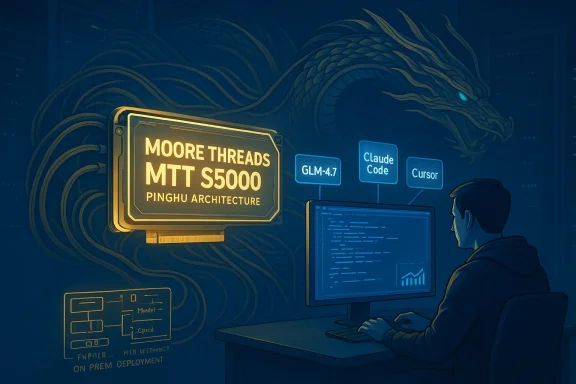
AI Coding Plan is marketed as a vertically integrated suite that pairs:- MTT S5000 GPU (Pinghu architecture) as the compute foundation;
- a silicon-accelerated inference engine developed with local partners; and
- code-specialized models (Moore Threads names GLM‑4.7 as a primary model) and multi‑IDE/adaptor integrations (Claude Code, Cursor, OpenCode and others).
Key product claims
Moore Threads and partner reports emphasize:- Lower response latency and higher throughput via operator fusion and runtime optimizations tuned to MTT S5000.
- Full‑precision compute support on the MTT S5000 for production‑grade code generation and verification tasks.
- Out‑of‑the‑box adapter support for mainstream developer tools and code environments so teams can integrate the service with minimal friction.
- A 30‑day free trial and tiered commercial plans aimed at teams from solo developers to enterprise customers.
Technical deep dive: MTT S5000 and the Pinghu architecture
What Moore Threads publicly claims
Moore Threads credits the MTT S5000 — built on its fourth‑generation Pinghu GPU architecture — as the hardware enabling the AI Coding Plan. The company reports that S5000 entered mass production in 2025 and that clusters based on the chip can handle very large model workloads. Those claims are directly connected to the company’s revenue forecast and IPO disclosures.Independent writeups and conference coverage add context: demonstrations shown at developer events and trade press previews highlight the S5000 running inference workloads (DeepSeek‑style demos and code-model workloads), and Moore Threads’ product roadmap previews (Huagang/Huashan family) signal iterative architecture investments that span gaming and AI accelerators. Those previews show the company is thinking in terms of scale, memory capacity and interconnect for cluster-level AI performance.
What to accept with caution
Vendor claims about “comparable computational efficiency to foreign GPU clusters” and dramatic performance multipliers should be treated as vendor‑provided until third‑party benchmarks are published. The company’s filings and demonstrations indicate real progress, but external validation across a broad set of workloads and independent replicable benchmarks are required before procurement or architectural decisions are made on those numbers alone.How Moore Threads is positioning the offering commercially
Market rationale
Moore Threads’ playbook is twofold:- Capture the domestic stack: Offer a trusted, controllable stack for Chinese enterprises concerned about supply‑chain and regulatory risk, by providing a domestic compute + model + tooling option.
- Monetize beyond silicon: Transition from one‑time chip sales to recurring software and services (SaaS-style per‑token or subscription revenues) that have much higher margin potential when scaled. This mirrors the path Western firms have taken: chips to cloud services to developer products.
Pricing and go‑to‑market
Public coverage indicates a four‑tiered pricing model (Free Trial, Lite, Pro, Max) aimed at capturing a broad spectrum of developer needs and accelerating adoption through low initial friction. This approach is consistent with competitive offerings globally and domestically.How this stacks against incumbent developer assistants
Western incumbents and their strengths
Products like GitHub Copilot (and more agentic variants such as Copilot Agent) and other IDE‑centric assistants focus on deep editor integration, multi‑model backends, and tight developer workflows. They benefit from large ecosystems, established enterprise relationships, and scale economics that subsidize model and tooling investments. Documentation and technical previews show feature sets that emphasize safe execution, multi‑model backends, and agent‑style workflows.Microsoft in particular combines software, cloud, and bespoke accelerator strategy (Azure Maia) to optimize per‑token economics across its services, which is a different — and often deeper — integration than a chip vendor offering a standalone coding product. That integrated hyperscaler approach aims to lower recurring inference costs through specialized silicon, custom fabrics and developer tooling.
Domestic competition
Within China, large cloud providers and platform companies (for example, Alibaba and other AI cloud vendors) already push developer‑facing AI tools and code assistants, often bundled into their cloud or enterprise suites. Moore Threads’ unique selling proposition is the fully domestic hardware-to-model stack and the claim that this reduces friction for companies that must satisfy “trustworthy/secure” procurement requirements. Several Chinese outlets emphasized this national‑security / supply‑chain angle in their writeups of the launch.Where Moore Threads can be competitive
- Sovereign customers and regulated sectors that must minimize foreign hardware/model dependence.
- On‑premises deployments where the ability to purchase a domestic stack and run it behind enterprise firewalls is a decisive advantage.
- Integrated optimization if Moore Threads’ runtime stacks actually deliver the claimed latency and throughput gains for code-model patterns (compilation, static analysis, test generation), enabling a better UX for high‑frequency developer workflows.
Strengths and opportunities
- Strategic verticalization: Turning a chip into a recurring software revenue engine gives Moore Threads a pathway to higher margins and stickier customers.
- Timing and momentum: The S5000’s mass production and the company’s IPO momentum create a marketing and sales tailwind that can accelerate ecosystem partnerships and cloud provider integrations.
- Ecosystem leverage: By offering plug‑ins/adaptors for popular code platforms, the firm lowers adoption friction; integration with tools like Cursor and Claude Code can rapidly extend reach if compatibility claims hold.
- Policy alignment: China’s broader push for semiconductor self‑reliance ensures policy and procurement tailwinds for domestically produced full‑stack AI solutions.
Risks, technical caveats, and unanswered questions
1. Performance claims need independent verification
The S5000’s mass production and vendor benchmark demos are real milestones, but claims of “comparable cluster efficiency to foreign peers” require independent benchmarking across representative workloads (code generation, static analysis, unit‑test generation, vulnerability detection). Procurement teams should ask for reproducible third‑party reports before making lifecycle commitments.2. Model quality and model‑ops maturity
A developer assistant’s success depends not only on raw throughput but on:- model accuracy on code tasks (correctness, security, style),
- toolchain reliability (prompting, context handling, hallucination control),
- and safe execution semantics (explaining code, not executing risky commands without confirmation).
3. Ecosystem and developer trust
Developers are conservative about workflow changes. Entrenched IDE plugins, cloud keys, CI/CD hooks and enterprise policies create friction. Moore Threads will need to demonstrate clearly superior reliability or cost benefits to overcome inertia.4. Supply‑chain and packaging constraints
Domestic silicon still relies on foundry, packaging and memory supply chains that have constrained capacity. SMIC and other domestic fabs are scaling, but wafer/packaging capacity for advanced nodes remains a wildcard that can throttle growth or spike costs. Public commentary on China’s fab expansions underscores this uncertainty.5. Geopolitics and market access
While domestic adoption may accelerate, export markets and multinational customers will evaluate Moore Threads through geopolitical lenses. Access to some global cloud providers or toolchains may remain limited depending on policy and partner choices.Practical implications for enterprises and developers
If you run developer platforms or manage internal dev teams, here’s a pragmatic checklist to evaluate Moore Threads’ AI Coding Plan:- Validate model quality: Run a controlled A/B test with your codebase (coverage, language patterns).
- Measure latency and cost: Benchmark S5000-backed inference vs your current provider under representative workloads.
- Test integrations: Verify the claimed plug‑ins for your IDE, CI/CD, and security scanning pipelines.
- Assess operational fit: Review on‑prem deployment needs, system requirements, and support SLAs.
- Risk‑manage supply: For procurement, quantify vendor roadmaps and fallback strategies in case of capacity or supply issues.
Why Moore Threads’ move changes the conversation
Historically, GPU companies either sold silicon to cloud providers or to device makers. Moore Threads is trying to capture more of the value chain by delivering a consumable developer experience anchored to its hardware. That matters because:- It shortens the path from hardware adoption to recurring service revenue.
- It enables a differentiated product story — “secure, domestic, full‑stack” — which resonates with certain strategic buyers.
- It raises the bar for competitors who must now defend not just on silicon performance but on integrated developer UX and local compliance.
What to watch next
- Third‑party benchmarks that compare S5000‑backed coding models against mainstream alternatives on real engineering workloads.
- Adoption signals from major Chinese cloud providers and enterprise customers — integrations into Alibaba Cloud, Tencent Cloud, or regional government projects would be a strong validation.
- Moore Threads’ roadmap for future GPUs (Huagang / Huashan) and whether those chips expand the company’s addressable market into training and larger‑scale inference clusters. Early architecture previews hint at ambitious goals, but they remain to be proven in production.
- Evidence of sustained product quality improvements in GLM‑4.7 based code tasks and the evolution of safety mitigations for code generation.
Conclusion
Moore Threads’ AI Coding Plan is a notable and strategically significant step: it signals a GPU vendor attempting to convert silicon credibility into developer‑facing SaaS traction and national‑stack adoption. The product leverages the MTT S5000’s mass production momentum and feeds a broader narrative about domestic AI sovereignty and industrial policy advantages.At the same time, the most important claims remain those that require independent verification — cluster‑level efficiency, model quality on real codebases, and long‑term supply resilience. For enterprises and developers, the immediate opportunity is to trial the service where data sovereignty or cost profiles make a domestic stack attractive, but any broad migration should be grounded in rigorous benchmarking and staged adoption. If Moore Threads can prove its runtime and model‑ops capabilities at scale, the company will have taken a meaningful step beyond silicon — but the hardest work remains building the repeatable, mission‑critical software and operations experience that modern developer tools demand.
Source: South China Morning Post China’s chip champion Moore Threads sees beyond silicon with push into AI coding
