

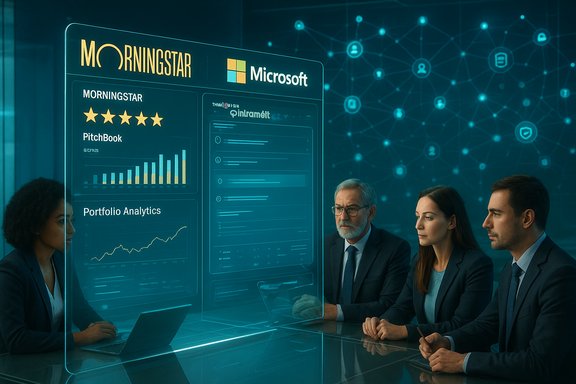
Morningstar has wired its research and datasets directly into Microsoft’s agent-first AI stack, enabling licensed users to surface Morningstar’s proprietary ratings, portfolio analytics, performance data and PitchBook intelligence inside Microsoft Foundry, Microsoft Copilot Studio, and — soon — Microsoft 365 Copilot, a move designed to make premium investment research “AI‑ready” inside the tools financial professionals already use.
Overview
Morningstar’s November 18 announcement positions the firm as a content provider adapting to an agent-native enterprise world: the company is exposing its content through two named technical components — the Morningstar Agent and a Morningstar Model Context Protocol (MCP) Server — to deliver entitlement-aware, auditable access to Morningstar data inside Microsoft agent runtimes. The initial integrations target Microsoft Foundry for enterprise-scale AI applications and Microsoft Copilot Studio for building custom agents, with Microsoft 365 Copilot connectivity advertised as coming soon. This is more than a marketing play: Morningstar explicitly frames the capability as a way to reduce workflow friction for advisors, asset managers and institutional teams by letting them retrieve grounded research without switching systems, while Microsoft’s Copilot and Foundry platforms supply the agent orchestration, identity and governance primitives needed for regulated environments.Background: why this matters now
Financial services workflows are highly fragmented: research lives in editorial systems, private‑market intelligence in sealed databases, portfolio analytics in specialized platforms, and compliance artifacts in separate archives. Agents and Copilot‑style assistants change the “front end” of that stack: instead of users navigating multiple systems, agents act as the UI and synthesis layer — provided the underlying content can be discovered, authenticated and provably sourced.Morningstar’s announcement leverages that trend by making its editorial research, ratings methodologies, performance metrics and PitchBook content available as discoverable, entitlement‑aware services for agents. The timing aligns with two platform shifts:
- Microsoft’s push to make Copilot Studio a low‑code authoring environment where agents can be published into Microsoft 365 Copilot and Teams, with built‑in governance and admin controls.
- Industry adoption of the Model Context Protocol (MCP) as a standard for agent-to-tool connectivity and provenance-first retrieval. Microsoft has been explicit about MCP support in its agent tooling.
What Morningstar is delivering — product and technical summary
Core components
- Morningstar Agent: Acts as a tool provider/broker that agents can call to retrieve curated outputs — textual analyst notes, ratings, analytics and structured metrics — in formats suitable for downstream generative workflows.
- Morningstar MCP Server: Implements the Model Context Protocol to publish tool metadata, enforce entitlements, and return provenance-rich retrievals that agents can ingest while preserving audit trails and access control.
- Integration endpoints:
- Microsoft Foundry — for enterprise-scale AI apps and model orchestration.
- Microsoft Copilot Studio — for building low-code agents that can call Morningstar as a tool.
- Microsoft 365 Copilot (coming soon) — surfacing Morningstar insights inside Teams, Outlook and the Copilot chat experience.
Data scope and claims
Morningstar asserts the integration will include global coverage of open‑end funds, ETFs, equities, portfolio analytics, ratings and proprietary methodologies. The announcement also highlights PitchBook intelligence as part of the content sweep, noting exclusive or non‑public PitchBook insights in certain contexts — a point firms must treat as license‑dependent until contractual scope is confirmed.Practical benefits for financial firms
Morningstar and Microsoft frame this as productivity and quality-of-advice acceleration. Key benefits emphasized:- Faster research-to-client cycle: Agents can assemble fund comparisons, performance snapshots and analyst commentary on demand, producing client‑ready narratives in minutes rather than hours.
- Scalable personalization: Agents can combine client profile data with Morningstar metrics to generate tailored proposals or talking points at scale.
- Operational automation: Routine tasks — daily portfolio drift checks, compliance screening, standardized reports — can be automated with Morningstar metrics feeding deterministic agent flows.
- Centralized governance: Using MCP plus Microsoft identity (Entra/Azure AD) allows tenant admins to control which agents can call Morningstar, who can access which datasets, and to capture audit logs for regulatory review.
Technical anatomy and enterprise controls
How agents will typically interact with Morningstar
- An agent running in Copilot Studio or Foundry discovers Morningstar as a registered MCP tool.
- The agent requests a specific dataset or analyst note using the MCP protocol and tenant‑scoped credentials.
- Morningstar MCP Server enforces entitlements, returns structured results with a data ID, and logs the retrieval for provenance.
- The agent composes an answer that includes the Morningstar citation snippet and the Morningstar data ID; the tenant logs and retention systems archive the exchange.
Platform controls to mandate
- Entitlement enforcement: per-user, per-agent and per-tenant access controls mapped to commercial license terms.
- Provenance-first RAG: retrieval-augmented generation patterns must force the agent to return the Morningstar snippet, data ID or analyst-note link for every material factual claim.
- Immutable logging & retention: retrievals, agent transcripts and final outputs must be archived in tamper-evident storage aligned with regulatory schedules.
- DLP and exfiltration gates: prevent agent outputs containing licensed content from being copied into non-entitled notebooks, public clouds or third‑party LLMs.
Strengths of the Morningstar–Microsoft pairing
- Editorial depth meets platform reach: Morningstar’s editorial coverage and PitchBook datasets plugged into Microsoft’s agent runtimes reduce the friction of discovery and synthesis for advisors and analysts. That combination creates a defensible workflow advantage for firms that require auditable, high‑fidelity outputs.
- Standards-first integration: By using MCP, Morningstar aligns with an industry pattern that simplifies agent-tool discovery and structured invocations — increasing maintainability and easing enterprise security reviews.
- Entitlement-aware design: The emphasis on entitlement enforcement addresses a major commercial and compliance reality that simple API feeds fail to handle. When implemented correctly, this reduces the risk of unauthorized distribution of premium content.
- Operational leverage: For advisory teams, automating routine document creation and client-ready proposals with grounded research can materially reduce turnaround time and scale personalization.
Risks, blind spots and governance pitfalls
The new capability is powerful, but not plug‑and‑play. Firms must watch these failure modes carefully:- Licensing ambiguity and PitchBook scope
Morningstar’s messaging references non‑public PitchBook intelligence. Access to private-market or non-public PitchBook datasets is frequently governed by separate commercial agreements. Treat statements about non‑public PitchBook access as contract-dependent until verified. Request a precise data map from Morningstar that lists included datasets, metering rules and any special restrictions. - Model risk and hallucinations
Retrieval grounding cuts hallucination risk, but it does not eliminate it. Agents that synthesize across multiple sources still require RAG discipline and mandatory human sign-off for any client-facing advice. Test outputs aggressively with red‑teaming that mimics real compliance and suitability checks. - Data exfiltration and downstream leakage
Agent outputs that mix licensed Morningstar content with client PII or account details create a leakage risk; firms must prevent agent outputs from being used to re-train third-party models or posted to uncontrolled repositories. Contractual DLP clauses and tenant-level technical controls are essential. - Auditability & recordkeeping burden
Regulatory regimes will expect immutable logs, retrieval evidence and retention matching human advice recordkeeping. Agents that produce advice may generate far more discrete records than traditional workflows, increasing storage and supervision overhead. Map retention and archive costs into pilot KPIs. - Cost & meterability
Agent-driven consumption introduces new cost vectors (Copilot Credits, tool invocations, retrieval counts). Model consumption can be unpredictable; firms should pilot small, measure consumption and model chargeback before broad rollout. - Vendor lock-in and portability
Deep integration across agent logic, retrieval stores and proprietary prompts raises migration costs. Design for portability: detachable RAG stores, exportable logs, and contract exit clauses to avoid being locked into a single vendor-agent combination.
Practical implementation checklist (IT, legal, compliance)
- Conduct a contract and entitlements audit with Morningstar: identify which datasets (including PitchBook subsets) are included, per-user vs per-agent licensing, and metering details.
- Define identity model and agent registry policy: use Microsoft Entra/Azure AD, restrict which agents can call the Morningstar MCP Server and register agents in an MCP registry.
- Adopt provenance-first RAG patterns: every material claim must include the Morningstar data ID or analyst-note link; preserve raw retrievals for audit.
- Implement DLP and exfiltration protections: block agent outputs from being copied to non-entitled services or external LLMs; prohibit downstream model training on licensed content by contract.
- Provision immutable logs and retention: map retention windows to regulatory requirements and store retrievals and outputs in tamper-evident archives.
- Start with a narrow pilot: one advisory desk or product team, fixed dataset scope, mandatory human-in-the-loop sign-off, and measurable KPIs (time saved, error rate, proposal throughput).
- Maintain AgentOps playbooks: incident isolation, entitlement revocation, forensic retrieval of agent logs and vendor SLAs for breach response.
Use cases — what works well today (and what to avoid)
High-value, low-risk wins
- Internal research assistants: analysts query Morningstar for curated snippets and numeric IDs to speed deck creation; human verification remains the norm. This is low-risk when access is contract-verified.
- Automated monitoring & alerts: agents poll Morningstar metrics for portfolio drift or threshold breaches and create tickets for human follow-up. Provenance and logging make this a compliance‑friendly automation.
- Proposal scaffolding: advisors use agents to assemble proposal templates with grounded Morningstar metrics and citations; advisor edits and signs before sending. This reduces manual work while preserving advisor judgment.
Use cases to treat conservatively
- Fully automated suitability recommendations: any automated suitability output should be human‑approved and supervised until governance artifacts and audit trails are proven robust.
- Private‑market intelligence for public advice: access to non‑public PitchBook intelligence must be contractually verified and carefully controlled to avoid unauthorized dissemination.
- Cross-tenant sharing or model training: never allow licensed Morningstar content to be used to train third‑party models without explicit consent.
Competitive and market implications
Morningstar’s pivot reflects a broader vendor trend: high‑value content providers are moving beyond raw feeds and toward agent‑aware, API‑first distribution. That changes negotiation dynamics: buyers are now purchasing not just data but the right to use that data interactively inside agent workflows.For Microsoft, the partnership expands Copilot Studio and Foundry’s catalog of enterprise connectors, strengthening its proposition for regulated verticals where provenance and licensing matter. For Morningstar, embedding content into agent UXes where advisors and analysts spend their time increases stickiness — but also redefines commercial and operational responsibilities for both vendor and customer.
Verification and cautionary flags
- The integration and the platform primitives are documented by Morningstar’s official press release and BusinessWire bulletin. The stated AUMA figure (~$369B as of Sept. 30, 2025) is reported in Morningstar’s Q3 2025 financial results. These are primary confirmations of scale and the product announcement.
- Microsoft’s Copilot Studio channeling into Microsoft 365 Copilot and MCP support are documented in Microsoft’s Copilot blog and docs, which describe agent publishing flows, admin approval controls and MCP general availability inside Copilot Studio. These platform capabilities are the enablers of Morningstar’s claims.
- Cautionary note on PitchBook: Morningstar’s announcement references non‑public PitchBook intelligence. Access to private‑market or non‑public PitchBook datasets is commonly governed by separate licensing — firms must validate contractual scope before enabling agent access to any private‑market research. Treat that particular claim as subject to verification.
Final assessment and practical recommendation
Morningstar’s integration into Microsoft’s agent ecosystem is a pragmatic, strategically timed product move that converts premium investment research into agent‑native services. The combination of Morningstar’s editorial depth and Microsoft’s agent orchestration, identity and governance primitives can yield genuine productivity gains and richer, more personalized client experiences when adopted prudently.But the upside is conditional: firms must pair the technical enablement with contractual clarity, robust RAG designs, DLP, immutable retention, and a conservative, measurable rollout plan. The firms that pilot with disciplined AgentOps and clear KPIs stand to reclaim advisor time and improve client engagement. Firms that rush to enable broad agent access without these controls risk compliance headaches, uncontrolled costs and reputational exposure.
Recommended next steps for decision makers:
- Convene legal, compliance, IT and business owners to request a definitive data map from Morningstar.
- Run a scoped pilot with mandatory human sign-off and defined KPIs.
- Build AgentOps runbooks before scaling, including incident response and entitlement revocation procedures.
(Verified against Morningstar press materials and Microsoft documentation.
Source: The Globe and Mail Morningstar Unleashes AI-Ready Investing Insights in Microsoft AI Tools
