

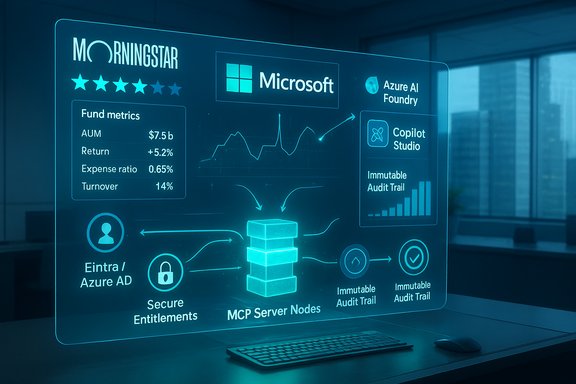
Morningstar has wired its research and data engines directly into Microsoft’s AI stack, giving licensed users — from advisors to institutional investors — the ability to surface Morningstar’s proprietary investment research, portfolio analytics, and ratings inside Microsoft Foundry, Copilot Studio and, soon, Microsoft 365 Copilot.
Background
Morningstar’s announcement frames the move as an effort to remove “friction” from investor workflows by embedding trusted, independent investment data and human-curated research into the AI tools professionals already use. The integrations are built around two technical components Morningstar names publicly: the Morningstar Agent and a Morningstar Model Context Protocol (MCP) Server, which enable entitlement-based access and contextualized data delivery to agentic AI workflows. Microsoft’s modern AI platform strategy — centered on Azure AI Foundry, Copilot Studio, and Microsoft 365 Copilot — has been explicitly designed to host and orchestrate “agents” and connect them to enterprise data sources via open protocols such as the Model Context Protocol (MCP). That API-style connectivity, together with Microsoft’s governance and identity services, is what Morningstar is leveraging to bring its content into enterprise-scale AI applications and Copilot experiences. Morningstar’s commercial pitch also highlights the company’s expanding pool of proprietary datasets — including PitchBook content following Morningstar’s acquisition of PitchBook — and positions the integrations as a way to accelerate speed-to-insight by combining human research with AI-driven workflows. Morningstar reports roughly $369 billion in assets under management and advisement (AUMA) in its most recent public filings, underscoring the company’s scale and the enterprise footprint it brings to these integrations.What Morningstar announced — the essentials
- Platforms supported today: Microsoft Foundry (enterprise-scale AI apps) and Microsoft Copilot Studio (custom agent creation). Microsoft 365 Copilot connectivity is scheduled to arrive later, enabling Morningstar insights within Teams and other productivity tools.
- Technical enablers: Morningstar Agent + Morningstar MCP Server provide secure, entitlement-aware access and contextualization for AI agents. These components are presented as the bridge between Morningstar’s APIs/data feeds and Microsoft agent frameworks.
- Content scope: Global coverage of open‑end funds, ETFs, equities, portfolio analytics, ratings, proprietary methodologies and Morningstar’s licensed PitchBook data and research. Morningstar markets this as “AI‑ready” data shaped for agentic retrieval and analysis.
- Target users: Financial advisors, asset & wealth managers, and institutional investors looking to accelerate research, portfolio analysis, client reporting, compliance checks, and custom AI workflows.
Why this matters now
AI agent frameworks and Copilot-style assistants are moving from proofs-of-concept into day-to-day professional workflows. Organizations that can place high‑quality data and domain expertise inside those agents will gain both speed and confidence in outcomes. Morningstar’s integration is the sort of move that converts static data feeds into interactive, context-aware services usable inside chat, automated reporting, and agent-driven appraisal tasks — without the need for end users to switch systems. For financial firms, where compliance, auditability, and data lineage are mandatory, an entitlement-aware “server + agent” architecture promises a practical model: licensed content is delivered on demand to an agent that can produce answers while retaining provenance and access control. Done correctly, that reduces friction and centralizes governance; done poorly, it creates risk — which is why the integration’s controls deserve close inspection.Technical anatomy — how the integration appears to work
Morningstar Agent + MCP Server: the connective tissue
- Morningstar Agent: Acts as a broker between licensed content and agent frameworks. It can receive queries from Copilot Studio agents or Foundry applications and return curated Morningstar outputs (textual insights, analytics, ratings, etc..
- MCP Server (Model Context Protocol): MCP is increasingly becoming the “USB‑C” of agent interoperability: a standard for agents to request contextual data from sources with explicit entitlements and provenance. Morningstar’s MCP server appears to present Morningstar content in a way that MCP‑capable agents (e.g., Copilot Studio agents or Foundry apps) can ingest while preserving access controls.
Microsoft endpoints in play
- Azure AI Foundry: Used for enterprise model deployment and orchestration. Integrations here mean Morningstar data can be used by enterprise-scale AI models and agents running within a controlled cloud environment.
- Copilot Studio: Allows firms to build custom agents that call out to Morningstar services for live research, portfolio analytics, or client-ready narratives. Agents there can be published to Microsoft 365 Copilot chat experiences.
- Microsoft 365 Copilot (planned): When available, Morningstar insights could surface inside Teams, Outlook, and other productivity surfaces — drastically lowering the friction to bring research into client conversations and internal reviews.
The upside — what firms stand to gain
- Faster, contextual advice: Advisors and portfolio managers can query an agent for fund comparisons, risk metrics, or analyst commentary and get answers that reference Morningstar’s research and ratings, rather than hunting across multiple systems. This shortens the research-to-client cycle.
- Scalable personalization: Agents can combine client profile data with Morningstar analytics to create personalized talking points, proposals, and portfolio scenarios at scale, enabling advisors to serve more clients without sacrificing relevance.
- Operational automation: Routine reporting, compliance screening, and portfolio monitoring can be automated with access to up‑to‑date Morningstar metrics and methodology-based signals. Firms can reduce manual reconciliations and produce standardized audit trails.
- Centralized governance: By delivering data through an entitlement-controlled MCP server and integrating with Microsoft’s identity/gov tools, Morningstar helps firms keep licensing, entitlements, and access logs centralized — an important control for auditors and regulators.
The risks and trade-offs — what to watch closely
1. Licensing and commercial terms
Morningstar’s message about “frictionless access” obscures the contractual complexity underneath. Firms must confirm:- Which datasets are included under existing contracts and which require explicit extension (PitchBook content is licensed separately in many cases).
- Whether entitlements apply per-user, per-agent, or per-tenant, and how usage-based billing is measured. The cost model will materially affect ROI.
2. Data governance and compliance
Embedding third‑party research into agent outputs magnifies responsibilities around:- Provenance and citation: Outputs must include clear provenance so advisors and compliance officers can trace claims back to specific Morningstar datasets or analyst notes.
- Regulatory archiving: Interaction logs and generated outputs will likely be capture targets for recordkeeping rules; custodians must ensure records are tamper-evident.
- Client data separation: When agents combine sensitive client data with licensed content, firms must ensure there’s no unauthorized sharing or training leakage across tenants.
3. Model risk — hallucinations and overconfidence
AI agents can hallucinate or produce plausible-sounding but incorrect summaries. Even with Morningstar as a ground-truth retrieval source, careless prompt engineering or insufficient grounding can produce outputs that misrepresent the underlying research.Best practice is to force retrieval-augmented generation (RAG) patterns where the agent returns the supporting Morningstar snippet or citation with every material claim. Firms should require human review for advice-grade outputs.
4. Security and operational risk
Connecting agent frameworks to proprietary data increases attack surface:- Credential theft or misconfiguration could expose licensed datasets.
- Misrouted agent requests could surface paid content to unauthorized users.
- Integration missteps could allow third-party or downstream services to inadvertently cache premium research.
5. Vendor lock-in and data portability
Embedding a third party’s content deeply into agent workflows creates migration costs. Firms should plan for portability — for example, ensuring exportable logs, detachable pipelines for RAG stores, and contractual exit clauses for data access.Practical implementation checklist for IT, data, and compliance teams
- Contract review and entitlements audit
- Confirm which Morningstar datasets are included and how usage is metered.
- Validate PitchBook access scope and agree clear entitlements for agent-level access.
- Identity, access, and agent registration
- Use Microsoft Entra / Azure AD for identity and map entitlements to roles.
- Register agents in a controlled MCP registry and restrict which agents can call the Morningstar MCP Server.
- Provenance, RAG design, and explainability
- Force agents to return the Morningstar citation snippet with every factual claim.
- Retain the raw retrievals so compliance can audit how answers were constructed.
- Logging, retention, and surveillance
- Ensure all agent interactions, retrievals, and final outputs are logged in immutable storage for the period required by regulators.
- Integrate alerts for anomalous data access or unusual agent behavior.
- Data handling and model training guardrails
- Contractually prohibit use of customer or licensed Morningstar content for third‑party model training without explicit permission.
- Implement data-loss prevention (DLP) policies that block exfiltration of premium content to unauthorized services.
- Governance and human-in-the-loop controls
- Define which outputs require human sign-off (e.g., client suitability recommendations).
- Maintain an approvals workflow inside Copilot Studio for any agent that delivers client-facing advice.
- Operational testing and slow rollouts
- Pilot agents in a controlled environment, validate provenance and accuracy, then scale by business lines.
- Maintain rollback plans and emergency access revocation for agents.
Use-case scenarios: realistic examples and limitations
Scenario A — Advisor proposal generation
An advisor uses a Copilot Studio agent to create a 5‑page proposal: the agent pulls Morningstar star ratings, analyst commentary, and portfolio performance metrics and composes a client-ready narrative. The advisor edits and signs off. This saves hours but requires that the output include clear citations to Morningstar reports and that the advisor verifies the methodology citations before distribution.Scenario B — Risk/compliance screening
An institutional investor wires a daily agentic check against Morningstar metrics for portfolio drift, concentration risk, and credit signals. The agent triggers alerts routed into a ticketing workflow. Operationally powerful, this requires robust logging and immutable evidence for regulatory audits.Scenario C — Desk research assistant
An equity analyst asks a Foundry-hosted model to summarize Morningstar analyst notes and related PitchBook private-market intelligence. The analyst gets a synthesized brief, but must confirm any private-company intelligence is licensed for use in the analyst’s workflow — and double-check for hallucinations when the agent synthesizes across datasets. This is where legal and vendor teams must be explicit about permitted uses.Governance: practical policies to adopt immediately
- Require result provenance: Agents must return the precise Morningstar data point ID or analyst note link with any material claim.
- Mandate human sign-off for client‑facing outputs: No client deliverable is published without advisor review and an audit trail that documents who approved it.
- Limit downstream sharing: Prevent agent outputs containing licensed content from being copied to personal email, public cloud notebooks, or third‑party LLMs. Use DLP and conditional access.
- Record retention and archiving: Retain interaction logs, retrievals, and final outputs according to regulatory schedules. Ensure the retention system is tamper-evident.
Competitive and market implications
Morningstar’s move signals that content providers are pivoting from feed‑style licensing to agent‑aware, API-first distribution. That changes negotiations: vendors can monetize not just data, but the contextualized, agent-friendly delivery of insights. It also raises the bar for data competitors — a handful of firms have the editorial depth, proprietary datasets, and distribution scale to make agentic integrations sticky. For Microsoft, the partnership strengthens Copilot Studio and Foundry’s catalog of enterprise content connectors and accelerates adoption in financial services, an area where compliance and provenance are high-value differentiators. That, in turn, cements Microsoft’s positioning as an enterprise AI platform for heavily regulated industries.Final assessment and recommendations
Morningstar’s integration into Microsoft’s AI tools is a pragmatic and timely product move: it reduces friction for end users and aligns premium research with the agentic workflows that financial professionals increasingly prefer. The combination of Morningstar’s curated content and Microsoft’s agent frameworks promises real productivity gains and the possibility of richer, more personalized client experiences. However, the benefits come with non‑trivial governance, contractual, and technical responsibilities. Firms should not treat these integrations as plug-and-play. Instead, they should:- Validate contracts and entitlements before enabling agent access.
- Implement strict identity and MCP registry controls.
- Build RAG patterns that force provenance and human oversight on advice-grade outputs.
- Test with controlled pilots, preserve audit trails, and document every workflow for compliance review.
The technology is available now; the discipline to use it responsibly is what will separate early adopters who win from those who pay the price for haste.
Source: The Globe and Mail Morningstar Unleashes AI-Ready Investing Insights in Microsoft AI Tools
