

Motorola’s new edge 70 arrives in India as a bold experiment: an ultra-slim 5.99 mm chassis that promises no-compromise flagship touches — triple 50MP AI cameras, a bright 6.7″ Super HD AMOLED, broad multi‑platform AI integration behind a dedicated AI key, MIL‑STD durability, and substantial battery life — all at an aggressive effective launch price just under ₹29,000.
Motorola positions the edge 70 as a new class of ultra‑thin smartphone that refuses the usual trade-offs: light weight and refined design without the typical concessions to camera quality, battery size or durability. The India launch messaging highlights an industry‑leading 5.99 mm thickness and a 159 g weight, a single India SKU (8 GB RAM + 256 GB storage) and an introductory price headline of ₹29,999 that can drop to an effective ₹28,999 with launch bank offers and carrier bundles. Those topline claims are supported by Motorola’s public specification pages and widespread Indian coverage, but the launch narrative mixes precise engineering specs with marketing superlatives (for example, “India’s largest 5000 mAh battery in an ultra‑thin phone”). Readers should treat the marketing framing as intent rather than independent validation and confirm the specific retail SKU details at purchase.
Caveats and verification points:
However, there is an important verification gap: Motorola’s official support/spec pages for some regions list the internal battery size as 4,800 mAh, not 5,000 mAh. This discrepancy suggests either regional SKU differences, conservative packing figures on support pages, or marketing rounding in launch materials. Buyers should confirm the printed battery capacity on the retail box and seek early independent battery endurance tests before treating the 5,000 mAh figure as final. Practical expectations:
Points to confirm:
For shoppers who prize thinness and polished display/camera editing workflows, the edge 70 is a strong contender — just confirm the few remaining technical gaps and real‑world performance before committing.
Source: AD HOC NEWS motorola edge 70 - No-Compromise Ultra-Slim Smartphone^ with Triple 50MP AI cameras, Snapdragon 7 Ge
 Background / Overview
Motorola positions the edge 70 as a new class of ultra‑thin smartphone that refuses the usual trade-offs: light weight and refined design without the typical concessions to camera quality, battery size or durability. The India launch messaging highlights an industry‑leading 5.99 mm thickness and a 159 g weight, a single India SKU (8 GB RAM + 256 GB storage) and an introductory price headline of ₹29,999 that can drop to an effective ₹28,999 with launch bank offers and carrier bundles. Those topline claims are supported by Motorola’s public specification pages and widespread Indian coverage, but the launch narrative mixes precise engineering specs with marketing superlatives (for example, “India’s largest 5000 mAh battery in an ultra‑thin phone”). Readers should treat the marketing framing as intent rather than independent validation and confirm the specific retail SKU details at purchase. Design and Build: ultra‑thin, lightweight, refined
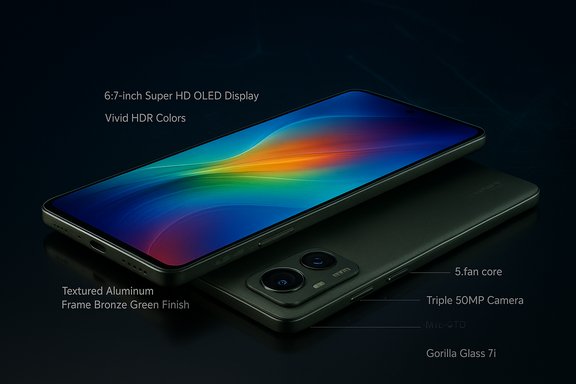
The edge 70’s design is the clearest statement: a 5.99 mm thin body, 159 g mass, and an aircraft‑grade aluminium frame with a textured, Pantone‑curated finish (Bronze Green, Lily Pad, Gadget Gray). Those dimensions put the phone among the thinnest mainstream models available and make it a pocket‑friendly alternative to heavier, thicker handsets. Key build points:- 5.99 mm thickness and 159 g weight for strong pocketability.
- Textured aluminium frame and premium finishes to reduce perceived slipperiness.
- Camera island remains visually prominent; ultra‑thin backs can mean micro‑wobble on flat surfaces unless a case is used.
Display: Super HD Extreme AMOLED with extreme peak nit claim
Motorola emphasises the display as a headline differentiator: a 6.7″ Super HD pOLED panel with a 1.5K Super HD resolution (2,712 × 1,220), up to 120 Hz refresh, 10‑bit colour, Pantone & Pantone SkinTone validation, and a quoted 4,500 nits peak brightness for HDR highlights. Dolby Atmos stereo and Hi‑Res Audio support round out the multimedia credentials. What matters in practice:- The 4,500 nits figure is a peak/HDR metric used by many OEMs to advertise outdoor legibility; sustained display brightness in normal use will be far lower to conserve battery. Expect the peak to appear only in brief HDR highlights or when HBM (high‑brightness mode) is triggered. Independent testing is the best way to verify how long the panel can sustain high luminance and how aggressively the display down‑throttles to protect battery and thermals.
- Pantone validation and SkinTone calibration are meaningful for creators and social photographers who want consistent colour reproduction across devices and workflows.
- 120 Hz + 300 Hz touch sampling aims to deliver smooth scrolling and fast touch response for gaming and UI fluidity.
Performance and on‑device AI: Snapdragon 7 Gen 4, NPU and a dedicated AI key
The edge 70 is powered by the Qualcomm Snapdragon 7 Gen 4 platform — a 4 nm‑class, upper‑midrange SoC focused on balancing CPU/GPU performance with efficiency and better on‑device AI acceleration than previous 7‑series chips. Motorola pairs the SoC with 8 GB LPDDR5X RAM and UFS 3.1 storage in the India retail SKU, and adds a vapour‑chamber cooling solution to sustain performance. Motorola’s software story focuses on multi‑platform AI freedom: a dedicated AI key at the hardware level that surfaces Moto AI 2.0, while also offering user choice to integrate Microsoft Copilot, Google Gemini, or Perplexity. That approach is notable because it avoids lock‑in to a single AI assistant and aims to let users choose the assistant that best fits their workflow.Caveats and verification points:
- On‑device AI experiences depend on the SoC’s NPU topologies and software integrations; some advanced assistant features still rely on cloud models. The practical responsiveness and privacy benefits depend on how many workflows run locally versus on remote servers. Expect variation across features and regions.
- Benchmarks for Snapdragon 7 Gen 4 place the chip solidly in the upper midrange; it offers smooth multitasking, capable gaming at medium settings, and efficient AI inference for compressed models — but it doesn’t match the absolute raw CPU/GPU peaks of flagship silicon. Independent performance reviews will show where it lands vs competitors.
Cameras: an uncommon triple 50MP array — promise vs. practical outcomes
Motorola markets the edge 70 as India’s only ultra‑thin phone with three 50MP cameras: a 50MP OIS main (with “2.0 µm Ultra Pixel” marketing), a 50MP ultra‑wide that doubles as a macro, and a 50MP front selfie camera — with bold claims of 4K/60 fps recording across all cameras and a suite of moto AI photo/video tools (AI Video Enhancement, AI Adaptive Stabilization, AI Action Shot, AI Group Shot) plus integration with Google Photos AI tools (Magic Eraser, Photo Unblur, Magic Editor). Strengths:- High‑resolution sensors across all modules give flexibility for cropping and high‑detail stills in good light.
- Integration with Google Photos AI editing tools and Moto AI features can speed post‑production and rescue imperfect shots.
- Resolution isn’t a surrogate for optics. A 50MP ultrawide or selfie sensor can capture more pixels, but the optical path (aperture, lens quality) still determines edge detail, low‑light performance and dynamic range. Without a dedicated optical telephoto, medium‑range zoom relies on digital cropping and software sharpening rather than true optical zoom fidelity.
- 4K/60 across all cameras is an ambitious claim for thin hardware. Ultrawide and front modules typically have less advanced stabilization and ISP tuning than the main lens; expect ultrawide and selfie 4K/60 clips to show higher noise and less steady stabilization compared with the primary camera until proven by independent samples. Buyers who prioritise multi‑lens video workflows should wait for third‑party footage and in‑hand reviews.
Battery and charging: high capacity in a very thin body — and an important discrepancy
Motorola advertises a 5,000 mAh silicon‑carbon battery inside the ultra‑thin edge 70, plus 68W TurboPower wired charging, 15W wireless charging, and reverse wireless charging — and claims up to 40 hours of battery life in mixed‑use messaging. Those are compelling numbers for a phone under 6 mm thick if accurate.However, there is an important verification gap: Motorola’s official support/spec pages for some regions list the internal battery size as 4,800 mAh, not 5,000 mAh. This discrepancy suggests either regional SKU differences, conservative packing figures on support pages, or marketing rounding in launch materials. Buyers should confirm the printed battery capacity on the retail box and seek early independent battery endurance tests before treating the 5,000 mAh figure as final. Practical expectations:
- Even if the cell is 4,800–5,000 mAh, the combination of a high‑brightness panel (peak 4,500 nits) and AI features will affect real‑world endurance. Sustained high brightness or heavy on‑device AI processing will shorten runtimes compared with conservative test conditions.
- The 68W wired charging spec is positive for quick top‑ups; 15W wireless is useful but not class‑leading. Reverse wireless adds flexible accessory charging.
Durability: MIL‑STD, IP68 + IP69, and Gorilla® Glass 7i
Motorola emphasizes robust protection for an ultra‑thin product: MIL‑STD‑810H claims, combined IP68 + IP69 ingress protection, and Corning Gorilla Glass 7i on the front. Those badges are unusual for a sub‑6 mm chassis and, if accurate, add strong practical value for users who worry about drops, dust and water jets. Reality check:- MIL‑STD certification denotes testing under specified environmental exposures, but manufacturer claims can represent lab testing rather than guaranteed field resilience over years of daily wear. IP ratings reflect factory seal integrity; repeated drops, case removals and repair cycles can erode ingress protection.
- Users who plan high‑risk use should still confirm warranty terms for liquid damage and consider protective cases — thin phones can be more vulnerable to flex and seal degradation over time despite initial ratings.
Software, updates and ownership experience
Software: the edge 70 ships with Hello UI on Android 16, and Motorola promises 3 OS upgrades and 4 years of security updates for the device in launch materials. Additional software features include Moto Secure with ThinkShield, Family Spaces, Moto Unplugged, and Smart Connect. Motorola also highlights Moto Premium Care service plans offering 24×7 support and enhanced repair services.Points to confirm:
- Update promises are competitive for the mid‑range segment, but historically OEM update commitments can vary by SKU and region. Buyers should verify the precise terms in the India warranty and official product page — what counts as an OS “upgrade” (major Android version vs. maintenance release) and the cadence of security patches are material to long‑term ownership.
Pricing, offers and availability (India)
Availability:- Sales started in India on 23 December 2025 through Flipkart, motorola.in and retail partners. The India launch SKU is listed as 8 GB + 256 GB in three Pantone‑curated colours.
- Launch MSRP: ₹29,999 for 8 GB + 256 GB.
- Launch bank discount: ₹1,000 off, producing an effective price of ₹28,999 for a limited time, plus operator bundles (Reliance Jio benefits referenced in launch bundles). These offers are time‑bound and can vary by retailer.
- Confirm the exact SKU shown on the retailer’s product page (look for 8 GB + 256 GB vs any other variant).
- Verify box‑stamped battery capacity and the presence of any bundled charger/accessory.
- Compare bank and carrier offers carefully — operator benefits may require specific recharge plans or voucher redemptions to unlock full value.
Strengths — what Motorola gets right
- Design and portability: The edge 70 is a real head‑turner for buyers who prioritise thinness and low weight in a modern smartphone.
- Display ambitions: A 6.7″ Super HD pOLED with Pantone skin‑tone validation and a very high quoted peak brightness supports excellent HDR and outdoor use in theory.
- Camera versatility on paper: Three 50MP modules backed by Moto AI + Google Photos tools create a strong creative package for casual creators.
- Multi‑assistant AI approach: Letting users choose Moto AI 2.0, Copilot, Gemini or Perplexity avoids vendor lock‑in and encourages flexible workflows.
- Aggressive pricing: The effective launch price under ₹29k puts an aspirational spec set within reach for a broad segment of buyers.
Risks and open questions — what to watch for
- Battery capacity discrepancy: Marketing cites 5,000 mAh while some official support pages list 4,800 mAh — reconcile this on the retail box and wait for third‑party battery tests.
- Camera video realism: The claim of 4K/60 across all cameras is impressive on paper but often overstated in thin devices; expect ultrawide and selfie video to trail the main lens in stabilization and noise performance until verified.
- AI experience balance: Many assistant features depend on cloud access and model licensing; on‑device functionality will vary by region and may change over time. Verify which AI features are local vs cloud‑based for privacy and latency expectations.
- Durability over time: MIL‑STD and IP ratings are valuable, but repeated real‑world stress and repairs can reduce ingress resilience. Check warranty terms for water and accidental damage.
- Software update clarity: “3 OS upgrades + 4 years security” is competitive but varies by region and SKU; confirm the exact commitment in India.
Practical buying checklist (quick)
- Confirm the India SKU (8 GB + 256 GB) and box‑printed battery capacity before purchase.
- Check retailer pages for the advertised bank/offer stack and any operator‑required top‑ups to realise full benefits.
- Wait for independent camera and battery reviews if multi‑lens 4K video or marathon battery life are priorities.
- Confirm availability of Moto Premium Care and local service options in your city, particularly if rugged use is expected.
Conclusion
The motorola edge 70 is an ambitious attempt to reframe what an ultra‑thin smartphone can be in 2025: a striking combination of thin industrial design, an expansive and colour‑calibrated OLED, wide AI integration, and a flexible triple‑50MP camera package — all priced to challenge rivals in the sub‑₹30,000 segment. Those headline specs and the hardware choices make the edge 70 a compelling proposition for design‑minded buyers who want modern AI hooks and creative tools without the bulk of many flagship phones. That said, several important claims require independent verification: the exact battery capacity (5,000 mAh vs 4,800 mAh discrepancy), sustained display brightness behavior in daily use, and real‑world 4K/60 capture across ultrawide and selfie modules. The multi‑assistant AI promise and the MIL‑STD/IP protection are valuable differentiators on paper, but their real value will be determined by software integration, regional feature parity, and long‑term reliability. Buyers should treat the launch pricing, bank offers and operator bundles as timely incentives while verifying SKU specifics and waiting for third‑party camera and battery tests to validate the marketing claims.For shoppers who prize thinness and polished display/camera editing workflows, the edge 70 is a strong contender — just confirm the few remaining technical gaps and real‑world performance before committing.
Source: AD HOC NEWS motorola edge 70 - No-Compromise Ultra-Slim Smartphone^ with Triple 50MP AI cameras, Snapdragon 7 Ge
