

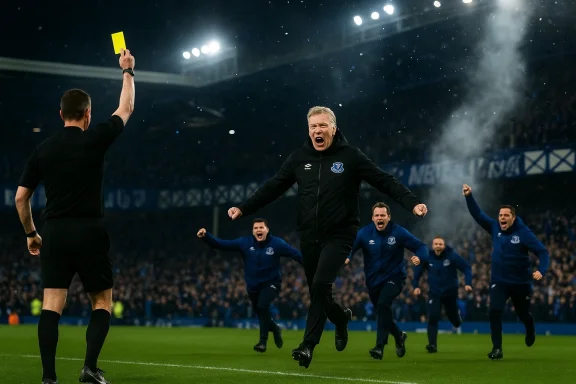
Everton’s dramatic 97th‑minute equaliser at Brighton set off more than frenzied celebrations on the pitch — it reignited a debate about the modern game’s rules on managerial conduct after David Moyes stormed from the technical area to join his players and was booked for doing so.
Everton went to the Amex Stadium on January 31, 2026, chasing points in a season where momentum has been at a premium. Brighton took the lead through Pascal Gross in the 73rd minute, and the match looked to be slipping away from the visitors — until substitute Beto bundled home a 97th‑minute leveller that prompted scenes of delirium among the Everton staff and players.
The celebration did not go unpunished: referee Chris Kavanagh produced a yellow card for Moyes after he left the technical area to join the jubilation, a decision the Everton manager described as a “killjoy” moment and vowed would not deter him from celebrating in future.
Other famous moments — Sir Alex Ferguson’s touchline displays, Roberto Mancini’s plate‑throwing outbursts, José Mourinho’s theatrical interactions with match officials — illustrate a shifting relationship between spectacle and sanction. Over recent decades, as the Laws have been codified and refereeing standards professionalised, tolerance for managers breaching the technical area has declined. The shift reflects two forces:
Three points Moyes made, and which have traction with fans and pundits:
This is a tension familiar in many sports as professionalisation increases:
For fans, the sight of a manager’s knee slide or impromptu sprint onto the turf is shorthand for passion and authenticity. For officials and administrators, allowing unchecked incursions risks safety and inconsistency. The pragmatic path forward lies in clearer guidance, consistent referee training, and narrowly tailored clarifications that preserve the game’s theatre while protecting its integrity. Until that balance is struck, incidents like Moyes’ booking will continue to produce headlines, hot takes and the occasional cheeky vow to “do it again” — which, in the modern game, will always be an act equal parts defiance and theatre.
Source: AOL.co.uk Moyes blasts killjoy booking after Everton's late leveller
 Background
Everton went to the Amex Stadium on January 31, 2026, chasing points in a season where momentum has been at a premium. Brighton took the lead through Pascal Gross in the 73rd minute, and the match looked to be slipping away from the visitors — until substitute Beto bundled home a 97th‑minute leveller that prompted scenes of delirium among the Everton staff and players. The celebration did not go unpunished: referee Chris Kavanagh produced a yellow card for Moyes after he left the technical area to join the jubilation, a decision the Everton manager described as a “killjoy” moment and vowed would not deter him from celebrating in future.
The incident in detail
- The equaliser: Beto’s goal came deep in stoppage time — reported as the seventh minute of added time — and immediately prompted a chorus of reactions from players, substitutes, and bench staff.
- Moyes’ reaction: The 62‑year‑old manager sprinted from the technical area and briefly entered the pitchside space in a spontaneous celebration; he later told reporters he “would bloody do it again,” and cheekily considered a knee slide had he been younger and more mobile.
- The booking: Match officials signalled a yellow card for the act of leaving the technical area, applying the cautionable offence for not respecting the confines of team officials’ zones as defined in the Laws of the Game. The decision was enforced live by referee Chris Kavanagh.
Rules and refereeing: what the law says
To understand whether Moyes’ booking was anomalous or simply the correct application of the rules, we need to return to the IFAB Laws of the Game and national governing‑body guidance.- Technical area boundaries and cautionable conduct: IFAB and national FAs make clear that team officials must respect the confines of the technical area; clearly or persistently not doing so is a cautionable offence. The FA’s Law 12 guidance lists “clearly/persistently not respecting the confines of their team’s technical area” among acts that merit a yellow card.
- When an entry becomes a sending‑off offence: If a manager leaves the technical area to engage in provocative, confrontational or physically aggressive behaviour — for example remonstrating with a match official or interfering with play — the entry may warrant a red card under the sending‑off criteria. IFAB’s guidelines distinguish between non‑confrontational celebrations and behaviour that crosses into dissent, aggression, or interference.
- Competition rules and referee discretion: Competitions can add clarifications or temporary dismissal protocols, and referees retain discretion about the level of sanction appropriate to the behaviour witnessed. The modern referee is encouraged to apply the Laws consistently, but interpretation and proportionality play a role in high‑pressure, high‑emotion moments.
A short history of managers and the technical area
Football is littered with memorable managerial celebrations that would not pass muster under today’s standards. David Pleat’s jubilant on‑pitch dance when Luton Town secured survival in 1983 remains an oft‑cited contrast to modern cautioning of managers who cross the white line. Moyes himself referenced Pleat in his post‑match remarks, arguing that older examples of exuberance were tolerated without a booking.Other famous moments — Sir Alex Ferguson’s touchline displays, Roberto Mancini’s plate‑throwing outbursts, José Mourinho’s theatrical interactions with match officials — illustrate a shifting relationship between spectacle and sanction. Over recent decades, as the Laws have been codified and refereeing standards professionalised, tolerance for managers breaching the technical area has declined. The shift reflects two forces:
- A prioritisation of safety and the smooth operation of match officials.
- An institutional desire to limit confrontation and maintain control of the sideline environment.
Moyes’ argument: emotion, spectacle and consistency
David Moyes’ public case is straightforward and rhetorically effective: celebrating a last‑gasp equaliser is part of the human fabric of football, and booking managers for doing so is a needless end to the spontaneous joy that makes the sport compelling. His pithy line — “I bloody will do it again!” — is both a protest and a provocation.Three points Moyes made, and which have traction with fans and pundits:
- Celebration is part of football’s theatre. Fans, players, and managers share those ecstatic moments; restricting them can sanitize the emotional core of the game.
- Perceived inconsistency. When managers in the past have dancingly celebrated without sanction, but are now booked, supporters see arbitrariness or over‑zealous officiating. Moyes invoked David Pleat as shorthand for this perceived double standard.
- Symbolic consequence. Banning or disciplining spontaneous celebrations risks making managers robotic, undermining the human narratives that make the Premier League globally compelling.
Counter‑arguments: law, safety and control
The counterpoint is also stark and rooted in practicalities.- Control and precedent: Referees must apply the Laws consistently. Allowing managers to cross into the field for celebrations — even if harmless — can create slippery slopes where others justify more provocative or confrontational entries. The law’s clarity on technical‑area boundaries exists to prevent escalation.
- Safety and match flow: A sudden manager entry into the field of play — especially in crowded penalty areas late in matches — can create safety issues, obstruct play (even unintentionally), or provoke altercations with opposing staff. The referee’s primary duty is player safety and the integrity of the match.
- Consistency for officials: If referees allow celebrations on a discretionary basis, they risk being accused of favoritism or introducing arbitrary standards. A clear rule reduces post‑match controversy about inconsistency in enforcement.
The practical impact on managers, teams and broadcasting
Beyond the debate about principle, several practical and reputational effects follow from Moyes’ booking and related enforcement practices.For managers and clubs
- Disciplinary accumulation: Yellow cards for managers can accumulate into fines or further disciplinary measures in some competitions. Clubs and managers will need to weigh the emotional satisfaction of an on‑pitch celebration against potential regulatory consequences.
- Behavioural coaching: Coaching staffs will increasingly brief managers on the limits of the technical area, particularly in high‑emotion moments, to avoid avoidable cautions that could escalate (or be used against them in future disciplinary proceedings).
For broadcasting and fan engagement
- Lost theatre: Broadcast producers and rights holders have monetised the spontaneous moments that come from touchline emotion. If managers are chilled into passivity, TV narratives and viral clips that drive engagement may diminish. Moyes’ complaint taps directly into this commercial and cultural dimension.
- Social media narratives: The knee‑jerk reaction to a yellow card is immediate on social platforms, often polarising fan bases and pundits; managers’ reactions become part of the spectacle, not just the match. Moyes’ combative soundbites — ripe for clipping and meme‑making — will circulate regardless of the referee’s intent.
Refereeing consistency: is there evidence of random enforcement?
Moyes’ protest includes an implied claim of inconsistent enforcement: older managers were tolerated, newer ones are booked. There is merit — but the evidence is mixed.- Institutional tightening: Over the last decade IFAB and national FAs have increasingly codified expectations of sideline behaviour. That institutional shift naturally produces more visible enforcement as referees align with updated guidance. IFAB guidance and recent law changes underscore a push toward clarity and safety.
- Discretion remains: Referees have latitude and the onus of making a real‑time judgment call. Different referees and match officials' teams may apply the rule with varying thresholds for what is “clearly/persistently” outside the technical area, leading to apparent inconsistency even where the underlying laws are stable.
- High‑profile cases attract scrutiny: Incidents involving well‑known managers are disproportionately reported and debated, which amplifies the perception of inconsistency even when enforcement is broadly steady across lower‑profile matches. Moyes’ case is a high‑visibility example; that magnifies both the emotional resonance and the media echo chamber.
What regulators and refereeing bodies should consider
If the governing bodies want to reduce controversy while preserving the human dimension of the game, several pragmatic options exist:- Clarify the celebratory exception (or not): IFAB could provide clearer, published examples of what constitutes a tolerable celebration — e.g., brief steps out of the technical area in a non‑confrontational way — and what unequivocally crosses the line. This would reduce post‑match debate about “what should have been” done.
- Pre‑match communication: Competition referees could remind managers before kick‑off about the application of the technical area rule, particularly for televised matches where incidents garner widespread attention. That gives managers the opportunity to self‑police.
- Graded sanctions: Introduce a graded approach where a first, genuinely spontaneous and harmless entry might trigger a warning or a post‑match reprimand rather than an immediate yellow card, reserving cautions for behaviour that risks safety or incites confrontation. This would balance order with spontaneity, but it could reintroduce inconsistency unless tightly defined.
- Referee training and assessment: Ensure match officials are trained with a consistent set of examples from elite games and that referee assessment frameworks reward appropriate, proportionate interventions rather than mechanical application.
The broader cultural question: how much theatre should football sacrifice?
Moyes’ protest is not simply about a yellow card; it’s a wider cultural gripe about whether the rules are drifting toward sanitising the game. Fans crave the raw, unscripted emotion that attaches the human to the professional. Yet the modern game also protects players, officials and the integrity of competition with rules that sometimes feel joyless.This is a tension familiar in many sports as professionalisation increases:
- Fans hunger for authenticity and moments that make matches feel alive.
- Governing bodies aim to minimise risk, abuse and inconsistency.
- Broadcast partners capitalise on moments that boost engagement, but they also prefer predictable, non‑disruptive matches.
Practical takeaways for managers and clubs
- Expect rules to be enforced: Managers should assume referees will caution entries into the field unless an explicit exception is announced by competition organisers. The safe default is to celebrate within the technical area.
- Weigh the optics: A spontaneous celebration can generate valuable fan goodwill and social‑media buzz, but it can also lead to fines or disciplinary action. Clubs will increasingly brief staff on trade‑offs.
- Use the platform: Moyes’ post‑match remarks show that protesting a booking can itself become a narrative engine — a way to galvanise fans and draw attention to perceived overreach. If clubs choose to contest enforcement, they should do so with a strategy: public comment, formal complaints only where warranted, and engagement with refereeing bodies where precedent matters.
Conclusion
David Moyes’ booking for celebrating Everton’s last‑gasp equaliser is a microcosm of a larger debate about modern football’s appetite for emotion versus its need for order. The Laws of the Game clearly permit referees to caution managers who step outside the technical area, and recent years have seen a tightening of sideline expectations — but the emotional argument Moyes makes is powerful because it speaks to what draws global audiences to the Premier League in the first place.For fans, the sight of a manager’s knee slide or impromptu sprint onto the turf is shorthand for passion and authenticity. For officials and administrators, allowing unchecked incursions risks safety and inconsistency. The pragmatic path forward lies in clearer guidance, consistent referee training, and narrowly tailored clarifications that preserve the game’s theatre while protecting its integrity. Until that balance is struck, incidents like Moyes’ booking will continue to produce headlines, hot takes and the occasional cheeky vow to “do it again” — which, in the modern game, will always be an act equal parts defiance and theatre.
Source: AOL.co.uk Moyes blasts killjoy booking after Everton's late leveller
