Mozilla’s public commitment to turn Firefox into an “AI browser” under new CEO Anthony Enzor‑DeMeo has reignited a familiar debate: can a privacy‑first browser embrace powerful generative AI without betraying the users who have long chosen it specifically to avoid the AI‑centric direction of other vendors? The announcement — explicit about a planned three‑year push toward an AI‑driven Firefox while repeatedly promising user control and opt‑out settings — has delivered a mix of cautious optimism from product watchers and furious backlash from a vocal portion of the Firefox community.
Mozilla has named Anthony Enzor‑DeMeo as CEO and published a strategic manifesto positioning the organization around trust, user agency, and a vision of Firefox evolving into a “modern AI browser” within the next three years. The messaging is careful: AI must be optional, controls must be simple, and privacy and data usage must be understandable to everyday users. That framing is central to Mozilla’s pitch and appears repeatedly in the company’s announcement. This move is not happening in isolation. Browsers from Google and Microsoft tightened AI integrations in recent years — Gemini in Chrome and Copilot in Edge being the most visible examples — and those approaches have reshaped user expectations. Mozilla’s stated ambition is to meet that moment on different terms: provider choice, hybrid local/cloud execution, and opt‑in models rather than a single, always‑on assistant baked into the default experience. Early product signals from Firefox’s experiments — an AI sidebar, local alt‑text generation, and on‑device summarization features — make the AI Window concept plausible as a next step.
Execution must reconcile three often‑competing constraints:
The next year will be decisive. If Mozilla turns its stated commitments into concrete product artifacts — clear UI indicators, provable on‑device privacy modes, robust enterprise controls, and transparent product economics — it may succeed in carving out an AI‑capable niche that honors its values. If those promises are not backed by tangible, user‑facing safeguards and straightforward choices, the community backlash will not only persist but may harden into attrition.
For now, the central question is empirical rather than rhetorical: will Mozilla build AI the Firefox way — with choice, transparency, and user agency genuinely at the core — or will it follow the industry’s gravitational pull toward convenience at the expense of control? The answer will be written in code, settings, and the small but powerful text of consent dialogs and policy keys.
Source: Windows Central https://www.windowscentral.com/soft...-seen-a-company-so-astoundingly-out-of-touch/
 Background
Mozilla has named Anthony Enzor‑DeMeo as CEO and published a strategic manifesto positioning the organization around trust, user agency, and a vision of Firefox evolving into a “modern AI browser” within the next three years. The messaging is careful: AI must be optional, controls must be simple, and privacy and data usage must be understandable to everyday users. That framing is central to Mozilla’s pitch and appears repeatedly in the company’s announcement. This move is not happening in isolation. Browsers from Google and Microsoft tightened AI integrations in recent years — Gemini in Chrome and Copilot in Edge being the most visible examples — and those approaches have reshaped user expectations. Mozilla’s stated ambition is to meet that moment on different terms: provider choice, hybrid local/cloud execution, and opt‑in models rather than a single, always‑on assistant baked into the default experience. Early product signals from Firefox’s experiments — an AI sidebar, local alt‑text generation, and on‑device summarization features — make the AI Window concept plausible as a next step.What Mozilla actually announced
The core message
- Leadership and strategy: Anthony Enzor‑DeMeo’s leadership memo emphasizes trust as a strategic priority, and lays out three pillars: agency in product behavior, monetization aligned to trust, and expanding Firefox into a family of trusted software. The memo explicitly states that Firefox “will evolve into a modern AI browser.”
- AI as choice: Mozilla repeatedly frames AI features as opt‑in. The company promises simple toggles that make it easy to enable or disable AI capabilities, and a preference for local processing for privacy‑sensitive tasks when technically feasible.
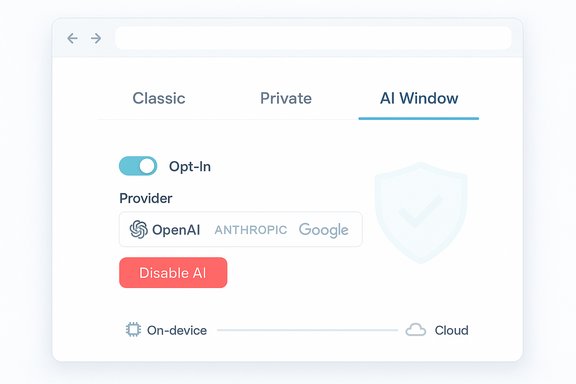
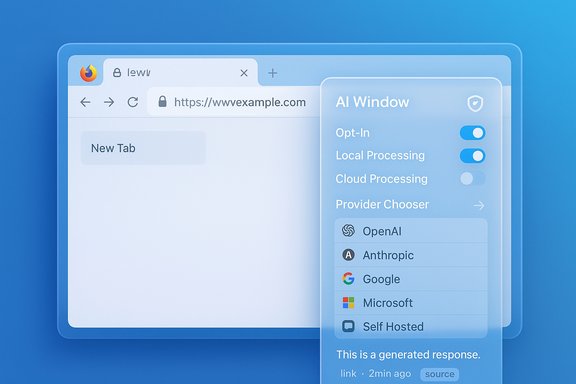
- Product direction: The public concept under discussion inside Mozilla is often referred to as an “AI Window” — a separate browsing mode or panel that contains AI interactions and lets users pick providers and local vs cloud modes. This preserves a separation between normal browsing and AI‑assisted sessions.
Why Mozilla is making the move
Mozilla’s calculus is straightforward: without a competitive AI story, Firefox risks irrelevance in a market where users increasingly expect assistant capabilities from their browsers. The company also argues it can offer a distinctive value proposition — choice, neutrality, and user control — that addresses privacy‑conscious users who distrust the integrated, single‑vendor assistants offered by bigger rivals. That positioning is part mission, part market defense.The immediate reaction: community backlash and broader concern
Mozilla’s announcement produced an unusually loud reaction online. Many long‑time Firefox users expressed anger and disappointment, saying they chose Firefox precisely to avoid the “AI obsession” permeating other browsers. Social media posts and community threads criticized the decision as out of touch with the browser’s core user base and warned that an AI‑forward Firefox would push them to alternatives. This blowback is visceral and broad, and it reflects more than product nitpicking — it’s about identity and trust. At the same time, some technologists, product analysts, and enterprise stakeholders welcomed Mozilla’s stated stance on provider choice and local processing, noting that a neutral surface for assistants — implemented with true transparency and enterprise controls — could be a meaningful third way between a walled‑garden assistant and no assistant at all. But those voices are quieter than the cacophony of online anger.Why the anger is so loud
- Identity crisis for users: Many Firefox users self‑identify as privacy‑minded, and the perception that Mozilla is moving toward the same AI strategies as Google and Microsoft feels like a betrayal to some. That sense of identity explains the intensity of the reaction.
- Distrust of AI: Beyond identity, there’s widespread unease about generative models: hallucinations, data retention, and opaque training practices. For users who already mistrust cloud vendors, the idea that Firefox would surface assistants that might route user data to third parties raises immediate red flags.
- Execution skepticism: Many critics don’t accept the “opt‑in” argument at face value. There’s a long history in software where opt‑in promises eventually erode into subtle defaults and discoverability nudges that push users toward the feature. That institutional memory shapes skepticism.
What “AI Window” likely means in practice
Mozilla’s early signals (and public experiments) outline an architecture and UX that are consistent across leaks, reports, and Mozilla’s own community posts:- A dedicated AI workspace or panel — AI Window — that users open explicitly when they want assistance, rather than an assistant permanently embedded in every tab.
- Provider agnosticism: the UI will let users pick which backend powers their session — Anthropic, OpenAI, Google, Microsoft, or local/self‑hosted models — avoiding single‑vendor lock‑in.
- Hybrid processing model: lightweight or sensitive tasks run locally where possible, and heavier reasoning falls back to cloud providers, with visible indicators showing where a request is processed.
- Developer and extension hooks: APIs to allow third‑party assistants and experiments, giving the open web a chance to innovate on top of the AI surface.
Technical and product risks
1. Performance and battery life
Running local models or even frequent cloud inference from inside a browser can spike CPU, memory, and battery usage, especially on older laptops and midrange devices. Early Firefox AI experiments already produced reports of CPU spikes and poor battery behaviors in limited tests, and Mozilla must solve resource management problems like throttling, model sizing, and graceful fallbacks. Without robust mitigation, the feature risks degrading the core browsing experience.2. Privacy complexity and data flows
A hybrid architecture that sometimes uses local inference and sometimes routes content to third‑party clouds is inherently confusing for users. Mozilla’s promise of clearly labeled processing indicators and provider disclosures is necessary — but not sufficient. The real test will be the product’s microcopy, UX flows, and how clearly it explains what data leaves the device, what metadata is recorded, and what third parties may store prompts or context. Per‑provider terms and retention policies will govern much of the privacy outcomes, which shifts responsibility (and risk) onto the chosen model vendors.3. Hallucinations and provenance
Generative assistants hallucinate — they invent facts and present them confidently. In a browser context, where a concise summary could replace a step in research or reporting, the danger is elevated. Mozilla needs mandatory provenance features (links, cited quotes, timestamps) and clear UI cues that prevent passive consumption of AI outputs. Early Mozilla messaging emphasizes provenance, but implementation details are thin so far.4. Monetization and gating
Many of the most capable backend models are behind paid tiers. If the “best” experiences inside Firefox require a separate subscription (to a model provider), the promise of choice rings hollow for users without budget. Mozilla must define which features are part of Firefox’s free baseline and which are considered premium add‑ons requiring third‑party accounts or paid upgrades. Lack of clarity here risks fragmentation and user confusion.5. Support and fragmentation
Supporting multiple providers, authentication flows, and local runtime options will increase the complexity of documentation, QA, and user support. Mozilla will need excellent defaults and a consistent UX so that swapping providers does not produce wildly different behaviors or privacy implications.Enterprise, compliance, and admin implications
Organizations rarely accept “opt‑in” at face value; they require centralized controls. For businesses and regulated sectors, Mozilla must ship enterprise policies (Group Policy/MDM templates) that let admins:- Disable AI Window entirely for managed devices.
- Restrict or whitelist approved providers.
- Audit and log AI usage for compliance.
- Prevent uploads of classified or protected data through DLP integration.
How this compares to Chrome, Edge, and newer entrants
- Chrome + Gemini: Google embeds Gemini tightly into Chrome and the broader Google ecosystem, enabling deep cross‑service actions but increasing ecosystem lock‑in. Google’s approach benefits from direct control of search, accounts, and data. Mozilla cannot — and arguably should not — replicate that single‑stack integration if it wants to remain neutral.
- Edge + Copilot: Microsoft’s strategy ties Copilot across Edge and Windows, providing privileged hooks to implement OS‑level automations. That vertical depth gives Edge some unique experiences, but it also raises stronger concerns about telemetry and platform control.
- Newer AI browsers and assistants: Several startups and alternative browsers experiment with agentic features that can act on behalf of users. These new entrants sometimes trade openness for convenience; Mozilla’s challenge is to strike a balance between utility and control.
Strengths of Mozilla’s approach
- Values alignment: Framing AI as user‑controlled and provider‑agnostic is consistent with the Mozilla Manifesto and may attract users who want AI only on their terms.
- Product differentiation: A neutral marketplace for assistants could be meaningful to developers, researchers, and enterprises that want choice without being forced into a single vendor’s data layer.
- Community development model: Building in the open with a waitlist and community feedback aligns with Mozilla’s history of participatory design, potentially giving them a path to iterate publicly and earn trust if they act on feedback.
Where Mozilla must prove itself — a practical checklist
- Clear, visible data‑flow indicators that show where content is processed and what is shared with third parties on each request.
- Mandatory provenance for generated answers: links, timestamps, and quick access to the source materials that led to a summary.
- Robust performance controls: model size options, throttles, power‑saver modes, and graceful fallbacks for resource‑constrained devices.
- Transparent monetization: document which features are free versus those that require provider subscriptions or sign‑ins.
- Enterprise policy kit at launch: group policy keys, MDM profiles, and DLP integration guides.
- Simple, frictionless provider switching with single‑sign‑on flows and consistent UX between providers.
The reputational risk and community trust gap
Mozilla faces a deeper challenge than engineering: trust is social and reputational. For many users, the announcement felt like a values shift away from what made Firefox unique. Rebuilding or preserving trust requires demonstrable discipline: shipping clear settings, refusing to bury defaults in dialog boxes, avoiding monetization patterns that privilege paid providers, and responding to user feedback in an accountable way. Failure in any of those areas will be treated as betrayal, not sad product evolution.Flagging the unverifiable and the hype
A few common claims about Mozilla’s plans should be treated cautiously until Mozilla publishes technical documentation or shipping builds:- Full parity of on‑device models with cloud models is unlikely at launch; local runtimes will probably address lightweight tasks while heavier reasoning uses cloud providers. Claims of “everything can run locally” should be flagged as aspirational.
- Exact provider lists, gating rules, and pricing models are not yet public. Any assertion about which providers will be “default” or which features will be free is speculative until Mozilla publishes release notes or product docs.
- Timeframes: the three‑year horizon described by Enzor‑DeMeo is a directional commitment, not a guaranteed product roadmap. Product roadmaps change; the three‑year window should be read as a strategic intent rather than a calendar of releases.
Editorial assessment — balancing practicality and principle
Mozilla’s position is defensible: ignoring AI entirely risks irrelevance, and participating in the AI era while preserving choice and transparency is a principled path. The company’s ambitions map to real needs: provenance, local inference for privacy, and provider choice are genuinely valuable. But rhetoric alone will not suffice.Execution must reconcile three often‑competing constraints:
- Utility: AI features must be useful enough that people want to try them.
- Simplicity: Controls and disclosures must be straightforward and discoverable for non‑technical users.
- Privacy and performance: The browser’s primary roles — speed, reliability, and predictability — cannot be compromised by experimental AI features.
Conclusion
Mozilla’s announcement — that Firefox will “evolve into a modern AI browser” while keeping AI optional — is a consequential strategic pivot born of necessity and principle. It recognizes that browsers are now battlegrounds for assistant experiences and aims to offer a third path rooted in choice and openness. But the path is narrow: delivering meaningful AI functionality while maintaining the trust that Firefox’s community expects requires exemplary execution in privacy disclosures, performance management, provenance, enterprise controls, and monetization policy.The next year will be decisive. If Mozilla turns its stated commitments into concrete product artifacts — clear UI indicators, provable on‑device privacy modes, robust enterprise controls, and transparent product economics — it may succeed in carving out an AI‑capable niche that honors its values. If those promises are not backed by tangible, user‑facing safeguards and straightforward choices, the community backlash will not only persist but may harden into attrition.
For now, the central question is empirical rather than rhetorical: will Mozilla build AI the Firefox way — with choice, transparency, and user agency genuinely at the core — or will it follow the industry’s gravitational pull toward convenience at the expense of control? The answer will be written in code, settings, and the small but powerful text of consent dialogs and policy keys.
Source: Windows Central https://www.windowscentral.com/soft...-seen-a-company-so-astoundingly-out-of-touch/