

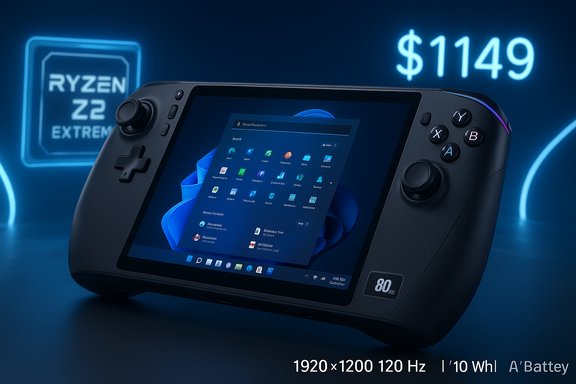
MSI’s Claw A8 has surfaced on U.S. retail pages with a sticker shock that’s hard to ignore: a Newegg listing shows an MSRP of $1,149 for the AMD-powered model, a price that places this compact Windows handheld among the most expensive consumer gaming portables on the market. The listing — paired with MSI’s own product pages and multiple independent previews and pre-order listings in Europe — confirms the headline hardware: an AMD Ryzen Z2 Extreme APU, 24GB LPDDR5x memory, a 1TB PCIe Gen4 NVMe SSD, Wi‑Fi 7, an 8-inch 1920×1200 120Hz display and an 80 Wh battery. Those specs partially explain the price, but the real story is about market positioning, component costs (especially memory), and how MSI expects consumers to value a premium Windows handheld in a crowded and fast-evolving category.
The Claw A8 is MSI’s AMD‑powered follow‑up in the Claw family, unveiled publicly during industry showcases earlier in the year and gradually rolling out through region‑by‑region preorders. MSI already ships Claw variants powered by Intel silicon (the Claw 8 AI+ series), and the A8 replaces that platform with AMD’s Z2 Extreme — the same Z2 family that several premium handhelds are adopting for higher peak and sustained performance in small, thermally constrained chassis. MSI’s official product pages list the A8’s hardware configuration and emphasize an 8‑inch FHD+ 120Hz touchscreen, 24GB LPDDR5x‑8000 memory, a 1TB PCIe Gen4 SSD, and an 80 Wh battery — a spec sheet aimed squarely at enthusiasts who want desktop‑class responsiveness in a handheld form factor. MSI’s timing matters: the broader handheld market has heated up as vendors race to deliver ever‑higher performance, better displays and console‑like ergonomics while layering Windows 11 and new “full‑screen” or console‑style launchers on top. Microsoft’s Full Screen Experience (FSE) — a Windows session posture designed to reduce background overhead and present a controller‑first launcher — is being rolled out to multiple handheld families (including MSI’s Claw models), and that software narrative is part of why OEMs are shipping more capable hardware even though it escalates cost and complexity. The Claw A8 is built to operate in that ecosystem.
The MSI Claw A8’s Newegg listing pulled back the curtain on a product already well documented in MSI’s regional pages and across independent outlets: it’s powerful, fully featured, and priced like a premium handheld. Whether consumers will accept that premium depends on how much they value the Claw’s particular blend of silicon, memory, I/O and ergonomics — and how patient they are with firmware, driver maturity and the inevitable first‑wave kinks of a new, high‑performance handheld category. For enthusiasts who want the most capable Windows handheld today and are comfortable with the tradeoffs, the Claw A8 is an appealing, if expensive, option; for the mainstream, the sticker shock may push shoppers to wait for price drops, competing OLED alternatives, or the next wave of silicon that could reset the value equation.
Source: Windows Central https://www.windowscentral.com/gami...ne-the-sticker-shock-is-impossible-to-ignore/
 Background / Overview
The Claw A8 is MSI’s AMD‑powered follow‑up in the Claw family, unveiled publicly during industry showcases earlier in the year and gradually rolling out through region‑by‑region preorders. MSI already ships Claw variants powered by Intel silicon (the Claw 8 AI+ series), and the A8 replaces that platform with AMD’s Z2 Extreme — the same Z2 family that several premium handhelds are adopting for higher peak and sustained performance in small, thermally constrained chassis. MSI’s official product pages list the A8’s hardware configuration and emphasize an 8‑inch FHD+ 120Hz touchscreen, 24GB LPDDR5x‑8000 memory, a 1TB PCIe Gen4 SSD, and an 80 Wh battery — a spec sheet aimed squarely at enthusiasts who want desktop‑class responsiveness in a handheld form factor. MSI’s timing matters: the broader handheld market has heated up as vendors race to deliver ever‑higher performance, better displays and console‑like ergonomics while layering Windows 11 and new “full‑screen” or console‑style launchers on top. Microsoft’s Full Screen Experience (FSE) — a Windows session posture designed to reduce background overhead and present a controller‑first launcher — is being rolled out to multiple handheld families (including MSI’s Claw models), and that software narrative is part of why OEMs are shipping more capable hardware even though it escalates cost and complexity. The Claw A8 is built to operate in that ecosystem. What the Newegg Listing Reveals — and What It Doesn’t
Key confirmed specs
- CPU: AMD Ryzen Z2 Extreme APU (8 cores / 16 threads, RDNA‑based integrated graphics).
- Memory: 24GB LPDDR5x‑8000 (soldered).
- Storage: 1TB NVMe PCIe Gen4 (M.2 2280).
- Display: 8" FHD+ (1920×1200) IPS‑level, 120Hz, touchscreen, VRR support.
- Battery: 80 Wh (listed on MSI product pages).
- Wireless: Wi‑Fi 7 + Bluetooth 5.4.
- I/O: Two USB‑C ports advertised as USB4 / DP / PD and Thunderbolt‑4 compatible, plus a microSD slot and 3.5mm audio combo jack.
What remains uncertain
- Manufacturer MSRP vs. retailer pricing: early retailer pages often publish placeholder or regional prices; European preorders showed prices near €975–€999, which translates into U.S. pricing in the mid‑to‑high‑$900s before taxes and tariffs — but retailer markup and stock scarcity can push prices higher. Early U.S. pages sometimes reflect actual street prices, and in this case Newegg’s $1,149 appears to be a concrete listing rather than a placeholder. Still, MSI’s own U.S. storefront or press materials did not list an official U.S. MSRP at the time the Newegg page was captured.
- Final shipping dates and channel availability: MSI enabled preorders in China and parts of Europe before a coordinated U.S. launch; the Newegg listing provides a “notify me” feature but no firm ship date is given on the product page at capture time. Historically, region staggered launches and limited inventory have led to price volatility at retail.
How the Claw A8 Compares on Paper
MSI’s spec choices put the Claw A8 among the high‑end handhelds in late 2025. Key comparison points:- Lenovo Legion Go 2 (premium 8.8" model) — Best Buy currently lists a 16GB/1TB configuration for $1,099.99 (and some configurations push higher). The Legion Go 2 differentiates with a larger 8.8" OLED (144Hz/2K) and detachable controllers, and select Z2 Extreme SKUs can include more RAM or larger SSDs. The Claw A8’s 8.0" screen is smaller but higher pixel density and a 120Hz IPS‑level panel; MSI emphasizes ergonomics, Hall‑effect sticks, and haptics. For many buyers, the Legion Go 2’s OLED and detachable controllers justify paying a similar or slightly higher price.
- MSI Claw 8 AI+ (Intel‑based sibling) — MSI’s own Claw 8 AI+ launched with Intel Core Ultra silicon and historically sat near the $999 mark at launch; current retail prices for high‑memory configurations (32GB) have drifted toward $1,099+ in some channels. The Claw A8 trades that Intel silicon for AMD’s Z2 Extreme and slightly different memory and graphics characteristics. Buyers who want AMD’s RDNA lineage and the Z2 Extreme’s performance per watt will prefer the A8, but it may compete for the same buyer pool as MSI’s existing inventory.
- Valve’s Steam Deck and Nintendo’s Switch 2 — neither competes directly on raw CPU/GPU headroom or Windows ecosystem flexibility. The Steam Deck remains substantially cheaper; the Claw A8 aims at power users who accept a Windows desktop experience and mod/launcher fragmentation for higher performance and Windows compatibility.
Why the Price Is So High: Components, Supply Chains, and Positioning
There are three distinct forces driving the Claw A8’s premium street price.- Premium silicon and memory: the Ryzen Z2 Extreme is a top‑tier APU with stronger CPU cores and an RDNA‑based iGPU that needs dual‑channel high‑speed LPDDR5x memory to deliver its best results. MSI ships the A8 with 24GB LPDDR5x‑8000, a high‑margin, high‑cost component that’s significantly more expensive than the 16GB configurations common in the mid‑range handheld market. Industry reporting throughout 2025 also flagged rising DRAM and LPDDR5X pricing pressures as memory makers reallocated capacity toward HBM and server/AI demand — a shift that pushed mobile LPDDR and desktop DDR5 prices up year‑over‑year. Those market forces make high‑capacity, high‑speed LPDDR5x configurations materially more expensive to produce.
- Platform validation and premium ergonomics: MSI added features that cost money — Hall‑effect sticks and triggers, HD haptics, an 80 Wh cell, and two USB4/Thunderbolt‑capable Type‑C ports. These are not cheap to spec into a compact enclosure, and MSI has clearly positioned the device as a premium handheld rather than a budget portable.
- Retail channel and scarcity effects: when a new high‑demand SKU appears in limited quantities, retailers often price to match expected demand; preorders in Europe landed near €975–€999 and the Newegg U.S. listing at $1,149 may reflect retailer expectations, import duties, shipping/logistics markup, or simply an initial premium for scarcity. Historical launches in this category have shown that early street prices can be higher than later MSRP as inventory fills.
Performance Expectations and Practical Tradeoffs
On paper, the Z2 Extreme + 24GB LPDDR5x puts the Claw A8 in a position to best most earlier handhelds in raw CPU throughput and integrated graphics performance — especially when thermal limits are handled well. Independent reviews and hands‑on previews show the Z2 Extreme delivering meaningful gains over previous Intel handheld APUs in CPU‑heavy titles and multitasking scenarios. Early testing indicates noticeable improvements in framerate headroom for demanding titles when paired with dual‑channel high‑speed LPDDR5x. That said, real‑world experience depends on thermals and power profiles: an 80 Wh battery in a small chassis is large for a handheld, but powerhungry games at higher TDPs will still substantially limit session lengths. Expect 2–4 hour gaming sessions under heavier loads unless you tune down power or frame rate. Key practical tradeoffs:- Thermals and acoustic profile: squeezing high sustained performance into a sub‑800 g chassis requires aggressive fan curves or thermal peaks that can become audible. Reviewers for similar high‑end handhelds consistently report a tradeoff between sustained FPS and noise/heat. MSI’s improved cooling and 80 Wh battery help, but physics still applies.
- Battery life: expect solid performance-per-watt in short bursts, but AAA titles at high settings will shorten runtime; efficient power profiles or cloud streaming remain practical ways to extend playtime. MSI advertises an 80 Wh pack but actual run times will vary widely.
- Windows ergonomics vs. console simplicity: Windows 11 is flexible, but not as seamless as a console’s launcher. Microsoft’s Full Screen Experience attempts to bridge that gap by reducing background overhead and surfacing controller‑first UI, and MSI Claw models are among the handhelds included in early FSE previews. That helps the user experience, but Windows still exposes antivirus, drivers, and multi‑storefront complexity that some buyers find cumbersome.
The Full Screen Experience and Software Play
Microsoft’s FSE is increasingly important to OEM handheld strategy. It’s a layered session in Windows 11 that can run the Xbox PC app (or another home app) as a full‑screen shell, deferring many desktop background activities to reclaim RAM and reduce CPU wakeups during gaming. MSI Claw devices were explicitly called out in recent Windows Insider build notes as being part of the staged FSE rollout, making the Claw A8 a first‑class candidate for a console‑like Windows handheld experience. That software-side optimization matters because it’s often the difference between a handheld that feels fast and one that merely is fast on paper. This matters for purchase decisions because Windows’ default posture tends to carry more background load than console environments. If FSE works as advertised on the Claw A8 (and early reports indicate modest but useful RAM reclamation and improved perceived smoothness), that will help justify the hardware premium for some buyers. However, FSE is still delivered via staged previews and OEM entitlements, so the experience may vary across units and firmware builds.Pricing Context: Is $1,149 Reasonable?
Price sensibility comes down to comparison and buyer intent.- Against laptops: a thin gaming laptop with equivalent CPU/GPU capability and 24GB RAM/1TB SSD typically costs more than $1,000 and offers better thermals and battery life. The Claw A8’s value hinges on portability and handheld ergonomics; if you need a true portable PC that fits in a coat pocket and plays modern AAA titles at reasonable settings, paying a premium for a handheld makes sense.
- Against rival handhelds: the Lenovo Legion Go 2’s 16GB/1TB OLED variant lists near $1,099 in some U.S. channels; MSI’s Claw 8 AI+ with 32GB has been seen in the $1,099–$1,199 range depending on inventory. The Claw A8 at $1,149 is priced squarely among these high‑end options — expensive, but not unprecedented for top SKUs in this category. Buyers who value OLED, detachable controllers, or a larger screen may still prefer rivals.
- Against lower‑cost alternatives: the Steam Deck and other lower‑cost handheld PCs remain far cheaper and offer excellent value for many gamers who don’t need very high framerates or Windows compatibility. If price is the top priority, the Claw A8’s premium is hard to justify.
Risks, Caveats, and What Buyers Should Watch
- Component shortages and price volatility: DRAM and NAND price dynamics in 2025 have been volatile. Industry analysts and outlets reported notable DRAM price increases mid‑2025 as memory makers shifted capacity toward HBM and AI workloads, and some manufacturers signaled price adjustments. That contributes to higher BOM (bill of materials) costs for devices using large LPDDR5x configurations. Expect price changes and small‑SKU shortages to affect availability and retailer pricing.
- Software maturity and real‑world frametimes: marketing often highlights impressive peak figures, but real gaming depends on driver maturity, power tuning and game‑specific optimizations. Independent testing is the only reliable path to understanding what the Z2 Extreme will deliver across a broad title set on Claw‑class thermals. Early reviews suggest strong gains, but also emphasize that expectations should be calibrated.
- Warranty, repairability and user upgrades: the Claw A8 lists a single M.2 2280 SSD slot and soldered LPDDR5x memory in many SKUs; buyers who prize upgrade paths should verify the exact model and return policies. Also confirm warranty coverage and whether cross‑region units carry different terms.
- Price vs. resale and depreciation: handhelds are fast‑moving categories. Newer silicon or a market glut can quickly reduce resale values; buy from retailers with good return policies if you’re an early adopter.
Practical Buying Checklist (If You’re Considering a Claw A8)
- Confirm the SKU: verify the exact memory, SSD capacity and regional SKU code on the retailer page. Don’t assume all Claw A8 models are identical.
- Check return windows and warranty terms: early handheld launches can be bumpy; choose a seller with flexible returns.
- Compare display and controller priorities: an OLED 144Hz larger display (Legion Go 2) or detachable controllers (Legion Go 2) may be more valuable than the A8’s raw silicon for some users.
- Read independent reviews and thermals tests before heavy use: firmware and driver improvements can change the experience substantially in the first weeks after launch.
- If battery life is critical, review measured runtimes in the wild and consider lower power modes or cloud streaming options.
Strengths — What MSI Did Right
- Competitive silicon pairing: Ryzen Z2 Extreme offers significant compute headroom and efficient RDNA‑based graphics for a handheld. Combined with high‑speed LPDDR5x, that makes the device credible for demanding gameplay and multitasking.
- Quality controls and ergonomics: Hall‑effect analog sticks, Hall triggers, HD haptics, and a roomy control layout are upgrades that show MSI focused on usability as well as raw specs. Those improvements matter in everyday play and longevity.
- Modern connectivity: USB4/Thunderbolt‑class ports and Wi‑Fi 7 future‑proof the device for docks and high‑bandwidth accessories. For users who want to dock to monitors or external storage, that’s a meaningful advantage over cheaper handhelds.
Weaknesses and Risks — Where MSI Could Face Pushback
- Price sensitivity: at $1,149, the Claw A8 sits in a pricing tier where buyers expect near‑laptop polish and longevity. Any software bugs, thermals issues, or lack of firmware updates will be punished in reviews and resale.
- Battery/runtime tradeoff: an 80 Wh cell is large but not magical; sustained high‑watt games will still drain battery quickly in a handheld chassis. Some users will prefer larger, heavier devices or external battery solutions for marathon sessions.
- Windows friction: until Microsoft’s FSE and OEM firmware are mature across the board, Windows handhelds will continue to feel less plug‑and‑play than console alternatives. That increases the importance of MSI’s firmware support and MSI Center tooling.
Final Analysis: Who Should Buy the Claw A8?
The Claw A8 is tailored for a specific buyer profile: a Windows‑oriented enthusiast who wants the best possible portable PC gaming experience without jumping up to a bulky laptop.- Buy if you: value high single‑thread and integrated GPU performance, need modern I/O and docking options, prioritize premium controls/ergonomics, and accept paying a premium for a high‑spec handheld.
- Don’t buy if you: want the best battery life per dollar, prefer a console‑like plug‑and‑play experience, or need the best possible display tech (OLED) and detachable controllers for local co‑op. Steam Deck, Lenovo Legion Go 2 and other options remain attractive for value or specific features.
The MSI Claw A8’s Newegg listing pulled back the curtain on a product already well documented in MSI’s regional pages and across independent outlets: it’s powerful, fully featured, and priced like a premium handheld. Whether consumers will accept that premium depends on how much they value the Claw’s particular blend of silicon, memory, I/O and ergonomics — and how patient they are with firmware, driver maturity and the inevitable first‑wave kinks of a new, high‑performance handheld category. For enthusiasts who want the most capable Windows handheld today and are comfortable with the tradeoffs, the Claw A8 is an appealing, if expensive, option; for the mainstream, the sticker shock may push shoppers to wait for price drops, competing OLED alternatives, or the next wave of silicon that could reset the value equation.
Source: Windows Central https://www.windowscentral.com/gami...ne-the-sticker-shock-is-impossible-to-ignore/
