

Michigan State University’s student-run AI Club has become a surprising — and instructive — bellwether for how tomorrow’s workforce is learning to live with generative artificial intelligence: enthusiastic about the tools, pragmatic about the limits, and deliberate about teaching both techniques and ethics. mpus pivot toward practical AI
Since the public debut of ChatGPT in November 2022, generative AI has accelerated from a technical curiosity into a mainstream productivity platform that colleges can no longer ignore. The technology’s adoption in higher education has split institutions into different strategies: some ban or restrict tool use in specific courses; others teach AI literacy and integrate tooling into learning outcomes. Michigan State University’s approach combines campus-wide access to enterprise tools with grassroots student training and ethics programming — a model that is visible in the MSU-AI Club’s weekly workshops and the university’s decision to make Microsoft Copilot available to the MSU community under its enterprise agreement.
MSU IT formally announced Microsoft Copilot availability to the campus community as part of its enterprise agreement in late 2024, framing the move as an equity play that provides secure, institutionally managed access rather than leaving students to rely solely on public consumer services. The university’s course-level guidance has reinforced that Copilot is the approved GenAI resource for MSU coursework, requiring students to log in with university credentials to use Copilot in class.
Vibe-coding is not a niche fad: the term and practice were popularized in the last two years, and media, industry, and even dictionary trackers have documented its rapid rise. Industry reporting shows startups and tooling companies racing to productize AI-first development workflows, and commentators are already warning of a “vibe-coding hangover” when AI-produced code is promoted into production without the usual engineering safeguards. Those conditions make student clubs like MSU’s particularly valuable: they are low-risk environments where prototyping and critique can co-exist.
That institutional control also enables clearer academic policy. Several MSU course materials and syllabi now make explicit statements: only MSU-approved GenAI tools (Copilot, in particular) may be used for course tasks unless otherwise specified; assignments that test raw cognitive skills may restrict AI use; and instructors may require disclosure and evidence of student-led reasoning when AI-assisted outputs are present. Those classroom guardrails mirror approaches educators nationwide who are trying to balance learning outcomes with tool-driven productivity.
Employers increasingly seek candidates who demonstrate tool fluency and responsible usage: being able to describe how you used Copilot, what checks you applied, and how you mitigated data leakage can be differentiators in interviews. The MSU club’s alumni network emphasizes this practical benefit — members build demonstrable experience and the soft skills of translating tools into business decisions.
That experiential learning is where education may deliver its greatest value in an age of rapid automation. Rather than trying to freeze-surface learning in a policy ban, MSU’s model of managed access plus structured literacy training offers a template that other campuses can study — with the caveat that governance, equity, and contractual transparency must keep pace with technological change.
Generative AI will reshape work and learning; how universities respond will determine whether students enter the workforce empowered to lead change or unprepared for the nuanced responsibilities of AI-enhanced roles. MSU’s approach — a campus-sanctioned Copilot plus hands-on, ethically framed club programming — offers a pragmatic path forward. Clubs, classrooms, and administrators all have roles to play: teach the fundamentals, require critical verification, and use institutional leverage to ensure tools are safe, equitable, and auditable. That combination is the best safeguard against hype — and the clearest route to ensuring students benefit from the power of AI without surrendering the intellectual habits that education is meant to cultivate.
Source: The State News For MSU-AI Club, new tech generates excitement - The State News
Since the public debut of ChatGPT in November 2022, generative AI has accelerated from a technical curiosity into a mainstream productivity platform that colleges can no longer ignore. The technology’s adoption in higher education has split institutions into different strategies: some ban or restrict tool use in specific courses; others teach AI literacy and integrate tooling into learning outcomes. Michigan State University’s approach combines campus-wide access to enterprise tools with grassroots student training and ethics programming — a model that is visible in the MSU-AI Club’s weekly workshops and the university’s decision to make Microsoft Copilot available to the MSU community under its enterprise agreement.
MSU IT formally announced Microsoft Copilot availability to the campus community as part of its enterprise agreement in late 2024, framing the move as an equity play that provides secure, institutionally managed access rather than leaving students to rely solely on public consumer services. The university’s course-level guidance has reinforced that Copilot is the approved GenAI resource for MSU coursework, requiring students to log in with university credentials to use Copilot in class.
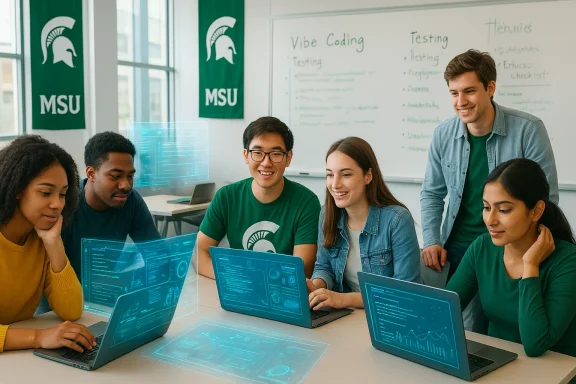 What the MSU-AI Club is doing — hands-on learning, fast prototyping, and ethics
Weekly workshops and cross-major participation
The MSU-AI Club has built its identity around weekly workshops that deliberately serve a heterogeneous audience: freshmen and transfer students with little technical background, juniors and seniors pursuing deep CS projects, and majors outside computing who want AI skills for research, business, or design. Workshop topics range from prompt engineering and dataset basics to vibe-coding sessions that demonstrate how modern models can turn human language into working code nearly instantly. The club’s outreach balances rapid prototyrring lessons in fundamentals so students don’t mistake convenience for mastery.Vibe-coding: speed, novelty — and a cautionary tail
“Vibe-coding” — a term popularized by prominent AI engineers to describe the practice of prompting LLMs to generate code and accepting iterative, conversationally-produced outputs rather than writing every line manually — has become a headline topic in the club’s programming. Vibe-coding enables blisteringly fast prototypes and lowers the barrier to software creation, but it also raises hard questions about maintainability, security, and technical understanding. MSU’s student leaders explicitly make space in workshops to demonstrate both sides: how quickly a full stack prototype can be assembled and how brittle if students skip testing, code review, or basic debugging.Vibe-coding is not a niche fad: the term and practice were popularized in the last two years, and media, industry, and even dictionary trackers have documented its rapid rise. Industry reporting shows startups and tooling companies racing to productize AI-first development workflows, and commentators are already warning of a “vibe-coding hangover” when AI-produced code is promoted into production without the usual engineering safeguards. Those conditions make student clubs like MSU’s particularly valuable: they are low-risk environments where prototyping and critique can co-exist.
Why campus access to enterprise Copilot matters
Enterprise access to tools like Microsoft Copilot changes the dynamics of student exposure. Consumer-grade AI services are convenient, but they often pose unknown privacy and data-retention risks. When universities provide Copilot under a managed license, IT teams can enforce protections around student data, control how enterprise content is used, and integrate tools into teaching with consistent policies. MSU’s rollout explicitly framed Copilot as a way to equalize access — allowing students from different socioeconomic backgrounds to use the same capabilities without incurring personal subscription costs.That institutional control also enables clearer academic policy. Several MSU course materials and syllabi now make explicit statements: only MSU-approved GenAI tools (Copilot, in particular) may be used for course tasks unless otherwise specified; assignments that test raw cognitive skills may restrict AI use; and instructors may require disclosure and evidence of student-led reasoning when AI-assisted outputs are present. Those classroom guardrails mirror approaches educators nationwide who are trying to balance learning outcomes with tool-driven productivity.
Strengths: what students (and employers) gain
- Rapid prototyping and portfolio building. Vibe-coding and Copilot-assisted workflows let students produce demonstrable artifacts — apps, small data pipelines, or analytics dashboards — that can be included in portfolios and interviews.
- Tool fluency that employers increasingly expect. Companies are shifting hiring criteria toward practical tool use: being able to explain how you used AI responsibly is as marketable as traditional programming fluency in many roles.
- Lowered access barriers. Providing Copilot through campus licensing reduces inequities in who can experiment with paywalled AI products, giving more students practical exposure to industry-standard tools.
- Focus on real-world problem framing. In workshops, students often start with domain problems (policy analysis, group project coordination, or small-business automation) and use AI to move from idea to prototype, promoting product-thinking skills.
- Community learning and knowledge transfer. Clubs create peer-to-peer learning that is more responsive than static courses — members share new techniques, tooling updates, and ethical pitfalls in near real time.
Risks and technical realities: where enthusiasm must be tempered
Overreliance and cognitive short-cuts
Generative models produce fluent, authoritative outputs that can lull students into accepting answers without verification. Studies and instructor reports from campuses experimenting with open access show a decline in certain kinds of practice-based learning when students default to AI solutions for reasoning-intensive tasks. That’s why workshops that pair productivity demonstrations with ethics and fundamentals are important: they intentionally force verification steps, test-driven development, and explanation requirements.Fragility of AI-generated code
AI can fabricate plausible but incorrect APIs, gloss over error handling, or recommend insecure defaults. Vibe-coded prototypes that “work” in a demo can contain obscure vulnerabilities or logic bugs that surface under load. The club’s practice of emphasizing testing, code review, and the limits of AI-generated solutions addresses this practical risk, but students must be made explicitly aware that production-readiness demands domain knowledge the model cannot replace. Industry reporting on “vibe-coding hangover” scenarios publicly amplifies these concerns as projects scale beyond throwaway prototypes.Data governance and privacy
Enterprise Copilot adds institutional controls, but broad AI use still raises questions: which data sources are appropriate to feed into models, how student work is stored or logged, and whether vendor policies permit reuse of university data. Contractual arrangements matter: universities that sign enterprise agreements need to audit vendor data practices and maintain policies that protect students’ intellectual property and sensitive information. MSU’s policy choices show awareness of these concerns by designating Copilot as the approved tool and embedding disclosure expectations in course guidance.Equity and educational justice
If AI adoption is uneven — with well-resourced campuses offering deep tool access while underfunded institutions lag — educational inequities could widen. Centralized licenses and open-access experimentation help, but administrators and faculty must also ensure curricular alignment so AI skills aren’t siloed into extracurricular clubs that only some students can access. The MSU model — coupling campus provision of Copilot with community workshops and curricular guidance — is a practical template for mitigation, bned investment.How MSU-AI Club balances speed with rigor — practices worth copying
- Teach the fundamentals first. Workshops deliberately cover debugging, algorithmic thinking, and test design before encouraging students to lean into vibe-coding. That reduces the risk that a student’s portfolio contains impressive-looking but shallow artifacts.
- Require prompt documentation and model critique. Students are asked to save prompts, document model outputs, and write short critiques that surface hallucinations or incorrect assumptions — an approach instructors can adopt to preserve assessment ed deliverables. Assignments that require incremental submissions (plan → initial unaided attempt → AI-assisted refinement) reward learning process rather than end-product polish.
- Maintain an ethics workshop every year. The club’s annual ethics session ensures students discuss fairness, bias, and the social consequences of automating tasks. These conversations are as essential as technical training.
The job market and the two-sided coin of displacement and specialization
Students and alumni tied to the MSU-AI Club express a realistic view: AI will displace some routine tasks while creating new niche roles and shifting craft boundaries. That view is consistent with broader labor-market analyses which suggest that automation disproportionately affects repetitive and well-defined tasks, while adding demand for roles that combine domain expertise with AI oversight, tooling, and governance. For students, this means adaptability — learning how to ask better questions of models, design audits, and understand datasets — is as valuable as memorizing syntax.Employers increasingly seek candidates who demonstrate tool fluency and responsible usage: being able to describe how you used Copilot, what checks you applied, and how you mitigated data leakage can be differentiators in interviews. The MSU club’s alumni network emphasizes this practical benefit — members build demonstrable experience and the soft skills of translating tools into business decisions.
Critical analysis: what MSU’s approach gets right — and where institutional leaders must be vigilant
What MSU gets right
- Managed access to enterprise tools reduces privacy and vendor-risk exposure compared to ad hoc consumer use.
- Combining hands-on workshops with explicit ethics and fundamentals training preserves learning outcomes while enabling innovation.
- Club-driven peer learning complements formal courses and keeps students connected to evolving industry practices.
- Documentation and staged assignment formats align assessment with learning in an AI-augmented environment.
Where MSU (and similar institutions) must be vigilant
- Policy continuity: enterprise licenses and course guidance need consistent enforcement and periodic review to reflect rapid changes in vendor policies and model capabilities.
- Cross-campus equity: student clubs are valuable, but institutions must ensure that curricular integration of AI doesn’t rely solely on extracurricular engagement.
- Auditable use and faculty training: instructors require ongoing professional development to design assessments that measure reasoning instead of product polish.
- Data contract transparency: institutional leaders should publish summaries of vendor contracts and privacy safeguards so students and faculty understand what data is used and how.
Practical recommendations for faculty, administrators, and student leaders
- Faculty: Require prompt logs and short reflective memos alongside any AI-assisted deliverable. Use staged submissions that mandate unaided attempts before AI use.
- Administrators: Treat enterprise AI access as an extension of campus infrastructure. Audit vendor practices, publish clear usage policies, and fund training for teaching staff.
- Student clubs: Continue to pair speed-focused workshops (vibe-coding demos) with mandatory fundamentals sessions and ethics forums. Encourage cross-major recruitment to widen participation.
- Career services: Update job-prep modules so students can articulate responsible AI usage in interviews and translate club projects into role-relevant narratives.
The larger story: campus labs as laboratories for social adaptation
Student organizations like the MSU-AI Club are not simply hobby groups; they function as adaptive labs where future professionals practice integrating new tools into real workflows. In these spaces, students learn to move from curiosity to competence: they build prototypes, examine where models fail, and develop the habits of testing and critique required to deploy AI responsibly.That experiential learning is where education may deliver its greatest value in an age of rapid automation. Rather than trying to freeze-surface learning in a policy ban, MSU’s model of managed access plus structured literacy training offers a template that other campuses can study — with the caveat that governance, equity, and contractual transparency must keep pace with technological change.
Conclusion: a hopeful, hard-headed roadmap
The MSU-AI Club’s mix of excitement and skepticism captures the pragmatic mindset students will need in the generative-AI era. The club’s programming — from vibe-coding demos to recurring ethics workshops and practical guidance on Copilot — demonstrates how campuses can provide both exposure to transformative tools and the scaffolding necessary to use them responsibly. Institutional provision of enterprise tools like Microsoft Copilot reduces privacy and equity gaps, but it also imposes an obligation on universities to pair access with curriculum, transparent governance, and faculty development.Generative AI will reshape work and learning; how universities respond will determine whether students enter the workforce empowered to lead change or unprepared for the nuanced responsibilities of AI-enhanced roles. MSU’s approach — a campus-sanctioned Copilot plus hands-on, ethically framed club programming — offers a pragmatic path forward. Clubs, classrooms, and administrators all have roles to play: teach the fundamentals, require critical verification, and use institutional leverage to ensure tools are safe, equitable, and auditable. That combination is the best safeguard against hype — and the clearest route to ensuring students benefit from the power of AI without surrendering the intellectual habits that education is meant to cultivate.
Source: The State News For MSU-AI Club, new tech generates excitement - The State News
