

MTR Corporation’s move to embed generative AI across its passenger services and frontline workforce — using Microsoft 365 Copilot and the Microsoft Power Platform — is a vivid example of how a legacy transport operator can combine low-code innovation and role-based AI agents to reduce repetitive work, improve information quality, and surface faster decisions at scale. Microsoft’s customer story lays out a concise narrative: public-facing virtual assistants (branded as AI Tracy), internal chatbots for station staff, and HR automation built with Power Apps all sit alongside Copilot features in Word, Excel, Outlook and Teams to reclaim “thousands of hours” of manual labour and tighten consistency across hundreds of daily operational decisions. (microsoft.com)
This feature unpacks what MTR has implemented, separates vendor claims from independently verifiable facts, and evaluates the operational benefits, governance needs, and technical risks transport operators should plan for when adopting similar AI-driven workflows.
MTR Corporation operates one of the world’s busiest urban rail networks and has made digital transformation a strategic priority to “keep cities moving.” The company’s public statements and vendor materials describe a dual-track approach:
What these systems typically do:
Independent coverage specifically naming the internal staff chatbot is limited in public press; the primary description of the staff chatbot appears in Microsoft’s customer case study. Because this is currently a vendor‑published claim, it should be treated as an accurate account of MTR’s stated architecture but flagged as a claim that lacks independent operational metrics in public reportage. (microsoft.com)
Conclusion
MTR’s integration of Microsoft 365 Copilot and Power Platform provides a clear, replicable framework for modernising both customer service and frontline operations in a transit environment. The combination of public kiosks (AI Tracy), staff-facing chatbots, and low-code HR automation shows what a pragmatic, human-led AI strategy looks like in transport: rapid iteration, human review, and governed expansion. Organisations that follow MTR’s example should prioritise grounding, governance, observability, and workforce engagement to convert vendor promises into durable operational value. The promise is real — but the safeguards determine whether the transformation remains a durable improvement or an operational liability. (microsoft.com)
Source: Microsoft Keeping Cities Moving: How MTR Corporation Elevates Service with Microsoft 365 Copilot and Power Platform | Microsoft Customer Stories
This feature unpacks what MTR has implemented, separates vendor claims from independently verifiable facts, and evaluates the operational benefits, governance needs, and technical risks transport operators should plan for when adopting similar AI-driven workflows.
 Background / Overview
MTR Corporation operates one of the world’s busiest urban rail networks and has made digital transformation a strategic priority to “keep cities moving.” The company’s public statements and vendor materials describe a dual-track approach:- Deploy customer-facing generative AI kiosks and virtual ambassadors (AI Tracy) to answer passenger queries and reduce simple front-line enquiries.
- Embed role-based internal copilots and chatbots to give station staff instant access to operating procedures, and to accelerate HR and administrative tasks via low-code Power Platform solutions. (microsoft.com)
What MTR built — concrete elements
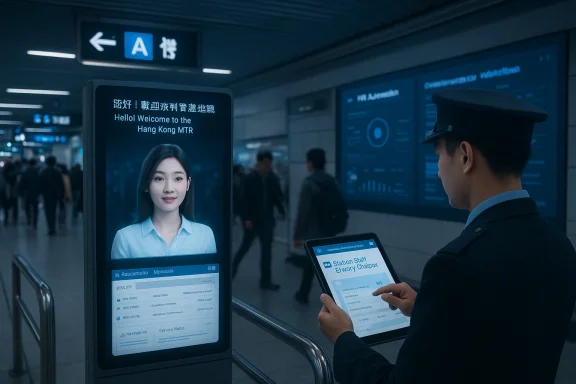
1. AI Tracy — a virtual service ambassador for passengers
MTR’s public materials describe AI Tracy as a Gen‑AI-powered “virtual service ambassador” deployed on kiosks in several stations. Independent local reports and third‑party vendors that supplied digital-human technology corroborate the deployment and document station pilots and expansions. Reporting indicates AI Tracy was installed at multiple high‑traffic stations and has been used to provide bilingual (Cantonese/Mandarin/English) assistance, route guidance, and contextual station information. Some local outlets also covered interactive marketing tie‑ins that used AI Tracy during large events. (microsoft.com)What these systems typically do:
- Accept spoken or typed passenger queries and respond in natural language.
- Ground answers in curated station data, timetables, and service notices to avoid inconsistent guidance.
- Escalate to human staff when queries are complex, sensitive, or flagged by safety policies.
- Support content in multiple languages and mixed-language “Cantonese + English” patterns commonly used in Hong Kong.
2. Station Staff Enquiry Chatbot — frontline enablement
According to the Microsoft customer story, MTR created an internal Station Staff Enquiry Chatbot that provides immediate access to approved operating procedures and work instructions. The goal is to reduce onboarding time for new staff and give experienced staff fast clarification in the flow of work, improving compliance and operational consistency. This capability is described as part of a broader program of role-based copilots and low-code apps. (microsoft.com)Independent coverage specifically naming the internal staff chatbot is limited in public press; the primary description of the staff chatbot appears in Microsoft’s customer case study. Because this is currently a vendor‑published claim, it should be treated as an accurate account of MTR’s stated architecture but flagged as a claim that lacks independent operational metrics in public reportage. (microsoft.com)
3. Power Platform for low‑code automation (HR example)
MTR’s customer story highlights Microsoft Power Platform (Power Apps, Power Automate, Power BI) as the backbone for low‑code, governable solutions. An explicit HR use case: Power Apps integrated with generative AI helps draft job descriptions and other HR artefacts, turning a task that “once required hours” into a process that completes in minutes and is then refined by humans. This captures a practical low-code + Copilot pattern: Copilot generates structured content; a human reviews and publishes. (microsoft.com)4. Microsoft 365 Copilot across knowledge work
MTR uses Microsoft 365 Copilot embedded in Word, Excel, Outlook, and Teams to accelerate drafting, summarisation, and analysis. The customer story calls out specialised agents — Researcher and Interpreter — for research‑to‑brief workflows and real‑time language interpretation, respectively. These agents are part of Microsoft’s broader Copilot feature set and road map. Microsoft’s release notes and product documentation confirm Researcher and Interpreter (and other agent features) are public parts of Copilot’s enterprise tooling. (microsoft.com)Independent corroboration: what is verifiable today
- Microsoft’s own customer story documents MTR’s adoption and describes AI Tracy, the staff chatbot, Power Platform use, and the CIO’s quotes. This is the primary source for many implementation details. (microsoft.com)
- Independent local press and industry writeups confirm AI Tracy’s public kiosk deployments, station coverage expansion, and event-based interactions (e.g., collaboration for concerts and station broadcasts). These reports independently verify the public-facing ambassador exists and is in active use.
- Microsoft product documentation and release notes verify the technical capabilities MTR claims to be using — for example, Researcher and Interpreter agents, Power Platform connectors, and the ability to publish Power Platform agents in Teams/Copilot. These docs also detail the governance and admin controls organisations should implement.
- Specific operational metrics cited in the customer story (e.g., “thousands of hours saved”) are vendor-reported efficiency claims without third‑party audit data publicly available. Treat these as directional indicators, not independently audited facts. (microsoft.com)
- Details about the exact scope, number of internal users for the Station Staff Enquiry Chatbot, and a quantified reduction in onboarding time are not published outside vendor materials; those remain MTR‑reported outcomes. (microsoft.com)
Why this matters for transport operators
Public transport is a high‑frequency, safety‑critical service. The pragmatics of deploying AI in this context are different from a marketing or back‑office app. The MTR story illustrates three high‑value, low‑risk starting points that other operators can emulate:- Customer self‑service at scale — Deploying a grounded virtual ambassador reduces simple ticketing and wayfinding queries and improves service consistency at busy nodes. Because kiosks are localized and backed by curated knowledge, they can reduce repetitive calls and free human staff for exceptions. (microsoft.com)
- Frontline workforce augmentation — A staff chatbot delivers point‑of‑need access to procedures, lowering cognitive load in operational situations where staff must follow exact protocols. This reduces variance and speeds onboarding. (microsoft.com)
- Low‑code for operational velocity — Power Platform lets domain teams own solutions, shortening the time from problem identification to production while retaining IT governance controls for connectors, data classification, and lifecycle management. (microsoft.com)
Critical analysis — strengths, trade-offs, and hidden risks
Strengths and operational wins
- Speed and reach: Generative AI plus low-code drastically shortens build cycles and gets capability into the hands of business users quickly. MTR’s narrative — and its verified public kiosks — show how quickly a public‑facing service can scale once the content and safety scaffolding are in place. (microsoft.com)
- Consistency at scale: Role‑based copilots and internal chatbots help reduce human variance in repetitive decisions, improving service reliability in a safety‑oriented environment. (microsoft.com)
- Human-led governance: MTR states that AI outputs are always reviewed by human experts and that low‑code apps are deployed with oversight — a pragmatic, hybrid approach that balances speed and compliance. (microsoft.com)
Trade‑offs and technical risks
- Model hallucination and grounding: Generative models sometimes invent plausible-sounding but incorrect facts. In passenger-facing or safety‑sensitive contexts, the system must be strictly grounded to verified data and include robust fallbacks. Vendors’ product features (like document grounding and knowledge connectors) exist, but their effective configuration is an operational responsibility.
- Data residency and compliance: Kiosk interactions, staff queries, and HR artefacts can contain personal data. Where cloud LLMs or third‑party components are used, operators must ensure data residency, encryption-in-transit/at-rest, and regulatory alignment with local privacy laws. Microsoft’s agent and Power Platform docs flag potential data flows across services and advise admins to configure connectors and controls.
- Operational dependency on vendor stack: Deep integration with a single vendor’s Copilot + Power Platform suite speeds rollout but concentrates supply-chain risk. Operators should plan for portability of critical knowledge and offline fallback capabilities so a vendor outage or change in commercial terms doesn’t cripple frontline workflows.
- Workforce dynamics: While staff chatbots can accelerate onboarding, they can also shift work patterns and expectations. Organisations must invest in reskilling and ensure that AI augments rather than simply offloads responsibility unsafely onto less experienced staff.
- Monitoring and observability gaps: Agent-driven workflows — especially when they automate multi‑step actions — require observability, audit trails, and performance metrics. Microsoft’s Copilot tools include agent analytics, but effective governance requires integrating those telemetry streams into existing incident and change processes.
Governance and safety — what a responsible rollout requires
Operators wanting to replicate MTR’s results should design a clear governance playbook before any public deployment. Key elements include:- Data classification and access policies
- Identify which data sources are permissible for grounding generative responses (timetables, official notices, safety procedures).
- Enforce role-based access controls for editors and reviewers.
- Treat HR and personally identifiable information (PII) as a higher-risk domain: lock it to approved services and review connectors carefully.
- Human-in-the-loop and escalation patterns
- Mandate human review for content that affects safety, service changes, or financial transactions.
- For kiosks and staff chatbots, define explicit escalation criteria so any query that indicates risk, abuse, or uncertainty routes to trained staff immediately.
- Model grounding and update cadence
- Anchor answers to canonical datasets and maintain a strict update cadence; e.g., service notices and timetable changes must propagate to the knowledge base within X minutes/hours.
- Log knowledge versions so answers can be audited to a specific data snapshot.
- Telemetry, auditing and KPIs
- Collect interaction logs, handover rates to humans, satisfaction scores, and mis‑response incidents.
- Use these metrics to iterate on prompts, knowledge coverage, and retraining of grounding rules.
- Red-team testing and safety ops
- Conduct scenario-based testing including adversarial prompts, mixed‑language inputs, and edge cases (emergencies, service delays).
- Maintain an incident runbook for model misbehaviour that includes public communications and remediation.
- Legal and procurement
- Negotiate SLAs and data‑handling clauses that cover model retraining, data deletion, and access to raw logs for compliance audits.
Recommended phased rollout — a practical blueprint
- Pilot: Start small with a single station kiosk and an internal staff chatbot for a narrow set of procedures. Measure handover rates and query accuracy.
- Harden: Add grounding to canonical sources (timetables, safety manuals), implement RBAC, and build the escalation pathways to human staff.
- Scale: Expand kiosk coverage and staff chatbot scope, while instrumenting telemetry and automating update pipelines for knowledge changes.
- Govern: Establish a Copilot/Power Platform Centre of Excellence (CoE) to manage templates, connectors, cost allocation, and lifecycle management.
- Iterate: Use metrics-driven improvements to prompts, knowledge, and UI. Integrate employee feedback loops and formal retraining cycles.
Measuring success — meaningful KPIs
Avoid vanity metrics and focus on operational outcomes that matter to passengers and safety:- Reduction in average call-to-human time at information counters.
- Percentage of passenger queries resolved end‑to‑end by kiosks (first‑contact resolution).
- Onboarding time for new station staff (measured before/after knowledge-chatbot introduction).
- Number and severity of mis‑response incidents and time to remediate.
- Employee satisfaction and adoption metrics for Copilot in day‑to‑day work.
- Cost‑per‑interaction and ROI timeline (months to break‑even).
Technical nitty‑gritty and integration considerations
- Connector hygiene: Many agent features rely on connectors to SharePoint, OneDrive, Teams, or third‑party systems. Operators must inventory which connectors are allowed, and configure data loss prevention (DLP) policies accordingly. Microsoft docs show the publisher flows and explicit admin steps for publishing agents into Teams and Copilot.
- Grounding and search: Use enterprise search (Copilot Search or alternative) that can return authoritative documents and exact quotes, and avoid exposing unfettered web results in safety‑critical answers. Release notes and Copilot product pages emphasise the Researcher agent’s ability to ground research in internal docs — a capability MTR is reported to use.
- Localization and language mixing: Hong Kong passengers frequently issue mixed Cantonese/English queries. MTR’s kiosk deployments demonstrate LLM systems can be tuned to these patterns, but doing so requires careful dataset curation and testing against common local expressions. Independent reporting documents that AI Tracy supports mixed language inputs.
- Offline resilience: Build offline fallbacks for critical services — for example, cached canonical responses, printable quick reference sheets, or a call‑in fallback to human staff when connectivity or model backends are unavailable.
Ethical and social considerations
- Transparency: Notify passengers when they interact with a digital agent rather than a human, and provide simple options to escalate to a person. Public feedback around AI Tracy shows users expect an immediate and clear path to human assistance.
- Bias and fairness: Evaluate language models for differential performance across languages and accents. A bilingual deployment must be audited for accuracy parity across Cantonese, Mandarin and English.
- Workforce impact: Communicate clearly with staff about how chatbots and Copilot will change workflows, and offer reskilling opportunities. The right outcome is augmentation — freeing staff from repetitive tasks while preserving human accountability for safety and service decisions.
Final assessment — can other operators replicate MTR’s approach?
Yes — but only if they pair technology with disciplined governance, measurement, and human oversight. MTR’s case illustrates a pragmatic blueprint:- Use customer‑facing AI to offload routine queries and improve passenger experience, but keep escalation and safety controls in place. Independent reports confirm AI Tracy is active in multiple stations and handles sizable volumes of queries.
- Use internal copilots and staff chatbots to reduce onboarding time and standardise procedures, while accepting vendor claims about hours saved as indicative rather than audited. The specific internal metrics reported by Microsoft appear to be vendor-supplied and are not, as of publication, independently verified. (microsoft.com)
- Use Power Platform to let domain teams pilot low‑code solutions, but govern them with a CoE, DLP, and clear lifecycle rules to manage sprawl and risk. Microsoft documentation provides the admin controls and agent publishing guidance necessary for this approach.
Conclusion
MTR’s integration of Microsoft 365 Copilot and Power Platform provides a clear, replicable framework for modernising both customer service and frontline operations in a transit environment. The combination of public kiosks (AI Tracy), staff-facing chatbots, and low-code HR automation shows what a pragmatic, human-led AI strategy looks like in transport: rapid iteration, human review, and governed expansion. Organisations that follow MTR’s example should prioritise grounding, governance, observability, and workforce engagement to convert vendor promises into durable operational value. The promise is real — but the safeguards determine whether the transformation remains a durable improvement or an operational liability. (microsoft.com)
Source: Microsoft Keeping Cities Moving: How MTR Corporation Elevates Service with Microsoft 365 Copilot and Power Platform | Microsoft Customer Stories
