
Multilingual text-to-speech has moved from a niche convenience to a core content infrastructure layer, and that shift is reshaping how creators, educators, enterprises, and developers distribute audio in 2026. The strongest platforms now produce speech with more natural pacing, more expressive emotion, and better support for multiple languages, accents, and use cases than the robotic voices that defined earlier generations. What used to be a novelty for accessibility or automation is now a practical engine for localization, voiceovers, customer support, and cross-border publishing.
The rise of multilingual text-to-speech did not happen in a single product cycle. It was the result of several overlapping shifts: better neural synthesis models, cloud platforms scaling language coverage, and creator workflows demanding faster output with less manual recording. Even a fast-moving editorial like Analytics Insight frames the category as one where human-like tone, scale, and accessibility are now central value propositions, not side benefits. judged by a simple metric: did it sound obviously synthetic? That question has become far less useful. The modern benchmark is whether a voice can carry brand identity, preserve intelligibility across languages, and remain convincing enough for long-form listening. The best tools now compete less on basic playback and more on emotional nuance, multilingual consistency, and workflow integration.
This matters because demand is no longer limited to assistive reading. Platforms like ElevenLabs, Google Cloud Text-to-Speech, Microsoft Azure Speech, and Amazon Polly are increasingly judged on whether they can support localization at scale, not just render a sentence aloud. Official documentation shows broad language coverage on the cloud side, with Google publishing supported voices and languages, Amazon Polly offering language variants, and Microsoft Azure advertising 150+ languages and variants in its speech catalog.
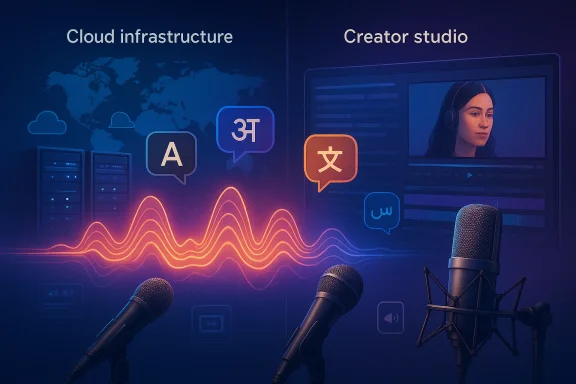
The market also reflects a split between enterprise infrastructure and creator-facing apps. Cloud providers are winning on reliability, compliance, and global scale, while tools like Murf AI, Speechify, NaturalReader, VEED.io, and Resemble AI are winning by making audio production more approachable. That divide is central to understanding the ranking of top multilingual TTS tools in 2026.
At the same time, the category has become more strategically important because voice is no longer an isolated output format. It now sits inside video production, e-learning, accessibility, customer service, and even voice-first assistants. In other words, multilingual TTS is not merely another AI feature; it is becoming a workflow primitive.
That speed has real commercial value. If a company launches a new product in five regions, it can now create voice assets in parallel instead of serially. That enables faster market entry, tighter campaign coordination, and more consistent messaging across territories.
This is where the market becomes more than a feature checklist. A tool can sound beautiful in one language and still be a poor fit if it lacks the specific dialects or delivery styles a business needs. That is why enterprise buyers evaluate support matrices carefully and why creators care about emotional fidelity as much as pronunciation.
Cloud vendors still matter because they provide the backbone. But creator tools matter because they make the technology accessible enough that more people can actually use it. The winners in 2026 are the products that bridge those two worlds.
What makes ElevenLabs stand out is not simply that it speaks in many languages. It is that the speech often carries a recognizable human cadence. That matters for audiobook work, character voice design, creator narration, and marketing assets where tone is part of the product.
The company also benefits from a strong public association with voice cloning and multilingual dubbing. AP reported in late 2025 that the platform was originally developed for dubbing audio in different languages while preserving voice and emotion, and that high-profile voice-cloning partnerships further amplified its profile.
Unlike creator-first products, Google’s strength is consistency. It is the kind of service enterprises select when they need dependable output across products, regions, and large-scale usage patterns.
The platform’s value proposition is simple but powerful: global reach with stable engineering. For developers, that reduces risk. For enterprises, it lowers the chance that a voice asset becomes a fragile dependency.
That makes it a common choice for product teams, education platforms, and large organizations with multilingual requirements. It may not win every emotional comparison, but it often wins on dependable execution.
The differentiator here is not only scale. It is the way Azure fits into broader Microsoft enterprise workflows, which matters for organizations already using Microsoft 365, Copilot, security tooling, or Azure-native development pipelines.
The company also benefits from trust. Enterprises that already rely on Azure often prefer to keep their voice workloads inside the same cloud boundary for governance and procurement reasons. That is a serious advantage in regulated environments.
This is important because voice identity increasingly functions like a logo. A consistent synthetic voice across languages can make a brand feel coherent in every market, which is a subtle but powerful advantage.
Polly’s strength is not hype. It is friction reduction. If you already build on AWS, Polly often becomes the default because it is there, stable, and good enough for a wide range of production use cases.
The platform’s integration with AWS is a major strategic advantage. Once a company has infrastructure, identity, storage, and compute on Amazon, speech naturally becomes another service in the same operational environment.
That matters because many buyers do not just want audio generation. They want a finished asset with minimal post-production. Murf’s product design reflects that reality.
This is where Murf’s advantage becomes clear. It takes a potentially technical process and makes it editorial instead of engineering-heavy. That is a major usability win.
That matters for game studios, media teams, and branded content projects where the voice is not just narration but character identity. Resemble’s strength lies in making voice expressive without turning it into a black box.
That makes it useful in gaming, immersive media, and brand storytelling. In those settings, control is often more valuable than sheer ease.
The real advantage is convenience. Users can generate voiceovers and align them with visuals in the same environment, which reduces tool-switching and shortens the path from script to export.
It is a strong example of how TTS is becoming embedded in broader content workflows rather than existing as a separate category. That makes it more valuable than a standalone voice tool in some production stacks.
Its value is that it lowers the cost of attention. For people who prefer audio or need screen-free access, that is not a luxury feature; it is a usability requirement.
That simplicity is a strategic asset. Not every user wants a complex creative platform; many simply want clear audio output with minimal setup.
That matters for teams that cannot rely on cloud services or that need a more customizable, self-hosted speech stack. It is not the easiest option for everyone, but for the right audience, it is a serious advantage.
That means enterprises are often less interested in the most emotional voice and more interested in the most dependable deployment. In other words, they want speech that is boring in the best possible way.
This split creates a useful market map:
That is why the strongest platforms in 2026 are not necessarily the ones with the most features. They are the ones that match the work being done.
Cloud platforms will keep pushing breadth and enterprise reliability, while creator tools will keep pushing emotional realism and ease of use. The most interesting developments may come from the middle ground: tools that can do both well enough to move between departments, regions, and content types without friction.
Multilingual TTS in 2026 is no longer about replacing a microphone. It is about rethinking how information travels across languages, devices, and audiences. The platforms that understand that shift will shape not only the next generation of audio production, but also the broader future of voice-first computing.
Source: analyticsinsight.net Top Multilingual Text-to-Speech Tools in 2026
 Background
The rise of multilingual text-to-speech did not happen in a single product cycle. It was the result of several overlapping shifts: better neural synthesis models, cloud platforms scaling language coverage, and creator workflows demanding faster output with less manual recording. Even a fast-moving editorial like Analytics Insight frames the category as one where human-like tone, scale, and accessibility are now central value propositions, not side benefits. judged by a simple metric: did it sound obviously synthetic? That question has become far less useful. The modern benchmark is whether a voice can carry brand identity, preserve intelligibility across languages, and remain convincing enough for long-form listening. The best tools now compete less on basic playback and more on emotional nuance, multilingual consistency, and workflow integration.This matters because demand is no longer limited to assistive reading. Platforms like ElevenLabs, Google Cloud Text-to-Speech, Microsoft Azure Speech, and Amazon Polly are increasingly judged on whether they can support localization at scale, not just render a sentence aloud. Official documentation shows broad language coverage on the cloud side, with Google publishing supported voices and languages, Amazon Polly offering language variants, and Microsoft Azure advertising 150+ languages and variants in its speech catalog.
The market also reflects a split between enterprise infrastructure and creator-facing apps. Cloud providers are winning on reliability, compliance, and global scale, while tools like Murf AI, Speechify, NaturalReader, VEED.io, and Resemble AI are winning by making audio production more approachable. That divide is central to understanding the ranking of top multilingual TTS tools in 2026.
At the same time, the category has become more strategically important because voice is no longer an isolated output format. It now sits inside video production, e-learning, accessibility, customer service, and even voice-first assistants. In other words, multilingual TTS is not merely another AI feature; it is becoming a workflow primitive.
Why Multilingual TTS Became a 2026 Priority
The simplest reason is demand. Global content teams need faster ways to produce audio in multiple languages without hiring separate voice talent for every market. That pressure is especially visible in media, training, and product education, where a single script may need to become dozens of localized assets.Localization Without the Old Bottlenecks
Traditional dubbing and narration are expensive, slow, and hard to scale. Multilingual TTS compresses that process by replacing studio scheduling, retakes, and manual editing with software-driven generation. The result is not just lower cost, but a much faster revision cycle when scripts change.That speed has real commercial value. If a company launches a new product in five regions, it can now create voice assets in parallel instead of serially. That enables faster market entry, tighter campaign coordination, and more consistent messaging across territories.
- Faster localization cycles
- Lower production costs
- Easier script revisions
- More market coverage
- Better accessibility support
- Less dependence on studio logistics
Why Language Coverage Matters More Than Ever
The best tools are no longer judged only by English quality. Buyers want broad language support, dialect coverage, and the ability to handle code-switching or regional accents. Official documentation from Google, Amazon, and Microsoft shows that the cloud leaders continue expanding multilingual coverage, while ElevenLabs now states that voice creation supports 32 languages and voice search can surface voices that perform well in multiple languages.This is where the market becomes more than a feature checklist. A tool can sound beautiful in one language and still be a poor fit if it lacks the specific dialects or delivery styles a business needs. That is why enterprise buyers evaluate support matrices carefully and why creators care about emotional fidelity as much as pronunciation.
The New Standard Is “Good Enough to Publish”
The quality bar has changed. Users are no longer asking whether AI speech sounds real enough to impress in a demo; they are asking whether it is reliable enough for published work. That subtle shift explains why so many tools now emphasize natural pauses, expressive delivery, and editable workflows.Cloud vendors still matter because they provide the backbone. But creator tools matter because they make the technology accessible enough that more people can actually use it. The winners in 2026 are the products that bridge those two worlds.
1. ElevenLabs: The Realism Benchmark
ElevenLabs remains the headline name in multilingual voice generation because it has become synonymous with realism. Its public documentation emphasizes a broad voice library, voice cloning, and support for 32 languages, while its voice library also highlights voices that perform well across multiple languages.What makes ElevenLabs stand out is not simply that it speaks in many languages. It is that the speech often carries a recognizable human cadence. That matters for audiobook work, character voice design, creator narration, and marketing assets where tone is part of the product.
Why Creators Keep Choosing It
Creators tend to choose ElevenLabs when they care about emotional delivery. The tool is strong for narration that needs pauses, inflection, and a more conversational feel than most enterprise TTS systems. That makes it particularly attractive for YouTube, podcasting, and long-form storytelling.The company also benefits from a strong public association with voice cloning and multilingual dubbing. AP reported in late 2025 that the platform was originally developed for dubbing audio in different languages while preserving voice and emotion, and that high-profile voice-cloning partnerships further amplified its profile.
Where It Fits Best
ElevenLabs is not the cheapest or most bureaucratic option, but it is often the most persuasive in a creator workflow. It is especially strong when the output must sound polished without requiring a full production studio.- Audiobooks
- Podcasts
- YouTube narration
- Character voices
- Marketing explainers
- Cross-language dubbing
2. Google Cloud Text-to-Speech: Broad Coverage and Reliability
Google Cloud Text-to-Speech remains one of the safest enterprise choices because it offers extensive language and voice coverage, backed by a platform built for reliability and global scale. Google’s own documentation maintains a detailed list of supported voices and languages, reinforcing its role as a dependable multilingual infrastructure layer.Unlike creator-first products, Google’s strength is consistency. It is the kind of service enterprises select when they need dependable output across products, regions, and large-scale usage patterns.
The Enterprise Case
Google Cloud TTS is attractive for teams that need to wire speech into larger application systems. That includes call flows, digital assistants, accessibility layers, and customer-facing tools where uptime and standardization matter more than stylistic novelty.The platform’s value proposition is simple but powerful: global reach with stable engineering. For developers, that reduces risk. For enterprises, it lowers the chance that a voice asset becomes a fragile dependency.
Why It Still Matters in a Creator World
Even though Google is not always the flashiest option, it remains one of the most practical. The service is especially strong when a project needs scalable, standardized output in many languages rather than a highly stylized voice identity.That makes it a common choice for product teams, education platforms, and large organizations with multilingual requirements. It may not win every emotional comparison, but it often wins on dependable execution.
- Extensive language support
- Reliable cloud infrastructure
- Good fit for developers
- Strong for assistants and apps
- Stable at scale
- Practical for enterprise workflows
3. Microsoft Azure Text-to-Speech: Enterprise Customization at Scale
Microsoft Azure Speech has become a major force in multilingual TTS because Microsoft has paired broad language coverage with enterprise-oriented customization. Microsoft’s catalog advertises more than 150 languages and variants, and Azure’s speech stack is positioned as a major option for global applications and inclusive user experiences.The differentiator here is not only scale. It is the way Azure fits into broader Microsoft enterprise workflows, which matters for organizations already using Microsoft 365, Copilot, security tooling, or Azure-native development pipelines.
Why Microsoft Wins in Enterprise
Microsoft is especially strong when speech output needs to be part of a larger business system. That includes internal assistants, accessibility tools, contact center experiences, healthcare apps, and training platforms.The company also benefits from trust. Enterprises that already rely on Azure often prefer to keep their voice workloads inside the same cloud boundary for governance and procurement reasons. That is a serious advantage in regulated environments.
Custom Voices and Brand Control
Azure’s appeal grows when companies want a branded voice rather than a generic one. Customization is one of the platform’s defining strengths, and that aligns well with organizations that view voice as part of the customer experience.This is important because voice identity increasingly functions like a logo. A consistent synthetic voice across languages can make a brand feel coherent in every market, which is a subtle but powerful advantage.
- Strong enterprise governance
- Wide multilingual coverage
- Custom voice options
- Good Microsoft ecosystem fit
- Useful for regulated industries
- Scales across global deployments
4. Amazon Polly: The Quiet Workhorse
Amazon Polly remains a dependable favorite because it is fast, deeply integrated with AWS, and easy to plug into real-time applications. Amazon’s documentation states that Polly offers 40 female and 20 male standard voices across 29 language and language variants, making it a practical choice for multilingual delivery.Polly’s strength is not hype. It is friction reduction. If you already build on AWS, Polly often becomes the default because it is there, stable, and good enough for a wide range of production use cases.
Built for Developers, Not Drama
Polly has always appealed to developers who want speech synthesis without reinventing their stack. It is especially strong in automation, e-learning, notifications, IVR systems, and other use cases where speech needs to be generated quickly and repeatedly.The platform’s integration with AWS is a major strategic advantage. Once a company has infrastructure, identity, storage, and compute on Amazon, speech naturally becomes another service in the same operational environment.
Where Polly Makes Sense
Polly is rarely the most expressive tool in a direct voice comparison. But it is often one of the most practical, especially when you need scale, ease of integration, and predictable performance.- Real-time speech generation
- E-learning narration
- Application alerts
- IVR and automation
- AWS-native systems
- Cost-conscious deployments
5. Murf AI: The Workflow-Friendly Creative Studio
Murf AI stands out because it blends voice generation with editing in a way that feels purpose-built for non-technical teams. Instead of treating TTS as an isolated API, Murf presents it as part of a creative workflow where tone, pacing, and emphasis can be adjusted without jumping between tools.That matters because many buyers do not just want audio generation. They want a finished asset with minimal post-production. Murf’s product design reflects that reality.
Why Teams Like It
Murf is especially useful for marketing, training, and internal communications. Those teams often need polished voiceover content fast, but they do not want to learn a full audio workstation just to make edits.This is where Murf’s advantage becomes clear. It takes a potentially technical process and makes it editorial instead of engineering-heavy. That is a major usability win.
The Practical Value
Murf is a good fit for explainers, learning modules, sales content, and presentation-style deliverables. It is less about cinematic voice acting and more about making voice production feel manageable inside normal business workflows.- Easy editing controls
- Good for training content
- Strong for marketing teams
- Faster turnaround
- Lower production complexity
- Comfortable for non-specialists
6. Resemble AI: Control, Emotion, and Multilingual Character Work
Resemble AI is one of the more interesting tools in the category because it focuses on controllability. Rather than simply generating a voice that sounds good, it gives users more room to shape how the voice feels and performs.That matters for game studios, media teams, and branded content projects where the voice is not just narration but character identity. Resemble’s strength lies in making voice expressive without turning it into a black box.
A Better Fit for Character and Brand Voices
For projects that need emotional range, Resemble can be especially compelling. The platform is well suited to content where different scenes, characters, or markets require subtle tonal variation.That makes it useful in gaming, immersive media, and brand storytelling. In those settings, control is often more valuable than sheer ease.
The Enterprise Angle
Resemble also has strategic value for multilingual productions that need voice continuity across languages. If a company wants the same vocal identity to travel from English to another language with minimal drift, that kind of control becomes valuable very quickly.- Strong control over delivery
- Useful for character voices
- Good fit for media production
- Helpful in branding work
- Supports multilingual continuity
- Better for expressive use cases
7. VEED.io: TTS Inside a Video Workflow
VEED.io is not merely a TTS tool; it is a video creation environment where voice generation is one part of a larger production flow. That makes it attractive to teams that think in terms of videos, subtitles, and localized distribution rather than stand-alone audio files.The real advantage is convenience. Users can generate voiceovers and align them with visuals in the same environment, which reduces tool-switching and shortens the path from script to export.
Why Video Teams Care
VEED is especially useful for short-form creators, social teams, and training departments. These users often need quick multilingual versions of talking-head or explainer content, and VEED’s model helps reduce the friction of producing them.It is a strong example of how TTS is becoming embedded in broader content workflows rather than existing as a separate category. That makes it more valuable than a standalone voice tool in some production stacks.
Where It Fits Best
VEED is best when voice is part of a finished video asset, not an isolated deliverable. It is a good match for social content, explainers, internal comms, and lightweight dubbing workflows.- Video-first workflow
- Fast social production
- Easy multilingual voiceovers
- Strong fit for creators
- Better for simple video tasks
- Less suited to deep audio work
8. Speechify, NaturalReader, and Coqui TTS: Accessibility and Control
This category is broader than creator tools and cloud infrastructure. Speechify, NaturalReader, and Coqui TTS each serve a different audience, but together they show how multilingual TTS has expanded beyond professional studios into everyday productivity, accessibility, and open-source development.Speechify and Daily Use
Speechify is built around daily listening. It is especially useful for students, professionals, and accessibility users who want to turn articles, PDFs, and notes into audio. That makes it more of a consumption tool than a production studio.Its value is that it lowers the cost of attention. For people who prefer audio or need screen-free access, that is not a luxury feature; it is a usability requirement.
NaturalReader and Simplicity
NaturalReader has long appealed to users who want something straightforward. Its OCR support and easy text-to-speech workflow make it useful for scanned documents and quick reading assistance.That simplicity is a strategic asset. Not every user wants a complex creative platform; many simply want clear audio output with minimal setup.
Coqui TTS and Open-Source Flexibility
Coqui TTS reflects the open-source side of the market. It appeals to developers who want local control, privacy, and the ability to tailor models for specific languages or use cases.That matters for teams that cannot rely on cloud services or that need a more customizable, self-hosted speech stack. It is not the easiest option for everyone, but for the right audience, it is a serious advantage.
- Speechify for everyday listening
- NaturalReader for simple accessibility
- Coqui TTS for developer control
- Local or self-hosted flexibility
- Privacy-friendly deployments
- Custom language experimentation
Cloud Giants vs Creator Platforms
The TTS landscape in 2026 is shaped by a clear tension between cloud-first infrastructure and creator-friendly applications. That split is not accidental. It reflects two very different buying behaviors and two different definitions of value.Enterprise Buyers Want Assurance
For enterprises, the big questions are compliance, uptime, localization breadth, and integration. Microsoft Azure, Google Cloud, and Amazon Polly all score well because they fit neatly into broader enterprise architectures and already have the trust of IT departments.That means enterprises are often less interested in the most emotional voice and more interested in the most dependable deployment. In other words, they want speech that is boring in the best possible way.
Creators Want Speed and Personality
Creators, by contrast, want voices that feel expressive and easy to work with. They care about emotional nuance, voice cloning, editing convenience, and quick export paths. That is why ElevenLabs, Murf AI, Resemble AI, VEED.io, Speechify, and NaturalReader continue to gain attention.This split creates a useful market map:
- Cloud giants win on scale
- Creator tools win on usability
- Enterprises want governance
- Creators want personality
- Developers want APIs
- Consumers want convenience
What the Split Means Strategically
The market is not converging into a single winner. Instead, it is organizing around workflow. A bank, a media company, and a student all need speech, but they need very different kinds of speech.That is why the strongest platforms in 2026 are not necessarily the ones with the most features. They are the ones that match the work being done.
Strengths and Opportunities
The strongest opportunity in multilingual TTS is simple: AI speech makes global communication cheaper, faster, and more scalable without forcing teams to sacrifice quality. As more content moves into audio-first and video-first formats, tools that can handle multiple languages with human-like delivery will become increasingly central to digital production. This is especially true for companies that want to localize content quickly without expanding headcount.- Faster localization across regions
- Lower production costs
- Better accessibility for diverse audiences
- More scalable creator workflows
- Stronger brand consistency in multiple languages
- Easier e-learning and onboarding production
- Greater flexibility for voice-first interfaces
Risks and Concerns
The biggest risks are not technical alone; they are operational, legal, and reputational. When AI voices become convincingly human, the consequences of misuse rise sharply. Voice cloning, impersonation, licensing uncertainty, and unreviewed output can create problems that are harder to contain than simple transcription errors.- Voice impersonation and misuse
- Consent and rights questions
- Brand safety risks
- Mispronunciation in sensitive contexts
- Output inconsistency across languages
- Vendor lock-in for enterprise users
- Overreliance on synthetic narration
Looking Ahead
The next phase of multilingual TTS will likely be defined less by whether voices sound human and more by whether they sound appropriate in context. The winners will be the tools that understand not just language, but tone, setting, audience, and workflow. That means future differentiation will come from better control, tighter integrations, and more responsible identity safeguards.Cloud platforms will keep pushing breadth and enterprise reliability, while creator tools will keep pushing emotional realism and ease of use. The most interesting developments may come from the middle ground: tools that can do both well enough to move between departments, regions, and content types without friction.
- More expressive multilingual voices
- Better pronunciation controls
- Stronger consent and identity safeguards
- Tighter video and dubbing integration
- More local and open-source options
- Greater enterprise governance
- More contextual voice adaptation
Multilingual TTS in 2026 is no longer about replacing a microphone. It is about rethinking how information travels across languages, devices, and audiences. The platforms that understand that shift will shape not only the next generation of audio production, but also the broader future of voice-first computing.
Source: analyticsinsight.net Top Multilingual Text-to-Speech Tools in 2026
