

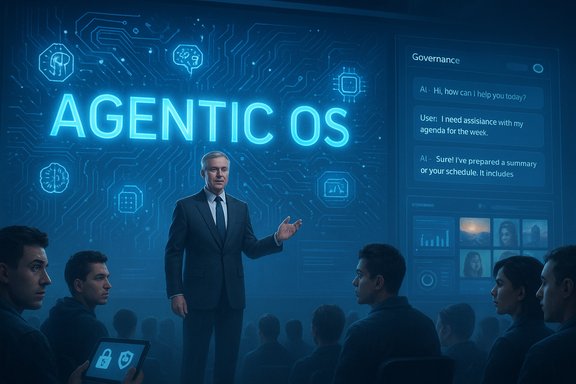
Mustafa Suleyman’s blunt reaction to a wave of public skepticism about Microsoft’s AI push has turned an already heated conversation into a full‑blown reputation test for the company: his social post calling it “mindblowing” that people could be “unimpressed” by conversational and generative AI crystallizes a widening gap between executive enthusiasm and user frustration as Microsoft presses forward with an “agentic OS” vision and expanded Copilot features.
Background
What happened, and why it matters
In mid‑November, Microsoft’s Windows leadership published language describing Windows as “evolving into an agentic OS,” a phrase that immediately provoked an intense backlash from many users and developers who said they simply want a faster, more reliable operating system—not an always‑active AI layer. Microsoft’s Windows and devices president framed the change as an enterprise and productivity play ahead of Microsoft Ignite; the post drew large numbers of negative replies and prompted follow‑up messaging about listening to feedback. Into that debate stepped Mustafa Suleyman, CEO of Microsoft AI, who posted a terse and incredulous response on social media: in essence, he said that given how far technology has come since the days of playing Snake on a Nokia phone, he finds it “mindblowing” that people would be underwhelmed by the ability to hold fluent conversations with a “super smart AI” and to generate images or video on demand. The remark quickly spread across tech media and social platforms and prompted both supportive and sharply critical responses.Where this sits in Microsoft’s strategy
Microsoft has made AI the center of its product roadmap for everything from Azure to Office to Windows. That strategy includes deeper Copilot integration, the creation of a centralized Microsoft AI division led by Suleyman, and public statements from Microsoft leadership about a rising share of code and product features being produced or assisted by AI. Those corporate choices are now colliding with user expectations: reliability, privacy, choice, and the basic day‑to‑day usability of Windows.Overview: the public friction points
The “agentic OS” framing
“Agentic” is shorthand for software that can operate on users’ behalf: scheduling meetings, synthesizing information, acting on context without continuous direction. For enterprise IT teams, thoughtfully implemented agents can deliver real productivity gains and efficiencies. For everyday users and many developers, however, the prospect of persistent, proactive agents inside an OS often reads as intrusive, fragile, or unnecessary bloat. The negative responses to Microsoft’s messaging were immediate and vocal.Performance vs. promise
Public anger has clustered around a familiar pattern in modern tech marketing: bold product claims or ad narratives that don’t match real‑world experiences. Examples include social media posts implying Copilot can “finish your code before you finish your coffee,” which many developers interpreted as hyperbole when hands‑on attempts failed to reproduce advertisement‑style outcomes. Those discrepancies have amplified skepticism and deepened distrust.Executive tone and the optics problem
Suleyman’s “mindblowing” comment is a small, candid example of a larger PR and optics issue: when company leaders frame innovation as self‑evidently astonishing, the messaging can look dismissive to people reporting practical problems. The result isn’t simply annoyance; it’s a credibility breakup between vendor and user that takes time and evidence to repair. Multiple outlets captured the backlash and underscored that the tech community sees the gap not as a question of whether AI is powerful, but whether it’s being applied in ways users actually value.Timeline and verification of key facts
- Windows leader Pavan Davuluri publicized the “agentic OS” concept in a social post on November 10 as part of the lead‑up to Microsoft Ignite. That post generated unusually negative responses and prompted follow‑up clarifications from Microsoft staff.
- Mustafa Suleyman’s social post expressing incredulity at public skepticism was published amid the Ignite timeframe and quoted in multiple outlets; the direct quotation and its context are independently reported.
- Microsoft Ignite 2025 was held at the Moscone Center in San Francisco from November 18–21, and many of the statements and product announcements being discussed appeared at or around that conference.
- Separately, Microsoft CEO Satya Nadella has publicly stated that AI already writes a non‑trivial percentage of the company’s code — “20 to 30 percent” was his on‑stage estimate at an industry event — a claim widely reported and relevant because it both explains why executives are bullish on AI and raises questions about quality control and engineering oversight.
Why Suleyman’s reaction matters beyond a single tweet
Power of leadership narratives
When a senior product executive publicly frames public skepticism as “mindblowing,” that statement affects three constituencies at once:- Customers: who interpret the rhetoric as either reassurance or dismissal depending on lived experience.
- Developers and partners: who need clear, realistic product roadmaps and dependable APIs rather than hyperbolic marketing.
- Regulators and enterprise customers: who watch tone as a proxy for governance and risk management culture.
Escalation risk for trust and adoption
Trust is a scarce resource for platform vendors. When marketing and product reality diverge, two things happen simultaneously: elevated expectations and faster reputation damage when features underdeliver. Given Microsoft’s scale—Windows remains the world’s most widely deployed desktop OS—erosion of trust in a major product can have outsized consequences for corporate customers and consumer retention. The present friction is a test of whether Microsoft can demonstrate real, measurable value rather than simply more feature noise.Technical reality check: what the press and Microsoft are actually claiming
Copilot and agentic features: what’s real today
Microsoft has rolled Copilot and other generative capabilities into Windows and Microsoft 365 in staged releases, shipping features that range from document summarization to code suggestions. At Ignite, Microsoft introduced new governance tooling for agents and announced enterprise controls to manage agent behavior, acknowledging the need for administrative oversight as agent proliferation accelerates. Those product moves are concrete, but their stability, performance, and UX consistency vary across platforms and customer deployments.Production use of AI in engineering
Executives have publicly acknowledged that AI writes a significant slice of code in major tech companies. Satya Nadella’s estimate that roughly 20–30 percent of code in some Microsoft repositories is AI‑generated is verified by multiple reputable accounts. That number illustrates an important inflection: organizations now rely on AI within engineering pipelines, which increases throughput but also raises questions around testing, intellectual property, maintainability, and auditing.The limits of “impressive” in the real world
Generative AI excels at producing drafts—summaries, images, code snippets, text—but production readiness still requires human review, integration testing, and contextual judgment. For many users, the experience of AI is a mixture of impressive outputs and frustrating failures; this heterogeneous experience explains why some people are unenthusiastic even when the underlying models are technically sophisticated. The “impressiveness” argument therefore conflates technical capability with consistent user value.Strengths in Microsoft’s approach
- Deep integration across a large product portfolio: Microsoft can move quickly to embed AI into widely used applications (Windows, Office, Azure) and thereby realize cross‑product synergies that smaller vendors cannot match. This scale translates into rapid feature rollouts and extensive telemetry for model improvement.
- Enterprise governance tools: The company’s announcements at Ignite, including tools aimed at managing thousands or millions of agents in corporate fleets, show recognition that governance must accompany innovation. Management planes for authorizing, monitoring, and securing agents are necessary for enterprise adoption.
- Investment in in‑house models and partnerships: Microsoft is simultaneously building its own models and preserving broad cloud partnerships, which reduces single‑vendor risk and provides customers with deployment flexibility. Those strategic options enable both performance gains and resilience.
Key risks and blind spots
1) Messaging and perception risk
When senior leaders characterize skepticism as ignorance rather than a request for better, clearer execution, they risk compounding the trust deficit. Language that frames users as cynics rather than stakeholders invites headlines and fuels social backlash. Suleyman’s comment is a textbook example of how tone can escalate a tactical marketing misstep into a strategic problem.2) Feature creep and usability degradation
Embedding agents and generative features everywhere can produce clutter and unpredictability. Users prioritize stability, performance, and control; prioritizing new AI features before addressing long‑standing platform quality issues will deepen dissatisfaction. Multiple outlets reported that core Windows reliability concerns remain top of mind for users reacting to the agentic OS announcement.3) Engineering and quality control
If meaningful portions of production code are being generated by AI, organizations must invest in new testing, metadata tracking, and provenance systems to ensure code quality, maintainability, and auditability. Claims that AI writes 20–30% of code highlight efficiency gains, but they also flag new technical debt if code provenance and integration testing are not adapted.4) Privacy and data‑protection concerns
Pervasive agents interacting with local files, calendars, and communications raise privacy and compliance questions. Even with enterprise controls, the prospect of cloud‑backed agents operating at scale requires careful data minimization, transparent logging, and clear opt‑out mechanisms—especially for regulated industries. Public pushback has repeatedly included privacy as a major theme.5) Environmental and operational costs
Large‑scale generative models operate at substantial energy and infrastructure cost. Enterprises will weigh the ROI of agentic automation against the compute, storage, and governance overhead; Microsoft must show that agentic scenarios produce net productivity and financial benefits after accounting for these costs. Reported infrastructure deals and partnerships point to a race for capacity; buyers will expect that compute investments translate into dependable product outcomes.Practical steps Microsoft should take (and what users should demand)
For Microsoft (short, medium, and long term)
- Clarify opt‑in vs. opt‑out semantics: make agent behavior explicit and reversible at the system level.
- Reorient marketing around measured, repeatable user outcomes instead of superlatives—ship reproducible demos and publish performance metrics.
- Strengthen engineering pipelines for AI‑generated code: require provenance tags, automated test coverage, and human‑in‑the‑loop sign‑offs for safety‑critical modules.
- Expand enterprise governance tooling and make it default for business customers, including role‑based controls and attestation logs.
- Run a public program measuring real user outcomes—time saved, errors reduced, tasks automated—so claims about productivity gains are verifiable.
For enterprise customers and IT teams
- Insist on explicit SLAs and governance for agentic features deployed in managed environments.
- Require documentation of AI model lineage and data handling: where models are trained, what data is used, and what access controls exist.
- Pilot agentic workflows in narrow domains first; measure outcomes and stability before broader rollouts.
For end users
- Expect clear settings: the OS should offer fast, visible toggles to control agent behavior, telemetry, and data sharing.
- Demand reproducible examples: marketing should be backed by clear, testable scenarios you can run on your device or in a sandbox.
Assessing the CEO’s “mindblowing” claim in context
Suleyman’s emotional reaction is understandable from a technical perspective: the achievements of large‑scale language and generative models are indeed enormous from a research vantage point. Yet, impressiveness in the lab does not equal usefulness in the field. The stubborn reality is that many users encounter AI through imperfect features, incomplete integrations, and invasive marketing. Those are not trivial gaps—they are adoption blockers.Putting this another way: technological astonishment is not a substitute for usability, governance, and reliability. Microsoft’s leadership can credibly celebrate breakthroughs while simultaneously acknowledging and fixing the gaps that prompt everyday users to say “no thanks” or “not yet.” That balance is what the public debate is demanding.
Conclusion: a fork in the road for platform stewardship
Microsoft stands at a common inflection point: be the company that defines an agentic future while protecting users with transparent controls, rigorous testing, and honest messaging—or be the company that churns out flashy features and pays the long‑term cost in user goodwill and enterprise trust. Suleyman’s “mindblowing” comment matters because it revealed the executive frame: wonder at capability. The choice now is whether that wonder will be translated into robust products that earn user faith through reliability, respect for choice, and demonstrable value.The technical capability is real; the business problem is not technical alone but social and organizational. For Windows to become an effective agentic OS, Microsoft must show that agents can be managed, audited, and disabled; that AI‑generated code meets enterprise quality standards; and that users retain control over the devices they rely on. Absent those proofs, executive proclamations will continue to be met with precisely the skepticism Suleyman found “mindblowing”—and as history shows, skepticism that’s ignored becomes a far more consequential problem than the early teething troubles of any new technology.
Source: pc-tablet.com Microsoft AI Head Finds Public AI Scepticism ‘Mindblowing’
