

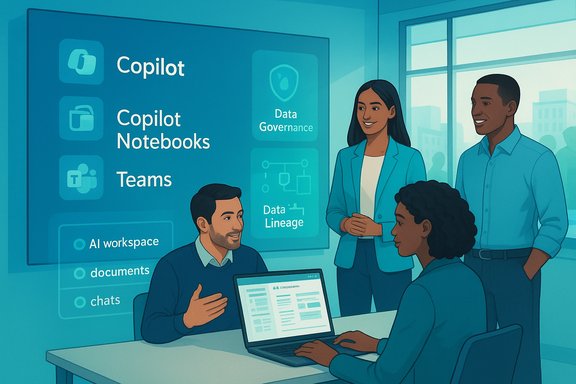
Microsoft’s Americas Partner team has quietly — and strategically — opened a new window into the partner ecosystem with the launch of My AI Journey, a short-form podcast series that spotlights real-world AI adoption inside the Microsoft partner community. The debut episodes, released on December 10, 2025, feature in-conversation storytelling with Kerri Connolly and Jim Lee and are hosted by Jordan Duffield and Diego Saez. The series is explicitly framed as a community amplifier: short practitioner narratives about using Microsoft Copilot, Copilot Notebooks, Microsoft Teams, and emerging agentic workflows to reshape daily work, customer engagements, and partner GTM models.
AI is no longer an experiment for most enterprises — it’s a component of operational reality. Microsoft has been consolidating a broad “Copilot” family across Microsoft 365, Dynamics, GitHub, and Azure; the product ecosystem now includes creative and productivity copilots, Copilot Studio for building role-specific agents, Copilot Notebooks as an AI workspace inside OneNote and the Copilot app, and Azure AI Foundry for lifecycle management of models and agents. These platform moves reflect an intentional strategy: make AI accessible, integrated, and extensible for both customers and partners so that partners can package and operationalize AI experiences for verticals and processes. For partners, the implication is straightforward: the vendor-level engineering (models, compute, model catalogues) is being paired with tooling that lowers the implementation bar — and that gives systems integrators, ISVs, and consultancies room to productize domain-specific copilots. That partner play is visible in Microsoft’s public partner content and community events, where partner-led case studies and enablement programs emphasize data readiness, governance, and packaged connectors as the value-add Microsoft expects from its ecosystem.
That said, there are opportunities to increase the series’ long-term credibility and utility:
However, adoption at scale will hinge on three partner capabilities: data engineering, governance, and an evidence-first measurement approach. Partners that invest early in those capabilities — and who can translate pilot wins into packaged offerings with clear measurement playbooks — will capture the most traction from Microsoft’s Copilot ecosystem and from the community visibility My AI Journey offers.
My AI Journey launches a conversation, not a conclusion. For partners ready to move beyond experiments and into productized AI services, the podcast is a concise signal of what customers and Microsoft expect: clear outcomes, repeatable delivery, and operational controls. The series is worth watching — and worth contributing to — provided partners bring disciplined evidence and governance to the stories they tell.
Source: Microsoft Introducing My AI Journey: Real stories of AI in action across the Microsoft Americas Partner Community | Microsoft
 Background: Why a partner-focused podcast matters now
AI is no longer an experiment for most enterprises — it’s a component of operational reality. Microsoft has been consolidating a broad “Copilot” family across Microsoft 365, Dynamics, GitHub, and Azure; the product ecosystem now includes creative and productivity copilots, Copilot Studio for building role-specific agents, Copilot Notebooks as an AI workspace inside OneNote and the Copilot app, and Azure AI Foundry for lifecycle management of models and agents. These platform moves reflect an intentional strategy: make AI accessible, integrated, and extensible for both customers and partners so that partners can package and operationalize AI experiences for verticals and processes. For partners, the implication is straightforward: the vendor-level engineering (models, compute, model catalogues) is being paired with tooling that lowers the implementation bar — and that gives systems integrators, ISVs, and consultancies room to productize domain-specific copilots. That partner play is visible in Microsoft’s public partner content and community events, where partner-led case studies and enablement programs emphasize data readiness, governance, and packaged connectors as the value-add Microsoft expects from its ecosystem.What My AI Journey actually says — the short read
- The series is positioned as a “spotlight” for partners and Microsoft leaders to share practical, day‑to‑day AI wins and lessons.
- Debut guests are Kerri Connolly (Director of Partner Development, Enterprise Solutions, Americas) and Jim Lee (VP, Americas Global Partner Solutions & Sales). Their episodes emphasize Copilot for productivity, Copilot Notebooks for project-based grounding, Teams as the collaboration fabric, and the creation of agentic solutions across teams.
- The podcast is hosted by in‑ecosystem voices (Jordan Duffield and Diego Saez) and is positioned to grow through partner submissions and future episodes on YouTube and partner channels.
The broader platform context: Copilot, Notebooks, and agentic AI
To understand the value proposition My AI Journey is showcasing, it helps to map the product building blocks partners are already using.- Microsoft 365 Copilot — an embedded AI assistant across Word, Excel, PowerPoint, Outlook, and Teams designed for drafting, synthesis, and meeting productivity. It increasingly acts as the user-facing layer for AI-driven workflows.
- Copilot Notebooks — an AI workspace that lets users gather documents, chats, meeting recordings, and other artifacts into a grounded context that Copilot uses to generate summaries, drafts, and actionable insights. The Notebooks feature is rolling into OneNote and the Copilot web app, and it supports up to dozens of documents as grounding sources.
- Copilot Studio & Azure AI Foundry — tooling for assembling role-based agents, orchestrating model selection, and managing agent fleets in production. These are the backend levers partners use to create vertical or process copilots.
Strengths in Microsoft’s partner strategy (what’s working)
- Product moment: Microsoft has stitched AI into widely used productivity surfaces. That lowers friction for adoption because the assistants are where users already work. This matters: productivity gains are easier to demonstrate when AI appears in Word, Teams, or Excel rather than a bespoke application.
- Tooling for partners: Copilot Studio, Azure AI Foundry, and connectors reduce the effort of building domain-specific copilots. Partners don’t have to start from scratch; they can customize, ground, and govern models with Microsoft tooling. That turns a platform bet into a channel opportunity.
- Storytelling and peer learning: My AI Journey leverages narrative marketing to surface use cases rather than just technical specs. Stories from partners and Microsoft leaders act as low‑friction social proof for other partners evaluating adoption approaches. The partner community forums and published partner spotlights echo that emphasis on use-case storytelling.
- Integrated governance primitives: Microsoft is not only shipping features; it is layering enterprise controls (sensitivity labels, Purview integration, admin toggles) into Copilot experiences. That’s critical for partners operating in regulated industries where data handling matters.
Risks, blind spots, and the real constraints partners must plan for
- Data readiness remains the gating factor. Partners can’t meaningfully deliver reliable copilots without cleansed, discoverable, and governed data. Across partner sessions and community conversations, the refrain is consistent: models and UIs are the easy part; data engineering, lineage, and lifecycle management are the hard work. Treat vendor-promoted time-savings as directional until you validate them against your customer’s data estate.
- Vendor-reported metrics should be validated. Microsoft and partners publish impressive adoption and ROI figures, but some of the most striking efficiency claims in partner spotlights and event roundups are vendor-sourced and lack independent validation. Procurement teams should request methodology, holdout data, and measurement frameworks before basing financial commitments on headline figures.
- Security and prompt injection threats are real. As organizations embed Copilot and agentic features inside productivity surfaces and browsers, new attack vectors emerge (malformed documents, dataset poisoning, prompt injection). Independent coverage and security advisories recommend layered defenses, behavior-based detection, and strict policy enforcement as prerequisites to broad rollouts. Partners reselling or integrating Copilot experiences must bake security into delivery.
- Over-automation without governance creates operational risk. When partners automate decisions (routing, approvals, customer replies), auditability, fallback paths, and human review must be architected from day one. Agentic workflows increase velocity — and therefore the potential scope of mistakes — when grounding and guardrails are insufficient. Microsoft’s security blog and partner guidance emphasize agent-specific control points and partner responsibilities in production deployments.
Practical playbook for partners: how to turn this window into revenue
Partners who want to translate the attention around My AI Journey and the Copilot family into business should approach with a pragmatic, repeatable plan. Below is a sequenced playbook that aligns with the platform reality.- Audit and prioritize data sources. Inventory data silos that matter to targeted use cases and score them for cleanliness, accessibility, and governance readiness. If data isn’t discoverable, AI will be brittle.
- Build a small, high-impact pilot. Focus on one measurable outcome (e.g., time-to-resolution for a service desk, proposal generation time, or lead response time). Use Copilot Notebooks as a project workspace to demonstrate grounded insights.
- Implement governance and observability. Add sensitivity labels, logging, and human-in-the-loop checkpoints. Prove you can trace decisions back to inputs and tune model behavior.
- Package a verticalized MVP. Convert the pilot into a repeatable offering with connectors, templates, and an adoption playbook — this is the partner product Microsoft expects.
- Measure and iterate. Report on delta metrics (time saved, cost avoided, conversion lift) and refine the grounding and prompts. Publish a customer-friendly story for community channels — that’s the currency My AI Journey amplifies.
What My AI Journey signals about Microsoft’s GTM and partner lifecycle
My AI Journey is more than a short podcast series — it’s a piece of partner GTM scaffolding. Microsoft is using human stories to:- Surface repeatable partner plays so other partners can copy and accelerate adoption.
- Encourage partners to tell customer stories that feed the marketing flywheel. The partner ecosystem’s case studies often act as the social proof Microsoft uses at events and digital campaigns.
- Reinforce a behavioral change: partners should own the integration and governance work while Microsoft supplies models, hosting, and compliance primitives. That division of labor is explicit across partner-focused communications and event programming.
Editorial assessment: where My AI Journey succeeds — and where it should go next
My AI Journey succeeds at a simple but valuable editorial objective: it normalizes AI adoption by telling short, human-scale stories about how people use Copilot in everyday workflows. By focusing on leaders inside the partner ecosystem, Microsoft highlights use cases that prospective adopters can imagine replicating in their own teams.That said, there are opportunities to increase the series’ long-term credibility and utility:
- Add technical follow-ups. Each story should be paired with a technical appendix: architecture diagrams, lists of data connectors, licensing notes, and an ROI measurement plan. That turns stories into actionable artifacts for partners who want to replicate outcomes.
- Publish verification checklists. When partners claim time-savings or forecast improvements, a quick methodology table would help procurement and customers evaluate claims critically. Vendors and partners cite positive outcomes frequently; independent validation matters to enterprise buyers.
- Highlight operational controls. Every episode that celebrates agentic automation should explicitly describe the governance and auditing controls implemented, and any human-in-the-loop design. This would model best practices for safe, scalable agent rollouts.
Quick reference: what partners should watch and why
- Copilot Notebooks in OneNote — useful for project-led grounding, content synthesis, and generating drafts from multiple artifacts. This is the easiest way to demo contextualized Copilot capabilities.
- Copilot Studio & Agent tooling — the place to build role-based assistants, exportable templates, and agents that can be operationalized for vertical markets.
- Security Copilot agents — an example of agentic automation applied to SecOps; partners building security or compliance solutions should study agent patterns and guardrails here.
Final verdict: a pragmatic amplification that partners should leverage — but with discipline
My AI Journey is a useful, thoughtfully positioned series for showcasing everyday AI wins inside the Microsoft partner universe. It amplifies the partner narrative Microsoft needs: partners translate platform capability into industry outcomes. For partners, the series is a marketing and community-education opportunity — and a gentle reminder that the commercial runway for AI is in repeatable, governed solutions, not one-off proofs.However, adoption at scale will hinge on three partner capabilities: data engineering, governance, and an evidence-first measurement approach. Partners that invest early in those capabilities — and who can translate pilot wins into packaged offerings with clear measurement playbooks — will capture the most traction from Microsoft’s Copilot ecosystem and from the community visibility My AI Journey offers.
My AI Journey launches a conversation, not a conclusion. For partners ready to move beyond experiments and into productized AI services, the podcast is a concise signal of what customers and Microsoft expect: clear outcomes, repeatable delivery, and operational controls. The series is worth watching — and worth contributing to — provided partners bring disciplined evidence and governance to the stories they tell.
Source: Microsoft Introducing My AI Journey: Real stories of AI in action across the Microsoft Americas Partner Community | Microsoft
