

Oracle’s January 2024 security advisory revealed a stability flaw in the MySQL Server optimizer that can be triggered remotely by a low‑privilege, network‑accessible account to hang or repeatedly crash the server process, producing a reliable denial‑of‑service (DoS) condition for affected MySQL instances.
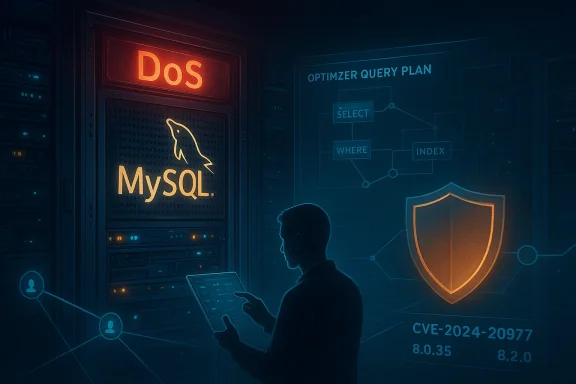
MySQL remains one of the most widely deployed relational database engines across web, cloud and enterprise environments. In mid‑January 2024 Oracle published a Critical Patch Update that grouped multiple MySQL fixes; among them was CVE‑2024‑20977, an issue rooted in the Server: Optimizer component. The vulnerability affects MySQL release lines identified as
Source: MSRC Security Update Guide - Microsoft Security Response Center
 Background / Overview
MySQL remains one of the most widely deployed relational database engines across web, cloud and enterprise environments. In mid‑January 2024 Oracle published a Critical Patch Update that grouped multiple MySQL fixes; among them was CVE‑2024‑20977, an issue rooted in the Server: Optimizer component. The vulnerability affects MySQL release lines identified as 8.0.35 and earlier in the 8.0 family and 8.2.0 and earlier in the 8.2 family, and it was assigned a CVSS v3.1 base score of 6.5 with the vector AV:N/AC:L/PR:L/UI:N/S:U/C:N/I:N/A:H. In plain terms, the flaw is:- Network‑accessible (attacker can reach the service over the network).
- Easily exploitable given the conditions described by the vendor.
- Requires low privileges on the database (an authenticated MySQL user account with limited rights can be enough).
- Has no confidentiality or integrity impact in the published description, but it does permit total loss of availability (complete DoS).
Technical summary of the flaw
Where the bug lives
The defect lies in the Optimizer layer of the MySQL Server. The optimizer is the subsystem that analyzes SQL statements and chooses efficient execution plans. Optimizer bugs can manifest as crashes, assertion failures, or unbounded resource consumption when the query planner hits unexpected internal state.What an attacker can do
According to the vendor advisory and downstream vulnerability trackers, exploitation can cause the server to:- Enter a hung state (no new queries are accepted or served), or
- Crash repeatedly and reliably, forcing service restarts or leaving the service unavailable until manual remediation.
Required attacker capabilities
- Network access to a MySQL service (standard MySQL/TCP listener or other protocols that surface the same server components).
- An authenticated MySQL account with low privileges (the advisory explicitly notes PR:L, meaning low privilege is sufficient).
- No user interaction is required (UI:N), and the attack surface is not restricted to a single platform or client.
Why this matters: operational context and threat model
Many modern architectures deliberately segment database access behind application layers; that reduces exposure. But there are numerous realistic operational patterns that raise risk:- Development, staging, metrics or admin endpoints exposed to the internet for convenience.
- Multi‑tenant platforms where customer accounts connect directly to a shared MySQL instance.
- Cloud images or vendor distributions that include MySQL and are reachable within a multi‑tenant or hybrid network.
- Replication, clustering, or router components that proxy queries and could trigger optimizer codepaths on behalf of remote clients.
Confirmed facts and notable details
- Affected versions are the
8.0family up to8.0.35and the8.2family up to8.2.0. Vendors and cloud providers mapped the flaw to those upstream releases in their advisories. - The CVSS v3.1 Base Score is 6.5, with the vector indicating network attackability and low required privileges; the impact is availability only (
A:H,C:N/I:N). - Oracle bundled the fix information into its January 2024 Critical Patch Update. Distribution vendors and cloud operators listed the advisory in their vulnerability inventories and recommended patching.
8.0.35 or earlier, or 8.2.0 or earlier, plan to remediate.)Immediate mitigation checklist (what to do right now)
If you operate MySQL instances that may be impacted, run the following prioritized steps immediately:- Inventory: Identify all MySQL instances and note the exact server version string reported by the server (for example,
8.0.35). - Isolate: If any instance is reachable from untrusted networks, restrict access immediately using network controls (firewall rules, security groups).
- Patch: Prioritize upgrading to the vendor‑released fixed MySQL releases (apply MySQL vendor/packaged fixes or upgrade the server to the next patched minor release).
- Harden: For short‑term risk reduction, consider the following temporary measures:
- Bind local interfaces only (
bind‑address/skip‑networking) if remote connections are unnecessary. - Place the database behind application servers or private subnets; block direct public access to port 3306/TCP and other MySQL listeners.
- Enforce strong authentication and limit accounts that can connect from external networks.
- Monitor: Watch MySQL error logs for signs of crashes or repeated restarts; enable and retain crash/autopsy artifacts (core dumps, crash stack traces) for incident analysis.
- Failover validation: If you use HA/replication, simulate and verify failovers after remediation so recovery behavior is known.
How to prioritize remediation: risk‑based triage
Not every affected instance carries equal risk. Use a simple risk score to prioritize effort:- Highest priority
- Internet‑exposed MySQL endpoints.
- Multi‑tenant or shared MySQL instances where multiple untrusted users can authenticate.
- Production primaries for business‑critical applications with little redundancy.
- Medium priority
- Instances reachable only across a VPN but used by many external partners.
- Staging or public demo environments that host realistic traffic.
- Lower priority
- Local development instances bound to
127.0.0.1. - Read‑only replicas behind strict private network controls (still patch eventually).
Recommended patching strategy
- Apply vendor patches supplied in the January 2024 CPU or later MySQL patch releases that explicitly remediate the CVE. Where packaged versions are used (distributions/managed services), rely on their security updates and verify the packaged MySQL version is at or above the fixed release.
- If you run custom-compiled MySQL builds, replace them with vendor binaries that include the fix, or rebuild from fixed upstream sources.
- For cloud managed databases, consult your provider’s maintenance calendar: many cloud vendors map upstream MySQL fixes to their managed engine updates; schedule in‑place maintenance windows to accept those updates.
- Validate after upgrade: run a brief smoke test of application connectivity and key queries; confirm no regressions in the optimizer behavior for critical workloads.
Detection and forensics: signs exploitation may have occurred
Look for the following operational artefacts if you suspect attempted or successful exploitation:- Repeated mysqld crashes or restart cycles recorded in the MySQL error log.
- Sudden inbound spikes of authenticated session attempts from the same client IPs followed by immediate server unavailability.
- Core dumps or stack traces referencing optimizer internals in crash reports.
- Application errors showing database connections refused, timeouts, or long queueing followed by abrupt recovery.
- Monitoring/observability alerts for database availability or SLA breaches that coincide with logs of low‑privilege account activity.
Operational hardening beyond immediate mitigation
Patching and network controls are central, but operational resilience reduces blast radius and speeds recovery:- Least privilege for database accounts: ensure application accounts have strictly necessary privileges. Avoid granting broad rights to service accounts that are exposed to untrusted clients.
- Connection limits and query governors: enforce resource limits on connections, per‑user thread limits, and configured query timeouts to reduce the likelihood that malformed or pathological workloads can exhaust resources.
- Use of proxies and connection pools: expose a hardened application tier rather than direct DB access. Proxies or connection pools can act as choke points for access control, authentication, and rate limiting.
- High‑availability and automatic failover planning: design replication and failover so that a crashed primary can be repaired while minimizing application downtime. Test failover and restoration procedures regularly.
- Change control for cloud images: ensure vendor or platform images that include MySQL are tracked in asset inventories and receive timely updates.
Threat landscape: how likely is in‑the‑wild exploitation?
The public advisory language describes the vulnerability as “easily exploitable” under the stated conditions and assigns a medium CVSS score driven by availability impact. Historically, DoS vulnerabilities in database engines have had several operational consequences:- Direct application downtime affecting web fronts and API services.
- Automated monitoring and remediation loops (restarts, failovers) that in some cases magnify service instability.
- Opportunistic scanning by attackers targeting poorly patched infrastructure.
- Instances are reachable from the internet, or
- Tenant or partner users can create authenticated sessions directly to the server.
Common questions operators ask
“Do I need to rotate data or keys after patching?”
No public information ties this CVE to confidentiality or integrity loss; the disclosed impact is availability only. Nevertheless, if you suspect an attacker had broader access during an incident (or you observed lateral movement), perform a full compromise assessment and rotate credentials as part of a standard incident response.“Can I block specific client libraries or protocols as a workaround?”
Blocking client libraries by fingerprint is brittle. Focus on network segmentation, firewall rules, and restricting access to trusted application tiers rather than attempting to block classes of protocol traffic.“What about managed MySQL services?”
Managed services typically ingest upstream fixes into scheduled maintenance. Verify your provider’s published advisory or maintenance notices and schedule the managed upgrade promptly. If you use a hosted image that includes MySQL binaries, ensure the provider has applied the patch and that your instance is on the patched engine version.Practical remediation playbook (step‑by‑step)
- Stop the bleeding
- If an instance is internet‑exposed, immediately add firewall rules or security group changes to restrict access to trusted IPs or application tiers.
- Inventory and prioritize
- List all hosts running MySQL server binaries, capture
SELECT VERSION();output or examine themysqld --versiontext to confirm vulnerable versions. - Patch or upgrade
- Apply the supplied vendor or upstream MySQL fix. For production, follow staged rollout: pre‑prod → canary → production.
- Validate
- Run smoke tests, execute representative workloads, and monitor error logs for regressions.
- Harden
- Implement the short‑term hardening controls described earlier (bind‑address, connection limits).
- Post‑remediation monitoring
- Keep increased logging retention and watch for signs of repeated exploitation attempts.
Critical analysis: strengths and remaining risks
- Strengths of the vendor advisory
- Clear identification of affected versions and the impacted component (Optimizer).
- Public CVSS scoring and a concise description of the impact (availability).
- Inclusion in a regularly published Critical Patch Update provides an organized remediation path.
- Remaining operational risks
- Because exploitation only requires low privileges, the incident window is wider: application credentials or tenant accounts can become attack vectors.
- Patching can be non‑trivial for multi‑node clusters and cloud provider images; rollout coordination and test validation require time, which leaves temporary exposure.
- Temporary mitigations are effective but may degrade developer or operational workflows (e.g., disabling remote access to an administrative instance may interrupt maintenance tooling).
Closing guidance and checklist for teams
- Treat any MySQL instance running
8.0.35/8.2.0or earlier as potentially vulnerable until proven otherwise. - Prioritize patching of internet‑facing, multi‑tenant, and production database servers.
- If immediate patching is not possible, use network isolation and strict access controls to reduce exposure.
- Collect crash logs and perform a forensic analysis on any node that exhibited crash loops prior to remediation.
- Review your incident response runbooks: ensure database failover and recovery procedures are up to date and tested.
Source: MSRC Security Update Guide - Microsoft Security Response Center
