

Satya Nadella opened the year with a pointed, strategy-first provocation: 2026 must be the year the AI industry stops trading in the shorthand of “slop versus sophistication” and instead builds systems that deliver measurable human benefit and earn society’s permission.
Satya Nadella’s short essay, published on his new personal blog “sn scratchpad” and titled “Looking Ahead to 2026,” reframes the primary debate about generative AI. He argues the sector has moved beyond discovery and spectacle and now faces the harder task of diffusion: embedding AI in everyday workflows so it reliably amplifies human cognition rather than producing viral, low‑value outputs often derided as “slop.” Nadella’s timing is strategic. After years of rapid capability gains and headline demos, public sentiment and product evidence have converged on two uncomfortable truths: many AI outputs remain brittle or low quality, and large‑scale model deployments are expensive, energy‑intensive, and operationally complex. Nadella’s post is both a product roadmap and a public-policy nudge: prioritize engineering scaffolds, governance, and selective deployment over model‑first spectacle.
Ultimately, Nadella did what CEOs must sometimes do: reframe the debate and align incentives. For Microsoft and the rest of the industry, the next and harder phase is to turn those words into systems, metrics, and public evidence that AI can be a dependable amplifier of human potential rather than a factory of low‑value outputs.
Source: The Economic Times Microsoft CEO Satya Nadella calls for a big AI reset in 2026, says we need to move beyond... - The Economic Times
 Background
Satya Nadella’s short essay, published on his new personal blog “sn scratchpad” and titled “Looking Ahead to 2026,” reframes the primary debate about generative AI. He argues the sector has moved beyond discovery and spectacle and now faces the harder task of diffusion: embedding AI in everyday workflows so it reliably amplifies human cognition rather than producing viral, low‑value outputs often derided as “slop.” Nadella’s timing is strategic. After years of rapid capability gains and headline demos, public sentiment and product evidence have converged on two uncomfortable truths: many AI outputs remain brittle or low quality, and large‑scale model deployments are expensive, energy‑intensive, and operationally complex. Nadella’s post is both a product roadmap and a public-policy nudge: prioritize engineering scaffolds, governance, and selective deployment over model‑first spectacle. What Nadella Actually Asked For
Nadella distilled his thinking into three linked priorities — clear, sequential, and operational:- Build a new human‑centered “theory of mind” that treats AI as a cognitive amplifier, not a substitute for human judgment. This updates Steve Jobs’ “bicycles for the mind” metaphor to an era of agentic tools.
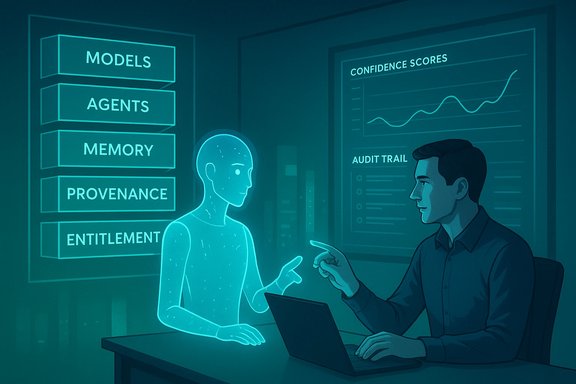
- Move from models to systems: compose models, agents, memory, entitlements, provenance, and safe tools use into engineered platforms that work in production.
- Make deliberate choices about where to apply scarce compute, energy, and talent so AI produces measurable societal benefit and can earn “societal permission.”
Why This Matters: From Hype to Durable Value
The shift Nadella describes is not merely semantic. It has concrete engineering and commercial consequences that affect Microsoft’s product roadmaps, Azure cloud economics, enterprise customers, and Windows users.- Operational discipline over showmanship. Systems thinking demands robust observability, fallbacks, audit trails, and UX patterns that expose uncertainty. That reduces feature velocity in favor of long‑tail reliability.
- Capital allocation and datacenter strategy. Large models and agentic systems drive GPU, power, and network spend. Microsoft’s choices about where to invest will shape cloud pricing, performance, and regional infrastructure.
- Regulatory and social license. Building for measurable societal impact invites third‑party evaluation, transparency, and governance mechanisms — areas where Microsoft seeks to lead but which will invite scrutiny.
The Technical Turn: What “Models → Systems” Really Means
Nadella’s “models to systems” sentence is shorthand for a stack of engineering commitments. For practitioners and Windows administrators, these translate into five technical directives:- Build orchestration layers that route tasks to specialized models and agents, rather than treating any single foundation model as the universal backend.
- Add persistent memory and provenance so interactions are contextualized, auditable, and recoverable.
- Implement entitlements and access controls so agents respect data boundaries, permissions, and privacy regulations.
- Provide tool‑use primitives that allow secure integration of external actions (APIs, databases, device controls) with instrumentation and safety checks.
- Surface uncertainty to users — confidence scores, fallbacks, and human‑in‑the‑loop workflows — to reduce harm from hallucinations.
How This Aligns with Microsoft’s Product Moves
Nadella’s essay reads as a public justification for a company already pivoting toward agentic systems: Copilot, Copilot Studio, Copilot+ devices, and CoreAI platform moves aim to make agents the default productivity surface across Microsoft 365, Windows, and developer tools.- Copilot is positioned as the “UI of AI” across Office and Windows, but user experience evidence has been mixed. Independent testing and user reports cite regressions, hallucinations, and unfinished behaviors — the very “slop” Nadella wants the industry to outgrow.
- Internally, Microsoft has reorganized teams and leadership to accelerate platform work — core platform groups, CoreAI, and leadership changes that free Nadella to focus more on technical strategy. That structural shift is consistent with a move to systems engineering.
Strengths of Nadella’s Reset
Nadella’s call has several clear strengths and realistic elements that are worth highlighting.- Product realism. Shifting the conversation to systems and outcomes pushes companies to prioritize reliability, observability, and real user value over viral demos. That is a practical, measurable objective.
- Public leadership on governance. By linking technical choices to societal permission, Nadella frames infrastructure and deployment decisions as public goods, nudging industry and policymakers toward shared standards.
- Alignment with enterprise needs. Enterprises want predictable, auditable AI; a systems approach maps directly to the compliance and governance requirements CIOs and security teams demand.
Risks and Blind Spots
Nadella’s essay is a welcome orientation, but it also leaves open a set of operational and ethical questions.- Rhetoric vs. execution. The post is high level; it lacks concrete, time‑bound commitments such as explicit quality SLAs for Copilot, independent audit mechanisms, or disclosure frameworks that would make “real‑world eval impact” verifiable. That gap invites skepticism.
- Concentration of power. Systems that orchestrate models, memories, and entitlements create new choke points — the very aggregation of compute, data access, and governance could centralize influence over what agents see and do. Nadella notes this risk, but the post doesn’t propose structural mitigations.
- Operational cost and carbon footprint. Building agentic systems at scale compounds GPU, networking, and energy consumption. How Microsoft balances environmental impact with product demands is an open question that requires transparent metrics.
- Human cognition and deskilling. Emerging studies and user reports suggest repeated reliance on generative AI can reduce human critical engagement on routine tasks. Nadella’s “cognitive amplifier” framing is aspirational; the real effect on worker skill and decision quality will depend on UX design and workplace policy.
Claims That Need Caution
Several widely circulated claims about Microsoft’s AI transition are still not independently verifiable and should be treated cautiously.- Reports that Nadella privately told managers “Copilot doesn’t really work” or similar internal quotes have been widely repeated but originate from secondary reporting and paywalled pieces; they should be flagged as unverified unless primary sources are published. Readers should treat such attributions as important but not confirmed.
- Large headline investments and partner seat counts announced in region tours (for example, multibillion-dollar commitments in India and partner license numbers) are often promotional and can overstate immediate, verifiable adoption; independent verification is necessary to assess real impact.
What This Means for Windows Users and IT Pros
The Nadella reset has direct product and administrative consequences for the Windows ecosystem. Here’s a practical checklist for IT teams evaluating the coming wave of agentic features:- Expect more agent integrations in Windows and Microsoft 365 that will require updated deployment and privacy controls. Add these to your product acceptance criteria.
- Insist on observable, auditable behavior from AI features: logs, provenance, and configurable entitlements should be mandatory for enterprise deployments.
- Pilot agentic workflows in low‑risk domains first, measure real productivity changes, and protect against unintended automation biases or data leakage.
- Track cloud cost and governance implications of heavier AI usage: budgets for GPU hours, data egress, and model retraining are new line items for most organizations.
Policy and Competitive Implications
Nadella’s public posture has broader industry and policy effects. By explicitly asking for a societal consensus on where to apply scarce resources, Microsoft is nudging regulators, customers, and rivals toward rule‑making and standards that favor auditable systems over opaque model monopolies.- Policymakers will likely respond by pushing for transparency requirements — provenance, explainability, and audit rights — in enterprise AI contracts.
- Competitors will frame their roadmaps similarly, competing on systems reliability, commercial tooling, and governance primitives rather than raw model size. That will favor companies with large cloud footprints and established enterprise relationships.
Final Analysis: Credible Pivot — If Backed by Metrics
Satya Nadella’s call for an AI reset in 2026 is an important, defensible repositioning. Its strength lies in shifting the conversation from spectacle to production engineering and public accountability. That is the correct framing for an industry moving toward mass diffusion of generative technologies. However, rhetoric will not suffice. The real test of this “models → systems” thesis will be measurable, public progress on:- Product quality metrics and SLAs for flagship AI features.
- Instrumentation and provenance that make agent outputs auditable by customers and regulators.
- Transparent reporting on compute, cost, and environmental impact.
- Independent evaluations that assess real‑world benefits, not just demoable capabilities.
Ultimately, Nadella did what CEOs must sometimes do: reframe the debate and align incentives. For Microsoft and the rest of the industry, the next and harder phase is to turn those words into systems, metrics, and public evidence that AI can be a dependable amplifier of human potential rather than a factory of low‑value outputs.
Source: The Economic Times Microsoft CEO Satya Nadella calls for a big AI reset in 2026, says we need to move beyond... - The Economic Times
