

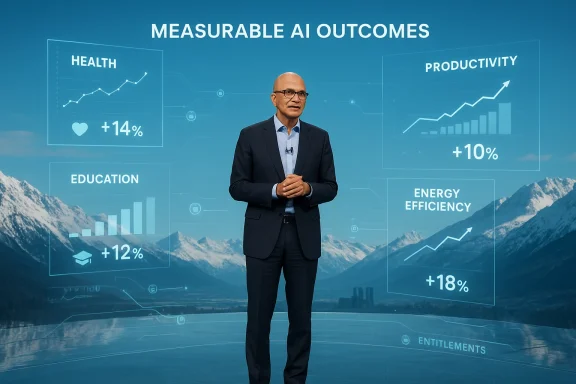
Satya Nadella’s blunt message from Davos is a challenge and a warning: generative AI must start delivering measurable, real-world impact or risk losing the fragile public mandate that enables today's AI boom. At the World Economic Forum this year Nadella reframed the debate away from benchmark chasing and sensational demos toward a simple business and civic demand — AI should be judged on whether it improves health, education, public-sector efficiency and private‑sector competitiveness, or else society will withdraw the “social permission” to use scarce resources like energy to run large models.
Satya Nadella published a short, strategic note late last year and followed up with public remarks at Davos that crystallize Microsoft’s public posture for 2026: move from flashy model demos to production-grade systems that reliably amplify human work. He describes a “model overhang” — capability outpacing the product engineering, govern to convert those capabilities into dependable outcomes for users. That framing deliberately reframes the benchmark conversation into one about measurable outcomes, provenance, observability and where scarce compute and energy should be applied.
This is an industry moment: hyperscalers have committed enormous capital to datacenters, GPUs and custom silicon; enterprises and regulators are demanding auditability; and public sentiment has hardened againsduced generative outputs — the cultural shorthand “slop” captures that frustration. Nadella’s thesis is both product-level and political: to survive and scale, AI must earn broad diffusion through measurable benefit, not hype.
Satya Nadella’s Davos message is both a business manifesto and a public-policy nudge: AI must justify the energy, money and social trust we invest in it by delivering measurable improvements in people's lives and enterprise outcomes. That call reframes success from the raw appetites of benchmark-chasing and viral demos to a tougher, longer game — one that demands instrumentation, governance, and demonstrable effectiveness.
The industry’s choice is material. If companies invest in the hard work of systems engineering, transparency, and equitable diffusion, AI can become a durable productivity platform that augments people and industries. If they do not, public skepticism, regulatory intervention and capital contraction could transform today’s boom into a painful consolidation. Either way, Nadella’s test for 2026 is clear: prove it works, or forfeit the political and commercial license to scale.
Source: Windows Central Microsoft CEO Satya Nadella says AI needs to prove its worth
 Background / Overview
Satya Nadella published a short, strategic note late last year and followed up with public remarks at Davos that crystallize Microsoft’s public posture for 2026: move from flashy model demos to production-grade systems that reliably amplify human work. He describes a “model overhang” — capability outpacing the product engineering, govern to convert those capabilities into dependable outcomes for users. That framing deliberately reframes the benchmark conversation into one about measurable outcomes, provenance, observability and where scarce compute and energy should be applied.This is an industry moment: hyperscalers have committed enormous capital to datacenters, GPUs and custom silicon; enterprises and regulators are demanding auditability; and public sentiment has hardened againsduced generative outputs — the cultural shorthand “slop” captures that frustration. Nadella’s thesis is both product-level and political: to survive and scale, AI must earn broad diffusion through measurable benefit, not hype.
Why Nadella’s plea matters to Microsoft and the industry
Nadella’s remarks are strategic, not merely rhetorical. Microsoft has placed enormous commercial weight on AI across Azure, Microsoft 365 Copilot, Windows integrations, and its partnership with major model developers. The “models → systems” shipes where Microsoft must invest: not just bigger models, but orchestration layers — memory, entitlements, provenance, runtime guardrails, and observability — that make agentic assistants reliable at scale.- Microsoft’s business model now depends on turning AI capability into sustainable, monetizable products rather than one-off demos.
- Enterprise buyers increasingly insist on verifiable SLAs, audit trails, and governance before committing mission‑critical workloads.
- The cost structure of model training and inference (compute, networking, energy) rewards durable revenue streams rather than viral attentionreframes Microsoft’s risk calculus: billions of dollars of capex and tens of thousands of person-years of engineering are at stake if the industry cannot demonstrate verifiable impact.
The "models to systems" thesis — what it means in practice
Nadella’s shorthand — moving from models to systems — is a compact way to describe a deep technical and product roadmap. Translating that idea into practice requires multiple engineering and organizational commitments:1) Instrumentation and observability
- Record provenance for every generated output: who asked, what context, which data sources, and what confidence level.
- Surface uncertainty and provide provenance UI so end users can make informed decisions.
2) Memory, entitlements and safe tool use
- Design persistent, consented memory with robust access controls and revocation.
- Build entitlements so models operate within the right scope and privileges for a given user or organization.
3) Fallbacks, audit trails and human‑in‑the‑loop controls
- Implement reliable fallbacks where automation fails — one‑click undo, human review gates, and built-in validation checks.
- Maintain audit trails for regulatory compliance and forensic analysis.
4) Domain‑specific validation programs
- Fund independent, subject‑matter expert evaluations in healthcare, law and education to produce measurable impact metrics.
Energy, compute and the "social permission" to run AI
One of the most combustible phrases in Nadella’s remarks is that AI could lose the “social permission” to consume energy if it doesn’t demonstrably improve outcomes. This is a political and operational warning with three practical implications:- Public policy and civil society will push back on wasteful compute if outputs are low value or harmful, increasing regulatory and reputational risk.
- Corporations will face transparency demands for emissions, compute efficiency (tokens-per-watt), and demonstrable ROI for AI features that justify their energy footprint.
- Platforms that cannot show measurable benefit will compete on engagement alone — a race that leads to low‑value mass production and further erosion of trust.
Labor market implications and the "junior roles" discussion
At Davos this year other AI leaders echoed the disruptive implications of diffusion. DeepMind CEO Demis Hassabis and Anthropic CEO Dario Amodei both signaled early signs of AI displacing junior roles at their companies, and Amodei’s longer‑standing prediction that up to 50% of entry‑level white‑collar roles could be eliminated remains influential in policy debates. Those comments underline a core tension: diffusion that improves productivity can also shrink pathways into professions. Key policy and corporate considerations:- Reskilling and education systems must accelerate to provide alternative career paths for early‑career workers.
- Organizations need transparent transition programs, redeployment pathways and measured productivity metrics when automation reduces headcount.
- Public policy should consider income support, retraining funding and incentives for firms that invest in human capital alongside automation.
The bubble debate: caution versus optimism
Nadella warned that AI could become a bubble unless adoption broadens to deliver measurable value and not just speculative investment. This is a mainstream concern: Bill Gates has publicly compared elements of today’s AI investment climate to the dot‑com of overvalued companies and infrastructure bets will end as “dead ends.” Prominent investors and technologists diverge: some call it a structural shift, others a speculative mania. Why the comparison matters:- The dot‑com era produced durable winners but also destroyed capital in many “me‑too” companies that lacked product-market fit.
- AI today has enormous technical momentum, but the distribution of value depends on durable product economics and governance — not novelty alone.
On the question of OpenAI’s finances — what’s verified and what’s speculative
A particularly explosive claim floating around tech coverage and social feeds is that OpenAI could suffer a multi‑billion dollar loss in 2026 and potentially face bankruptcy by mid‑2027. That narrative has been repeated in outlets that summarize social posts, financial conjecture and model‑cost estimates, but it currently rests on speculative extrapolations rather than confirmed audited filings. Several reports suggest heavy spending on compute, datacenter expansion, and hiring, and analysts have pointed to difficult unit economics for large-scale models. But the precise headline numbers (for example, "$14 billion loss in 2026" or "bankruptcy by mid‑2027") are not backed by published audited financial statements and should be treated with caution. It is responsible journalism to highlight two points:- The structural facts are clear: model training and inference at frontier scale are costly; enterprise monetization must keep pace with that cost.
- The specific dollar figures and insolvency timetables reported in some outlets are speculative and not corroborated by primary financial filings from OpenAI or major regulatory disclosures as of the time of reporting.
Strengths in Nadella’s framing
- Operational clarity — Nadella moves the conversation from slogans to engineering: observabilitements and safety are concrete workstreams.
- Market discipline — demanding measurable impact aligns product teams with customers and regulators, increasing the odds of durable monetization.
- Public-policy savvy — by invoking societal permission and resource allocation, Nadella signals an openness to standards, third‑party metrics and governance that may preempt harsher regulatory outcomes.
- Strategic alignment with Microsoft assets — Microsoft can leverage Azure, enterprise sales channels, and Microsoft 365 integrations to make the "systems" approach tangible for large customers.
Risks and blind spots
- Product execution gap: Strategic rhetoric must be matched with measurable product upgrades. Several independent reports and community tests have highlighted reliability gaps in early Copilot f concrete SLAs and independent audits could erode credibility.
- Concentration risk: Prioritizing frontier models without widening accessible, affordable systems increases economic concentration and platform power.
- Creator and labor backlash: Rapid policy shifts or product rollouts that decimate creator value or eliminate entry-level work without transition plans invite political and legal pushback.
- Energy and supply constraints: Hardware and energy supply limitations can throttle diffusion, and public debate about sustainability could translate into new regulation or higher operating costs.
- Misinformation & hallucinations: Systems that don’t contain robust provenance and guardrails risk regulatory action and consumer harm if outputs are used in safety‑critical domains.
Practical checklist for enterprises and product teams
For CIOs, product leaders and regulators who want to operationalize Nadella’s thesis, the following checklist provides actionable priorities:- Define measurable impact metrics (KPIs) for AI features tied to business outcomes (time saved, error reduction, revenue uplift).
- Implement provenance and confidence UI for all generative outputs.
- Require human review for decisions that materially affect rights, finance, health, or legal outcomes.
- Publish quarterly, independently verifiable reliability and safety metrics for production AI features.
- Invest in staff reskilling programs and transparent redeployment frameworks to address labor disruption.
Scenarios to watch in the next 12–24 months
- Scenario A — Systems succeed: platforms deploy robust provenance, SLAs and domain validation; enterprise adoption widens and the market rewards durable revenue models.
- Scenario B — Speculative retrenchment: inadequate product discipline and shaky unit economics lead to investor pullback, layoffs and a market correction similar to prior tech cycles.
- Scenario C — Regulatory enforcement: governments impose mandatory disclosure, provenance requirements, or carbon/compute taxes for large models, accelerating the "systems" agenda but adding compliance costs.
- Scenario D — Labor and social policy crisis: rapid automation of entry-level roles without reskilling triggers political intervention and a rethinking of social safety nets.
Satya Nadella’s Davos message is both a business manifesto and a public-policy nudge: AI must justify the energy, money and social trust we invest in it by delivering measurable improvements in people's lives and enterprise outcomes. That call reframes success from the raw appetites of benchmark-chasing and viral demos to a tougher, longer game — one that demands instrumentation, governance, and demonstrable effectiveness.
The industry’s choice is material. If companies invest in the hard work of systems engineering, transparency, and equitable diffusion, AI can become a durable productivity platform that augments people and industries. If they do not, public skepticism, regulatory intervention and capital contraction could transform today’s boom into a painful consolidation. Either way, Nadella’s test for 2026 is clear: prove it works, or forfeit the political and commercial license to scale.
Source: Windows Central Microsoft CEO Satya Nadella says AI needs to prove its worth
