

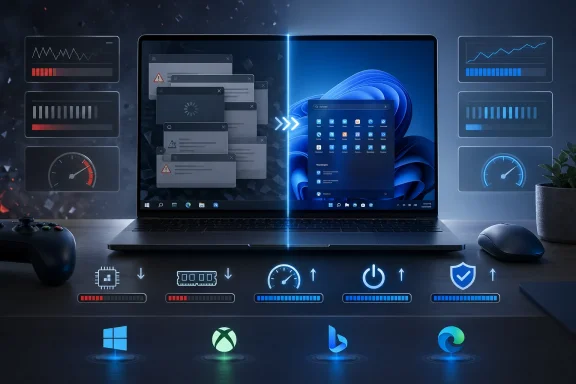
Microsoft CEO Satya Nadella used Microsoft’s fiscal 2026 third-quarter earnings call on April 29, 2026, to say the company is doing “foundational work” to win back fans across Windows, Xbox, Bing, and Edge, including Windows performance improvements for lower-memory devices. That is not a throwaway line from a CEO filling airtime. It is a public admission that Microsoft’s consumer platforms have a trust problem, and that Windows cannot AI-demo its way out of one more year of basic irritations. The interesting part is not that Windows may use less RAM; it is that Microsoft has finally started talking as if memory, updates, latency, and user patience are strategic assets.
For much of the last two years, Microsoft’s consumer Windows story has been dominated by Copilot, cloud integration, AI PCs, and the slow normalization of the operating system as a launchpad for services. That strategy was understandable from Redmond’s point of view: Windows remains the most important consumer computing surface Microsoft controls, and every surface is now expected to carry an AI story. But the average Windows user does not experience strategy. They experience boot time, battery life, File Explorer stalls, search results, surprise prompts, update anxiety, and the nagging feeling that the OS is always trying to sell them something.
That is why Nadella’s wording matters. “Win back fans” is not the language of a company merely tuning a feature pipeline. It is the language of a company that knows affection has been spent down. Windows still has users by the hundreds of millions, but users are not the same thing as fans, and Microsoft appears to understand that distinction again.
The RAM angle is particularly revealing. Memory consumption is not the flashiest problem in Windows 11, and it is rarely the one Microsoft prefers to emphasize on stage. Yet it is one of the places where the OS feels most unforgiving on real hardware, especially on machines that technically meet Windows 11 requirements but have little headroom for modern browsers, Teams, Discord, launchers, security tools, background sync clients, and whatever else the OEM bundled before first boot.
This is the practical edge of Microsoft’s new consumer message. A Windows that feels better on a lower-memory PC is a Windows that respects the installed base rather than treating every complaint as a reason to buy newer hardware.
That might have been tolerable if the fundamentals were immaculate. They were not. Windows 11 has improved since its launch, but its reputation has remained uneven among enthusiasts because the improvements often arrived beside regressions, removed affordances, or UI rewrites that seemed prettier than they were faster. A redesigned surface that takes longer to load does not feel modern. It feels like debt with rounded corners.
The challenge is made worse by Windows’ sheer diversity. Microsoft has to support new Copilot+ PCs, old business laptops, gaming towers, cheap education devices, workstations, and enterprise fleets with layers of management tooling. Apple can optimize macOS around a narrower hardware and software stack. Microsoft cannot. But that old defense has worn thin because users are not asking Windows to become macOS; they are asking it to stop wasting the resources they already paid for.
When Nadella points to performance improvements for lower-memory devices, he is implicitly conceding that the old bargain has cracked. Windows has long gotten away with being heavier because PC hardware got faster. In 2026, that logic is less comfortable. Memory prices, AI-driven component demand, longer PC replacement cycles, and a huge installed base of 8GB machines have made baseline efficiency matter again.
That leaves Microsoft with a simple problem: even if Windows is not the only culprit, it is the platform everyone blames. The operating system is the landlord. When the building feels cramped, tenants do not care that every app brought extra furniture.
Reducing Windows’ baseline memory footprint is not just about making a 4GB or 8GB device technically usable. It is about lowering the invisible tax the OS takes before the user does anything. A leaner shell, faster Explorer, more disciplined background processes, and better memory reclamation all contribute to a system that feels like it is working with the user rather than idling against them.
This is also where Microsoft has to be careful with its AI ambitions. On-device models, semantic indexes, recall-like experiences, background summarization, and natural-language system controls all sound useful in isolation. Together, they risk becoming a new resident layer of compute and memory demand. If Microsoft wants AI to feel native rather than parasitic, it has to make the rest of Windows lighter, calmer, and more predictable.
That is the deeper importance of Nadella’s remark. A company that wants to put AI everywhere is now promising to make the platform feel less burdened. Those goals are not automatically compatible. Microsoft has to prove it can do both.
Microsoft knows this. The company has spent years building better release health dashboards, known issue rollbacks, safeguard holds, deployment rings, Autopatch, hotpatching in supported scenarios, and more transparent servicing documentation. Yet for many Windows users, the emotional model of Windows Update remains stubbornly primitive: something may break, and the user may not be in control when it happens.
That perception is hard to reverse because Windows Update has to serve two masters. For security, Microsoft needs broad, fast patch adoption. For trust, users want agency, timing, clarity, and confidence that the cure will not be worse than the vulnerability. Enterprise administrators understand this tension better than anyone. Consumers simply feel it.
A more streamlined update experience is therefore not a cosmetic change. It is a governance change. The best update mechanism is the one users barely notice because it gives them enough information to trust it and enough control to schedule it. The worst is the one that turns every cumulative update into folklore.
If Microsoft is serious about winning back fans, Windows Update has to become boring again. Not invisible, not optional, not magically risk-free — just boring. Boring is underrated. Boring is what you want from the software layer responsible for keeping your PC secure.
Windows is the tell because it sits underneath all of them. It is the most intimate consumer product Microsoft ships. Users may choose whether to open Edge or use Bing, but they live inside Windows if they own a Windows PC. Every friction point elsewhere feels more offensive when the operating system itself appears to be nudging the user toward Microsoft’s preferred services.
That is why “core users” is such an important phrase. Core users are not always the largest or easiest audience. They are the enthusiasts, admins, gamers, developers, repair people, power users, and long-time Windows households who shape the reputation of the platform. They are the people relatives ask before buying a laptop. They are the ones who notice when a context menu takes too long, when a setting moves for no reason, or when a local-account path becomes harder to find.
Winning them back does not require Microsoft to abandon AI, cloud services, or subscriptions. It requires Microsoft to stop treating loyalty as a renewable resource that can be mined indefinitely. Windows fans will forgive ambition. They are much less forgiving of ambition that arrives as clutter.
That is where lower memory usage becomes a moral test for Windows. Not moral in the grand philosophical sense, but moral in the product sense: does Microsoft still believe the OS should improve the hardware people own, or does it increasingly exist to create pressure for the hardware and services Microsoft wants to sell next?
Windows 11’s official minimums have always been a source of tension because they formalized a sharper break with older PCs. Microsoft had legitimate security reasons for TPM and CPU requirements, but the user-facing result was simple: many machines that ran Windows 10 adequately were told they were not welcome. That made every Windows 11 performance complaint politically charged. If the OS demanded newer hardware, users expected it to feel obviously better.
For some, it did. For others, Windows 11 felt like a lateral move with additional nags and fewer familiar controls. That is the kind of disappointment that does not show up cleanly in adoption charts. It shows up in forum threads, delayed migrations, third-party tweaking tools, and the quiet decision to stop recommending Windows laptops with enthusiasm.
Optimizing for low-memory devices is one way to repair that breach. It signals that Microsoft understands real-world PCs are not spec sheets. They are ecosystems of aging hardware, impatient users, legacy apps, and background services. Making those systems feel faster is not glamorous, but it is exactly the kind of work Windows needs.
Windows cannot afford that cycle forever. The PC is no longer the only computing device in most people’s lives. Phones own casual computing. Tablets own couch computing. Consoles and cloud services own large pieces of entertainment. The Windows PC remains indispensable for work, gaming, development, creation, and compatibility, but indispensability is not the same as affection.
Performance work has to survive beyond the next earnings-cycle sound bite. It has to become a release gate. If a feature increases memory use, startup time, shell latency, or background network activity, somebody inside Microsoft should have to justify that cost in plain language. If a new AI component makes a low-end device worse, the default should not be “ship it and let hardware catch up.”
That is difficult because modern Microsoft is deeply metric-driven. Engagement can be measured. Click-throughs can be measured. Service conversion can be measured. The absence of annoyance is harder to quantify, and the business value of not irritating users often appears only when it is too late. Windows needs a way to measure restraint.
The best version of this new push would make performance a cultural constraint. Not a temporary project. Not a blog series. Not a handful of cherry-picked benchmarks. A constraint.
The enterprise stakes are different from the consumer stakes, but they overlap. Lower RAM usage can extend the useful life of fleets. Faster shell responsiveness reduces support noise. More reliable updates reduce operational risk. Cleaner defaults make image management less painful. Fewer consumer-service intrusions simplify policy enforcement and user training.
But enterprise admins will also watch for the usual catch. Are improvements available broadly, or only on the newest hardware? Do they apply to existing Windows 11 versions, or are they tied to future feature releases? Are AI components optional, manageable, and transparent? Are new update controls actually exposed through policy, or only through consumer-facing Settings screens?
Microsoft has earned skepticism here. The company often delivers powerful management tools, but it also has a habit of making consumer and commercial priorities collide inside the same OS. An admin can lock down many things, but the work required to keep Windows quiet has become part of the job. If Microsoft wants to win back core users, it should remember that many of those core users manage other people’s PCs.
The irony is that enterprise customers may benefit most from a consumer-driven quality push. When Microsoft makes Windows better for impatient home users, it often makes Windows better for everyone. Nobody in a managed fleet wants a sluggish Start menu either.
Microsoft participates in that world. Teams, Outlook transitions, widgets, web-powered panels, and service integrations have all leaned on web technologies where native code might have been leaner but slower to develop. The company cannot credibly lecture the ecosystem about efficiency while shipping its own share of web-heavy experiences.
Still, Windows has a unique role. It can improve scheduling, memory compression, app suspension, startup impact visibility, energy recommendations, and developer guidance. It can make waste more visible. It can pressure Microsoft’s own app teams to meet higher standards. It can make native Windows development feel worthwhile again rather than merely nostalgic.
That last point matters. Windows has sometimes seemed ambivalent about its own native app story, caught between Win32 legacy, UWP retrenchment, WinUI ambitions, web containers, and cross-platform realities. Developers notice ambiguity. Users experience it as inconsistency. A renewed focus on fundamentals should include a clearer answer to what a good Windows app is supposed to be in 2026.
If Microsoft wants Windows to feel premium again, it cannot be satisfied with a shell that hosts a collection of semi-native service panels. Craft is not just animation. Craft is resource discipline, input latency, accessibility, consistency, and the confidence that the thing you clicked will respond now.
That is where Microsoft finds itself. Even sensible changes are now met with “what is the catch?” A better Edge feature becomes another suspected push for Bing. A useful Copilot capability becomes another concern about telemetry or resource use. A Windows feature update becomes another reason to wait three months. Trust is a lens, and Microsoft has fogged it.
The company does not need universal love. Windows has never been universally loved. It needs enough credibility that users believe improvements are for them, not merely for engagement metrics. That is a lower bar than adoration but a higher bar than compatibility.
Nadella’s earnings-call comment suggests Microsoft understands the emotional math. The next step is product behavior that proves it. Fewer interruptions. Better defaults. Cleaner update controls. Measurable performance gains. Less RAM pressure. More polish in old places. Less insistence that every surface become a funnel.
That would not make Windows cool overnight. But it might make it recommendable again, and that is the more important goal.
Source: XDA Satya Nadella wants Windows to use less RAM as part of a bigger push to win back consumers
 Nadella Puts Windows Back in the Repair Shop
For much of the last two years, Microsoft’s consumer Windows story has been dominated by Copilot, cloud integration, AI PCs, and the slow normalization of the operating system as a launchpad for services. That strategy was understandable from Redmond’s point of view: Windows remains the most important consumer computing surface Microsoft controls, and every surface is now expected to carry an AI story. But the average Windows user does not experience strategy. They experience boot time, battery life, File Explorer stalls, search results, surprise prompts, update anxiety, and the nagging feeling that the OS is always trying to sell them something.That is why Nadella’s wording matters. “Win back fans” is not the language of a company merely tuning a feature pipeline. It is the language of a company that knows affection has been spent down. Windows still has users by the hundreds of millions, but users are not the same thing as fans, and Microsoft appears to understand that distinction again.
The RAM angle is particularly revealing. Memory consumption is not the flashiest problem in Windows 11, and it is rarely the one Microsoft prefers to emphasize on stage. Yet it is one of the places where the OS feels most unforgiving on real hardware, especially on machines that technically meet Windows 11 requirements but have little headroom for modern browsers, Teams, Discord, launchers, security tools, background sync clients, and whatever else the OEM bundled before first boot.
This is the practical edge of Microsoft’s new consumer message. A Windows that feels better on a lower-memory PC is a Windows that respects the installed base rather than treating every complaint as a reason to buy newer hardware.
The AI Year Left a Quality Debt Behind
The problem Microsoft is now trying to fix was not created by one bad update or one unpopular feature. It was accumulated through a series of choices that made Windows feel increasingly instrumental: useful, necessary, but less and less beloved. Copilot was pushed hard. Edge and Bing integrations kept surfacing in ways that many users read as coercive rather than helpful. Settings pages, account flows, lock screens, widgets, and search surfaces all seemed to blur the line between operating system and monetization channel.That might have been tolerable if the fundamentals were immaculate. They were not. Windows 11 has improved since its launch, but its reputation has remained uneven among enthusiasts because the improvements often arrived beside regressions, removed affordances, or UI rewrites that seemed prettier than they were faster. A redesigned surface that takes longer to load does not feel modern. It feels like debt with rounded corners.
The challenge is made worse by Windows’ sheer diversity. Microsoft has to support new Copilot+ PCs, old business laptops, gaming towers, cheap education devices, workstations, and enterprise fleets with layers of management tooling. Apple can optimize macOS around a narrower hardware and software stack. Microsoft cannot. But that old defense has worn thin because users are not asking Windows to become macOS; they are asking it to stop wasting the resources they already paid for.
When Nadella points to performance improvements for lower-memory devices, he is implicitly conceding that the old bargain has cracked. Windows has long gotten away with being heavier because PC hardware got faster. In 2026, that logic is less comfortable. Memory prices, AI-driven component demand, longer PC replacement cycles, and a huge installed base of 8GB machines have made baseline efficiency matter again.
Less RAM Is a Product Feature Now
There was a time when “uses less RAM” sounded like a footnote for release notes or a boast from a Linux distribution. In the current PC market, it is a consumer feature. The browser is heavier. Collaboration apps are heavier. Game launchers are heavier. Desktop apps increasingly arrive as web wrappers. Meanwhile, users are running more background services, more sync clients, more endpoint security, more chat tools, and more AI-adjacent utilities than they did a decade ago.That leaves Microsoft with a simple problem: even if Windows is not the only culprit, it is the platform everyone blames. The operating system is the landlord. When the building feels cramped, tenants do not care that every app brought extra furniture.
Reducing Windows’ baseline memory footprint is not just about making a 4GB or 8GB device technically usable. It is about lowering the invisible tax the OS takes before the user does anything. A leaner shell, faster Explorer, more disciplined background processes, and better memory reclamation all contribute to a system that feels like it is working with the user rather than idling against them.
This is also where Microsoft has to be careful with its AI ambitions. On-device models, semantic indexes, recall-like experiences, background summarization, and natural-language system controls all sound useful in isolation. Together, they risk becoming a new resident layer of compute and memory demand. If Microsoft wants AI to feel native rather than parasitic, it has to make the rest of Windows lighter, calmer, and more predictable.
That is the deeper importance of Nadella’s remark. A company that wants to put AI everywhere is now promising to make the platform feel less burdened. Those goals are not automatically compatible. Microsoft has to prove it can do both.
Windows Update Is Where Trust Goes to Be Tested
Nadella also pointed to a streamlined Windows Update experience, and that may be even more important than the RAM line for IT pros. Memory pressure annoys users every day, but update failures create institutional memory. One bad patch can become a year of delayed deployments, blocked feature upgrades, internal warnings, help desk scripts, and executives asking why their laptop rebooted before a meeting.Microsoft knows this. The company has spent years building better release health dashboards, known issue rollbacks, safeguard holds, deployment rings, Autopatch, hotpatching in supported scenarios, and more transparent servicing documentation. Yet for many Windows users, the emotional model of Windows Update remains stubbornly primitive: something may break, and the user may not be in control when it happens.
That perception is hard to reverse because Windows Update has to serve two masters. For security, Microsoft needs broad, fast patch adoption. For trust, users want agency, timing, clarity, and confidence that the cure will not be worse than the vulnerability. Enterprise administrators understand this tension better than anyone. Consumers simply feel it.
A more streamlined update experience is therefore not a cosmetic change. It is a governance change. The best update mechanism is the one users barely notice because it gives them enough information to trust it and enough control to schedule it. The worst is the one that turns every cumulative update into folklore.
If Microsoft is serious about winning back fans, Windows Update has to become boring again. Not invisible, not optional, not magically risk-free — just boring. Boring is underrated. Boring is what you want from the software layer responsible for keeping your PC secure.
The Consumer Business Is Bigger Than Windows, but Windows Is the Tell
Nadella grouped Windows with Xbox, Bing, and Edge, and that grouping is revealing. Microsoft’s consumer problem is not confined to one product. Xbox fans have been through years of mixed hardware signals, studio upheaval, subscription strategy pivots, and debates over exclusivity. Edge is technically strong but still carries the stigma of aggressive promotion. Bing has benefited from AI search attention but remains trapped in the gravitational field of Google’s habits and defaults.Windows is the tell because it sits underneath all of them. It is the most intimate consumer product Microsoft ships. Users may choose whether to open Edge or use Bing, but they live inside Windows if they own a Windows PC. Every friction point elsewhere feels more offensive when the operating system itself appears to be nudging the user toward Microsoft’s preferred services.
That is why “core users” is such an important phrase. Core users are not always the largest or easiest audience. They are the enthusiasts, admins, gamers, developers, repair people, power users, and long-time Windows households who shape the reputation of the platform. They are the people relatives ask before buying a laptop. They are the ones who notice when a context menu takes too long, when a setting moves for no reason, or when a local-account path becomes harder to find.
Winning them back does not require Microsoft to abandon AI, cloud services, or subscriptions. It requires Microsoft to stop treating loyalty as a renewable resource that can be mined indefinitely. Windows fans will forgive ambition. They are much less forgiving of ambition that arrives as clutter.
The Low-End PC Is the Moral Test of Windows
A Windows build that flies on a $2,000 laptop tells us less than Microsoft thinks. The real test is the machine bought three years ago from a warehouse store, the school laptop with modest RAM, the small-business desktop with too many startup apps, the family PC with an aging SSD, and the office fleet that cannot be replaced on an AI-PC marketing schedule.That is where lower memory usage becomes a moral test for Windows. Not moral in the grand philosophical sense, but moral in the product sense: does Microsoft still believe the OS should improve the hardware people own, or does it increasingly exist to create pressure for the hardware and services Microsoft wants to sell next?
Windows 11’s official minimums have always been a source of tension because they formalized a sharper break with older PCs. Microsoft had legitimate security reasons for TPM and CPU requirements, but the user-facing result was simple: many machines that ran Windows 10 adequately were told they were not welcome. That made every Windows 11 performance complaint politically charged. If the OS demanded newer hardware, users expected it to feel obviously better.
For some, it did. For others, Windows 11 felt like a lateral move with additional nags and fewer familiar controls. That is the kind of disappointment that does not show up cleanly in adoption charts. It shows up in forum threads, delayed migrations, third-party tweaking tools, and the quiet decision to stop recommending Windows laptops with enthusiasm.
Optimizing for low-memory devices is one way to repair that breach. It signals that Microsoft understands real-world PCs are not spec sheets. They are ecosystems of aging hardware, impatient users, legacy apps, and background services. Making those systems feel faster is not glamorous, but it is exactly the kind of work Windows needs.
Performance Cannot Be a Campaign
The risk is that Microsoft treats this as a 2026 theme rather than a permanent discipline. We have seen this movie before. A platform gets criticized for bloat, the company announces a renewed focus on quality, several releases improve the fundamentals, and then the product organization slowly resumes layering new engagement surfaces on top. The bloat returns, just with different icons.Windows cannot afford that cycle forever. The PC is no longer the only computing device in most people’s lives. Phones own casual computing. Tablets own couch computing. Consoles and cloud services own large pieces of entertainment. The Windows PC remains indispensable for work, gaming, development, creation, and compatibility, but indispensability is not the same as affection.
Performance work has to survive beyond the next earnings-cycle sound bite. It has to become a release gate. If a feature increases memory use, startup time, shell latency, or background network activity, somebody inside Microsoft should have to justify that cost in plain language. If a new AI component makes a low-end device worse, the default should not be “ship it and let hardware catch up.”
That is difficult because modern Microsoft is deeply metric-driven. Engagement can be measured. Click-throughs can be measured. Service conversion can be measured. The absence of annoyance is harder to quantify, and the business value of not irritating users often appears only when it is too late. Windows needs a way to measure restraint.
The best version of this new push would make performance a cultural constraint. Not a temporary project. Not a blog series. Not a handful of cherry-picked benchmarks. A constraint.
Enterprise IT Will Believe the Telemetry Before the Slogan
For sysadmins, Nadella’s remarks are welcome but not sufficient. Enterprise IT does not deploy sentiment. It deploys builds, policies, baselines, rings, rollback plans, and support scripts. A CEO saying Windows will focus on fundamentals is useful only if the next year of servicing proves it.The enterprise stakes are different from the consumer stakes, but they overlap. Lower RAM usage can extend the useful life of fleets. Faster shell responsiveness reduces support noise. More reliable updates reduce operational risk. Cleaner defaults make image management less painful. Fewer consumer-service intrusions simplify policy enforcement and user training.
But enterprise admins will also watch for the usual catch. Are improvements available broadly, or only on the newest hardware? Do they apply to existing Windows 11 versions, or are they tied to future feature releases? Are AI components optional, manageable, and transparent? Are new update controls actually exposed through policy, or only through consumer-facing Settings screens?
Microsoft has earned skepticism here. The company often delivers powerful management tools, but it also has a habit of making consumer and commercial priorities collide inside the same OS. An admin can lock down many things, but the work required to keep Windows quiet has become part of the job. If Microsoft wants to win back core users, it should remember that many of those core users manage other people’s PCs.
The irony is that enterprise customers may benefit most from a consumer-driven quality push. When Microsoft makes Windows better for impatient home users, it often makes Windows better for everyone. Nobody in a managed fleet wants a sluggish Start menu either.
The Web Wrapper Problem Is Bigger Than Microsoft
Any discussion of RAM usage has to admit that Microsoft is not alone in making PCs feel heavier. The modern desktop is full of apps that are, in practice, packaged websites. Electron, WebView2, Chromium-based runtimes, and cross-platform frameworks have made development faster and deployment easier, but they have also normalized a world in which chat clients, launchers, note apps, and dashboards each carry browser-like overhead.Microsoft participates in that world. Teams, Outlook transitions, widgets, web-powered panels, and service integrations have all leaned on web technologies where native code might have been leaner but slower to develop. The company cannot credibly lecture the ecosystem about efficiency while shipping its own share of web-heavy experiences.
Still, Windows has a unique role. It can improve scheduling, memory compression, app suspension, startup impact visibility, energy recommendations, and developer guidance. It can make waste more visible. It can pressure Microsoft’s own app teams to meet higher standards. It can make native Windows development feel worthwhile again rather than merely nostalgic.
That last point matters. Windows has sometimes seemed ambivalent about its own native app story, caught between Win32 legacy, UWP retrenchment, WinUI ambitions, web containers, and cross-platform realities. Developers notice ambiguity. Users experience it as inconsistency. A renewed focus on fundamentals should include a clearer answer to what a good Windows app is supposed to be in 2026.
If Microsoft wants Windows to feel premium again, it cannot be satisfied with a shell that hosts a collection of semi-native service panels. Craft is not just animation. Craft is resource discipline, input latency, accessibility, consistency, and the confidence that the thing you clicked will respond now.
The Fan Microsoft Lost Was the One Who Recommended Windows
The phrase “win back fans” risks sounding sentimental, but it has a hard business edge. Fans reduce customer acquisition costs. Fans defend rough transitions. Fans teach others. Fans normalize the platform in households, schools, small businesses, and workplaces. When fans drift into cynicism, every product decision is interpreted through suspicion.That is where Microsoft finds itself. Even sensible changes are now met with “what is the catch?” A better Edge feature becomes another suspected push for Bing. A useful Copilot capability becomes another concern about telemetry or resource use. A Windows feature update becomes another reason to wait three months. Trust is a lens, and Microsoft has fogged it.
The company does not need universal love. Windows has never been universally loved. It needs enough credibility that users believe improvements are for them, not merely for engagement metrics. That is a lower bar than adoration but a higher bar than compatibility.
Nadella’s earnings-call comment suggests Microsoft understands the emotional math. The next step is product behavior that proves it. Fewer interruptions. Better defaults. Cleaner update controls. Measurable performance gains. Less RAM pressure. More polish in old places. Less insistence that every surface become a funnel.
That would not make Windows cool overnight. But it might make it recommendable again, and that is the more important goal.
The Real Test Is Whether Windows Gets Quieter
The concrete lesson from Nadella’s remark is that Microsoft has finally made Windows’ everyday feel part of its executive narrative again. That alone does not fix anything, but it changes what the company can be judged against over the next year.- Microsoft has publicly tied its consumer recovery effort to Windows fundamentals, not just AI features or new hardware.
- Lower baseline memory use matters because many real-world Windows 11 PCs still operate with limited headroom.
- A calmer Windows Update experience may do more for trust than another marquee feature.
- Core users will judge Microsoft by latency, reliability, defaults, and control rather than earnings-call language.
- AI integration will succeed on Windows only if it does not make the operating system feel heavier, noisier, or less user-directed.
- Enterprise IT should watch whether these promises appear as measurable improvements across existing fleets, not just as claims attached to new devices.
Source: XDA Satya Nadella wants Windows to use less RAM as part of a bigger push to win back consumers
