

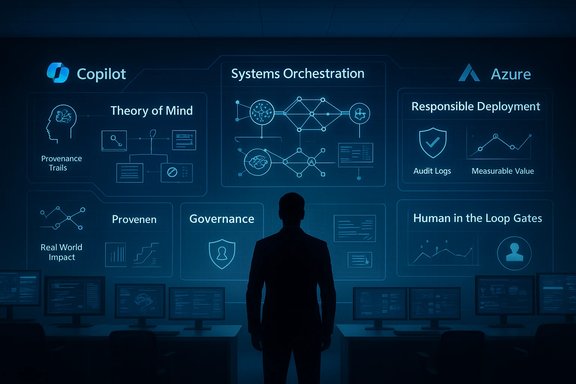
Satya Nadella’s short New Year note asking the industry to “stop calling AI ‘slop’” is more than CEO spin — it’s a strategic reset that reframes success in generative AI from model-driven spectacle to engineered systems that must prove measurable, human-centered value before they can claim broad social licence.
Background / Overview
Satya Nadella closed 2025 with a personal post on a blog branded “sn scratchpad,” where he argued that the AI era is shifting away from discovery and hype toward “widespread diffusion,” and that 2026 must be the year the industry proves durable benefit rather than trading on demos and viral outputs. His short note sets out three priorities: develop a “theory of mind” for AI as a human amplifier, move from single models to systems that orchestrate multiple models and agents, and make deliberate choices about where to apply scarce compute, energy and talent to deliver real‑world impact. Those themes arrive against a crowded backdrop: public fatigue with poor-quality, mass-produced generative outputs (the cultural shorthand “slop” became widely used in 2025), concerns among regulators and civic actors, and a capital-intensive infrastructure race as hyperscalers pour money into AI-optimized datacenters. The conversation Nadella opens is therefore simultaneously product strategy, investor messaging and public-policy signalling.What Nadella actually said — the three pillars
1) Build a human-centered "theory of mind" for AI
Nadella urges the industry to treat AI as a cognitive amplifier — a tool that augments human capabilities when products are designed with that premise in mind. He invoked Steve Jobs’ “bicycles for the mind” metaphor to stress that what matters is not raw model power but how people apply AI to meet human goals. The rhetorical aim is to shift debate away from pithy ridicule toward engineering and governance choices that preserve human agency.2) Move from "models" to "systems"
He argued that the future is orchestration: multiple models and agents coordinated by scaffolding that provides memory, entitlements, provenance, tool integration and safety guardrails. The implication is that production-grade AI will be less about one giant general model and more about composed systems, observability, and meaningful fallbacks.3) Decide where to deploy scarce resources for real impact
Nadella closed with a policy call: allocation of compute, energy and engineering talent matters. He framed these as socio‑technical choices that require broad consensus — essentially urging industry, customers and policymakers to align on where and how agentic AI should be used.Why the timing matters: adoption, trust and capital intensity
The rhetorical reset is not only about image. Several practical dynamics make Nadella’s framing consequential:- Public interaction with AI has ballooned: a Pew Research Center survey found that 62% of U.S. adults say they interact with AI at least several times a week — a marker that AI is no longer fringe but woven into daily life. That penetration raises the stakes for reliability, privacy and governance.
- The economics are capital-intensive: hyperscalers are investing heavily in AI datacenters and accelerators. Microsoft and its peers have signalled multibillion-dollar capex programs to expand GPU fleets, build purpose-built facilities and scale global capacity — moves that heighten pressure to convert those investments into sustainable revenue. Independent reporting places Microsoft’s capex intentions for AI-era infrastructure in unusually large ranges, and analysts emphasise the trade-offs in electricity, semiconductors and short‑lived hardware cycles.
- Product trust is fragile: users and admins have pushed back on buggy, intrusive, or low‑value AI features; the word “slop” crystallized that frustration. Public trust — and thus willingness to pay — depends on measurable, repeatable benefit rather than one-off demos.
The economics question Microsoft must answer
Microsoft and other hyperscalers face a simple business test: can recurring AI revenue and cloud consumption pay for the enormous capital expenditures on AI‑capable datacenters and GPU fleets?- Public headlines and analyst notes document materially higher capex plans for AI-era infrastructure across major cloud providers, with Microsoft explicitly increasing spend on GPUs, CPUs and datacenters to meet demand. That investment is strategic but costly; it changes the unit economics of cloud and raises questions about payback windows.
- On the revenue side, Copilot and cloud AI services are the monetization vector, but reported adoption and conversion rates are mixed and sometimes contested. Industry reporting has offered sharply different impressions: Microsoft executives have emphasised rapid adoption and “10x growth” metrics in certain quarters, while independent analysis suggests that paid Copilot seats remain a small fraction of Microsoft 365 customers — a gap that makes the payback for massive capex uncertain absent higher conversion and broader enterprise consumption. Those numbers are actively debated and, in places, not independently verifiable.
The technical reality: what "models → systems" means for Windows and enterprise environments
Nadella’s “systems” claim bundles several concrete engineering demands:- Persistent memory and context across sessions, enabling agents to hold state without re-asking the same questions and to follow multi-step workflows reliably.
- Provenance and auditability: every output that affects a decision should be traceable to data and model versions, with clear logs for compliance and debugging.
- Entitlements and least-privilege tool use so agents call only authorised APIs and access permitted data.
- Observability, fail-safes and human approval gates for high-risk actions.
Risks inside the “systems” thesis
- Consensus ≠ truth: routing prompts to multiple models to produce a “consensus” can be worse than a single model when training data is correlated; a false consensus can be confidently wrong.
- Cost and complexity: multi‑model orchestration increases inference and operational costs, which may make enterprise deployment economically challenging unless carefully engineered.
- UX overload: presenting multiple outputs or agent dialogues to average knowledge workers risks information overload unless UI/UX synthesises and prioritises results cleanly.
The human impact: amplification, labor and cognitive side-effects
Nadella explicitly frames AI as augmentation, not replacement. That distinction matters in messaging, but it is not just rhetoric:- Evidence on workplace impacts is mixed. Some enterprises report productivity gains in narrow tasks; other studies and opinion surveys highlight risks to critical thinking when workers over-rely on generative outputs. Emerging research and surveys suggest heavy AI reliance can erode certain skills if organizations do not redesign workflows and guardrails to keep humans in the loop.
- Workforce effects are real and complex: Microsoft has pared back headcount in certain areas while increasing capital and re‑allocating hiring to AI-centric roles. The net effect on employment and job quality depends on reskilling investments and whether AI projects truly augment remaining staff or simply concentrate work into fewer hands. The company’s public messaging emphasizes augmentation, but skeptics point to restructuring and layoffs as countervailing evidence.
The trust and governance mandate
Nadella’s appeal for a “consensus” about where to deploy AI is in part a governance ask: if the industry wants societal permission to scale agentic systems, it needs to deliver transparent metrics, independent validation, and durable opt‑outs.What governance will need to cover:
- Disclosure: model and data provenance markers, so users know when content is generated and which model/version produced it.
- Auditability: retention of model inputs, outputs, and decision trails for compliance and debugging.
- Entitlements: fine‑grained access control for non-human agents and API actions.
- Independent measurement: reproducible tests and third‑party audits that validate vendor claims about productivity and accuracy.
The commercial reality: Copilot, adoption and contested metrics
A focal point in the debate is how quickly paid adoption of AI services like Microsoft 365 Copilot scales compared with the infrastructure bill for AI datacenters.- Microsoft executives have described dramatic adoption metrics in earnings commentary and investor presentations, citing rapid seat growth and increasing commercial traction.
- Independent reporting and industry analysis have painted a more cautious picture: one recent report estimated Copilot paid seats in the single-digit millions, implying a tiny conversion of Microsoft 365 commercial seats to paid Copilot subscriptions. That figure is contested and not independently verified; vendor disclosures remain opaque on seat counts vs consumption and differentiated pricing tiers. Treat such numbers as indicative rather than definitive.
- Clear contract terms that tie fees to usage and measurable outcomes.
- Audit rights for claimed productivity gains and model behaviour.
- Exit strategies and data portability if vendor economics shift or quality fails to materialise.
Practical guidance for Windows administrators, IT directors and enterprise architects
Nadella’s call is strategic, but day-to-day decisions are tactical. The following is a concise, actionable roadmap for organizations considering agentic AI rollouts.Short-term (0–3 months)
- Run tightly scoped pilots in low-risk areas (helpdesk triage, internal document summarization).
- Define measurable KPIs before deployment (time saved, error rates, escalation frequency).
- Ensure opt‑in defaults for features that index or recall personal data.
Medium-term (3–12 months)
- Instrument everything: collect provenance logs, model version IDs, and user approval steps.
- Build human‑in‑the‑loop approval gates for any output that could materially affect customers or finances.
- Implement entitlement controls and non-human identities for agents with ACLs.
Long-term (12+ months)
- Standardise on independent evaluation metrics and third-party audit frameworks for agentic systems.
- Integrate model observability into incident response playbooks.
- Rework job descriptions and reskilling programs to cover agent supervision, MLOps and ethical oversight.
Strengths and blind spots in Nadella’s framing
Strengths
- Right orientation: moving from demo-driven hype to product engineering and measurement is an essential maturation step for the industry. The emphasis on scaffolding, provenance and entitlements aligns with technical best-practices.
- Platform advantage: Microsoft’s stack (Azure, M365, Copilot, GitHub) positions it to deliver integrated agentic experiences that could reduce friction for enterprise adoption if reliability improves.
- Policy pre-emption: pushing for consensus and governance voluntarily creates goodwill with regulators and customers if followed by transparent, measurable commitments.
Blind spots and risks
- Vagueness on metrics: the blog is short on quantifiable commitments. Saying systems must deliver “real‑world eval impact” is sensible; promising how that will be measured, audited and enforced is missing.
- Economics mismatch risk: capex for AI infrastructure is enormous and immediate; revenue conversion depends on higher, verifiable paid adoption and sustained consumption. That mismatch could pressure companies into shipping immature features to chase monetization.
- Consensus as persuasion vs coercion: asking for societal consensus is contractually different from lobbying for default integration of agentic features into OSes and productivity apps. There’s a thin line between persuasion and hard defaults that are difficult to opt out of — a policy risk that invites regulatory response.
What to watch in 2026
- Will Microsoft and peers publish independent, reproducible impact evaluations for core AI experiences (Copilot workflows, agentic automations)? External audits and disclosable test suites would be a high‑value signal.
- How will capex and hardware supply dynamics evolve — particularly GPU and DRAM availability, pricing and power constraints? Cost structure shifts will materially affect deployment economics.
- Will regulators demand disclosure standards (model provenance, generated‑content labelling) and entitlements primitives for non-human actors? Legislative or standards action would materially change product roadmaps.
- How will enterprise customers respond? If procurement teams insist on SLA‑backed, measurable benefits and audit rights, vendors will need to adapt pricing and deployment patterns.
Conclusion
Satya Nadella’s “stop calling AI ‘slop’” blog post is a deliberate and defensible repositioning: the conversation must evolve from flashy model demos to disciplined engineering, governance and measurable outcomes. That pivot is necessary if agentic AI is to be more than a collection of intriguing demos and become a durable, trusted part of enterprise and consumer workflow.But rhetoric needs follow-through. Engineering discipline, independent measurement, transparent pricing and robust governance are not optional extras — they are the price of permission. For IT leaders and Windows administrators, the pragmatic playbook is already clear: pilot conservatively, instrument obsessively, and demand verifiable, auditable evidence of impact before you scale.
Nadella’s framing maps to a sensible long-term roadmap for building agentic systems that amplify human capability. The immediate test for Microsoft and the industry will be execution — publishing the data, controls and auditability that turn a marketing pivot into measurable, trustworthy progress.
Source: theregister.com Microsoft CEO Satya Nadella calls for consensus about AI
