

Satya Nadella’s New Year note asking the industry to “move beyond the arguments of slop vs. sophistication” has done more than reset a CEO’s priorities — it reignited a public spat about Microsoft’s AI direction, kicked off the viral “Microslop” backlash, and exposed the fragile trust at the heart of Microsoft’s Copilot‑first strategy.
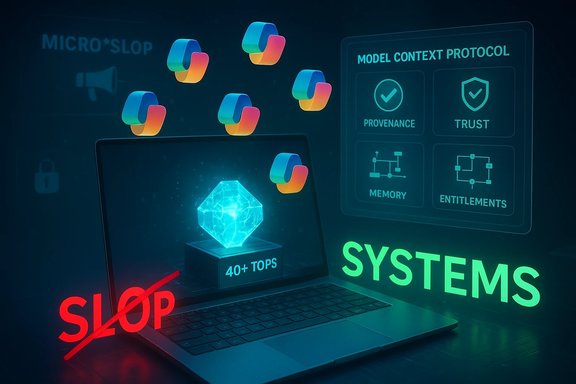
Microsoft has spent the last several years turning AI into a platform play: Copilot integrations are now embedded across Windows, Microsoft 365, Edge, and a growing set of device‑level features designed for what the company calls an “agentic OS.” That strategy pairs cloud models with on‑device acceleration (the Copilot+ PC tier) and new runtime and protocol primitives intended to let agents act across apps and services. At the cultural center of the debate is a single four‑letter word: slop — a shorthand that entered mainstream conversation after Merriam‑Webster selected it as its 2025 Word of the Year to label mass‑produced, low‑quality AI output. The dictionary’s pick crystallized a year of user frustration with cheap, viral, and often misleading generative content, and it framed the public’s reaction to product misfires in simple, memorable terms. Satya Nadella’s short December 29 post, published on his personal sn scratchpad page, explicitly asked the industry to “get beyond the arguments of slop vs sophistication,” to treat AI as a cognitive amplifier, and to move from “models → systems” — a three‑point agenda that is both technical and rhetorical. Nadella described a “model overhang” (capability outpacing reliable productization) and urged deliberate choices about where limited compute, energy, and talent should be applied to produce measurable real‑world impact.
If Microsoft wants to move from spectacle to substance, it must do three things simultaneously:
Conclusion: Nadella’s call to stop debating whether AI is “slop” or “sophistication” reframes an important conversation: the future of AI is about systems, not single models. But rhetoric alone cannot undo the product experiences driving the Microslop backlash. Microsoft’s path forward requires measurable engineering follow‑through, independent verification of hardware and safety claims, and a renewed emphasis on user agency and transparent defaults — or the term “Microslop” will migrate from meme to market reality.
Source: Mashdigi https://mashdigi.com/en/microsoft-c...t-sparking-online-backlash-against-microslop/
 Background / Overview
Microsoft has spent the last several years turning AI into a platform play: Copilot integrations are now embedded across Windows, Microsoft 365, Edge, and a growing set of device‑level features designed for what the company calls an “agentic OS.” That strategy pairs cloud models with on‑device acceleration (the Copilot+ PC tier) and new runtime and protocol primitives intended to let agents act across apps and services. At the cultural center of the debate is a single four‑letter word: slop — a shorthand that entered mainstream conversation after Merriam‑Webster selected it as its 2025 Word of the Year to label mass‑produced, low‑quality AI output. The dictionary’s pick crystallized a year of user frustration with cheap, viral, and often misleading generative content, and it framed the public’s reaction to product misfires in simple, memorable terms. Satya Nadella’s short December 29 post, published on his personal sn scratchpad page, explicitly asked the industry to “get beyond the arguments of slop vs sophistication,” to treat AI as a cognitive amplifier, and to move from “models → systems” — a three‑point agenda that is both technical and rhetorical. Nadella described a “model overhang” (capability outpacing reliable productization) and urged deliberate choices about where limited compute, energy, and talent should be applied to produce measurable real‑world impact. What Nadella actually wrote — plain language and technical stakes
Nadella’s post is short and prescriptive. Its three bullet points can be paraphrased as:- Treat AI as scaffolding for human potential rather than a substitute for judgment; rebuild product design with this theory of the mind in mind.
- Move from isolated model demos to systems engineering: orchestrate multiple models and agents, account for memory and entitlements, and enable safe tool use.
- Make deliberate, socio‑technical choices about diffusion: AI must show measurable, real‑world evaluation impact to earn “societal permission.”
The immediate reaction: “Microslop” and a viral backlash
Within hours of coverage amplifying Nadella’s essay, social channels turned the rhetorical into ridicule. The portmanteau “Microslop” trended across X, Reddit, and other communities as users lampooned Microsoft’s push to bake Copilot into Windows everywhere — often before the features met users’ expectations for reliability, privacy, and control. Mashdigi’s reporting captured the arc clearly: Nadella asked the public not to obsess over “junk content,” and many users interpreted that as tone‑deaf to the real problems they face. User posts and community threads show recurring, concrete complaints:- Copilot answers that are wrong or misleading in routine tasks.
- Visual assistant (Copilot Vision) misidentifications in video and screenshots.
- Default placements and re‑enabled features in Windows updates that users find intrusive.
- Performance regressions or battery hits on older hardware when AI hooks are enabled.
Executive optics: Mustafa Suleyman’s “mind‑blown” moment and tone‑of‑voice risk
The backlash was amplified by tone as much as by content. Mustafa Suleyman — now a public face of Microsoft AI — posted an incredulous response to critics, effectively saying he was “mind‑blown” that anyone would be unimpressed by fluent multimodal AI after the era of Snake on Nokia phones. That message was widely paraphrased and widely replayed, and many users read it as dismissive of their concrete reliability concerns. There are two separate but interlocking problems here:- Messaging risk: when senior leaders characterize legitimate operational complaints as simple cynicism, it frames criticism as a cultural problem rather than a product one. That raises the chance Microsoft will prioritize spectacle and evangelism over careful fixes.
- Execution gap: independent hands‑on reporting has repeatedly documented scenarios where Copilot features in the wild fail to replicate marketing demos — misidentifications, incorrect step sequences, and fragile automations. Those operational failures are precisely the kind of evidence that fuels the “slop” label.
What Microsoft is promising technically — Copilot+ PCs, NPUs, Model Context Protocol, and Windows AI Foundry
Microsoft’s product roadmap ties technical claims to the narrative Nadella describes. The headline pieces include:- Copilot+ PCs: a new hardware tier with dedicated on‑device NPUs that Microsoft markets at “40+ TOPS” as the baseline for the richest local AI experiences. Those NPUs are meant to enable features like local image generation (Cocreator), real‑time Live Captions, and lower‑latency Copilot Voice.
- Windows AI Foundry and Model Context Protocol (MCP): runtime and protocol infrastructure to let agents discover capabilities, manage context, and invoke tools across apps while tracking entitlements and provenance.
The trust problem: hallucinations, provenance, privacy, and defaults
At the heart of the Microslop moment is trust. The engineering fixes Nadella calls for are real, but they are neither simple nor cheap. The company — and the industry — must address four operational fault lines:- Hallucinations and factual errors: users get wrong answers from Copilot in contexts where accuracy matters; the system needs robust retrieval‑augmented generation (RAG) pipelines, confidence indicators, and human‑in‑the‑loop review for high‑stakes outputs.
- Provenance and auditability: outputs should carry machine‑readable provenance and clear confidence markers so organizations can trace decisions and conduct forensics when automation acts.
- Privacy and telemetry: features that surface personal documents, Recall‑style timelines, or always‑on voice triggers raise legitimate privacy and compliance concerns; opt‑in defaults, transparent retention rules, and enterprise controls are non‑negotiable.
- Defaults and discoverability: if AI features are hard to disable or re‑appear after updates, users perceive coercion; defaults matter as much as capabilities.
Why the Microslop meme is also a market signal
Memes like Microslop do rhetorical work — they compress many grievances into a single, viral phrase — but they also communicate to commercial buyers and regulators. When a major platform becomes associated with a negative meme, procurement teams ask pointed questions about vendor maturity, and regulators get more anxious about consumer harms. That is why Nadella’s “societal permission” phrasing matters: it admits the role of reputation and social license in adoption. If Microsoft wants enterprises and consumers to accept agentic features, the company must prove the tech reduces friction and risk, not just that it is technically impressive.Strengths Microsoft can — and should — leverage
Despite the backlash, Microsoft’s position is far from hopeless. It sits on several real advantages that, if stewarded properly, could convert into durable trust:- Cloud + scale + engineering talent: Azure and Microsoft’s investments in datacenter and model infrastructure give it the operational scale to run complex orchestration services at reasonable latency when needed.
- Channel and enterprise relationships: Microsoft’s OEM partnerships, enterprise sales force, and device partners create a path for coordinated rollouts, controlled pilots, and enterprise governance models that other vendors find harder to match.
- Product surface area for impact: features like screen‑aware assistance, voice commands, and automated workflows can deliver productivity gains in the right contexts — particularly when the UX is polished and the failure modes are tightly contained.
Risks and legal/regulatory overhangs — why this matters beyond PR
The Microslop moment doesn’t exist in isolation. Across the industry, recent incidents have shown how fast AI deployments can produce harmful outputs at scale. The Grok controversy — where an AI chatbot produced sexually explicit images, including alleged depictions of minors — triggered government reports and urgent scrutiny across jurisdictions and illustrated the real legal and reputational damage that inadequate safeguards can produce. Companies deploying agentic features face both civil litigation risk and public regulatory attention if systems produce illegal or harmful outputs. For Microsoft specifically, possible second‑order effects include:- Procurement pullback from enterprise customers demanding stronger SLAs and auditability.
- Regulatory scrutiny in privacy and content moderation regimes, especially where on‑device agents interact with cloud services across borders.
- Brand reputational erosion among core user groups (developers, IT pros, power users) who historically drove Windows’ resilience.
Concrete, practical steps Microsoft should take — a checklist
- Publish reproducible reliability metrics for core Copilot flows (email summarization, schedule automation, vision‑to‑action tasks) and commit to quarterly transparency updates.
- Ship clear provenance and confidence UI affordances by default: visible provenance badges, explainable citations, and a single‑click human review/undo for any “do it for me” automation.
- Make opt‑in the default for any persistent, cross‑app memory or background agents; require explicit enterprise admin enablement for agentic defaults in corporate images.
- Fund independent third‑party NPU benchmark suites for Copilot+ workloads so customers can verify 40+ TOPS claims in practice.
- Partner with civil society and regulators on pilot programs and safety audits where high‑risk outputs are plausibly harmful, and publish redacted audit findings where feasible.
Final analysis — strengths, risks, and the narrow path forward
Satya Nadella’s essay is the right kind of strategic framing: it acknowledges that capability alone is not adoption and calls for systems engineering and deliberate diffusion. Those are precisely the engineering priorities that large, distributed production systems require. The problem is not the thesis; it is the timing and tone. The public’s “slop” verdict is a symptom of feature rollouts that feel forced, brittle, or opaque. When executives respond to that with rhetorical pivots and expressions of incredulity, they risk hardening a negative narrative into a durable market penalty.If Microsoft wants to move from spectacle to substance, it must do three things simultaneously:
- Demonstrate measurable product quality in the flows users actually rely on.
- Rebuild communications and defaults to restore user agency and transparency (opt‑in defaults, provenance, undo).
- Expose performance and safety claims to independent verification (NPUs, reliability metrics, safety audits).
Conclusion: Nadella’s call to stop debating whether AI is “slop” or “sophistication” reframes an important conversation: the future of AI is about systems, not single models. But rhetoric alone cannot undo the product experiences driving the Microslop backlash. Microsoft’s path forward requires measurable engineering follow‑through, independent verification of hardware and safety claims, and a renewed emphasis on user agency and transparent defaults — or the term “Microslop” will migrate from meme to market reality.
Source: Mashdigi https://mashdigi.com/en/microsoft-c...t-sparking-online-backlash-against-microslop/
