

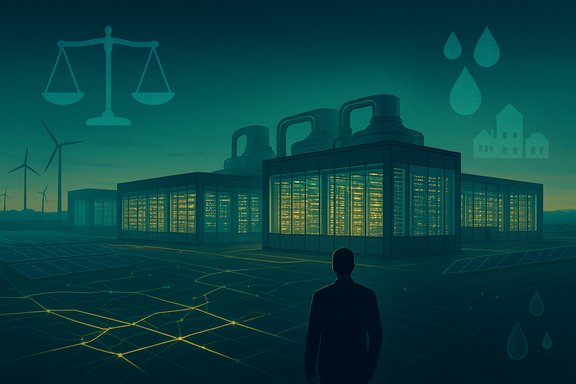
Satya Nadella’s blunt frame — that the AI industry must “earn the social permission” to consume vast quantities of electricity — has shifted a familiar corporate sustainability conversation into a sharper public policy and political contest over power, infrastructure and economic fairness. His remark crystallizes a growing reality: hyperscale AI is not merely a software problem, it is a grid, water and community problem too.
The past two years have seen an unprecedented expansion of AI-capable infrastructure: racks of GPUs, bespoke liquid-cooled servers and whole new hyperscale campuses built to host large models and to serve billions of inference queries. That expansion is already showing up in corporate spending and in energy demand figures. Microsoft’s cloud business — the backbone of Azure, Copilot and much of the company’s AI commerce — reported robust growth in the latest quarter, with Azure and other cloud services growing at roughly a 39–40% year-on-year pace in fiscal Q1, evidence that demand for AI cloud services is both real and accelerating. At the same time, independent energy analysts and national laboratories have reframed data centers as a major component of future electricity demand. In the U.S. alone, data centers consumed about 176 terawatt-hours (TWh) in 2023 — roughly 4.4% of national electricity — and that number is projected to rise substantially under plausible AI-driven growth scenarios. The scale of that shift is what Nadella was responding to when he warned that AI cannot simply assume unlimited access to power without demonstrating clear social benefit.
The corporate responses so far — major renewable frameworks, long-term PPAs, and strategic public messaging — are necessary but insufficient. They buy time and bring capacity online, but they do not eliminate the systemic risks of concentrated energy demand, nor do they automatically translate to equitable gains. The policy community must update grid planning, transparency rules and local negotiation frameworks. Technologists must ingest energy as an explicit constraint and optimize accordingly. And communities must be empowered to demand tangible, time- and location-sensitive evidence that corporate promises translate into local and national benefits.
Until those three vectors — corporate procurement, regulatory reform, and technological efficiency — align, Nadella’s formulation will remain a caution rather than a settled social contract: AI can expand, but only if the industry proves, transparently and verifiably, that the energy it consumes produces more than shareholder value.
Source: Technology Org Microsoft CEO: AI Needs Public Trust for Energy Use - Technology Org
 Background: why Nadella’s line matters now
The past two years have seen an unprecedented expansion of AI-capable infrastructure: racks of GPUs, bespoke liquid-cooled servers and whole new hyperscale campuses built to host large models and to serve billions of inference queries. That expansion is already showing up in corporate spending and in energy demand figures. Microsoft’s cloud business — the backbone of Azure, Copilot and much of the company’s AI commerce — reported robust growth in the latest quarter, with Azure and other cloud services growing at roughly a 39–40% year-on-year pace in fiscal Q1, evidence that demand for AI cloud services is both real and accelerating. At the same time, independent energy analysts and national laboratories have reframed data centers as a major component of future electricity demand. In the U.S. alone, data centers consumed about 176 terawatt-hours (TWh) in 2023 — roughly 4.4% of national electricity — and that number is projected to rise substantially under plausible AI-driven growth scenarios. The scale of that shift is what Nadella was responding to when he warned that AI cannot simply assume unlimited access to power without demonstrating clear social benefit. What Nadella actually said — and what he meant
The quote and the context
Nadella made the comments during a wide-ranging interview with Mathias Döpfner, chair and CEO of Axel Springer, and in separate appearances since then has repeated the core idea: if the AI industry wants to burn through electricity at scale, it needs to show that the outputs of that energy use create a social and economic surplus — not just corporate profit. He framed this as a matter of social permission: public acceptance earned through demonstrable public benefit. This is both rhetorical and tactical. Rhetorical because it appeals to a civic baseline: societies do not look kindly on industries that consume scarce public resources without visible returns. Tactical because it signals to regulators, investors and local communities that Microsoft understands the political risk of unconstrained build-out: grid constraints, local rate pressure, and elected officials reacting to constituents worried about higher utility bills or water stress.The corporate metrics he invoked
Nadella also pointed to financial evidence to justify continued investment: Microsoft’s cloud business remains one of the largest growth engines at the company, with recent earnings showing Azure-led cloud revenue growth in the high 30s to 40% range year-over-year. For executives and investors, those numbers are a shorthand for value generated per unit of energy consumed — a claim Nadella is implicitly asking the public to verify by watching how AI deployments translate into productivity gains and improved services for broad swathes of the economy.The scale of the energy problem: how big is “big”?
National and global context
The data center sector’s electricity footprint is no longer marginal. U.S. data centers consumed about 176 TWh in 2023, up sharply from a fraction of that a decade earlier, and independent projections suggest a range of 325–580 TWh for U.S. data-center demand by 2028 depending on adoption scenarios. Globally, the International Energy Agency and other analysts warn that data-center electricity demand could more than double within a few years as AI workloads scale. Those are not industry talking points — they are government lab and multilateral forecasts that imply major investments in generation, transmission and cooling infrastructure.Real examples that make the abstract concrete
- Training or fine-tuning very large models can require megawatt-scale power for days or weeks; inference workloads at hyperscale become a continuous, 24/7 load that raises both peak and baseload demand.
- Some market analyses now attribute large fractions of new corporate capital expenditure to AI-related infrastructure, including tens of billions of dollars in GPU purchases and the short-lived but heavy spending on rack- and building-level assets.
Microsoft’s response: investment in energy supply and “time- and location-aware” deals
Renewables, PPAs and a 10.5 GW framework
Microsoft is not taking the energy challenge passively. The company signed a major global renewable energy framework agreement with Brookfield to enable delivery of more than 10.5 GW of new renewable capacity between 2026 and 2030 — a contract explicitly framed as part of Microsoft’s goal to match 100% of its electricity consumption with zero-carbon purchases. That scale of deal-making is a direct corporate response to the need to align AI growth with decarbonization claims.Nuclear and long-term capacity choices
Separately, Microsoft has moved into long-term power purchasing that includes non-wind/solar sources — notably a long-term arrangement tied to a revived nuclear plant project — reflecting a pragmatic shift in the industry: when 24/7 baseload carbon-free power is the target, renewables alone (as built today) do not always meet the timing or location needs of hyperscale data centers. These contractual moves show hyperscalers hedging between annual matching rhetoric and real-time supply realities.The limits of “100% match” claims
It’s essential to understand that “100% of electricity consumption matched” is an accounting construct, not the same as being fully powered by carbon-free electrons at every hour in every grid region. Corporations match annual consumption with contracted renewable production and certificates, but critics point out that this does not necessarily remove fossil-fuel generation from the grid at the precise time and place the data center draws power. The industry is aware of the difference and many firms are now pushing toward 24/7 carbon-free energy goals that account for hourly matching; those are technically and economically challenging at scale.Political fallout: why “social permission” is also a political argument
Local backlash and election-year politics
Data center expansion has become a campaign issue in multiple jurisdictions. Candidates in recent U.S. elections ran on constraining energy-hungry data center builds, citing utility rate pressure and local infrastructure strains. This is not hypothetical: communities in parts of Virginia and other states have reported rising electricity costs and political pushback as hyperscalers seek new capacity. Nadella’s warning explicitly recognizes this political vector: if communities feel the costs — visible in taxes, rates or environmental impacts — they will demand a different allocation of privileges.Industry countermeasures and the rise of pro-AI political spending
To blunt punitive or constraining policies, a nascent pro-AI political ecosystem has emerged, with well-funded super PACs and advocacy groups seeking to shape state and federal regulation. A coalition network of pro-AI political actors has raised significant sums — in some reported cases in excess of $100 million — to support candidates and messaging that frame AI as an engine of economic growth and national competitiveness. The formation of those groups is itself evidence that industry players view political acceptance as a resource to be won, not given.The environmental and social trade-offs: risk, burden, and who benefits
Grid stress and consumer impacts
Large, concentrated new loads can drive system-wide consequences: higher wholesale prices during peak hours, accelerated need for transmission upgrades, and higher utility bills for ordinary consumers. Those externalities are concentrated in regions that host the densest clusters of data centers — often rural or exurban communities that view the corporate arrival as both a jobs-and-tax story and a utilities-and-water-stress problem. As one electricity market operator warned, the cost of connecting megawatt-class loads sometimes falls on ratepayers unless regulatory design or negotiated contributions change that outcome.Water and land-use concerns
Beyond electrons, AI campuses consume water for cooling in some deployments and require large land footprints for renewable generation tied to corporate PPAs. Local environmental and water-stress impacts are now reported in major investigations and are part of the calculus for municipal permitting. These are not abstract risks: in some jurisdictions, community resistance has already delayed or altered projects.Distribution of economic returns
Nadella’s public framing — that AI must deliver broad economic surplus, not just corporate profits for a few companies — is a direct acknowledgement of distributional risk. When the economic benefits from data-center projects accrue mainly to shareholders and to a narrow set of corporate vendors, while local residents see higher rates or environmental strain, “social permission” is quickly eroded. Microsoft’s argument that AI will boost productivity and create broad gains is plausible but needs empirical backing at regional and sectoral levels.What the data says — verified claims and open questions
Verified facts
- Microsoft’s Azure and cloud revenue growth in the company’s most recent fiscal first quarter ran close to the high 30s–40% year-on-year mark, underscoring accelerating demand for cloud and AI services. These figures are reported in company communications and corroborated by independent market coverage.
- The U.S. Department of Energy and Lawrence Berkeley National Laboratory estimate that U.S. data centers used approximately 176 TWh in 2023 and warn that, under AI-driven scenarios, demand could rise into the hundreds of TWh by 2028. Those peer-reviewed government analyses are the authoritative baseline for national planning.
- Microsoft has an explicit program of long-term renewable procurement and signed a global framework with Brookfield to enable delivery of more than 10.5 GW of new renewable capacity between 2026 and 2030. That framework is public and shows a corporate strategy of pre-procuring supply to match growth.
Claims that need caution (and why)
- Multiple press stories cite a 2023 estimate that Microsoft consumed about 24 TWh in one year, sometimes attributed to an organization named “Clean View Energy.” Several credible outlets reprinted the figure, but a direct, verifiable primary source or methodology from the alleged authoring group is not readily discoverable in the public record at this time. Because the number is material — it implies a single firm consuming electricity on the scale of a small country — it should be treated as provisional until the original analysis and methods are produced and independently audited. Repeating that statistic without the primary study risks overstating a single-company footprint and distracting from the sector-wide evidence compiled by government labs.
- “100% renewable matching” claims can be misleading if they are used to imply hourly, location-specific carbon-free operation. Corporate accounting for renewable energy purchases and certificates can achieve annual balances, but do not always equate to real-time, marginal decarbonization on the grid. The industry is working toward 24/7 carbon-free targets, but achieving those at hyperscale remains technologically and economically challenging. Readers should not conflate annual procurement matching with instantaneous decarbonization.
A practical checklist for policymakers, communities and technologists
For policymakers
- Update transmission planning and interconnection rules to account for continuous, high-density loads from AI campuses. Prioritize cost-allocation mechanisms that do not place disproportionate burden on local residential customers.
- Require time- and location-based reporting for corporate claims about renewable energy to move beyond annual matching and toward measurable grid decarbonization outcomes.
- Integrate water-stress and land-use analysis into data center permitting to avoid pricing in environmental externalities.
For municipal officials and planners
- Negotiate community benefit agreements that include grid upgrade contributions, job training, and local investment rather than relying only on property tax promises.
- Push for third-party verification of corporate energy claims and demand transparency on PPA terms and on-site versus off-site generation contributions.
For technologists and AI builders
- Design model architectures and operational practices with energy as a first-order optimization parameter. Efficiency at the model and systems layer reduces pressure on grids.
- Prioritize workload scheduling that harmonizes inference and training with low-carbon hours and locations — i.e., genuinely time-aware deployments.
Strengths in the industry response — and key weaknesses
Notable strengths
- The hyperscalers (including Microsoft) are proactively contracting large renewable portfolios and experimenting with diversified long-term supply, including nuclear PPAs where appropriate. Those contracts accelerate new generation build-out and can bring forward low-carbon capacity that benefits local grids.
- Public admission by industry leaders that energy is a political and civic constraint — as in Nadella’s “social permission” framing — is a candid shift away from purely techno-optimistic narratives. It creates space for governance conversations that were previously marginalized.
Key weaknesses and risks
- Corporate procurement practices that rely solely on annual matching and certificates risk being seen as greenwashing if they do not reduce emissions at the grid’s marginal hour. The social license to operate will be fragile until claims are demonstrably tied to grid decarbonization and to equitable local outcomes.
- Concentration risk: when the economic return from AI is tightly concentrated (e.g., a handful of platforms capturing most value), the political and regulatory backlash will be stronger. Nadella’s own admission that the returns must be broadly diffused points to a real governance challenge: ensuring that productivity gains manifest as wages, services, or public goods — not just higher market caps.
Conclusion: pragmatic stewardship — not technological exceptionalism
Satya Nadella’s “social permission” formulation is a useful normative test: it demands that AI’s energy appetite be justified in human terms, not only in balance-sheet terms. The test is practical and enforceable: if a technology consumes public resources — grid capacity, water, real estate — its proponents must document the public benefits and share enough of the economic returns to sustain local and national support.The corporate responses so far — major renewable frameworks, long-term PPAs, and strategic public messaging — are necessary but insufficient. They buy time and bring capacity online, but they do not eliminate the systemic risks of concentrated energy demand, nor do they automatically translate to equitable gains. The policy community must update grid planning, transparency rules and local negotiation frameworks. Technologists must ingest energy as an explicit constraint and optimize accordingly. And communities must be empowered to demand tangible, time- and location-sensitive evidence that corporate promises translate into local and national benefits.
Until those three vectors — corporate procurement, regulatory reform, and technological efficiency — align, Nadella’s formulation will remain a caution rather than a settled social contract: AI can expand, but only if the industry proves, transparently and verifiably, that the energy it consumes produces more than shareholder value.
Source: Technology Org Microsoft CEO: AI Needs Public Trust for Energy Use - Technology Org
