

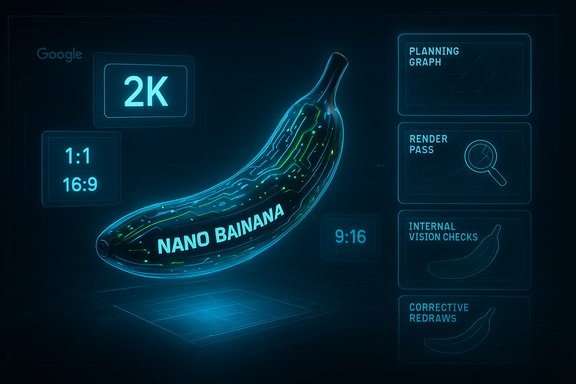
Google’s image generation pipeline appears poised for another rapid iteration: early leak signals and a flurry of community testing point to a second-generation “Nano Banana 2” (internal codename GEMPIX 2) surfacing in Media AI and in Gemini UI experiments, promising native 2K output, multi‑step iteration and stronger instruction following—but many core technical details remain unverified and should be treated as leaks until confirmed by Google.
Background / Overview
The “Nano Banana” label has become shorthand for Google’s Gemini image family variant that first drew mainstream attention as Gemini 2.5 Flash Image—a low‑latency, edit‑friendly image engine widely reported as the source of the viral “toyified” and packaging mockup outputs that spread across social platforms in late summer. Google published the Gemini 2.5 Flash Image announcement in August and that release is the confirmed origin of the Nano Banana nickname. What’s changed in the last 24–72 hours is a wave of leak reporting and community snapshots showing a variant labelled Nano Banana 2 (also referenced across the rumor mill as GEMPIX 2 or Nano Banana Pro). Several outlets and community posts say the model briefly appeared in preview on Media AI and in Gemini UI announcement cards, and leaked image samples circulated that appear noticeably more capable than the first generation—especially at tasks involving color precision, camera/view control, and readable in‑image text. Those initial leak writeups and sample galleries are the basis for community expectations right now.What the leaks claim — a concise summary
- Native 2K output with optional 4K upsampling modes, plus a new range of aspect ratios (1:1, 2:3, 3:2, 3:4, 4:3, 9:16, 16:9, 21:9) in code references.
- A new multi‑step generation workflow: the model “plans” the image, renders, analyzes the output with internal vision checks, identifies errors (especially in text or viewpoints), and iterates until the output meets internal criteria. This iterative correction loop is presented as a major change from prior single‑pass generations.
- Conflicting base‑model signals: some internal traces and community analysis indicate the initial Nano Banana 2 builds are still running on Gemini 2.5 Flash infrastructure (an incremental release), while other traces suggest an intended migration to Gemini 3.0 Pro / Imagen 4 or a hybrid path where early public builds use the Flash variant and later builds upgrade to Gemini 3.0 Pro.
- A possible rebranding or variant called Nano Banana Pro with claims of up to three‑times improvement in instruction‑following and consistency in stress tests (for example, reconstructing shredded images). Those claims appear in internal commit references and independent community summaries but are not yet corroborated by vendor documentation.
- Wider ecosystem rollout: insider UI cards and experiment flags reportedly show Nano Banana 2 being staged not only in the Gemini app, but also in Media AI, Whisk labs experiments, and other Google‑adjacent integration points—suggesting a multi‑surface release plan.
Verified base facts (what we can confirm now)
- Google released Gemini 2.5 Flash Image (the original Nano Banana) and documented its capabilities on the Google Developers blog on August 26. That release gave Gemini stronger image‑editing primitives and low‑latency image generation.
- The initial Nano Banana outputs—viral figurine and mockup renders—are well documented across mainstream tech press and community writeups (TechCrunch, DigitalOcean guides, and widespread social attention), confirming the cultural impact of the first model.
- Multiple independent news and community outlets are now reporting leaks and early previews of Nano Banana 2/GEMPIX 2; these coverage pieces show consistent signals (new UI cards, image samples circulating, variant labels). However, the technical claims about Gemini 3.0 Pro integration, native 2K, and multi‑step internal evaluation are currently rumored and have not been published in an official Google model card or press release.
Technical expectations and implications
Native resolution, aspect ratios and output modes
Leaked code references and UI screenshots cited in recent reports point to expanded output support including 1K, 2K and 4K modes and the common creative aspect ratios listed earlier. If true, native 2K as an option would be a material jump in fidelity and would reduce reliance on post‑generation upscaling for many use cases such as editorial images and product mockups. That would also change cost/latency tradeoffs for integrated product surfaces.Why it matters:
- Creators get cleaner, print‑ready outputs more often.
- Developers could rely less on third‑party upscalers in automation pipelines.
- Enterprises get higher SLO (service level objective) considerations for throughput vs. fidelity.
Iterative generation workflow (plan → render → analyze → correct)
One of the more novel claims in the leaks is procedural: Nano Banana 2 apparently runs an internal multi‑pass loop that includes an image‑analysis verification stage. The alleged workflow:- Parse and plan the visual composition from the prompt.
- Generate an initial image candidate.
- Run an internal vision quality check (typography correctness, geometry, view angle, obvious artifact detection).
- Identify deviations and re‑generate targeted regions or the whole image.
- Repeat until internal quality thresholds are met.
Technical implications:
- This adds latency per generation (longer time‑to‑first‑image) but can reduce the need for manual post‑edits and iteration.
- It requires stronger internal model evaluation metrics (automated visual QA), which is non‑trivial and a promising sign of production‑grade thinking.
- The loop is consistent with a product emphasis on accuracy over raw speed for cases where fidelity is essential.
Model lineage: Gemini 2.5 Flash vs Gemini 3.0 Pro (and Imagen)
Reports are split: some internal traces show Gemini 2.5 Flash being used as the initial runtime for Nano Banana 2 (earlier availability), while other reports and landing pages advertise a Gemini 3.0 Pro foundation. There’s also community chatter about Imagen 4 being involved in some experimental builds.Interpretation:
- Google often ships incremental product variants on a stable runtime (e.g., a Flash variant) first, then upgrades the backend architecture later when the new model is fully validated. That path provides a reliable release cadence and explains the mixed signals.
- Public claims that Nano Banana 2 is already on Gemini 3.0 Pro should be treated cautiously until Google publishes a model card or kernel announcement.
Where Nano Banana 2 is expected to appear (ecosystem rollout)
The release strategy for Nano Banana 1 favored a multi‑surface rollout: Gemini app, Google AI Studio, API/Vertex AI partners, and third‑party integrations (e.g., Adobe beta hooks reported in August). Leaks say Nano Banana 2 will follow a similar multi‑platform path:- Gemini app and Media AI preview channels (early tester access).
- Google AI Studio / APIs for developers and Vertex AI integration for enterprise workloads (likely after initial public testing).
- Experimental surfaces and partner experiments (Whisk labs, third‑party services) mirroring how Nano Banana 1 spread.
Strengths: What to expect if the leaks are accurate
- Better control for precision tasks: Improved text rendering, layout fidelity and multi‑angle control make the model more practical for marketing, packaging and UI tasks where legibility and composition matter.
- Higher usable resolution: Native 2K (and 4K upsampling) reduces dependence on separate upscalers and streamlines workflows that feed into print or high‑res editorial use.
- Improved consistency and instruction following: Reports of “Nano Banana Pro” and rebranding suggest stronger identity retention across multi‑image sessions—useful for brand assets, episodic art, and character sheets.
- Productization of QA: A built‑in image‑analysis loop implies Google is investing in automated visual QA to reduce human rework—good for enterprise adoption where error budgets matter.
Risks, open questions and governance concerns
1) Leak hygiene and credibility
Much of the Nano Banana 2 narrative currently rests on leaked UI captures, community posts, and third‑party landing pages that mirror rumor elements. Several “Gempix2” clone sites promise early access and free editors—treat these with caution: many domain pages reuse rumor text and may be advertising captures or scams. Verify claims only via official Google announcements or stable publications.2) Dataset provenance and legal exposure
Higher fidelity and improved likeness preservation amplify existing copyright and likeness risks: better face and character consistency makes it easier to produce convincing depictions of real people. Enterprises and creators must confirm the model’s training‑data provenance and Google’s licensing terms before using outputs commercially—especially for products, merchandising or identity‑sensitive contexts. The original Nano Banana rollout included an invisible SynthID watermark promise; whether that persists or is expanded for Nano Banana 2 is an important compliance question.3) Moderation, safety and over‑censorship tradeoffs
Early community feedback on the original Nano Banana flagged both over‑censorship and inconsistent moderation. With greater capability comes more risk: better tools make it easier to produce high‑impact misinformation or privacy‑violating imagery. Platforms must balance freedom and safety. The multi‑pass internal QA may help catch some content policy violations, but that depends on the polity and thresholds Google sets for its filters.4) On‑device vs cloud: what’s feasible?
Some rumor posts conflate on‑device promises with server‑side model upgrades. A Gemini 3.0 Pro level model with multi‑step analysis is likely heavy in compute and will initially be a cloud service. Any claims of full offline operation for higher‑tier Nano Banana 2 builds should be treated skeptically until Google clarifies device support. Community skepticism around on‑device Gemini 3.0 Pro is well documented.Practical guidance for creators, IT teams and Windows users
- If you rely on this type of model for commercial outputs, do not assume the leaked performance or licensing terms. Hold off on production launches until Google publishes an official model card and licensing notes.
- For rapid prototyping and social content, watch the Gemini app/Media AI experiment channels for early access and experiment there—keep editable source files and provenance metadata for any assets you publish.
- Preserve prompts, model selection and exported metadata for audit trails. If Nano Banana 2 introduces new content credentials (SynthID or Content Credentials), attach those artifacts to your deliverables.
- For enterprise use, ask procurement to obtain:
- A published model card and architecture summary.
- Training data provenance and third‑party audit results.
- Commercial licensing language and indemnities.
- DLP and region control guarantees before uploading customer or employee imagery.
How this fits into the broader image AI landscape
The Nano Banana phenomenon illustrated a pattern now common across the industry: specialized, viral creative transforms surface in consumer apps and then get productized across ecosystems. The original Nano Banana (Gemini 2.5 Flash Image) was a clear example: a focused capability that combined speed and strong editing primitives, then rapidly moved into partner integrations and media attention. If Nano Banana 2 truly adds iterative QA, native 2K, and stronger instruction following, it raises the bar for competitors and drives more enterprise interest in integrated image models across productivity surfaces. At the same time, cross‑vendor competition (OpenAI, Microsoft Sora/MAI, Adobe Firefly integrations) continues to push rapid capability advances, while governance and provenance mechanisms lag behind. That remains the dominant tension in the space: raw capability vs. accountable, auditable production usage.What to watch next — verification checklist
- Official Google announcement or developer blog post explicitly naming Nano Banana 2 / GEMPIX 2 and listing core specs (native resolutions, aspect ratio support, model family). Until then, treat the launch date, native 2K claim and Gemini 3.0 Pro pairing as unverified.
- Publication of a model card for Gemini 3.0 Pro (if that is indeed the base) that discloses architecture, evaluation metrics, safety mitigations and training data provenance.
- Documentation of content credentials (SynthID or other watermarking/provenance tags) for Nano Banana 2 exports—this is essential for trustworthy downstream use.
- Third‑party technical validations (benchmarks, independent audits) comparing Nano Banana 2 outputs against established baselines for text rendering, consistency, and demographic robustness.
- Product rollout notes indicating which surfaces (Gemini app, Media AI, Google AI Studio, Vertex API, partners) get the model and on what timeline.
Bottom line
The early signals around Nano Banana 2 / GEMPIX 2 point to meaningful engineering work: higher native resolutions, expanded aspect ratio support, and—most interestingly—an iterative generation + verification loop designed to reduce classic image‑generation failure modes such as bad typography and inconsistent viewpoints. Those changes would be valuable to creators, designers and enterprise pipelines if they prove reliable. However, the strongest technical claims remain leak‑level until validated by Google.For Windows users and creative teams, the prudent course is to monitor official Google communications for an exact spec sheet and model card, pilot the preview channels if available, and treat the current leaked performance expectations as promising but provisional. The potential for improved fidelity and control is real, but so are the governance and legal implications that come with more powerful, identity‑preserving image models.
Nano Banana 2 could be a generational step for Google’s image stack—or a cautious, incremental rollout that will be iterated on in the coming months. The signals are strong; the verification steps are clear. Watch for the official announcement cards inside Gemini and a formal Google blog post to move these items from rumor to confirmed product details.
Source: TestingCatalog Early look at images generated by Nano Banana 2 via Media AI
