

Napster’s announcement that it is among the first Microsoft partners to deploy Azure agentic AI for enterprises marks a clear milestone in the shift from experimental pilots to productized, low‑latency conversational agents that can be deployed at scale—and it asks enterprise IT teams to make hard choices about architecture, governance, and cost control before pressing “go.”
Napster—formerly Infinite Reality—rebranded and repositioned itself earlier in 2025 as a full‑stack AI experience vendor focused on embodied, multimodal agents and immersive web experiences. The company says its Napster AI division and products such as Napster Spaces, Napster Companion, and Napster View are designed to turn static web pages into interactive, video‑enabled agent experiences that can run in production. This repositioning follows a broader corporate move (including the acquisition of the Napster brand and other assets) intended to marry immersive UX with generative and agentic AI. The latest public announcement frames a multi‑year strategic partnership with Microsoft, one that places Microsoft’s Azure AI Foundry, the Azure OpenAI model catalog, and Azure Kubernetes Service (AKS) at the heart of Napster’s production stack. Napster positions itself as the UX and product layer—no‑code publishing, avatar tooling, and orchestration—while Microsoft supplies the model runtime, enterprise hosting, and compliance tooling. The published pilot examples (leadership coaching via a consultancy and a retail/commerce pilot with a large paints manufacturer) are concrete use cases Napster uses to illustrate its claim that the stack is now production‑ready.
However, capability is not destiny. The most important determinants of success will be:
Napster’s public announcement is a useful, early indicator that real‑time, embodied agents are moving from bespoke experiments into commercially supported offerings. For enterprise IT leaders, the immediate task is simple in concept and hard in practice: treat the capability as you would any new outsourced critical system. Validate the controls, stress the stack, and contract the guarantees before you expose customers to agents that look, speak, and act like humans. Conclusion: the technological ingredients for enterprise‑grade, agentic AI are finally converging. The Napster + Microsoft collaboration shows what a productized path looks like. The deciding factor for organizations will be governance and discipline—not the novelty of the technology.
Source: GlobeNewswire UPDATE - Napster Among First Microsoft Partners to Deploy Azure Agentic AI for Enterprises
 Background / Overview
Napster—formerly Infinite Reality—rebranded and repositioned itself earlier in 2025 as a full‑stack AI experience vendor focused on embodied, multimodal agents and immersive web experiences. The company says its Napster AI division and products such as Napster Spaces, Napster Companion, and Napster View are designed to turn static web pages into interactive, video‑enabled agent experiences that can run in production. This repositioning follows a broader corporate move (including the acquisition of the Napster brand and other assets) intended to marry immersive UX with generative and agentic AI. The latest public announcement frames a multi‑year strategic partnership with Microsoft, one that places Microsoft’s Azure AI Foundry, the Azure OpenAI model catalog, and Azure Kubernetes Service (AKS) at the heart of Napster’s production stack. Napster positions itself as the UX and product layer—no‑code publishing, avatar tooling, and orchestration—while Microsoft supplies the model runtime, enterprise hosting, and compliance tooling. The published pilot examples (leadership coaching via a consultancy and a retail/commerce pilot with a large paints manufacturer) are concrete use cases Napster uses to illustrate its claim that the stack is now production‑ready. Why this matters: the enterprise problem Napster and Microsoft say they solve
Enterprises have been experimenting with voice and agentic AI for months, but three persistent barriers kept these projects from scaling:- Latency and naturalness: delivering sub‑second, speech‑in / speech‑out interactions with audio and video that feel natural.
- Enterprise hosting and compliance: running inference in enterprise‑acceptable regions, with audit trails, encryption controls, and procurement channels.
- Repeatable productization: moving away from bespoke, expensive integrations toward templates, no‑code editors, and managed services.
Technical anatomy: what’s actually running under the hood
Azure AI Foundry and the Realtime API
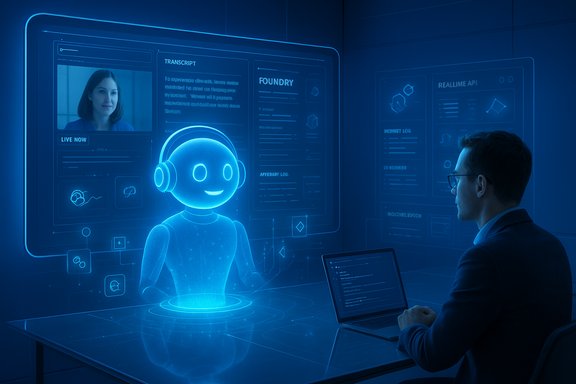
Microsoft’s Azure AI Foundry exposes a model catalog and a Realtime API tailored for low‑latency, multimodal interactions. The Realtime API explicitly supports WebRTC for client‑side audio and video because WebRTC is optimized for low latency, codec handling, and jitter/packet loss mitigation—exactly the properties needed for natural, live conversations. Microsoft documentation lists several realtime model SKUs (examples include gpt‑4o‑realtime and realtime mini variants) and prescribes API versions, supported regions, and session flows for ephemeral keys and WebRTC endpoints. These are the building blocks Napster cites as enabling live video companions. Key technical points verified from Microsoft documentation:- WebRTC is recommended for browser‑based, low‑latency audio/video and is supported by the Realtime API.
- Realtime model SKUs such as gpt‑4o‑realtime and
gpt-realtime/gpt-realtime-miniare listed for deployment in specific Azure regions; API versioning and sessions endpoints are documented by Microsoft.
Azure Kubernetes Service (AKS): the orchestration plane
Napster’s press text mentions AKS for the containerized, scalable parts of the agent stack—session orchestrators, media proxies, telemetry pipelines, and adapter microservices that call Foundry endpoints. AKS is a natural choice: it provides node pools (including GPU‑enabled nodes), autoscaling, and integrations with Azure Monitor and Azure Policy—features enterprises expect for production operations. That said, AKS is used to host the non‑model parts of the system; model inference and the realtime model runtimes live inside Foundry/Azure OpenAI managed endpoints.Data flows, keys, and residency (operational realities)
A production, realtime multimedia agent stack will generate several categories of data that enterprise teams must place and protect:- ephemeral audio/video streams,
- derived transcripts and embeddings,
- persistent memory stores and session logs,
- operational telemetry and audit trails.
Pilot case studies: what Napster is showing the market (and what’s unverified)
Napster highlights two pilot narratives in public materials:- Leadership coaching — Napster says the consultancy Leading Results used Napster’s AI to create 24/7 “AI coaches” for Cooper Parry, a UK firm. Napster presents quotes from Cooper Parry staff emphasizing cultural fit and authenticity. This is a classic low‑risk HR/training pilot: language‑rich, measurable outcomes (engagement, access), and lower regulatory exposure.
- Retail / in‑store commerce — Napster references a pilot with a leading paints and coatings manufacturer (operations in Mexico and 70+ countries) to bridge online and in‑store engagement with AI Companions. That pilot is described at high level but is unnamed in public technical materials, and measurable business results (latency, conversion uplift, retention) have not been published. Treat that as a vendor‑provided pilot claim until a named, metrics‑driven case study appears.
Responsible AI claims and the governance gap
Napster and Microsoft prominently foreground responsible AI in public remarks. Microsoft, in particular, has framed responsible AI as both a moral necessity and a commercial accelerator—citing a Microsoft‑commissioned IDC survey where over 30% of respondents named the lack of governance and risk‑management solutions as the top barrier to adopting AI. That IDC finding has been widely quoted in Microsoft materials and coverage as evidence that governance tooling unlocks AI adoption. Important points on governance:- The presence of platform controls (identity, regional deployments, content filtering, auditing hooks) is necessary but not sufficient. Enterprises must insist on configuration checklists, deployment diagrams showing data zoning, and contractual SLAs that include governance and incident response.
- Auditability and immutable logging are non‑negotiable for regulated verticals; model change‑management and versioning must be in procurement documents.
Strengths: what this partnership delivers well
- Low‑latency, multimodal conversations: Foundry’s Realtime API + WebRTC provides the technical plumbing needed for sub‑second audio/video interactions that feel natural. This is critical for sales and service scenarios where responsiveness drives engagement.
- Enterprise distribution and procurement: Packaging the solution with Azure Marketplace and Microsoft’s SI network gives Napster an established route to enterprise procurement and compliance channels—a substantial go‑to‑market advantage for a product firm moving from bespoke projects to SaaS.
- Faster time‑to‑market for non‑engineering teams: No‑code editors and agent templates reduce engineering lift and enable marketing or HR teams to iterate quickly, which can shorten POC timelines dramatically.
Risks and blind spots enterprises must manage
- Data residency and leakage: Real‑time sessions create transcripts and metadata that may be persisted. Confirm where those artifacts live and whether they are subject to in‑region residency or encrypted with customer keys. Vendor PRs rarely list the final data flow diagrams—get them in writing.
- Model hallucination and safety: Agentic systems can fabricate plausible but incorrect or harmful responses. Systems must have confidence thresholds, explicit escalation to humans in high‑risk contexts, and audit logs. Relying on vendor safety tooling without operational policies is risky.
- Deepfake and impersonation risk: Synthetic voices and avatars can be misused or erode trust if not properly disclosed. Require consent flows, agent identity markers, and opt‑out controls. This is especially important for public‑facing commerce or support agents.
- Vendor lock and portability: Napster’s product strategy intentionally couples its UX with Microsoft Foundry and Azure infrastructure. That simplifies operations but raises migration friction if the enterprise later seeks cross‑cloud portability. Insist on exportable artifacts and migration plans.
- Operational cost and observability: Realtime, multimodal usage (video + speech‑to‑text + TTS + long memory) is resource‑intensive. Architect model routing (use smaller models for routine tasks, reserve larger ones for complex reasoning) and instrument telemetry into chargeback systems before scaling.
A pragmatic checklist before you pilot Napster + Azure Foundry
- Validate data residency and encryption:
- Confirm the Azure regions used for realtime inference and storage.
- Confirm BYOK/CMK support for persistent stores and logs.
- Run a performance pilot:
- Simulate peak concurrent sessions (video + audio) to measure latency, error rates, and real‑world throughput.
- Measure per‑minute inference cost and operational overhead.
- Safety and governance:
- Define confidence thresholds and human‑in‑the‑loop escalation points.
- Enable immutable audit logging and model versioning.
- Identity and disclosure:
- Ensure agents explicitly identify themselves as synthetic and capture consent for voice/video interactions.
- Protect against impersonation by linking agent personas to verifiable brand assets.
- Contractual & procurement:
- Insist on SLAs that specify compliance, data deletion semantics, and incident response commitments.
- Require a migration plan and exportable agent configurations to reduce lock‑in risk.
- Monitoring and cost control:
- Set quotas and automated alerts for abnormal usage.
- Integrate telemetry with observability tools and finance reporting.
Deployment sequence recommended for production
- Start small with a non‑critical, internal pilot (training/coaching or FAQ assistants) to validate latency, correctness, and privacy controls.
- Expand to a closed beta for a subset of customers with human‑in‑the‑loop fallbacks and measurable KPIs (CSAT, conversion uplift, time saved).
- Harden governance, add region‑specific deployments, and scale once ROI and safety metrics are proven.
- Maintain a running incident playbook and model‑rollback process to address any misbehaviour quickly.
What enterprises should ask Napster and Microsoft during procurement
- Where are transcripts, embeddings, and memory stores persisted, and are they automatically routed to a designated region?
- Does the deployment support customer‑managed keys (CMK/BYOK) for all persistent artifacts?
- What specific realtime model SKUs are being used, what is the model update cadence, and how are model changes communicated and tested?
- What are the fallback and human‑in‑the‑loop procedures for high‑risk or ambiguous outputs?
- Can agent configurations, training data snapshots, and conversation logs be exported for audit and migration?
Competitive context and market implications
Other cloud vendors and platform players are pursuing similar approaches—model catalogs, agent orchestration, and enterprise controls—but Microsoft’s strategy with Azure AI Foundry aims to consolidate model hosting, orchestration, safety controls, and enterprise procurement into a single plane. That makes the Microsoft + Napster combo one example of a broader market pattern: product firms packaging agentic UX on top of hyperscaler model runtimes. The strategic value for ISVs is clear—reuse the hyperscaler’s model and compliance plumbing and focus investment on verticalized UX and content. The trade‑off is increased dependency on a single cloud and model provider.Bottom line: measured enthusiasm with operational rigor
Napster’s early production use of Azure AI Foundry’s Realtime API is a credible proof point that the industry’s long‑held promise—natural, low‑latency, multimodal conversational agents embedded directly into websites and commerce flows—is approaching mainstream viability. The combination of Foundry’s realtime models, Microsoft’s global infrastructure, and Napster’s productized UX lowers the barrier to enterprise experimentation and shortens time‑to‑market for many high‑value use cases.However, capability is not destiny. The most important determinants of success will be:
- Operational proof of governance, residency, and key control;
- Proactive safety engineering (confidence thresholds, human fallbacks, audit trails);
- Cost and observability governance to prevent runaway consumption; and
- Clear contractual exit and migration paths to avoid lock‑in.
Practical quick guide for IT decision makers (one‑page summary)
- Objective: Deploy low‑latency video/voice AI agents for support, commerce, or coaching while preserving enterprise security and compliance.
- Core stack to expect: Napster UI/UX + Azure AI Foundry realtime model layer + AKS for orchestration and auxiliary services.
- Top 3 pre‑launch checks:
- Confirm region/residency and CMK support for all persistent data.
- Run a performance pilot simulating peak concurrent multimedia sessions and track latency and cost.
- Define clear HITL (human‑in‑the‑loop) thresholds and audit logging requirements contractually.
- Starting use cases: HR coaching, internal training, and customer FAQ agents (lowest regulatory risk).
- Don’t escalate to transactional or regulated use cases (finance, healthcare) until safety and audit controls are proven under load.
Napster’s public announcement is a useful, early indicator that real‑time, embodied agents are moving from bespoke experiments into commercially supported offerings. For enterprise IT leaders, the immediate task is simple in concept and hard in practice: treat the capability as you would any new outsourced critical system. Validate the controls, stress the stack, and contract the guarantees before you expose customers to agents that look, speak, and act like humans. Conclusion: the technological ingredients for enterprise‑grade, agentic AI are finally converging. The Napster + Microsoft collaboration shows what a productized path looks like. The deciding factor for organizations will be governance and discipline—not the novelty of the technology.
Source: GlobeNewswire UPDATE - Napster Among First Microsoft Partners to Deploy Azure Agentic AI for Enterprises
