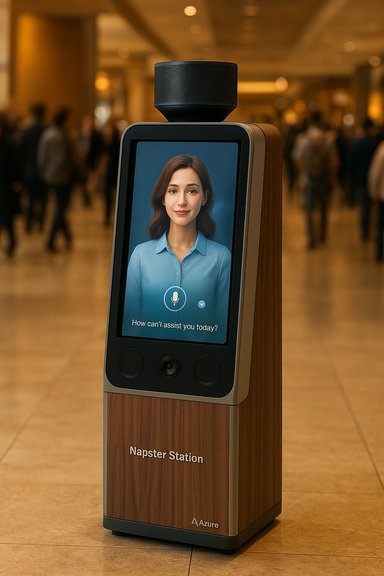
Napster’s new Napster Station promises to move conversational AI out of browser tabs and into the busiest public spaces by packaging purpose‑built hardware, studio‑grade audio, and Azure‑backed realtime models into a ready‑to‑deploy kiosk designed for noisy, crowded environments.
Napster—rebranded from Infinite Reality earlier this year—announced Napster Station on December 30, 2025 as an enterprise‑grade AI concierge kiosk targeted at hotel lobbies, airport concourses, retail floors, and healthcare waiting rooms. The vendor frames Station as the first kiosk engineered specifically to operate reliably in real‑world, high‑traffic settings where consumer voice assistants typically fail. The product positioning rests on two complementary claims: first, that purpose‑built hardware (microphone arrays, presence sensors, and tuned speakers) can materially improve speech‑capture and user selection in crowded spaces; second, that low‑latency, multimodal models running on Microsoft Azure OpenAI / Azure AI Foundry make natural, video‑enabled conversational agents practical at scale. Napster says Station will be available for enterprise deployment starting Q1 2026 and is being demonstrated at CES; those launch details come directly from Napster’s announcement.
However, that convenience creates dependencies. Napster’s platform layer on top of Azure Foundry simplifies procurement but can increase migration friction and vendor concentration risk. Contracts should include exportability of agent personas, memory snapshots, and content pipelines to reduce lock‑in.
Napster’s Station moves the conversation about AI in physical spaces from theoretical to practical; the onus is now on customers, auditors, and independent testers to separate compelling demos from reliable, scalable, and responsible deployments.
Conclusion
Napster Station represents a significant engineering and go‑to‑market effort to deliver an enterprise‑grade AI concierge for the messy realities of public spaces. The platform’s Azure integration and realtime model architecture are technically sound and supported by platform documentation; the hardware claims are promising but require independent validation. Organizations that pilot Station should start with narrow, informational use cases, insist on contractual protections for privacy and portability, and design phased scaling with instrumentation and clear HITL escalation. If the vendor claims check out in live pilots, Station could be a practical, cost‑effective way to bring conversational AI into the places customers actually live and work—provided that governance and operational discipline keep pace with the technology’s capabilities.
Source: GlobeNewswire Napster Launches Napster Station: The First AI Concierge Built to Provide Personalized Service in Crowded Spaces
 Background / Overview
Napster—rebranded from Infinite Reality earlier this year—announced Napster Station on December 30, 2025 as an enterprise‑grade AI concierge kiosk targeted at hotel lobbies, airport concourses, retail floors, and healthcare waiting rooms. The vendor frames Station as the first kiosk engineered specifically to operate reliably in real‑world, high‑traffic settings where consumer voice assistants typically fail. The product positioning rests on two complementary claims: first, that purpose‑built hardware (microphone arrays, presence sensors, and tuned speakers) can materially improve speech‑capture and user selection in crowded spaces; second, that low‑latency, multimodal models running on Microsoft Azure OpenAI / Azure AI Foundry make natural, video‑enabled conversational agents practical at scale. Napster says Station will be available for enterprise deployment starting Q1 2026 and is being demonstrated at CES; those launch details come directly from Napster’s announcement. What Napster Station Actually Ships With
Purpose‑built sensing and audio
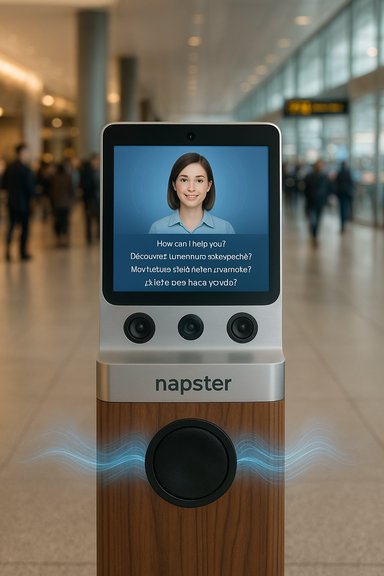
Napster’s marketing materials describe a stack of physical features designed to overcome the classic failure modes of on‑floor voice AI:- VoiceField™ Microphone Array — a proprietary near‑field microphone array that Napster claims isolates a single user’s voice even amid chaotic, high‑decibel noise.
- Multimodal Presence Sensing — fused camera and audio logic to determine which person is addressing the kiosk so interactions become context‑aware rather than purely acoustic.
- Audiophile‑Grade Sound — three precision tweeters and an integrated subwoofer to make text‑to‑speech playback clear and authoritative in reverberant spaces.
- Premium Aesthetic — walnut wood and aluminum construction intended to allow Station to sit comfortably in hospitality and retail settings.
Cloud, models, and realtime interaction
Napster makes no secret of the cloud backbone: Station sessions are intended to stream audio and video to Azure realtime model endpoints, specifically leveraging Azure OpenAI / Azure AI Foundry Realtime APIs for low‑latency speech‑in/speech‑out and video‑enabled agents. Microsoft documentation confirms that Azure’s Realtime API explicitly supports WebRTC for low‑latency, real‑time audio/video streams and lists realtime model SKUs intended for such use cases. That makes Napster’s architecture credible from a platform perspective. Microsoft’s public docs note that WebRTC is the recommended transport for low‑latency audio/video because it provides optimized media handling, error correction for packet loss and jitter, and peer‑to‑peer capabilities that reduce relay latency—technical elements that matter for a live, conversational kiosk. Napster’s use of Azure Foundry Realtime endpoints is consistent with Microsoft’s published capabilities and with Napster’s earlier partnership announcements.Where Napster’s Claims Are Verifiable — and Where They Aren’t
Verified and platform‑backed claims
- The product announcement, availability window (Q1 2026), and CES demo schedule are explicit in Napster’s press release. These are unambiguous vendor statements.
- Napster’s partnership and integration with Microsoft Azure and Azure OpenAI / Foundry is documented in prior Napster press materials and aligns with Microsoft’s public Realtime API guidance. That makes the architectural claim—an edge kiosk streaming to Azure realtime endpoints—technically plausible.
Vendor‑only assertions that require independent validation
- The real‑world performance of the VoiceField™ microphone array—its ability to isolate a single speaker in a crowded terminal at realistic sound pressure levels—has not been independently measured. Real acoustic environments introduce reflections, occlusions, and competing speech that are notoriously hard to reproduce in a brief trade‑show demo. Until third‑party acoustic tests or long‑running pilots are published, treat the microphone‑isolation claim as aspirational.
- The $1 per hour operational cost figure Napster quotes is a marketing metric, not an audited TCO calculation. Per‑hour cost depends heavily on session concurrency, model routing (which SKUs are used and for how long), cloud egress, storage, human‑in‑the‑loop moderation, and enterprise discounts. Buyers should insist on a workload‑specific cost model.
- The safety, privacy, and persistence characteristics of the kiosk’s memory model (how long it retains guest preferences, where memory is stored, and who has access) are described at a high level in marketing materials but lack the detailed data‑flow diagrams and contractual guarantees IT procurement teams require. Demand those details before a pilot.
Why this matters: practical uses that scale — and those that don’t
Napster highlights several verticals where Station could deliver measurable business value: hospitality, healthcare, retail, and airports. Those choices are sensible because they share three traits: frequent repeatable queries, a high premium on multilingual support and speed, and a tolerable regulatory risk profile when interactions remain informational.- Hotels & Hospitality: Station can surface guest preferences, speed simple check‑in steps, and provide concierge recommendations with persistent memory—useful for reducing lobby queues.
- Airports: Wayfinding, gate updates, and multilingual assistance are high‑value, low‑risk wins where a kiosk can reduce pressure on human information desks.
- Retail & Malls: Product lookups and configuration guidance can increase conversion if the kiosk is tied to live inventory and store maps.
- Healthcare waiting rooms: Informational explanations of procedures in a patient’s native language are useful but must be strictly limited to non‑diagnostic content with clear escalation paths to clinicians.
Technical anatomy: how Station is likely to work in production
- Station captures a local audio stream using the VoiceField array and a short video feed for presence detection.
- Local edge logic performs wake detection and basic filtering; it then requests an ephemeral session token from an orchestration service.
- The kiosk starts a WebRTC session to an Azure Foundry Realtime endpoint where a chosen realtime model (for example, gpt‑realtime or a mini variant) performs speech recognition, dialog control, and TTS generation. Microsoft’s docs recommend WebRTC precisely for this low‑latency audio/video flow.
- Persistent context (memory, guest preferences) is stored in a managed memory service or database that can be region‑scoped and secured with customer‑managed keys if contractually negotiated.
- Edge fallbacks (scripted answers or cached content) handle degraded or offline operation to maintain basic service during outages.
Security, privacy, and governance: checklist for IT leaders
Deploying a camera/audio‑enabled kiosk in public spaces changes legal and reputational risk profiles overnight. The following checklist is intended for procurement, security, and compliance teams evaluating Napster Station pilots:- Data Residency & Encryption: Get a detailed data‑flow map showing where audio/video streams, transcripts, embeddings, and memory are stored, and insist on CMK/BYOK for persistent artifacts.
- Consent & Signage: Ensure visible, plain‑language signage that the unit records audio/video for service, offers opt‑out mechanisms, and displays a clear identity marker that the agent is synthetic.
- Minimization & Retention: Define retention policies for recordings, transcripts, and embeddings; require an API for export/deletion on user request.
- Human‑in‑the‑Loop (HITL) & Escalation: Contractually define thresholds for HITL escalation (latency, confidence thresholds, topic restrictions) and test the escalation path under load.
- Hallucination Mitigation: Limit the kiosk’s remit for high‑risk content (medical/financial/legal) and implement guardrails such as deterministic, read‑only knowledge bases for critical facts.
- Auditability & Portability: Require exportable agent configurations, conversation logs, and memory snapshots; demand a migration plan to mitigate vendor lock‑in.
- Accessibility & Inclusion: Validate TTS voices, on‑screen captions, and alternative input paths (touch, text) to comply with ADA and accessibility best practices.
Cost calculus: why “$1 per hour” is a starting point, not a guarantee
Napster markets Station as offering a cost advantage of approximately $1 per hour compared to human or competing digital concierge solutions. That figure is attractive but simplified: total cost depends on multiple variables that vary by deployment:- Model runtime costs: which Azure realtime model is used (realtime vs. mini), how long each session runs, and concurrency.
- Cloud egress and storage: video streams, captured media, and transcripts add network and storage fees, especially if retention is required.
- Moderation and human oversight: live monitoring or HITL support adds labor and platform costs.
- Device amortization, maintenance, and replacement: hardware wear, physical security, and aesthetic upkeep (walnut finish) matter in airports and hotel lobbies.
- Integration and SLA support: enterprise integrations with property management systems, gate feeds, or inventory systems entail professional services.
Competitive landscape and strategic implications
Embodied, in‑space agents are a crowded strategic battleground: hyperscalers (including Microsoft through Azure AI Foundry) offer realtime model runtimes, while specialist ISVs and hardware integrators productize the UX and physical footprint. Napster’s differentiator is the combined hardware plus software offering and its packaged integration with Azure—a strategy that accelerates time‑to‑pilot for enterprises that prefer an end‑to‑end vendor rather than stitching components.However, that convenience creates dependencies. Napster’s platform layer on top of Azure Foundry simplifies procurement but can increase migration friction and vendor concentration risk. Contracts should include exportability of agent personas, memory snapshots, and content pipelines to reduce lock‑in.
Practical pilot plan: five steps to test Napster Station in your environment
- Define a narrow, low‑risk use case (wayfinding in a single concourse or FAQ/check‑in at one hotel desk).
- Conduct an acoustic and privacy audit at the pilot site; measure baseline signal‑to‑noise during peak hours.
- Run a 30‑day pilot with metrics collection (WER, speaker detection accuracy, latency, CSAT, fallbacks triggered).
- Validate data residency, CMK/BYOK options, and export/deletion APIs; run a legal review for consent requirements in the deployment jurisdiction.
- Only after meeting defined KPIs and governance checks, expand to additional sites and more complex interactions.
Critical analysis: strengths, realistic expectations, and the primary risks
Strengths
- Napster Station addresses a long‑standing boundary problem: making conversational AI robust in noisy, crowded real spaces. If the hardware and sensing deliver, the business case for reduced labor and higher throughput is strong.
- Integration with Azure’s realtime model stack gives enterprises a credible route to low‑latency, globally hosted inference and enterprise compliance tooling. Microsoft’s docs back the viability of realtime audio/video flows.
- A productized kiosk simplifies procurement for customers that lack deep AI and acoustics engineering teams.
Realistic expectations
- Early demos at CES and marketing collateral are useful for first impressions but do not replace representative pilots and independent acoustic testing. Expect an iterative engineering cadence to tune speech separation and presence logic for each deployment site.
- The “$1 per hour” figure works as a headline metric, not a guaranteed universal price. Real costs will vary with concurrency, model SKUs, and enterprise discounts.
Primary risks
- Privacy & surveillance: Vision sensors plus persistent memory create regulatory and reputational risk unless handled with explicit consent, signage, and contractual residency guarantees.
- Hallucination and liability: Generative outputs in public settings can mislead or harm; limit high‑risk content and define human escalation for consequential topics.
- Vendor concentration and lock‑in: Deep tie‑ins to a single cloud runtime (Azure Foundry) simplify delivery but raise portability concerns; insist on exportable artifacts and migration plans.
Final assessment
Napster Station is a credible and well‑packaged entry into the embodied AI kiosk market: the combination of bespoke hardware and Azure‑backed realtime models addresses an important, long‑standing gap between laboratory ASR and on‑floor performance. The architecture Napster proposes is consistent with Microsoft’s Realtime API guidance and with the current capabilities of realtime model runtimes. That said, the launch should be read as the start of a pragmatic, metrics‑driven deployment journey rather than a finished, universally‑deployable appliance. Key performance claims—microphone isolation in airport noise, precise presence sensing, and the $1/hour operating cost—remain vendor assertions until validated by independent tests and representative pilots. Enterprises should demand transparent data‑flow diagrams, CMK/BYOK options, exportable artifacts, and robust HITL escalation procedures before considering production rollouts.Napster’s Station moves the conversation about AI in physical spaces from theoretical to practical; the onus is now on customers, auditors, and independent testers to separate compelling demos from reliable, scalable, and responsible deployments.
Conclusion
Napster Station represents a significant engineering and go‑to‑market effort to deliver an enterprise‑grade AI concierge for the messy realities of public spaces. The platform’s Azure integration and realtime model architecture are technically sound and supported by platform documentation; the hardware claims are promising but require independent validation. Organizations that pilot Station should start with narrow, informational use cases, insist on contractual protections for privacy and portability, and design phased scaling with instrumentation and clear HITL escalation. If the vendor claims check out in live pilots, Station could be a practical, cost‑effective way to bring conversational AI into the places customers actually live and work—provided that governance and operational discipline keep pace with the technology’s capabilities.
Source: GlobeNewswire Napster Launches Napster Station: The First AI Concierge Built to Provide Personalized Service in Crowded Spaces