

NASA’s NEPP heavy‑ion campaign at Texas A&M has cleared EdgeCortix’s SAKURA‑II accelerator of destructive single‑event effects and recorded only limited, recoverable error modes — a result that moves low‑power, on‑board AI from conceptual promise toward operational plausibility for LEO, GEO and lunar missions.
Spaceborne autonomy demands compute that is both powerful and durable. Modern sensor suites, high‑resolution imaging payloads, navigation aids and on‑platform decision systems increasingly require on‑board machine learning inference to reduce downlink load and speed reaction times. But space is hostile: energetic particles cause single‑event effects (SEEs), total ionizing dose (TID) damage accumulates over time, and thermal, mass and power budgets are tight.
NASA’s Electronic Parts and Packaging Program (NEPP) has led efforts to put complex client‑class accelerators through SEE and proton campaigns to develop baseline qualification methods for machine‑learning devices. The SAKURA‑II test — executed at the Texas A&M K500 cyclotron and documented in a NASA technical memorandum — was explicitly designed to assess single‑event susceptibility for a modern, low‑power AI co‑processor intended for edge deployments. EdgeCortix positions SAKURA‑II as a highly efficient edge AI co‑processor with a performance envelope targeting generative AI and large‑model inference at low wattage (claimed 60 TOPS INT8 in the product literature). The company and several industry outlets released synchronized announcements after NASA published the test report.
Conclusion
NASA’s documentation provides the aerospace community with concrete Weibull parameters, clear failure classifications and a reproducible test methodology — the raw ingredients needed to move SAKURA‑II from lab demonstrator to mission‑qualified component. Combining this public test data with disciplined integration practices (packaged testing, watchdogs, redundancy and telemetry) gives mission designers a credible roadmap to harness low‑power, high‑efficiency edge AI in orbit and on the Moon — unlocking new autonomy while preserving the engineering rigor that space operations demand.
Source: Embedded Computing Design NASA Testing Confirms EdgeCortix SAKURA-II Radiation Resilience for LEO, GEO, and Lunar Operations - Embedded Computing Design
 Background / Overview
Spaceborne autonomy demands compute that is both powerful and durable. Modern sensor suites, high‑resolution imaging payloads, navigation aids and on‑platform decision systems increasingly require on‑board machine learning inference to reduce downlink load and speed reaction times. But space is hostile: energetic particles cause single‑event effects (SEEs), total ionizing dose (TID) damage accumulates over time, and thermal, mass and power budgets are tight.NASA’s Electronic Parts and Packaging Program (NEPP) has led efforts to put complex client‑class accelerators through SEE and proton campaigns to develop baseline qualification methods for machine‑learning devices. The SAKURA‑II test — executed at the Texas A&M K500 cyclotron and documented in a NASA technical memorandum — was explicitly designed to assess single‑event susceptibility for a modern, low‑power AI co‑processor intended for edge deployments. EdgeCortix positions SAKURA‑II as a highly efficient edge AI co‑processor with a performance envelope targeting generative AI and large‑model inference at low wattage (claimed 60 TOPS INT8 in the product literature). The company and several industry outlets released synchronized announcements after NASA published the test report.
What NASA Tested — Scope, Methods and Device Under Test
Test goals and rationale
NASA’s test campaign aimed to characterize the SAKURA‑II accelerator’s susceptibility to heavy‑ion induced SEEs (including single event upsets, single event functional interrupts, and single event latchup) and to quantify the operational impacts on representative ML inference workloads. The project builds on earlier campaigns for SAKURA‑I and is part of NEPP’s effort to create reproducible test baselines for client‑class accelerators.Device under test (DUT)
- The DUT was an M.2‑form SAKURA‑II accelerator card containing a SAKURA‑II ASIC, 20 MB on‑chip memory and 16 GB of external LPDDR4. The card conforms to M.2 2280 mechanical dimensions and interfaces to a host via an M.2 connector. The vendor reports the silicon can deliver ~60 TOPS (INT8) under an 8–10 W power envelope.
- For radiation analysis the device was decapsulated and thinned to expose the die — a standard approach that allows heavy‑ion beams to interact with the semiconductor material as they would in flight conditions (with differences noted below).
Test facility and beam parameters
- Facility: Texas A&M K500 cyclotron (heavy ion facility).
- Beam tune used: 25 MeV‑something (listed in the report as the 25 “something” beam — the full technical beam configuration and LET spectrum appear in the NASA memo).
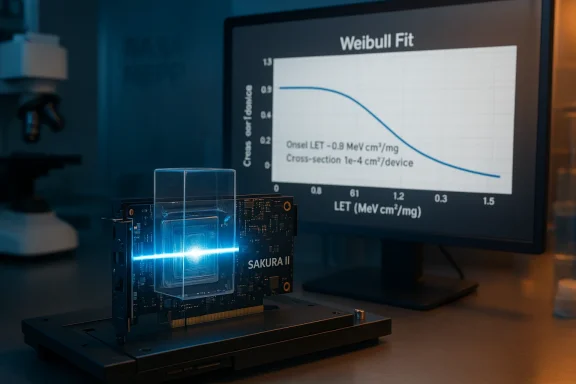
- Linear energy transfer (LET) was exercised up to ~40.9 MeV·cm²/mg at fluences >1E7 ions/cm² for the higher‑LET points. The team fit SEFI data to a Weibull curve to extract onset LET and asymptotic cross‑section metrics used in flight‑rate estimates.
Test Results — What NASA Observed (and What It Did Not)
Key findings
- No destructive single‑event latchup (SEL) nor permanently destructive SEEs were observed during the heavy‑ion campaign. This is an important outcome: the device hardware itself did not fail catastrophically under the irradiations performed.
- The dominant observed fault class was SEFIs localized to the PCIe/M.2 interface, which required resets or re‑initialization of the host interface to recover normal operation. SEUs (bit flips) manifested most commonly as changes in model output confidence scores rather than wholesale misclassification in many cases. Some SEUs were tolerable (minor score changes with correct class/bounding box), while other events caused persistent mispredictions that required a system reboot to fix.
- NASA reported a Weibull fit for SEFI behavior with an onset LET of ~0.9 MeV·cm²/mg and a limiting cross‑section near 1.00E‑04 cm²/device for the measured SEFI family. These are the parameters mission engineers use to estimate in‑orbit event rates once convolved with environmental flux models.
Practical interpretation
- Non‑destructive outcomes are encouraging — they mean the silicon and board survived nominal heavy‑ion strikes without catastrophic failure modes like latchup. However, the observable SEFIs and the occasional persistent misprediction indicate that system‑level mitigation and reboot strategies are still required for mission‑capable deployments.
- The tests were performed in‑air at room temperature with decapsulated and thinned die. These details influence particle penetration and charge deposition and must be accounted for when extrapolating to flight configurations with package lids, shielding, vacuum conditions, and thermal extremes.
EdgeCortix’s Specifications and Public Claims — Cross‑Checked
EdgeCortix advertises SAKURA‑II as a low‑power, high‑bandwidth edge AI accelerator tuned for generative models and real‑time Batch‑1 inference. Representative, independently available product details include:- Claimed performance: ~60 TOPS (INT8) and 30 TFLOPS (BF16).
- Onboard memory and bandwidth: tested boards used 16 GB LPDDR4, with vendor claims of “up to 4× DRAM bandwidth vs competitors.”
- Typical power envelope: ~8–10 W for the module/board variants in EdgeCortix literature and the evaluation hardware descriptions.
Why This Matters for LEO, GEO and Lunar Missions
Lower power, onboard AI is mission‑enabling
Small satellites and landers run on tight power budgets. A low‑power accelerator capable of running LLMs, large vision models or multi‑modal inference at Batch‑1 speeds on the platform reduces downlink volume and latency, enabling:- Autonomous hazard detection and real‑time navigation corrections.
- Local compression and event‑driven telemetry (send only important frames).
- On‑board mission decision agents for sample selection, anomaly triage or payload scheduling.
Orbit regimes matter: different threat models
- LEO (Low Earth Orbit): high flux of trapped protons during South Atlantic Anomaly passes and multiple daily passages through radiation belts at certain inclinations; transient SEEs are relatively frequent but shielding is modest.
- GEO (Geostationary Orbit): lower trapped proton exposure but greater vulnerability during solar energetic particle events; mission lifetimes are often longer and eclipse seasons impose energy management constraints.
- Lunar surface: exposure to galactic cosmic rays and solar particle events without Earth’s magnetospheric protection; devices must tolerate both single‑event rates and cumulative TID loads over mission timelines.
Strengths — What Makes the Result Notable
- Non‑destructive behavior under heavy ions: no SELs or irreversible device failures during the campaign, a strong positive indicator for survivability in transient particle environments.
- Low power / high efficiency footprint: SAKURA‑II’s claimed 60 TOPS at ~8 W fills a critical niche between tiny microcontrollers and high‑power GPUs — enabling more capable inference without heavy thermal hardware. Multiple vendor pages and independent writeups corroborate the performance envelope.
- Transparency from NASA/NEPP: public NEPP documentation with Weibull fits and explicit test procedures gives engineers the raw numbers necessary for mission‑level reliability modeling (not just vendor assertions). That transparency is essential for trustworthy selection in aerospace programs.
Risks, Limitations and Important Caveats
- SEFIs localized to host interface: the most common failure mode observed affects the PCIe/M.2 interface. If a flight architecture tightly couples the accelerator to a single host controller without watchdogs or redundant paths, SEFIs can produce mission‑affecting downtime until a reset or reboot is performed.
- Workload‑dependent errors: SEUs were observed as confidence‑score shifts and, in some cases, persistent mispredictions that required reboot. For safety‑critical classifiers (navigation, collision avoidance), even occasional mispredictions may be unacceptable without higher‑level voting, redundancy or conservative fallbacks.
- Test vs. flight environment mismatch: the device was decapsulated and thinned, and tests were conducted in‑air at room temperature. In‑flight packaging, sealing, thermal extremes, and real shielding will change LET deposition and secondary particle production — sometimes reducing SEE susceptibility, sometimes altering failure modes. Mission validation must include representative packaging and thermal profiles.
- TID and proton environments: this heavy‑ion campaign characterizes SEE susceptibility; TID accumulation and high‑energy proton effects (and displacement damage) are separate concerns. SAKURA‑I/II proton campaigns exist in NASA records, but integrators must ensure TID endurance is acceptable for mission duration and orbit.
- Operational lifecycle & replacement cadence: unlike radiation‑hardened space‑grade ASICs, modern COTS‑class accelerators often have faster obsolescence. For long missions, plan for replacement or modular upgrade strategies and assess the lifecycle economics of periodic hardware refresh vs. launch costs.
Recommendations for System Integrators (Practical, Sequential Steps)
- Validate mission profile: collect orbital/lunar flux models for the specific inclination, altitude, or surface exposure windows. Use NEPP Weibull parameters from the SAKURA‑II report to compute expected in‑mission SEFI/SEU rates.
- Run a complete qualification stack: augment heavy‑ion tests with TID, displacement damage and proton campaigns on the packaged unit (not only delidded die). Confirm thermal cycling, vacuum soak and outgassing behavior.
- Architect for graceful recovery: implement watchdog timers, automatic subsystem resets, host interface reinitialization sequences, and state‑checkpointing so that SEFIs can be recovered without operator intervention. Ensure the system can detect silent inference corruption (sanity checks, model confidence band monitoring, cross‑checks).
- Use redundancy where mission critical: deploy N‑version voting across multiple accelerators or fallback to verified CPU inference if the accelerator reports a fault. Add hardware ECC and CRC on communication paths.
- Quantify operational risk: model expected event frequency and the cost (in time, data loss, risk) of each event class. Incorporate these into system availability budgets and contingency planning.
- Negotiate telemetry and in‑orbit logging: if possible, arrange for mission telemetry that exposes accelerator health counters and error rates so you can refine mitigation with flight data. NEPP’s public reporting model shows the value of sharing measured metrics.
Strategic Implications for the Orbital Edge and Lunar Autonomy
This test advances a realistic path for integrating sophisticated ML inference on constrained space platforms. A radiation‑tolerant, low‑power accelerator able to run modern vision models and multi‑modal workloads could shift operational patterns:- Offload bulk preprocessing to orbit, reducing downlink costs and enabling near‑real time decisioning.
- Permit mission autonomy (e.g., sample capture selection on landers) that today requires conservative human oversight.
- Accelerate adoption of on‑platform generative or predictive models for data triage, enabling new science workflows.
Final Assessment — Balanced View
The NASA NEPP heavy‑ion validation of SAKURA‑II is a meaningful technical milestone: public, instrumented testing found no destructive failures and produced quantified SEFI/SEU metrics mission engineers can use. That elevates SAKURA‑II from vendor claim to an empirically characterized option for space integrators. Yet the test also highlights the realities of deploying modern COTS‑class accelerators in space:- Systems will need robust watchdogs and recovery strategies because SEFIs in the host interface were the most common fault.
- Workload design matters: certain models and inference flows tolerate transient confidence shifts better than others. Mission planners must adopt conservative classifiers or implement cross‑validation for safety‑critical decisions.
- Flight‑representative testing — packaged units, vacuum and thermal extremes, cumulative TID exposure — remains required before acceptance for long‑duration or safety‑critical missions.
Conclusion
NASA’s documentation provides the aerospace community with concrete Weibull parameters, clear failure classifications and a reproducible test methodology — the raw ingredients needed to move SAKURA‑II from lab demonstrator to mission‑qualified component. Combining this public test data with disciplined integration practices (packaged testing, watchdogs, redundancy and telemetry) gives mission designers a credible roadmap to harness low‑power, high‑efficiency edge AI in orbit and on the Moon — unlocking new autonomy while preserving the engineering rigor that space operations demand.
Source: Embedded Computing Design NASA Testing Confirms EdgeCortix SAKURA-II Radiation Resilience for LEO, GEO, and Lunar Operations - Embedded Computing Design