

C.H. Robinson’s decision to fold its Navisphere platform deeper into Microsoft’s Azure stack marks a deliberate push to turn episodic shipment tracking into continuous, sensor-driven intelligence — a move that could accelerate digitization across freight, cold chain and multimodal logistics while also surfacing a familiar set of integration, security and governance challenges for shippers and carriers alike.
Since mid‑2020 C.H. Robinson and Microsoft have publicly positioned a strategic alliance around Navisphere — the broker’s global multimodal transportation management system — and Microsoft Azure, with a specific emphasis on Azure IoT Central, Azure’s cloud platform services, and Microsoft business tooling such as Dynamics 365 and Power BI. The companies say the integration enables richer telemetry (temperature, shock, tilt, humidity, light and pressure), improved predictive analytics, and real‑time visibility across inventory at rest and in motion.
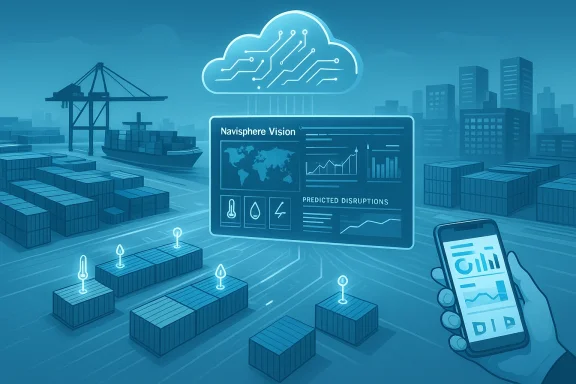
Navisphere Vision, a product created in collaboration with Microsoft, is described as a global real‑time visibility solution that layers Azure IoT, machine learning and predictive analytics on top of shipment tracking to assess and forecast disruptions. At the same time, C.H. Robinson is migrating parts of its stack and customer‑facing logistics functions into the Dynamics 365 ecosystem and using Power BI for visualization — a move that promises tighter CRM/process integration and packaged offerings for Microsoft customers.
This article examines what the partnership means technically and commercially, unpacks the practical benefits for shippers and carriers, and lays out the operational, security and governance tradeoffs that IT and procurement teams must manage before they commit to large‑scale adoption.
At the same time, large shippers increasingly demand not just location data but contextual condition data (temperature, tilt, shock) tied to contractual SLAs and automated exception workflows. Platforms that combine IoT ingestion, machine learning-driven anomaly detection and workflow integration (e.g., raising a hold, rerouting, or triggering a claims workflow) convert raw telemetry into business actions — the principal value proposition underscored by C.H. Robinson and Microsoft.
The enterprise consequences are similar across these partnerships: hyperscalers deliver scale, device management and AI tooling; logistics partners contribute domain data, operational processes and global carrier relationships. For enterprise buyers, the differentiator will be productization depth, integration ease and contractual clarity on data, cost and remediation responsibilities.
FedEx’s FedEx Surround was deployed to support vaccine logistics and has since been regionally expanded — an example of how a combined operations‑cloud product can be rapidly operationalized in a well‑funded carrier. That example is instructive: expect tiered rollouts, verticalized product variants (healthcare vs. retail), and regionally staged availability.
Conclusion: the technology stack and commercial channel unlocked by Navisphere running on Azure create a credible path to scaled, sensor‑driven logistics — but realizing the value requires disciplined pilots, contractual rigor, and operational readiness to act on the intelligence as it arrives.
Source: Heavy Duty Trucking C.H. Robinson, Microsoft Team up to Digitize Supply Chains
 Background / Overview
Since mid‑2020 C.H. Robinson and Microsoft have publicly positioned a strategic alliance around Navisphere — the broker’s global multimodal transportation management system — and Microsoft Azure, with a specific emphasis on Azure IoT Central, Azure’s cloud platform services, and Microsoft business tooling such as Dynamics 365 and Power BI. The companies say the integration enables richer telemetry (temperature, shock, tilt, humidity, light and pressure), improved predictive analytics, and real‑time visibility across inventory at rest and in motion. Navisphere Vision, a product created in collaboration with Microsoft, is described as a global real‑time visibility solution that layers Azure IoT, machine learning and predictive analytics on top of shipment tracking to assess and forecast disruptions. At the same time, C.H. Robinson is migrating parts of its stack and customer‑facing logistics functions into the Dynamics 365 ecosystem and using Power BI for visualization — a move that promises tighter CRM/process integration and packaged offerings for Microsoft customers.
This article examines what the partnership means technically and commercially, unpacks the practical benefits for shippers and carriers, and lays out the operational, security and governance tradeoffs that IT and procurement teams must manage before they commit to large‑scale adoption.
Why this matters now
The pandemic, ongoing demand spikes, and the broad adoption of cloud and IoT device economics have combined to push supply chains from periodic status checks into an era where continuous telemetry can be expected — especially for time‑ and condition‑sensitive cargo such as pharmaceuticals, food, and high‑value electronics. Hyperscaler platforms (Azure, AWS, Google Cloud) now offer managed IoT services that make it simpler to ingest, secure and analyze device telemetry at scale, reducing the custom middleware historically needed to connect edge devices to enterprise applications. C.H. Robinson’s move reflects that industry shift and leverages Microsoft’s global cloud footprint and enterprise sales channels.At the same time, large shippers increasingly demand not just location data but contextual condition data (temperature, tilt, shock) tied to contractual SLAs and automated exception workflows. Platforms that combine IoT ingestion, machine learning-driven anomaly detection and workflow integration (e.g., raising a hold, rerouting, or triggering a claims workflow) convert raw telemetry into business actions — the principal value proposition underscored by C.H. Robinson and Microsoft.
The technology stack — components and how they fit together
Navisphere + Azure: what’s being integrated
- Navisphere: C.H. Robinson’s multimodal TMS and customer portal that orchestrates booking, execution and visibility across carriers.
- Azure IoT Central / Azure IoT: Managed cloud services for device connectivity, device templates, telemetry ingestion, and device lifecycle management. In the collaboration, IoT Central is the ingestion and device‑management layer for sensor tags and gateways attached to shipments.
- Navisphere Vision: A visibility/analytics product built on top of Navisphere + Azure IoT; leverages machine learning and predictive analytics to surface likely disruptions and contextualize telemetry.
- Dynamics 365 & Power BI: CRM and analytics layers used to embed pricing, execution, and management data into business apps and dashboards for customers and Microsoft enterprise users.
Sensors and telemetry
C.H. Robinson’s public materials and Microsoft’s documentation specify typical IoT telemetry used in freight monitoring: temperature, shock, tilt, humidity, light and pressure. These measurements enable use cases from cold‑chain maintenance to tamper detection and impact logging. The partnership references Intel as a device partner in some deployments (gateway/device ecosystem), which is typical for enterprise IoT rollouts aimed at fast device onboarding.Practical benefits for shippers, carriers and logistics teams
- Richer visibility, not just location: Combining condition telemetry with GPS provides actionable context — e.g., a late truck that also experienced a temperature excursion can trigger prioritized intervention. This can reduce spoilage and support SLA and compliance reporting.
- Predictive disruption detection: Navisphere Vision’s ML models aim to warn customers about likely disruptions ahead of time by analyzing telemetry and historical patterns. Early intervention can reduce dwell time, expedite re‑routing and minimize penalty exposure.
- Faster customer workflows: Integrating real‑time pricing, execution, and transportation management into Dynamics 365 means sales and operations teams can act from a single pane; Power BI provides prebuilt visualization for trend analysis and SLA reporting. This reduces friction between operations and commercial teams.
- Economies of scale and security posture: Running Navisphere on Azure gives C.H. Robinson and its customers access to Microsoft’s global datacenter footprint, identity frameworks, and security controls — attractive for enterprises with multinational operations.
- Offerings packaged for Microsoft customers: Because Navisphere is now built to run on Azure and integrated with Dynamics 365, Microsoft can present Navisphere functionality to its enterprise account base as part of a broader suite of business applications — an important commercial distribution channel for C.H. Robinson.
The governance, security and operational risks
These benefits are substantial, but they are not automatic. IT leaders and logistics buyers should weigh the following risks and operational realities.1) Data governance and privacy
Telemetry may traverse multiple jurisdictions. Data residency, retention rules and regulatory obligations (customs, healthcare/pharma traceability, GDPR‑like regimes) must be mapped before device rollouts. Contracts must clarify who owns telemetry, who may access it, and how long historical telemetry is retained. This is especially important when telemetry is tied to performance claims or insurance.2) Vendor concentration and lock‑in
Migrating core logistics flows and device management to a single cloud/hyperscaler simplifies operations but concentrates risk. Dependence on Azure for ingestion, storage and compute can create bargaining asymmetry and raise questions about egress costs, portability and future migration complexity. Teams should insist on exportable data formats and well‑documented APIs.3) Device provisioning and lifecycle complexity
The IoT device lifecycle (certification, provisioning, firmware updates, end‑of‑life) is operationally heavy. Device tamper, battery life, inconsistent calibration and differing vendor hardware characteristics can degrade data quality and generate false positives in ML models. Implementation teams must design for device management at fleet scale, including automated provisioning and monitoring.4) Data quality and model drift
Machine learning models are only as good as the telemetry and contextual data they receive. Coverage gaps, sparse historical data for unusual lanes, or sensor calibration issues can lead to poor predictions. Organizations should require model explainability, model‑performance SLAs for critical predictions, and processes to retrain models when operating conditions change.5) Integration and carrier adoption
Many carriers (especially smaller owner‑operators) do not have standard device fleets or may be reluctant to adopt third‑party sensors. Coverage bias toward large carriers or high‑value lanes can limit the value of visibility platform investments. Where carrier participation is voluntary, expect incremental rollouts and mixed‑mode visibility (some lanes instrumented, others not).6) Cost and ROI ambiguity
IoT tags, gateways, data ingestion and analytics are not free. Buyers must model total cost of ownership — hardware, connectivity (e.g., cellular SIM plans), cloud ingestion and storage fees, analytics and human operational response costs — and contrast that against measurable reductions (spoilage, SLA penalties, claims) during pilots. Avoid vendor promises of quick ROI without contractual KPIs and pilot evidence.Real‑world deployment patterns: how to roll this out (recommended phased approach)
- Define the use cases and KPIs
- Prioritize business cases with highest unit economics: cold chain for pharma, high‑value electronics, time‑sensitive spare parts. Define explicit KPIs (reduction in temperature excursions, percent of interventions that prevent spoilage, SLA breach reduction).
- Pilot select lanes and device types
- Run 60–90 day pilots across 3–5 representative routes with mixed carriers to validate device selection, connectivity and model accuracy. Use both active (cellular) tags and passive NFC/BL where suitable.
- Standardize data models and APIs
- Map canonical telemetry schemas and event contracts early. Require the platform to export telemetry in interoperable formats to prevent lock‑in.
- Security and identity design
- Enforce device identity, mutual authentication (X.509), encrypted telemetry channels, and role‑based access to dashboards. Include contractual responsibilities for intrusion response.
- Operationalize exception handling
- Define and test the workflows: who receives an alert, what escalation path is used, what remediation steps are pre‑authorized (e.g., temperature‑controlled transload). Measure mean time to remediation.
- Scale with change management
- Expand instrumented lanes based on pilot outcomes, refine ML models, and provide training for carrier and shipper operations teams on new processes.
Governance checklist for procurement and IT
- Require explicit data ownership and export rights in contracts.
- Insist on SLAs for device management (uptime, provisioning time), ingestion latency and ML model accuracy for mission‑critical predictions.
- Demand transparency on how ML models are trained and what datasets are used; require audit logs for automated decisions.
- Negotiate cloud egress and storage pricing or establish caps for expected telemetry volumes.
- Obtain a breach notification timeline and technical response playbook from the vendor.
How this compares with other hyperscaler‑led supply‑chain moves
Microsoft is not alone. The FedEx–Microsoft collaboration that produced FedEx Surround is an explicit example of a carrier pairing its operational network with Azure to create near‑real‑time analytics and intervention services; it illustrates the same market logic — combine physical logistics platforms with hyperscaler analytics to create differentiated visibility services. Both moves show hyperscalers expanding from infrastructure to verticalized solutions through strategic partnerships.The enterprise consequences are similar across these partnerships: hyperscalers deliver scale, device management and AI tooling; logistics partners contribute domain data, operational processes and global carrier relationships. For enterprise buyers, the differentiator will be productization depth, integration ease and contractual clarity on data, cost and remediation responsibilities.
Case examples and early indicators
C.H. Robinson has run Navisphere internally within Microsoft’s own supply chain, which the companies cite as a validation point for broader enterprise use. The Navisphere Vision webinar and product materials highlight combined device telemetry and ML for predictive disruption detection and say Microsoft, Intel and C.H. Robinson ran joint deployments to accelerate device onboarding during peak seasons. Those customer‑facing pilots and early public deployments are promising but still represent a staged path to global scale, not an immediate, universal capability.FedEx’s FedEx Surround was deployed to support vaccine logistics and has since been regionally expanded — an example of how a combined operations‑cloud product can be rapidly operationalized in a well‑funded carrier. That example is instructive: expect tiered rollouts, verticalized product variants (healthcare vs. retail), and regionally staged availability.
What CIOs and logistics directors should ask next (practical checklist)
- Which lanes and SKUs will yield the quickest measurable ROI for condition telemetry?
- What device hardware vendors are supported, and how is device lifecycle (firmware updates, retirement) handled?
- How will predictive alerts be integrated with our existing ERP/WMS/TMS workflows and vendor contracts?
- What are the data residency, retention and export guarantees? Can we extract raw telemetry for independent analysis?
- What are the expected telemetry volumes and the corresponding cloud costs (ingest, storage, analytics)?
- How will the vendor handle false positives/negatives in ML alerts and who takes remediation costs when intervention fails?
- What carrier onboarding incentives or programs are in place to ensure broad coverage?
Strengths, caveats and a balanced verdict
Strengths- The combination of Navisphere’s freight expertise with Azure’s managed IoT tooling accelerates the path from sensor data to business outcomes.
- Integration with Dynamics 365 and Power BI creates a user experience where pricing, execution and visibility coalesce inside enterprise apps used by commercial teams.
- Microsoft’s global cloud footprint and device ecosystem partners shorten deployment time and provide enterprise‑grade security controls.
- Device management, carrier participation and model accuracy remain operationally heavy; buyers should expect multi‑phase rollouts rather than immediate universal coverage.
- Concentration risk with a single hyperscaler is real: procurement must negotiate portability and cost protections.
- Many benefits depend on robust operational response (human workflows) — good predictions without fast remediation only shift the problem, not solve it.
Final recommendations
- Begin with narrowly scoped, high‑value pilots (cold chain, pharma, high‑value electronics). Use those pilots to validate sensors, ML models and operational playbooks.
- Insist on exportable telemetry and documented APIs to protect against future vendor lock‑in.
- Build cross‑functional playbooks (operations, legal, procurement, IT) so that predictive alerts can be translated into fast, pre‑authorized remediation.
- Negotiate clear SLAs for device management, ingestion latency and model performance, and require transparency into how ML predictions are generated and validated.
- Track total cost of ownership closely — including device, connectivity and cloud fees — and compare to historical shrink/penalty costs to quantify ROI.
Conclusion: the technology stack and commercial channel unlocked by Navisphere running on Azure create a credible path to scaled, sensor‑driven logistics — but realizing the value requires disciplined pilots, contractual rigor, and operational readiness to act on the intelligence as it arrives.
Source: Heavy Duty Trucking C.H. Robinson, Microsoft Team up to Digitize Supply Chains
