

Lockheed Martin and Microsoft have launched Sanctum, a cloud‑native, AI‑driven counter‑unmanned aerial system (C‑UAS) that marries Lockheed’s sensor‑to‑effector engineering with Microsoft Azure’s cloud, telemetry and AI lifecycle tooling to deliver multi‑sensor detection, automated threat prioritization, and coordinated multi‑domain response across connected and intermittently connected environments.
Sanctum is presented as a modular, software‑first C‑UAS architecture designed to sit above heterogeneous sensor fields and effectors. It aggregates RF, radar, electro‑optical/IR (EO/IR), acoustic and other sensor streams, applies AI‑assisted classification and risk‑ranking, and orchestrates responses — from advisories to non‑kinetic and kinetic effectors — through a unified mission console. The announcement frames the system around three operational goals: see clearly, decide confidently, act quickly.
The partnership builds on an existing trajectory of collaboration between the two companies, including prior work to operate Microsoft Azure in classified and tactical contexts. That history explains why Azure is positioned as Sanctum’s digital backbone and why the product emphasizes cloud‑to‑edge lifecycle management for models and software.
Key technical realities:
However, the promise must be balanced with caution. Deep cloud integration increases attack surface and supplier dependency, vendor demonstrations are not a substitute for independent validation, and legal/regulatory constraints will significantly shape real‑world deployments. Buyers and program managers should condition procurement on independent trials, explicit portability and security guarantees, adversarial testing, and rigorous human‑in‑the‑loop safeguards. With those guardrails in place, Sanctum could speed adaptation to emerging aerial threats — but its ultimate value will be decided in contested, real‑world conditions and through verifiable performance data, not marketing narratives.
Source: NextGen Defense Lockheed, Microsoft Launch Sanctum C-UAS Leveraging Cloud Tech
 Background
Sanctum is presented as a modular, software‑first C‑UAS architecture designed to sit above heterogeneous sensor fields and effectors. It aggregates RF, radar, electro‑optical/IR (EO/IR), acoustic and other sensor streams, applies AI‑assisted classification and risk‑ranking, and orchestrates responses — from advisories to non‑kinetic and kinetic effectors — through a unified mission console. The announcement frames the system around three operational goals: see clearly, decide confidently, act quickly.The partnership builds on an existing trajectory of collaboration between the two companies, including prior work to operate Microsoft Azure in classified and tactical contexts. That history explains why Azure is positioned as Sanctum’s digital backbone and why the product emphasizes cloud‑to‑edge lifecycle management for models and software.
Overview: What Sanctum Claims to Be
Core capabilities (vendor description)
- Multi‑sensor fusion and tracking — fuse RF, EO/IR, radar and other signals into correlated tracks to improve discrimination of small and low‑observable UAS.
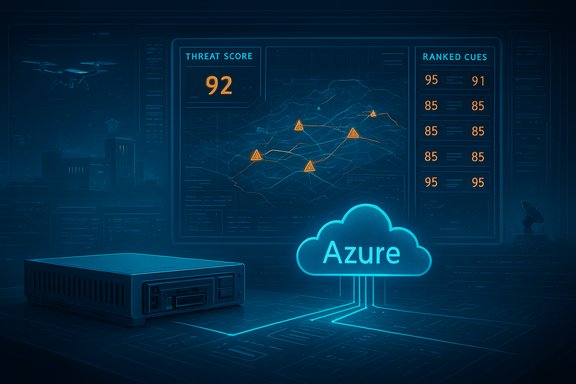
- AI‑assisted classification and prioritization — models classify friend/foe/unknown status, estimate payload type and swarm behavior, and surface ranked threat cues to operators.
- Coordinated multi‑domain response orchestration — a single orchestration layer integrates effectors and C2 networks to sequence and authorize mitigations.
- Cloud‑backed model lifecycle — centralized retraining, validation and controlled rollout of models to edge sites via Azure tooling.
- Interoperability by design — open interfaces and a software development kit (SDK) for third‑party sensors and effectors.
How Microsoft Azure is positioned
Sanctum explicitly references several Azure services as mapping to functional needs of C‑UAS:- Azure IoT Hub for device and sensor telemetry ingest, two‑way device control and over‑the‑air (OTA) updates to edge nodes.
- Azure Synapse Analytics as the large‑scale analytics and data warehousing plane for long‑range trend analysis and model training datasets.
- Azure AI Foundry / Microsoft Foundry for model cataloging, governance, multi‑agent workflows and controlled rollout of detection/classification models.
- Azure Monitor, IoT Edge and Device Update for operational observability, offline/edge runtime support and secure update delivery.
Technical Anatomy: Cloud, Edge and the Hybrid Split
Sanctum’s architecture follows a now‑common hybrid pattern: heavy training, analytics and model governance are centralized in the cloud while latency‑sensitive inference and deterministic decision aids run at the edge. This split is pragmatic for two reasons: model training benefits strongly from aggregated, labeled telemetry from many sites, and real‑time engagement decisions commonly demand local inference to meet tight latency budgets.Key technical realities:
- Edge nodes will typically host compressed, validated inference models on GPU/accelerator‑equipped gateways to meet real‑time detection needs. Cloud inference of live sensor streams is useful for cross‑site correlation, but cannot substitute for deterministic edge responses in contested or high‑latency links.
- Device Update and IoT Edge capabilities provide mechanisms for secure model distribution and staged rollouts to disconnected or intermittently connected sites, but customers must demand proofs of offline assurance (cached models, signed artifacts, rollback).
- Observability, auditing and immutable logging are essential for operational trust: operators require explainability, confidence scores and model provenance when decisions could lead to kinetic effects. Foundry and Azure observability tools can provide building‑block capabilities but do not replace programmatic governance, red‑teaming and auditing requirements.
Operational Use Cases and Deployment Scenarios
Sanctum is positioned for a range of mission sets that include:- Military base and logistics hub protection — defend critical assets in garrison and expeditionary basing.
- Critical infrastructure defense — ports, power plants, refineries and supply nodes where aerial intrusion risks have outsized impact.
- Event and venue security — temporary sensor grids and a coordinated mitigation layer for mass gatherings.
- Tiered force protection — combine local edge interception with centralized cloud retraining for rapid adaptation to new UAS tactics.
Strengths: Why the Approach Makes Sense
- Scale and speed of iteration — centralizing training and analytics lets one site’s telemetry shorten the detection curve for all deployed sites. This is a meaningful operational advantage for defenders facing evolving drone tactics.
- Interoperability reduces rip‑and‑replace costs — an orchestration overlay that accepts third‑party sensors and effectors lowers procurement friction and preserves existing investments.
- Operator‑centric design — unified mission consoles and ranked AI suggestions reduce cognitive load and can shorten the decision‑to‑engage window when engineered well.
- Cloud‑driven forensics and after‑action analysis — centralized storage and analytics support richer post‑event investigations and continuous model improvement.
Risks, Trade‑offs and What Remains Unverified
While the architecture is sensible, it raises real engineering, operational and governance risks that buyers and program offices must explicitly manage.1) Vendor lock‑in and portability
Deep integration with Azure services increases switching costs and can impede multi‑cloud or sovereign architectures unless mitigations are contractually enforced (exportable model weights, IaC templates, documented APIs). Procurement must demand exit plans and data export guarantees.2) Cloud dependence vs. edge assurance
Operational C‑UAS often operate in contested or disconnected environments. Sanctum claims support for connected and disconnected edge modes, but proofs are required: documented offline model caching, secure staged updates, deterministic fallback behaviors and rollback mechanisms. Vendor demos are informative but not a substitute for stress‑testing in degraded conditions.3) Supply chain and expanded attack surface
A cloud‑backed lifecycle increases the attack surface: sensor nodes, edge compute, update channels and the cloud tenant must be defended against tampering, telemetry poisoning and lateral movement. Attestation, signed model artifacts, zero‑trust networking and immutable audit logs should be baseline requirements.4) Adversarial ML and spoofing risks
ML classifiers can be targeted with adversarial examples, spoofed RF signatures or poisoning of training data. Independent adversarial testing and red‑team exercises must be required to quantify resilience.5) Legal, regulatory and safety constraints
Many mitigation options (RF jamming, GPS spoofing, kinetic intercepts) are highly regulated or illegal in civilian airspace. Deployments for law enforcement or public venues must be governed by explicit rules of engagement, aviation authority coordination and robust safety engineering. Privacy risks from EO/IR data collection require data governance and clear oversight.6) Verifiability of vendor performance claims
Lockheed’s public demonstration claims (for example, a vendor‑reported exercise where a single operator neutralized multiple drones in seconds) are compelling but remain vendor‑reported demonstrations. Independent, instrumented field tests that measure detection range, classification accuracy, false alarm rates and time‑to‑engagement are required before treating demonstrations as operational baselines.Procurement and Operational Checklist (what customers should demand)
- Require independent, instrumented trials that measure detection probability, false alarm rate, classification accuracy and time‑to‑interdiction under representative threat profiles.
- Insist on security attestations for the proposed configuration (FedRAMP/DoD IL levels where applicable), independent penetration tests and SBOMs for edge devices.
- Contractual guarantees for data residency, export and model portability: deliverable model weights, IaC templates and documented APIs.
- Edge assurance proofs: documented offline/rollback mechanics, signed model artifacts, and post‑update validation tests.
- Human‑in‑the‑loop rules: clearly defined engagement authorization, operator override workflows and immutable forensic logging for every engagement.
- Adversarial resilience testing: mandate red‑team and adversarial‑ML evaluations during acceptance testing.
- Cost modeling that includes cloud egress, telemetry retention, edge inference compute and model retraining cadence to estimate realistic TCO.
Verification: What Has Been Confirmed and What Needs Independent Validation
- Confirmed: The announced mapping of Sanctum to Azure building blocks (IoT Hub, Synapse, Foundry, Monitor) matches publicly documented Azure features—device telemetry, large‑scale analytics, model lifecycle tooling and observability. These mappings are technically plausible and align with published product capabilities.
- Unverified/Requires proof: Demonstrated operational performance metrics (detection ranges, classification accuracy, false alarm rates, operator decision‑to‑engage times) remain vendor‑reported. Independent test reports, red‑team results, and classified engineering artifacts for high‑assurance deployments are not yet public and are necessary to substantiate field claims.
- Security posture: Public statements reference DevSecOps, monitoring and governance, but detailed hardening for high‑assurance, classified, or sovereign deployments (attested firmware processes, zero‑trust network design, third‑party penetration test results) are not included in the announcement and must be obtained and independently reviewed.
Strategic and Market Implications
Sanctum signals three meaningful trends in the C‑UAS market:- Hyperscaler–prime partnerships are maturing: major defense contractors are integrating commercial cloud services into mission systems rather than isolating them as IT backends. This accelerates delivery velocity but amplifies procurement, security, and governance questions.
- The market is moving toward software‑upgradable, interoperable orchestration layers instead of hardware‑locked point solutions. That pressures smaller vendors to offer cloud integration or strong edge‑first alternatives.
- Procurement and policy will become gating factors: export controls, aviation regulation and civil liberties concerns will shape how and where cloud‑centric C‑UAS systems are fielded.
Practical Recommendations for CIOs, Program Managers and Operators
- Start with constrained pilots that replicate operational conditions, including degraded network scenarios and representative sensor volumes, to reveal hidden costs and engineering assumptions early.
- Maintain a bifurcated model architecture: cloud for heavy retraining and historical analytics; compact, validated inference models at the edge for real‑time decisions. Establish rigorous model governance, versioning and rollback procedures.
- Insist on demonstrable portability: require exportable model weights, documented APIs and infrastructure‑as‑code so switching vendors or clouds is procedurally feasible.
- Budget for recurring cloud costs: telemetry storage, egress, retraining compute and continuous integration pipelines are ongoing expenses that affect TCO.
- Enforce adversarial testing and red‑teaming as contract milestones, not optional extras.
Conclusion
Sanctum reflects the logical next step in C‑UAS evolution: a software‑first, hybrid cloud/edge orchestration layer that treats sensors, models and effectors as interoperable components in a continuously improving defensive ecosystem. The conceptual architecture — multi‑sensor fusion, cloud‑backed model lifecycle and operator‑centric orchestration — aligns with known operational needs and is technically plausible given Azure’s available services.However, the promise must be balanced with caution. Deep cloud integration increases attack surface and supplier dependency, vendor demonstrations are not a substitute for independent validation, and legal/regulatory constraints will significantly shape real‑world deployments. Buyers and program managers should condition procurement on independent trials, explicit portability and security guarantees, adversarial testing, and rigorous human‑in‑the‑loop safeguards. With those guardrails in place, Sanctum could speed adaptation to emerging aerial threats — but its ultimate value will be decided in contested, real‑world conditions and through verifiable performance data, not marketing narratives.
Source: NextGen Defense Lockheed, Microsoft Launch Sanctum C-UAS Leveraging Cloud Tech
