

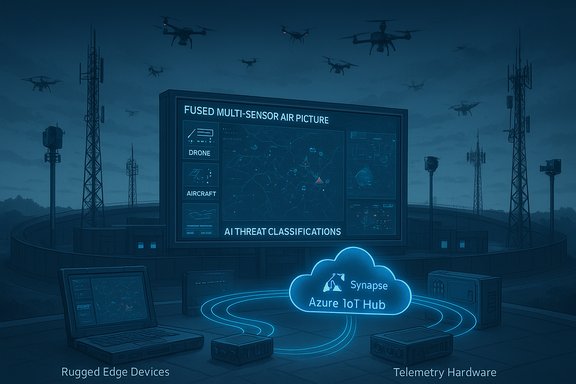
Lockheed Martin and Microsoft have announced a joint effort to build Sanctum, a cloud‑backed, AI‑driven counter‑unmanned aerial system (C‑UAS) platform that combines Lockheed Martin’s defense engineering with Microsoft’s Azure cloud and AI toolchain to detect, classify and respond to hostile drones at scale.
Background
The announcement of Sanctum follows several years of deepening collaboration between the two companies, including a landmark 2022 agreement that authorized Lockheed Martin to operate inside Microsoft’s Azure Government Secret environment and to cooperate on AI/ML, modeling and simulation, and tactical 5G (5G.MIL) capabilities. That relationship has been used to accelerate distributed, classified cloud operations and tactical‑edge projects—context that explains why Azure is the obvious choice as Sanctum’s digital backbone. Sanctum is not being introduced in a vacuum. The broader C‑UAS market has shifted rapidly toward multi‑sensor fusion, cloud‑enabled analytics, and AI model lifecycles so systems can adapt quickly to new drone types, swarms, and low‑observable platforms. Government guidance and industry pilots over the last three years have stressed integration, operator workflows, and cybersecurity as prerequisites for fieldable C‑UAS deployments.What is Sanctum? Overview and core architecture
Sanctum is described as a modular, interoperable C‑UAS ecosystem designed to ingest multiple sensor feeds, run AI‑assisted classification, present a unified operator interface, and orchestrate non‑kinetic and kinetic effectors. The platform is built on Microsoft Azure and uses specific platform services such as Azure IoT Hub for device telemetry, Azure Synapse Analytics for large‑scale data processing and analytics, and Azure AI Foundry (also called Microsoft Foundry in Microsoft documentation) for model lifecycle management and multi‑agent AI workflows. Key design objectives emphasized by Lockheed Martin and Microsoft include:- Sensor fusion across RF, radar, electro‑optical/infrared (EO/IR), acoustic and other sources to create a correlated air picture.
- AI‑powered threat classification to reduce false alarms and speed decision‑making.
- Edge‑capable processing so tactical sites can run detection and mitigation even when disconnected from the cloud.
- Open, modular interfaces to allow third‑party sensors, effectors, and command‑and‑control (C2) systems to plug in without ripping out existing investments.
How the cloud and edge are positioned
Sanctum uses Azure as the centralized engine for analytics, model retraining, and orchestration while enabling local (edge) instances to run hardened models and execute real‑time interdiction when latency or connectivity requires local decisioning. This hybrid model allows for a DevSecOps pipeline that continuously retrains and pushes updated AI models from cloud training to edge nodes, while Azure monitoring and governance tools provide a single pane for large‑scale health and security monitoring.Technical verification: what the named components actually provide
It’s important to verify what the platform pieces referenced in vendor statements actually do and why they matter in a C‑UAS context.- Azure IoT Hub: a cloud service for secure device telemetry, two‑way device control, and over‑the‑air updates—capabilities C‑UAS systems need to manage distributed sensor fleets and push model or firmware updates to edge nodes. Azure documents show IoT Hub supports per‑device authentication, device management and integration with edge runtimes.
- Azure Synapse Analytics: a scalable analytics service that unifies data warehousing and big‑data processing—suitable for ingesting and correlating high‑volume sensor telemetry, running batch or streaming analytics, and supporting model training pipelines. Azure product pages position Synapse as the enterprise service for large‑scale analytics and ML orchestration.
- Azure AI Foundry / Microsoft Foundry: a managed environment for building, validating and deploying enterprise AI applications and multi‑agent workflows. Foundry provides model catalogs, tools for responsible AI, and lifecycle tooling—useful for continuous retraining, operational validation and controlled rollout of detection and classification models in field systems. Microsoft documentation confirms Foundry’s role in enterprise model lifecycle management.
Operational promise: what Sanctum aims to do in the field
Lockheed and Microsoft position Sanctum for several concrete mission sets:- Military site defense — protect bases, logistics hubs and expeditionary sites from adversary UAS.
- Critical infrastructure protection — secure power plants, ports, refineries and other national critical infrastructure against aerial intrusion.
- Large public events and venues — offer layered detection and mitigation for stadiums, stadia environs, and mass gatherings that are vulnerable to malicious drone activity.
- Sensors distributed around a perimeter collect RF, radar and EO/IR signatures.
- Local edge nodes filter and preliminarily classify objects, then stream metadata and suspicious telemetry to a cloud analytics layer.
- Cloud models correlate multi‑site events, retrain detection models based on new data, and push validated updates to edge nodes.
- Operators see a unified map and suggested actions in an operator interface; effectors (electronic warfare, directed energy, capture systems) are coordinated through the platform to execute authorized countermeasures.
Strengths and opportunities
Sanctum’s design leverages several important trends that make it potentially powerful:- Hyperscale analytics and retraining: Centralized cloud training means data from multiple sites improves model accuracy faster than isolated deployments—this scales the "learning curve" across customers and deployments in a way a single installation cannot. Azure’s analytics and model management tooling are purpose‑built for that task.
- Sensor fusion reduces false alarms: Integrating RF, EO/IR, radar and acoustic data improves discrimination between benign objects (birds, balloons) and hostile drones—addressing one of the most costly operational problems for C‑UAS buyers. Industry analyses and the platform vendor’s description both emphasize this point.
- Operator‑centered UI and automation: By surfacing ranked threat classifications and recommended actions, Sanctum aims to reduce cognitive load and speed responses—critical when humans must make life‑and‑death decisions in seconds. Lockheed describes a unified console and automation workflows intended to shorten the operator decision loop.
- Modularity and interoperability: An open architecture that accepts third‑party sensors and effectors lowers integration costs and eases procurement friction for operators with existing investments. That design is attractive to government and enterprise buyers that do not want vendor lock‑in.
- Edge‑tolerant design: The ability to run validated models at the edge and continue operations when connectivity is poor is an operational necessity; Sanctum explicitly supports both connected and disconnected modes.
Risks, caveats and unanswered questions
The announcement reads well on paper, but several important operational, ethical and security risks must be considered before treating Sanctum as a finished, field‑proven product.Vendor claims vs independent validation
Lockheed’s materials include references to demonstrations and operator workflows (for example, vendor‑reported exercises where a single operator detected and neutralized multiple hostile drones quickly). Those demonstrations are meaningful but should be treated as vendor‑reported results until independent, third‑party testing data are published. The absence of independent efficacy trials in public reporting means procurement decisions should insist on independent end‑to‑end tests and red‑teaming. This claim is vendor‑reported and has not been independently verified in public sources.Cloud dependence and connectivity
Relying on a centralized cloud for model retraining and analytics raises two operational concerns:- Connectivity outages or degraded links in contested environments could delay updates or degrade situational awareness.
- Cloud‑centric command and control may create a single‑point target for adversaries seeking to disrupt multiple sites simultaneously.
Cybersecurity and supply chain risk
A cloud‑backed platform increases the attack surface: sensor nodes, edge compute devices, network links, and the cloud tenant itself must all be secured. Recent guidance from U.S. agencies has explicitly warned about supply‑chain and software integrity risks associated with cloud‑managed critical infrastructure solutions. Operators should demand hardened DevSecOps pipelines, attested firmware, signed model artifacts, and rigorous zero‑trust networking controls. CISA’s new UAS security guidance highlights these same concerns for critical infrastructure operators.Legal, regulatory and safety constraints
Many C‑UAS mitigation techniques (RF jamming, GPS spoofing, kinetic intercept) are legally restricted in civilian airspace. Deploying Sanctum in public venues or near airports will necessitate clear rules of engagement, memoranda of understanding with aviation authorities, and careful safety engineering to avoid collateral impacts. The MITRE and CISA guidance emphasize that policy and coordination are often the gating factors for deployment—not technology alone.Adversarial AI and spoofing risk
Machine learning models used for detection and classification can be targeted by adversarial techniques (e.g., spoofed RF signatures, adversarial imagery, or intentionally malformed telemetry). The academic literature and DoD‑directed research track adversarial threats to perception systems, and C‑UAS vendors must demonstrate resilience to such attacks. Operational testing should include adversarial scenarios that attempt to deceive the classifier and the sensor fusion layer.Ethical and geopolitical considerations
Microsoft’s growing role as a technology provider to militaries and defense contractors has generated debates about the ethical use of AI and commercial platforms in warfare. Recent investigative reporting shows how cloud and AI providers have been used in sensitive military operations abroad—a reminder that defense technology partnerships carry reputational and ethical weight that buyers and suppliers alike must manage. Customers should assess how a cloud‑backed C‑UAS will be governed, audited, and constrained to avoid unintended uses.Procurement and integration advice for buyers
For defense, homeland security and infrastructure operators considering Sanctum or comparable C‑UAS platforms, a disciplined acquisition strategy will reduce risk and build operational confidence.- Require independent, instrumented field trials that evaluate detection probability, false alarm rate, classification accuracy, and time‑to‑interdiction against representative threats.
- Demand cybersecurity artefacts: SBOMs (software bills of materials) for edge devices, signed firmware and model images, zero‑trust network architecture, and independent penetration testing.
- Insist on rules of engagement, safety cases and regulatory approval for any mitigation effectors planned for use in civilian or mixed environments. Include aviation authorities early in planning.
- Build procurement terms that ensure data governance and privacy controls for EO/IR and other sensors that may capture incidental imagery of people or private property.
- Plan for multi‑vendor interoperability: require open APIs and standards to avoid vendor lock‑in and allow layered defenses that combine specialized sensors and effectors.
What Sanctum means for the C‑UAS market
Sanctum signals a maturation of the C‑UAS market in two ways. First, it validates the hybrid cloud/edge pattern as the architecture of choice for modern, large‑scale drone defense: cloud‑native analytics make models better faster, while edge execution keeps responses timely and resilient. Second, it demonstrates how major defense primes are now integrating mainstream hyperscale cloud vendors into mission systems rather than treating cloud as mere IT infrastructure. That has procurement, security, and policy implications that buyers and policymakers are still digesting. The partnership also raises competitive pressures across the ecosystem. Smaller specialized C‑UAS vendors must demonstrate how they integrate with cloud providers or offer equivalent edge‑first capabilities if they are to compete in multi‑site, enterprise procurements. Governments and infrastructure operators will increasingly prefer modular, software‑upgradable stacks over hardware‑locked solutions.Conclusion: cautious optimism, with governance and testing first
Sanctum reflects a clear technical logic: combine multi‑sensor fusion with scaled cloud analytics and continuous AI model lifecycles to close detection and classification gaps that have long plagued C‑UAS deployments. The named Azure components—IoT Hub, Synapse and AI Foundry—are suitable, well‑documented building blocks for the intended functionality. That technical fit, and the existing Lockheed‑Microsoft relationship, make Sanctum a credible entrant in the market. However, the platform’s real value will be judged outside the marketing materials: in independent field tests, in cyber‑resilience under adversarial pressure, and in legally grounded rules of engagement that prevent harmful collateral effects. Buyers should treat early demonstrations as encouraging but vendor‑reported, and insist on rigorous verification, supply‑chain transparency, and operational playbooks before deploying Sanctum in high‑consequence environments. As drone threats keep evolving—autonomy, encrypted comms, and swarm tactics—Sanctum’s cloud‑centered, modular approach is promising, but it is not a silver bullet. Effective deployment will require disciplined testing, strong governance, and continuous red‑teaming to ensure that the platform protects what it intends to protect without introducing new systemic risks.Source: ExecutiveBiz Lockheed Martin, Microsoft to Build Sanctum C-UAS Platform
