

Cloudforce’s claim of being named Microsoft’s 2025 Education Partner of the Year lands as a watershed moment for campus AI — but it also raises the exact questions university IT teams should be asking before they hand a single-vendor orchestration layer control over student, research, and health data.
Cloudforce is promoting nebulaONE® as a secure, Azure-native generative AI gateway designed for higher education, academic medical centers, and enterprise education customers. The vendor describes a platform that installs inside an institution’s own Microsoft Azure tenancy, aggregates multiple foundation models, provides low‑code agent‑building tools, and enforces usage, governance, and cost controls at scale. Cloudforce’s materials highlight deployments and case studies at institutions including UCLA Anderson, Case Western Reserve University, California State University, Fullerton, and London Business School — and they assert a broad adoption footprint across dozens of universities.
Microsoft’s partner communications have also amplified the nebulaONE story in higher education contexts, profiling the approach as one practical path for institutions that want controlled, tenancy-contained access to Azure-hosted models while preserving compliance and data residency controls. That co‑promotion is meaningful for procurement and go‑to‑market, but the facts that buyers need to verify are operational and contractual, not just marketing.
However, success depends on three non‑technical factors that are often underemphasized in vendor messaging:
Yet the platform’s value will be decided not by awards and marketing, but by the diligence that institutions apply: verifying tenant isolation and telemetry controls; insisting on contractual exportability and non‑training guarantees; and pairing technical deployment with curriculum and assessment redesign. When those pieces are in place, nebulaONE‑style gateways can deliver real outcomes for students and staff — but without that discipline, the same investments risk becoming expensive, opaque, and institutionally brittle.
Source: StreetInsider Cloudforce Named Microsoft Partner of the Year: Global Recognition Validates Transformative Impact of nebulaONE®, Cloudforce's Secure AI Platform
 Background / Overview
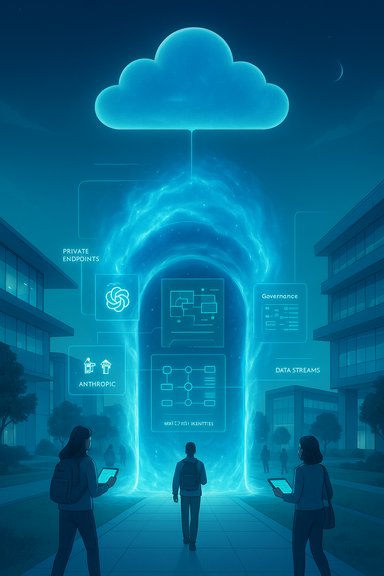
Cloudforce is promoting nebulaONE® as a secure, Azure-native generative AI gateway designed for higher education, academic medical centers, and enterprise education customers. The vendor describes a platform that installs inside an institution’s own Microsoft Azure tenancy, aggregates multiple foundation models, provides low‑code agent‑building tools, and enforces usage, governance, and cost controls at scale. Cloudforce’s materials highlight deployments and case studies at institutions including UCLA Anderson, Case Western Reserve University, California State University, Fullerton, and London Business School — and they assert a broad adoption footprint across dozens of universities.Microsoft’s partner communications have also amplified the nebulaONE story in higher education contexts, profiling the approach as one practical path for institutions that want controlled, tenancy-contained access to Azure-hosted models while preserving compliance and data residency controls. That co‑promotion is meaningful for procurement and go‑to‑market, but the facts that buyers need to verify are operational and contractual, not just marketing.
What Cloudforce says nebulaONE delivers
nebulaONE is marketed as a campus-scale, enterprise-grade AI gateway with the following headline capabilities:- Azure-native deployment: the platform runs within a customer’s Azure subscription so compute, telemetry and model endpoints reside inside the institution’s tenancy.
- Multi‑model choice: orchestration and routing to multiple model providers (OpenAI, Anthropic, Meta / Llama, Mistral, and others) so campuses can select models by task, cost, or governance profile.
- Private inference and data protection: vendor messaging stresses that prompts and institutional data are not used to train external models and that sensitive content never leaves the customer’s control.
- Governance and cost controls: per-user limits, chargeback reporting, telemetry for audits, and centralized policy enforcement.
- Low‑code agents and branded UX: faculty and staff can build task-specific assistants (admissions triage, tutoring aids, course selection agents, research summarizers) without heavy engineering.
- Human-in-the-loop delivery: Cloudforce supplies forward‑deployed engineers and professional services to integrate with identity (Entra/Azure AD), learning platforms (Canvas), Microsoft Fabric/OneLake, and Copilot Studio integration patterns.
Independent verification and what is provable today
- Cloudforce’s product announcements and case materials are publicly available and describe nebulaONE’s Azure-native architecture and the customer use cases above. Those vendor materials have been picked up and discussed across higher-education briefings and community forums.
- Microsoft education channels have profiled Cloudforce and nebulaONE as an example of Azure-hosted, tenancy-contained deployments that help institutions govern generative AI adoption — but Microsoft’s broader Partner of the Year lists and category winners are published separately and should be used to confirm awards claims. At the time of review, a consolidation of Microsoft’s winners and finalists is publicly accessible through Microsoft partner pages and blog posts; procurement teams should cross-check vendor press with Microsoft’s canonical winners/finalist assets.
Why the Azure‑tenant architecture matters (technical breakdown)
Deployment model and data flow
nebulaONE’s core architectural promise is that the orchestration layer and inference endpoints are deployed inside the customer Azure subscription. That topology yields three important technical properties when implemented correctly:- Tenant-level control: the institution retains the principal keys to data and logging; private endpoints and managed identities isolate traffic from the public internet.
- Auditability: logs, model versioning, and telemetry are subject to local retention policies and SIEM integration, enabling audits for compliance regimes (FERPA, HIPAA, GDPR).
- Interoperability with Microsoft services: using Entra/Azure AD, OneLake/Fabric tables, and Copilot Studio connectors simplifies SSO, data bring-your-own-model, and agent connectors to sanctioned enterprise data sources.
Multi‑model orchestration: benefits and complexity
Allowing multiple foundation models creates flexibility: inexpensive or high‑throughput tasks can use smaller models; high‑accuracy research assistants can use larger, more costly models. But orchestration adds complexity:- Model provenance, versioning, and patch management must be tracked.
- Model behavior and bias characteristics differ significantly: the institution must maintain an approved model inventory and a validation process for sensitive use cases.
- Routing decisions (which model to call for a student essay vs. a medical record summarization) must be policy driven and auditable.
Adoption examples and real-world signals
Cloudforce and Microsoft materials highlight rapid pilots and early production rollouts:- UCLA Anderson used nebulaONE for MBA capstone support, then expanded to bots for registration, essay feedback, and alumni services with significant adoption growth in a short timeframe.
- Case Western Reserve University, CSU Fullerton, University of Maryland, and London Business School are repeatedly cited in vendor and partner briefings as early adopters or pilot customers.
Strengths: what nebulaONE brings that matters
- Governance-first design: embedding the platform inside the campus Azure tenancy addresses the central legal and privacy concerns that stopped many CIOs from approving public consumer AI tools. This is a pragmatic enabler for regulated research and student data use.
- Speed to impact: low‑code agent creation and vendor‑led workshops can accelerate real use cases (admissions triage, student FAQs) from weeks to months versus in‑house replatforming.
- Model choice and experimentation: institutions can test multiple models and select the best fit per use case, avoiding a one‑size‑fits‑all dependency on a single provider.
- Human services and change management: Cloudforce’s forward‑deployed engineers and professional services reportedly help institutions integrate nebulaONE with Canvas, Copilot, and identity systems — a practical differentiator for teams without large internal SRE/DevOps teams.
Risks and failure modes universities must plan for
- Vendor lock‑in and portability risk
- nebulaONE’s orchestration and low‑code tooling create an ecosystem of prompts, prompts‑to‑agents, and connectors that can be hard to extract. Procurement should demand exit and data‑portability clauses.
- Hidden or runaway cloud costs
- “Pay for consumption” billing models can balloon when adoption grows, particularly with multimodal models and long context windows. Institutions must enforce hard usage caps and robust FinOps controls.
- Configuration and governance gaps
- Deploying inside Azure does not automatically ensure compliance. Tenant misconfigurations, negligent RBAC, or insufficient SIEM integration can leak data or expose telemetry to third parties. Independent security validation is essential.
- Model errors, hallucinations, and academic integrity
- Generative outputs require human verification. For high-stakes or research use, institutions must implement validation workflows, source‑attribution requirements, and redesigned assessments that prioritize process over final outputs.
- Accessibility and equity
- Multimodal, fast‑link features can advantage students with better connectivity or devices. Accessibility testing and alternative low‑bandwidth interfaces are necessary to avoid widening attainment gaps.
- Supply‑chain and third‑party model risk
- If nebulaONE routes inference to external model providers, institutions must bind those providers contractually regarding telemetry, data retention, and training usage. Verify where inference actually runs and what telemetry is retained.
Practical procurement and technical checklist for IT leaders
- Contract and legal
- Require explicit contractual guarantees that institutional prompts, documents, and telemetry are not used to train external models, and define deletion/retention terms.
- Include exit clauses that export agents, prompt histories, and training data in usable formats.
- Demand indemnities, breach notification windows, and SLAs for incident response and patching.
- Security and compliance
- Validate tenant isolation: private endpoints, managed identities, RBAC, and conditional access policies.
- Require SOC2 or equivalent security attestations, recent pen‑test results, and independent security assessments for the production deployment.
- Integrate logging into campus SIEM with immutable retention for audits.
- Cost governance and FinOps
- Establish departmental budgets, per‑user hard caps, and alerts for anomalous consumption.
- Pilot to estimate cost-per‑student before broad rollout. Include consumption dashboards in vendor deliverables.
- Pedagogy and academic policy
- Redesign assessments for process-based verification (portfolios, supervised tasks) where AI assistance is allowed.
- Require disclosure of AI use (prompts and responses) in submissions for traceability. Provide faculty training packages and student AI‑literacy modules.
- Model governance
- Maintain an approved model inventory with version tags, known limitations, and usage approvals per task.
- Require bias testing and domain validation for models used in high‑stakes or clinical settings.
- Operational readiness
- Run adversarial and red‑team exercises for agent workflows; verify connectors and rate limiting.
- Confirm support model: named local delivery leads, escalation contacts, and runbooks for incident response.
Where the claim “Microsoft Education Partner of the Year” fits in — and how to treat award headlines
Vendor press and PR frequently highlight partner awards to demonstrate credibility. That is useful context, but award headlines are signals — not substitutes for proof points in procurement. Vendor award claims should be validated against Microsoft’s official winners and finalists lists, and buyers should ask the vendor for the specific award documentation or Microsoft reference. In practice, awards increase visibility and GTM access, but procurement should still require production references, security attestations, and a clear SOW before advancing.Balanced verdict: pragmatic optimism with governance first
nebulaONE — as an Azure‑native orchestration layer for generative AI — offers a credible, practical route for institutions that want to scale secure AI without surrendering data governance or creating a patchwork of uncontrolled consumer tools. The product design addresses the central blockers for campus AI adoption: privacy, compliance, integration, and time‑to‑value. Real customer pilots at multiple universities show meaningful user adoption and practical wins for student services and admin automation.However, success depends on three non‑technical factors that are often underemphasized in vendor messaging:
- Contractual rigor (data rights, telemetry, exit).
- Operational discipline (tenant configuration, logging, FinOps).
- Pedagogical reform (assessment redesign, AI literacy).
Recommended next steps for universities and education CIOs
- Convene a cross‑functional AI governance committee (legal, IT security, pedagogy, student representation).
- Request a vendor data flow diagram, tenant configuration checklist, and independent security audit from Cloudforce prior to any proof‑of‑concept.
- Negotiate contractual assurances: telemetry deletion, non‑training clauses, exportable agent artifacts, and exit portability.
- Design a bounded pilot with measurable KPIs (cost-per‑student, reduction in response times, MAU growth), capped budgets, and mandatory pre‑production red‑team testing.
- Publish an institutional AI policy and a required AI literacy curriculum for students and staff before scaling.
Conclusion
Cloudforce’s nebulaONE and the company’s high‑visibility partner messaging crystallize a pragmatic model for campus AI: an Azure-hosted, tenant-contained gateway that combines model choice with governance and low‑code tooling. That approach neatly answers the two questions that have blocked institutional AI adoption for most campuses — how to protect sensitive data, and how to scale useful AI services without exploding support costs.Yet the platform’s value will be decided not by awards and marketing, but by the diligence that institutions apply: verifying tenant isolation and telemetry controls; insisting on contractual exportability and non‑training guarantees; and pairing technical deployment with curriculum and assessment redesign. When those pieces are in place, nebulaONE‑style gateways can deliver real outcomes for students and staff — but without that discipline, the same investments risk becoming expensive, opaque, and institutionally brittle.
Source: StreetInsider Cloudforce Named Microsoft Partner of the Year: Global Recognition Validates Transformative Impact of nebulaONE®, Cloudforce's Secure AI Platform
