

The AI infrastructure boom is creating a new class of cloud provider, and neoclouds are becoming essential to startups that need large-scale GPU access without the burden of building their own datacenters. As the Bismarck Brief piece argues, the demand for compute has surged because modern AI systems require enormous parallel processing power for both training and inference, and that demand has outgrown what many startups can realistically self-supply. Even well-funded frontier labs can find the economics and operational complexity of owning and refreshing GPU infrastructure prohibitive, which is why renting from specialized providers has become a strategic necessity rather than a convenience.
The rise of neoclouds sits at the intersection of three powerful trends: the explosion in AI model demand, the scarcity of premium accelerators, and the capital intensity of datacenter buildouts. The uploaded Bismarck Brief material frames the issue plainly: AI’s appetite for compute is not just high, it is structurally different from traditional cloud workloads because training and inference both depend on massive, scalable parallelism. That makes GPUs from Nvidia, AMD, and similar vendors the indispensable substrate for the current generation of AI products.
What makes the neocloud category interesting is that it is not merely a smaller version of AWS or Azure. It is an answer to a very specific market gap: AI teams want direct access to high-performance accelerators, high-bandwidth networking, and operational simplicity, but they do not necessarily want the full complexity of a hyperscale cloud relationship. The article’s framing suggests that the old assumption — that startups could simply rent generic cloud compute and move on — no longer holds when GPU demand becomes the bottleneck for product velocity and model quality.
This is also why the market has become more competitive than it first appears. Large clouds still matter, but neoclouds are carving out a role by specializing in AI-first infrastructure, often with a narrower product focus and a more direct sales motion. In practice, that can mean faster access to scarce hardware, more tailored support, and fewer layers between the customer and the machine that matters. For a startup racing to train, fine-tune, or serve an AI model, those differences can be decisive.
The stakes go beyond convenience. Compute access now shapes product roadmaps, fundraising narratives, and the ability to iterate quickly enough to stay competitive. In that sense, neoclouds are not just another vendor category; they are part of the industrial base of AI startup formation. That is why the article treats them as vital, not optional.
This distinction matters because many startups initially think of GPU spend as a development line item. In reality, the post-launch phase can be even more punishing, especially if the product gains traction quickly and inference volume rises faster than planned. The article’s logic is persuasive here: compute is not just a technical input, it is the fuel that determines how fast a startup can scale into a real business.
The result is a market in which compute availability can shape who gets to experiment, who gets to scale, and who gets forced into compromises. If a startup cannot secure the GPUs it needs, it may delay launches, shrink model ambitions, or accept lower performance. Those are not minor setbacks; they can determine whether the company survives the next funding cycle.
This gives neoclouds an edge when they can secure inventory and make it accessible faster than the large providers can expose it through broader product channels. For a startup, the practical question is often not “Which platform is best in theory?” but “Which platform can give me the exact compute I need this month?” That urgency is what creates room for a specialized provider to exist.
The strategic implication is that infrastructure no longer behaves like a background utility. It behaves more like a scarce industrial input, closer to a supply chain than to a software subscription. Startups that understand this early tend to think differently about vendor relationships, capacity planning, and the pace of model development.
There is also a management burden that does not show up in glossy pitch decks. Owning clusters means hiring infrastructure talent, balancing utilization, monitoring uptime, and planning refreshes. Those tasks can distract a startup from what it actually needs to do: build models, ship products, and win users.
That is why renting compute has become such an attractive default. It converts a huge fixed cost into a more flexible operating expense, and it lets the startup focus on product-market fit rather than utility management. In a sector where speed matters, that flexibility can be worth more than theoretical long-term savings.
This is where neoclouds gain practical appeal. They can take on the burden of sourcing, installing, and refreshing hardware so their customers do not have to. The customer gets what looks like an elastic service, while the provider absorbs the complexity of keeping the stack current.
That arrangement does not eliminate scarcity, but it redistributes it in a way that suits startup economics. The startup buys time and access; the neocloud carries the infrastructure problem. In a capital-constrained industry, that exchange is often exactly what founders need.
The real value proposition is operational confidence. If a startup can estimate its compute needs, secure the hardware, and deploy quickly, it can spend more time on the model and less on the procurement process. That accelerates iteration, which is exactly what early-stage AI firms need.
This is also why neoclouds can be appealing even when hyperscalers have larger ecosystems. Big clouds may offer breadth, but breadth can come with abstraction, friction, and slower access to the exact capacity a model team wants. A focused provider can win by being simpler and more direct.
Nebius is a useful example because it represents the type of company that can translate AI demand into a dedicated infrastructure business. Whether the market ultimately consolidates around a few winners or supports a broader set of specialists, the underlying pattern is clear: infrastructure providers that can stand up serious GPU capacity are becoming strategically important.
For startups, the lesson is straightforward. The provider that can reliably place the right chips in the right environment at the right time may be more valuable than the one with the broadest menu of services. In AI infrastructure, focus is often the product.
Another reason is throughput. AI teams care deeply about iteration speed, and slow provisioning can become a hidden tax. If a team can get its machines faster and deploy experiments more quickly, it can produce more model cycles per dollar. That can create a meaningful advantage in a fast-moving market.
A third reason is service alignment. A startup building foundation models or high-volume inference products does not necessarily need the full menu of enterprise networking, storage, and application services. It needs compute that behaves like a sharp tool, not a giant catalog. Neoclouds can be attractive when they are designed around that reality.
This is one of the deeper points in the article: infrastructure decisions are strategic bets on how uncertain the future is. Startups usually benefit from preserving flexibility, because the cost of being wrong is much higher than the cost of paying a premium for agility. Neoclouds fit that philosophy well.
But scope is not the same as fit. AI startups often do not need the whole bundle, and in some cases the extra layers are a disadvantage. A smaller provider that is closer to the workload can be a better operational match even if it lacks the scale of a hyperscaler.
This is why the category is likely to remain relevant. As long as the market values specialized access to high-end accelerators, there will be room for companies that build around that need rather than around general cloud abstraction.
That makes the business both attractive and unforgiving. The winners will likely be the firms that can turn supply-chain competence into customer trust. In AI infrastructure, trust is built through uptime, availability, and access to the right machines at the right time.
This is one reason neoclouds can be seen as enablers of startup formation. They allow founders to convert financial backing into technical progress without taking on the full burden of infrastructure ownership. That makes them part of the startup financing stack, even if they are usually discussed as an IT category.
There is also an accounting dimension here. Variable compute spend is easier to match to actual usage, while owned infrastructure introduces depreciation, utilization risk, and long-term maintenance commitments. For venture-backed companies, that can materially affect how investors view efficiency and runway.
That also means compute relationships can influence valuation narratives. Founders who can demonstrate they are not blocked by hardware shortages, datacenter delays, or procurement bottlenecks may appear more credible to investors. In a crowded market, that credibility matters.
Enterprises, by contrast, may care more about governance, contract structure, and data control. They may still use neoclouds, but their evaluation criteria are likely to be stricter. The significance of the category is that it is broadening the menu of options at a time when AI demand is no longer limited to research labs.
This difference is important because it suggests that neoclouds are not just a temporary workaround. They are part of a market segmentation trend in which compute is becoming more specialized across customer types. Startups want a runway extender; enterprises want an operational platform.
That creates an indirect but real consumer impact. If neoclouds help bring more compute online faster, they can help reduce deployment bottlenecks across the AI ecosystem. More capacity can mean faster releases, less throttling, and more experimentation across the industry.
The key test over the next phase will be whether neoclouds can maintain enough supply, reliability, and pricing discipline to justify their role as infrastructure partners rather than niche intermediaries. If they can, they will become embedded in the AI startup lifecycle from the earliest experiments through to scaled inference. If they cannot, the market will consolidate quickly around the providers that can prove durable operational value.
Source: Bismarck Brief Why Neoclouds Are Vital to AI Startups
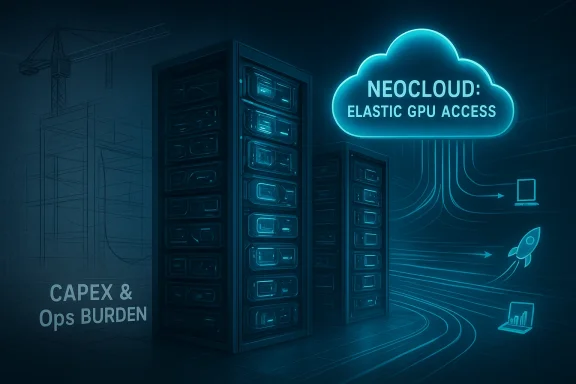 Overview
The rise of neoclouds sits at the intersection of three powerful trends: the explosion in AI model demand, the scarcity of premium accelerators, and the capital intensity of datacenter buildouts. The uploaded Bismarck Brief material frames the issue plainly: AI’s appetite for compute is not just high, it is structurally different from traditional cloud workloads because training and inference both depend on massive, scalable parallelism. That makes GPUs from Nvidia, AMD, and similar vendors the indispensable substrate for the current generation of AI products.What makes the neocloud category interesting is that it is not merely a smaller version of AWS or Azure. It is an answer to a very specific market gap: AI teams want direct access to high-performance accelerators, high-bandwidth networking, and operational simplicity, but they do not necessarily want the full complexity of a hyperscale cloud relationship. The article’s framing suggests that the old assumption — that startups could simply rent generic cloud compute and move on — no longer holds when GPU demand becomes the bottleneck for product velocity and model quality.
This is also why the market has become more competitive than it first appears. Large clouds still matter, but neoclouds are carving out a role by specializing in AI-first infrastructure, often with a narrower product focus and a more direct sales motion. In practice, that can mean faster access to scarce hardware, more tailored support, and fewer layers between the customer and the machine that matters. For a startup racing to train, fine-tune, or serve an AI model, those differences can be decisive.
The stakes go beyond convenience. Compute access now shapes product roadmaps, fundraising narratives, and the ability to iterate quickly enough to stay competitive. In that sense, neoclouds are not just another vendor category; they are part of the industrial base of AI startup formation. That is why the article treats them as vital, not optional.
Why Compute Became the New Bottleneck
AI startups used to compete on model ideas, talent, and data. Today, they also compete on the ability to secure and sustain enough compute to keep those ideas moving. The uploaded piece emphasizes that the demand curve for AI compute has risen sharply because the underlying algorithms are compute-hungry by design, and that demand is visible in both the training phase and the deployment phase.Training Is Only the Beginning
Training large models still consumes enormous amounts of GPU time, but the more important shift may be inference. Once a product ships, the system must answer real user queries continuously, which turns compute into an ongoing operating expense rather than a one-time research cost. That changes the economics of the business and makes infrastructure reliability a product feature in its own right.This distinction matters because many startups initially think of GPU spend as a development line item. In reality, the post-launch phase can be even more punishing, especially if the product gains traction quickly and inference volume rises faster than planned. The article’s logic is persuasive here: compute is not just a technical input, it is the fuel that determines how fast a startup can scale into a real business.
The result is a market in which compute availability can shape who gets to experiment, who gets to scale, and who gets forced into compromises. If a startup cannot secure the GPUs it needs, it may delay launches, shrink model ambitions, or accept lower performance. Those are not minor setbacks; they can determine whether the company survives the next funding cycle.
Hardware Scarcity Changes Strategy
The article also implicitly highlights a second constraint: not all GPUs are interchangeable. Nvidia remains the most important accelerator supplier in the market, and specialized AI clusters are often built around the latest high-demand parts. That means startups are not simply buying “cloud”; they are buying access to a constrained hardware supply chain.This gives neoclouds an edge when they can secure inventory and make it accessible faster than the large providers can expose it through broader product channels. For a startup, the practical question is often not “Which platform is best in theory?” but “Which platform can give me the exact compute I need this month?” That urgency is what creates room for a specialized provider to exist.
The strategic implication is that infrastructure no longer behaves like a background utility. It behaves more like a scarce industrial input, closer to a supply chain than to a software subscription. Startups that understand this early tend to think differently about vendor relationships, capacity planning, and the pace of model development.
- GPU availability now influences product launch timing.
- Inference can become the larger long-term cost center.
- Hardware specialization creates supplier concentration risk.
- Infrastructure is increasingly a strategic advantage, not a commodity.
Why Datacenters Are Not a Realistic Default for Startups
The Bismarck Brief article is strongest when it explains why on-premises ownership is often unrealistic even for very well-funded AI companies. Building a datacenter or compute cluster is not just a matter of buying servers; it involves facilities, power, cooling, networking, maintenance, and continual refresh cycles. The capital and operational burden is substantial, and it gets worse when chip generations advance quickly.Capex Is Only the First Bill
A startup that wants to own its compute stack must first raise the money, then commit it to equipment that will depreciate quickly. That is a difficult proposition in AI, where hardware cycles are moving fast and model appetite rarely stays still. The article suggests that even the most ambitious frontier labs may hesitate to take on this burden full-time, which says a great deal about the economics involved.There is also a management burden that does not show up in glossy pitch decks. Owning clusters means hiring infrastructure talent, balancing utilization, monitoring uptime, and planning refreshes. Those tasks can distract a startup from what it actually needs to do: build models, ship products, and win users.
That is why renting compute has become such an attractive default. It converts a huge fixed cost into a more flexible operating expense, and it lets the startup focus on product-market fit rather than utility management. In a sector where speed matters, that flexibility can be worth more than theoretical long-term savings.
Refresh Cycles Matter More Than They Used To
AI hardware also creates a timing problem. A datacenter built for one generation of chips may become less competitive as newer accelerators arrive, and the owner then faces a choice between paying again or living with lower efficiency. For startups, that tradeoff is especially harsh because they often need the newest hardware to stay competitive in the first place.This is where neoclouds gain practical appeal. They can take on the burden of sourcing, installing, and refreshing hardware so their customers do not have to. The customer gets what looks like an elastic service, while the provider absorbs the complexity of keeping the stack current.
That arrangement does not eliminate scarcity, but it redistributes it in a way that suits startup economics. The startup buys time and access; the neocloud carries the infrastructure problem. In a capital-constrained industry, that exchange is often exactly what founders need.
- Datacenter ownership requires power, cooling, networking, and operations expertise.
- Hardware refresh cycles create ongoing reinvestment pressure.
- Renting lets startups preserve capital for product development.
- Specialized providers can absorb infrastructure complexity more efficiently.
What Neoclouds Actually Offer
Neoclouds are not merely “smaller clouds.” They are usually more focused providers that optimize around AI-specific workloads, especially GPU-intensive training and inference. The article’s terminology matters here because it points to a distinct business model: sell the compute that AI teams need most, rather than trying to be everything to everyone.Specialization as a Product Feature
Specialization can show up in several ways. It may mean faster access to current-generation accelerators, more transparent pricing for GPU instances, or support teams that understand distributed training and model serving workflows. Those details may sound mundane, but they are often what separates a usable AI infrastructure partner from a generic cloud vendor.The real value proposition is operational confidence. If a startup can estimate its compute needs, secure the hardware, and deploy quickly, it can spend more time on the model and less on the procurement process. That accelerates iteration, which is exactly what early-stage AI firms need.
This is also why neoclouds can be appealing even when hyperscalers have larger ecosystems. Big clouds may offer breadth, but breadth can come with abstraction, friction, and slower access to the exact capacity a model team wants. A focused provider can win by being simpler and more direct.
The Nebius Example
The supplied article includes a photo of Nebius founder Arkady Volozh touring Nvidia Blackwell GPU installation at a data center in Finland in December 2025. That image is telling because it illustrates the physical reality behind the business: neoclouds are not just software platforms, they are hardware operators with real facilities and real supply-chain exposure.Nebius is a useful example because it represents the type of company that can translate AI demand into a dedicated infrastructure business. Whether the market ultimately consolidates around a few winners or supports a broader set of specialists, the underlying pattern is clear: infrastructure providers that can stand up serious GPU capacity are becoming strategically important.
For startups, the lesson is straightforward. The provider that can reliably place the right chips in the right environment at the right time may be more valuable than the one with the broadest menu of services. In AI infrastructure, focus is often the product.
- AI-specific provisioning reduces operational friction.
- GPU-focused support can be more relevant than general cloud support.
- Physical datacenter capacity remains a differentiator.
- Dedicated AI hardware makes the service easier to plan around.
Why Startups Choose Neoclouds Over Hyperscalers
The obvious question is why startups would not simply use AWS, Azure, or Google Cloud. The answer is not that hyperscalers are irrelevant; it is that they are not always the best fit for AI-first workloads. The article suggests that neoclouds exist precisely because the biggest clouds are optimized for broad enterprise demand, while AI startups often need a narrower and more aggressive infrastructure experience.Economics Can Favor the Specialist
One reason is price clarity. Specialized providers may structure their offerings around the realities of GPU-heavy workloads in ways that make cost modeling easier for AI teams. When a startup is planning burn rate, that predictability matters almost as much as raw speed.Another reason is throughput. AI teams care deeply about iteration speed, and slow provisioning can become a hidden tax. If a team can get its machines faster and deploy experiments more quickly, it can produce more model cycles per dollar. That can create a meaningful advantage in a fast-moving market.
A third reason is service alignment. A startup building foundation models or high-volume inference products does not necessarily need the full menu of enterprise networking, storage, and application services. It needs compute that behaves like a sharp tool, not a giant catalog. Neoclouds can be attractive when they are designed around that reality.
The Startup Mindset Prefers Optionality
AI startups also tend to value optionality because their technical direction can change quickly. Renting compute makes it easier to move between model sizes, workload types, and deployment patterns without locking into a rigid asset base. That matters when product-market fit is still shifting.This is one of the deeper points in the article: infrastructure decisions are strategic bets on how uncertain the future is. Startups usually benefit from preserving flexibility, because the cost of being wrong is much higher than the cost of paying a premium for agility. Neoclouds fit that philosophy well.
- Faster provisioning supports experimentation.
- More focused pricing can simplify budgeting.
- Less platform sprawl means fewer moving parts.
- Flexibility matters when product direction is still evolving.
The Competitive Landscape Is Getting Crowded
A key implication of the piece is that the neocloud market is not just about demand; it is also about positioning. If AI compute remains scarce and valuable, multiple types of provider will compete to capture that spend. Hyperscalers have breadth and brand trust, while neoclouds have specialization and intimacy with AI workloads.Hyperscalers Still Set the Baseline
The largest cloud providers still define the broad market because they can bundle compute with storage, networking, identity, and software tooling. They also have enormous existing customer relationships, which matters when enterprises want one vendor for many needs. Neoclouds cannot easily replicate that scope.But scope is not the same as fit. AI startups often do not need the whole bundle, and in some cases the extra layers are a disadvantage. A smaller provider that is closer to the workload can be a better operational match even if it lacks the scale of a hyperscaler.
This is why the category is likely to remain relevant. As long as the market values specialized access to high-end accelerators, there will be room for companies that build around that need rather than around general cloud abstraction.
Differentiation Will Come From Execution
The crowdedness of the field means neoclouds must execute well or disappear into the background. They need reliable hardware sourcing, strong datacenter operations, and credible performance at scale. If they fail on any of those fronts, customers can fall back to larger clouds or to alternative specialist vendors.That makes the business both attractive and unforgiving. The winners will likely be the firms that can turn supply-chain competence into customer trust. In AI infrastructure, trust is built through uptime, availability, and access to the right machines at the right time.
- Hyperscalers offer breadth.
- Neoclouds offer focus.
- Execution quality will determine which specialists survive.
- Customer trust depends on reliability, not branding alone.
The Startup Finance Angle
The financial logic behind neocloud adoption is one of the most important parts of the story. Startups are under constant pressure to turn venture capital into product momentum, and compute is now one of the biggest drains on that capital. Renting infrastructure can be expensive, but owning it can be far more expensive in both cash and managerial attention.Burn Rate and Capital Allocation
For early-stage firms, every dollar spent on datacenter buildout is a dollar not spent on research talent, customer acquisition, or product iteration. That tradeoff is especially acute in AI, where the market can move faster than capital planning cycles. A rented GPU fleet may cost more over time, but it can also shorten the path to traction.This is one reason neoclouds can be seen as enablers of startup formation. They allow founders to convert financial backing into technical progress without taking on the full burden of infrastructure ownership. That makes them part of the startup financing stack, even if they are usually discussed as an IT category.
There is also an accounting dimension here. Variable compute spend is easier to match to actual usage, while owned infrastructure introduces depreciation, utilization risk, and long-term maintenance commitments. For venture-backed companies, that can materially affect how investors view efficiency and runway.
Why This Matters for Fundraising
A startup that can show access to reliable compute has a stronger operational story when it goes fundraising. Investors increasingly understand that AI performance is tied to infrastructure quality, so access to GPU capacity is no longer a back-office concern. It is part of the company’s ability to execute.That also means compute relationships can influence valuation narratives. Founders who can demonstrate they are not blocked by hardware shortages, datacenter delays, or procurement bottlenecks may appear more credible to investors. In a crowded market, that credibility matters.
- Renting preserves venture capital for growth.
- Compute access supports fundraising credibility.
- Owning infrastructure creates depreciation and utilization risk.
- Flexible spending is easier to align with startup milestones.
Enterprise and Consumer Implications
The article’s focus is AI startups, but the implications extend farther. Neoclouds are a startup story on the surface, yet they also reflect a broader shift in how compute is consumed. Enterprises may value compliance and integration, but startups tend to value speed and raw access, and those two demands are increasingly shaping the cloud market together.Startups Need Speed; Enterprises Need Assurance
For startups, the question is often how quickly a team can turn an idea into a working model. Neoclouds help by removing infrastructure drag and getting GPUs into the hands of engineers faster. That accelerates experimentation and shortens the feedback loop between idea and execution.Enterprises, by contrast, may care more about governance, contract structure, and data control. They may still use neoclouds, but their evaluation criteria are likely to be stricter. The significance of the category is that it is broadening the menu of options at a time when AI demand is no longer limited to research labs.
This difference is important because it suggests that neoclouds are not just a temporary workaround. They are part of a market segmentation trend in which compute is becoming more specialized across customer types. Startups want a runway extender; enterprises want an operational platform.
Consumer AI Still Depends on the Same Stack
Even consumer-facing AI products ultimately depend on the same compute story. Chatbots, copilots, image generators, and code assistants all run on infrastructure that must scale economically and reliably. So while consumers may never know the name of the provider, neoclouds can still influence the quality and availability of the services they use.That creates an indirect but real consumer impact. If neoclouds help bring more compute online faster, they can help reduce deployment bottlenecks across the AI ecosystem. More capacity can mean faster releases, less throttling, and more experimentation across the industry.
- Startups prioritize speed and availability.
- Enterprises prioritize governance and predictability.
- Consumers feel the downstream effects through better AI services.
- Compute specialization is reshaping the whole stack.
Strengths and Opportunities
The strongest argument for neoclouds is that they solve a real bottleneck with a real business model. The AI industry needs high-performance compute now, not in some abstract future, and specialized providers can bring that capacity online in a way that startup teams can actually use. The opportunity is large because compute demand is structural, not cyclical, and because AI workloads continue to intensify as products move from prototypes to production.- They reduce the need for startups to build expensive datacenters.
- They give AI teams faster access to scarce GPU capacity.
- They turn capex-heavy infrastructure into usable operating expense.
- They align well with startup urgency and experimentation.
- They can differentiate through AI-specific support and provisioning.
- They may benefit from sustained demand across training and inference.
- They help preserve capital for product and model development.
Risks and Concerns
Neoclouds are promising, but they are not risk-free. Their success depends on hardware access, capital discipline, and the ability to keep pace with accelerator generations that change quickly. A provider that cannot source enough current-generation GPUs, or that fails to operate them reliably, can quickly lose credibility in a market where customers are highly sensitive to delays and outages.- Hardware supply constraints can limit growth.
- Rapid chip refresh cycles can strain margins.
- Datacenter operations are capital intensive and unforgiving.
- Competition from hyperscalers remains intense.
- Customers may still prefer larger vendors for some workloads.
- Overdependence on a narrow hardware set can create vulnerability.
- Provider failure can disrupt customer training schedules and product timelines.
Looking Ahead
The most likely outcome is not that neoclouds replace hyperscalers, but that they become a durable layer in the AI infrastructure stack. The market appears to be moving toward segmentation: big clouds for general-purpose breadth, specialized providers for AI-specific speed and access, and startups choosing the route that best matches their technical and financial stage. The Bismarck Brief piece captures that shift well by treating compute not as an abstract resource but as the central constraint shaping AI startup strategy.The key test over the next phase will be whether neoclouds can maintain enough supply, reliability, and pricing discipline to justify their role as infrastructure partners rather than niche intermediaries. If they can, they will become embedded in the AI startup lifecycle from the earliest experiments through to scaled inference. If they cannot, the market will consolidate quickly around the providers that can prove durable operational value.
- Watch for continued GPU supply agreements and datacenter expansion.
- Watch for startup adoption patterns across training and inference workloads.
- Watch for pricing pressure as hyperscalers defend share.
- Watch for consolidation among smaller providers.
- Watch for AI infrastructure becoming a more explicit funding and hiring criterion.
Source: Bismarck Brief Why Neoclouds Are Vital to AI Startups
Last edited:
