

Build Has Become a Startup Operating Manual in Conference Clothing
Microsoft Build was once easy to summarize: developers came for platform updates, SDKs, framework roadmaps, Azure announcements, and the occasional Windows surprise. Build 2026 looks different. The developer conference is still there, but Microsoft’s curated startup path reads more like a founder operating manual than a loose collection of technical sessions.
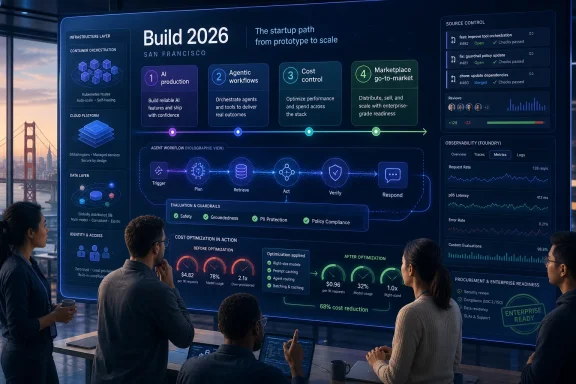
The Microsoft for Startups team groups its recommended Build sessions around four pressures that now define the software startup: moving fast, multiplying a small team’s output, keeping infrastructure costs under control, and scaling into enterprise customers without breaking the product or the company. That framing matters because it compresses the past two years of startup anxiety into a conference agenda. The question is no longer whether a startup should use AI. The question is whether it can ship AI systems that behave predictably, cost less than they earn, and survive contact with customers.
The recommended sessions are unsurprisingly heavy on Azure, GitHub, Foundry, Kubernetes, Cosmos DB, and Marketplace. This is Microsoft’s ecosystem talking about itself. But the interesting part is not the vendor alignment; the interesting part is the maturity curve Microsoft is pushing. Prototype quickly, ground agents in usable context, distill large models into cheaper ones, observe and evaluate the system, then package it for enterprise procurement.
That sequence is the quiet thesis of the Build 2026 startup track. Microsoft is arguing that the founder’s edge in 2026 comes from moving from demo to durable service faster than rivals — and that the route runs through disciplined cloud architecture, not just clever prompting.
The Prototype Is No Longer the Impressive Part
The first recommended theme, “early traction to fast execution,” is built around a reality that many AI startups learned the expensive way: a prototype is cheap, but a production architecture is not. A chatbot demo, an internal agent, or a retrieval-augmented workflow can be assembled quickly. The bill arrives later, when the team discovers that latency, orchestration, deployment, observability, security boundaries, and model lifecycle management were not afterthoughts.
That is why LAB510, “Take LLMs from prototype to production on AKS,” is arguably the most revealing recommendation in the whole list. Microsoft is not telling founders to begin with the friendliest low-code wrapper or the flashiest agent demo. It is telling them to think hard about architectural choices before their early product decisions calcify into technical debt.
AKS — Azure Kubernetes Service — is not the simplest place for a tiny startup to begin. Kubernetes has operational overhead, and founders have historically been warned not to over-engineer before product-market fit. But AI workloads complicate that old advice. Once a startup is juggling model endpoints, vector retrieval, batch jobs, evaluation harnesses, GPU scheduling, traffic spikes, and customer-specific deployments, the “simple” stack can become a trap.
The practical lesson is not that every startup should rush to Kubernetes on day one. It is that AI products have a habit of becoming distributed systems earlier than expected. If a team expects to move from internal prototype to customer-facing service in weeks, it needs to make deployment, scaling, and rollback choices before the first pilot customer becomes the first angry customer.
Microsoft’s inclusion of DEM364, “Postgres and OpenAI – a match made in Azure,” points in the opposite but complementary direction. Founders do not want architectural purity; they want momentum. Postgres remains one of the most familiar building blocks in software, and Microsoft’s pitch is that startups can bolt intelligent features onto technology they already know rather than pausing to adopt an exotic AI-only data stack.
That tension — Kubernetes discipline on one side, Postgres pragmatism on the other — is the startup problem in miniature. Move too casually and the prototype buckles. Architect too grandly and the company burns runway before customers care. Microsoft’s Build guidance is trying to thread that needle: use familiar tools where they accelerate you, but do not confuse familiarity with production readiness.
Microsoft Wants Startups to Treat the Inner Loop as a Competitive Weapon
LTG408, “The developer experience with AKS Desktop and VS Code,” is easy to underestimate because developer experience sounds like a luxury. It is not. For a small engineering team, the speed of the inner loop — edit, run, test, debug, deploy — is the difference between compounding learning and drowning in friction.
AI products make that loop harder. Developers are no longer just testing deterministic business logic. They are testing prompts, retrieval quality, model behavior, orchestration chains, failure handling, and versioned context. A change in the data pipeline can change the apparent intelligence of an agent. A change in model routing can change latency and cost. A change in prompt structure can quietly degrade customer trust.
That is why local and near-local development workflows matter. If engineers cannot reproduce enough of the cloud-native AI stack from their normal tools, experimentation slows down or becomes reckless. Teams either wait too long to validate changes, or they ship because testing the real thing is too painful.
The deeper Microsoft play is obvious: keep the founder inside Visual Studio Code, GitHub, Azure, and AKS from prototype to production. But that does not make the workflow argument wrong. Startups do not win because they have the most elegant architecture diagram. They win because they can make more correct changes per week than the next team without blowing up the product.
The Agentic AI Reality Check Is the Session Founders Probably Need Most
BRK222, “The honest practitioner’s take on agentic AI on Kubernetes,” may be the most valuable session precisely because of its promised lack of glamour. The startup market is saturated with agent theater: animated workflow diagrams, autonomous-sounding demos, and claims that software labor is about to become a neatly delegated swarm of digital workers. Production has been less tidy.
Agents fail in mundane ways. They call the wrong tool, retrieve stale information, loop unnecessarily, mishandle permissions, exceed cost budgets, or produce plausible work that still needs human review. Running them on Kubernetes does not magically solve those issues. It merely gives teams a more serious substrate on which to manage services, isolation, scaling, and operational policy.
An “honest practitioner’s take” is valuable because startups need to know where agents are actually earning their keep. In many companies, the best early uses are constrained and boring: summarizing support context, triaging issues, generating test cases, drafting internal knowledge updates, or helping developers inspect failures. These are not science-fiction assistants. They are productivity wedges.
Microsoft’s agenda suggests a sober evolution of the AI startup narrative. The agent is no longer the product by default. The agent is a component in a system, and the system needs infrastructure, context, evaluation, and guardrails. That is a less viral message, but a more investable one.
The New Startup Leverage Is Hidden Inside Existing Workflows
The second theme, “supercharged AI workflows,” is where Microsoft makes its strongest claim about productivity. Every founder wants leverage because headcount is expensive, hiring is slow, and incumbents have distribution advantages. AI’s promise is that a small team can behave like a larger one without inheriting the coordination costs of a larger organization.
The important word in Microsoft’s framing is “workstreams.” The recommended sessions are not just about building AI into the product a startup sells. They are about putting AI into the work a startup performs: coding, debugging, testing, knowledge retrieval, DevOps, and software delivery. In other words, Microsoft is selling AI not only as an application platform but as an operating layer for the company itself.
Lab532, “From data to context: Agent-ready knowledge with Foundry IQ,” captures the core problem. Agents are only as useful as the context they can access, interpret, and act upon. A startup may have design docs in one place, tickets in another, customer notes in a CRM, code in GitHub, architecture diagrams in a wiki, and tribal knowledge in chat. That mess is tolerable when five people sit in the same room. It becomes a tax when the company grows, and it becomes a blocker when agents are expected to help.
The phrase “agent-ready knowledge” deserves scrutiny because it signals a shift in how companies may organize information. Documentation used to be written primarily for humans. Now Microsoft is nudging startups to structure knowledge so that machines can retrieve it with high signal and low ambiguity. That means cleaner sources of truth, better metadata, stronger permissions, and less tolerance for stale internal sprawl.
This is one of those changes that sounds technical but becomes cultural. If an agent cannot answer a question reliably because the company’s knowledge base is chaotic, the problem is not the agent alone. It is the organization. Startups that learn this early may build a durable advantage, not because they have smarter models, but because they have cleaner context.
Copilot Is Moving From Assistant to Participant
BRK207, “GitHub Copilot in Visual Studio: Agents That Debug, Profile, and Test,” shows how far the coding assistant category has moved. The original Copilot value proposition was autocomplete with uncanny timing. The new value proposition is closer to delegated software maintenance: find the bug, inspect performance, write tests, and operate with more autonomy through modes such as fleet and autopilot.
For founders, that changes the hiring and execution model. A small team still needs senior engineering judgment, perhaps more than before. But the mechanical parts of development — scaffolding tests, exploring failures, generating candidate fixes, profiling paths, and keeping routine work moving — increasingly become AI-mediated. That can make a two-person engineering team feel less fragile.
The risk is that startups mistake activity for progress. An autonomous coding agent can generate branches, tests, and fixes faster than a human can review them. Without strong engineering discipline, the bottleneck moves from writing code to validating intent. A bad test suite plus an eager agent is not leverage; it is a defect multiplier.
This is where Microsoft’s GitHub story intersects with its Azure story. Copilot can accelerate the development loop, but production AI systems still need deployment discipline. The startup that benefits most is not the one that lets AI write the most code. It is the one that uses AI to shorten the path from problem discovery to verified, observable, reversible change.
Azure DevOps and GitHub Are Becoming One Migration Story
BRK202, “Azure DevOps meets GitHub, the path to AI powered SDLC,” is aimed at a constituency that many startups eventually join even if they do not begin there: teams with split tooling. Some startups inherit Azure DevOps through enterprise customers, acquired codebases, regulated environments, or founders coming from Microsoft-heavy organizations. Others begin in GitHub and later need more formal planning, compliance, or integration.
Microsoft has spent years positioning GitHub as the center of modern developer gravity while Azure DevOps remains deeply embedded in many enterprises. The startup implication is simple: if you want to sell to Microsoft-oriented customers, you need to understand both worlds. A clean GitHub-only story may work early, but enterprise buyers often bring their own process expectations.
The phrase “AI powered SDLC” is broad enough to be marketing fog, but the underlying direction is real. Requirements, code review, testing, deployment, incident response, and documentation are all becoming surfaces for AI assistance. If Microsoft can unify those surfaces across GitHub and Azure DevOps, it can make its ecosystem feel less like a collection of products and more like a guided conveyor belt from issue to production.
For startups, the value is not ideological. It is practical. The less time a small team spends reconciling work tracking, pull requests, CI/CD, security scans, and deployment approvals, the more time it spends building. The catch is lock-in: the smoother the conveyor belt becomes, the more deliberate founders must be about which platform assumptions they are willing to bake into the company.
The Runway Killer Is Not Training, It Is Inference
The third Microsoft theme is cost, and here the guidance becomes blunt. Inference costs can become a startup’s largest line item, especially when product usage scales faster than monetization. That is the AI-era version of the old cloud bill shock, except the unit economics can be more opaque and more volatile.
The seductive startup story is that model quality keeps improving and prices keep falling. That may be broadly true over time, but it is not a business model. A company that depends on expensive frontier models for every user interaction must either charge enough to cover the bill, constrain usage, optimize aggressively, or accept that growth will punish its margins.
DEM322, “Smaller, faster, smarter: Distilling agents with fine-tuning,” attacks the problem directly. Distillation is not just a model technique; it is a business strategy. Use a large model to define or teach behavior, then move repetitive, narrow, or latency-sensitive work to smaller models that are cheaper and faster.
This is where many startups will separate themselves. The first version of an AI product may call the best available model because the team needs quality and speed. The mature version should route work based on difficulty, risk, customer tier, and required latency. Not every task deserves the most expensive intelligence in the building.
Fine-tuning and distillation also force a product team to understand what its AI system actually does. If a startup cannot identify the repeatable tasks, expected outputs, and evaluation criteria well enough to train or distill a smaller model, it may not yet have a product. It may only have a wrapper around a general-purpose model with a pricing page attached.
Retrieval Is Where Cost, Latency, and Trust Collide
LTG411, “Agentic RAG for fast, low-cost knowledge retrieval on Azure Cosmos DB,” points to another cost lever: retrieval architecture. Retrieval-augmented generation became the default answer to a basic problem — models need current, private, or domain-specific information. But RAG systems are not automatically cheap, fast, or accurate.
A startup’s knowledge base grows. Customers upload documents. Support histories accumulate. Product catalogs change. Permissions become more granular. The retrieval layer that worked in the seed-stage demo can become slow, expensive, and unreliable when real customers start asking real questions against real data.
Cosmos DB is Microsoft’s answer here because it can sit in the company’s broader Azure data story. The claim is not merely storage. It is predictable retrieval at scale, with the performance characteristics needed for agentic systems that cannot spend ten seconds rummaging through context before taking action.
Trust is the hidden cost dimension. A slow answer is annoying, and an expensive answer hurts margins, but a wrong answer can break a customer relationship. Retrieval systems decide what the model sees. If they surface the wrong policy, the wrong customer record, or the wrong version of a document, the model may confidently produce nonsense with enterprise polish.
For startups, the architecture lesson is that RAG is not a feature to bolt on after the pitch deck. It is part of the product’s reliability story. Teams should measure retrieval quality, latency, and cost as first-class metrics, not as backend trivia.
Custom Models Are a Commitment, Not a Flex
BRK234, “Shipping custom models at scale from fine-tuning to inference,” addresses the part of the AI journey that founders often romanticize. Custom models sound like defensibility. They suggest proprietary intelligence, differentiated performance, and escape from commodity wrappers. They also bring operational complexity.
A custom model has to be trained or fine-tuned, evaluated, deployed, monitored, versioned, rolled back, secured, and paid for. It has to behave under load. It has to fit into compliance and customer commitments. It has to improve the business enough to justify the engineering work that surrounds it.
The Build session’s promise of an end-to-end view matters because the market has too often treated model customization as a single step. Upload data, tune model, ship. In reality, the model is one part of a system that includes data pipelines, eval suites, infrastructure, routing, logging, and incident response. The custom model is not the end of the journey; it is the beginning of a new maintenance burden.
That does not mean startups should avoid custom models. It means they should be honest about why they need one. If customization improves accuracy in a high-value domain, reduces inference cost, lowers latency, or creates a product capability competitors cannot easily copy, it may be essential. If it exists because “we fine-tuned our own model” sounds good in a fundraising slide, it may be vanity infrastructure.
Microsoft Marketplace Is the Distribution Layer Hiding in Plain Sight
The fourth theme shifts from engineering to growth, and that shift is important. Microsoft is not just telling startups how to build AI applications. It is telling them how to sell them, especially to enterprise customers that already buy through Microsoft channels.
DEM363, “From the Field: Accelerate Your Development for Microsoft Marketplace,” is the clearest go-to-market session in the startup list. Marketplace is not glamorous in the way agent frameworks are glamorous. But for enterprise software startups, procurement friction can kill deals as effectively as poor product design. If a customer wants to buy but legal, security, vendor onboarding, and purchasing processes stretch for months, the startup’s sales pipeline becomes a swamp.
Microsoft Marketplace offers a route around some of that friction because it fits into existing enterprise purchasing motions. For startups, that can mean access to buyers who already have Microsoft commitments, cloud budgets, and procurement habits. It can also mean conforming to Microsoft’s packaging, listing, transacting, and co-sell expectations.
The deeper point is that distribution is becoming part of the platform decision. A founder choosing Azure may not be choosing only compute, databases, and AI services. They may be choosing a future sales channel. That is strategically powerful for Microsoft, and it is worth founders understanding both sides of the bargain.
Marketplace can help a startup look more enterprise-ready than its headcount suggests. But it cannot substitute for a product that passes security review, solves a budgeted problem, and supports customers after the purchase order clears. Listing is not distribution by itself. It is a door; the company still has to walk through it with a credible offer.
Foundry Labs Is Microsoft’s Argument for Boring AI
LTG419, “Turn ideas into AI applications with Microsoft Foundry Labs,” includes the most important unsexy words in the whole agenda: observability, evaluation, and safety. Those terms do not trend like “multi-agent framework,” but they determine whether AI applications can be trusted in production.
Founders like speed because speed creates options. Enterprise customers like control because control reduces risk. The startup that can satisfy both has an advantage. That means building systems that can explain what happened, measure whether outputs are improving, detect regressions, and enforce safety boundaries without turning every release into a research project.
Evaluation is especially critical because AI software breaks differently from traditional software. A normal regression test might tell you whether a function returns the expected value. An AI evaluation suite has to judge quality, groundedness, tone, policy compliance, tool usage, and sometimes domain-specific correctness. The pass/fail line can be fuzzy, but the business consequences are not.
Observability closes the loop. When a customer complains that an agent gave a bad answer, the team needs to know which model ran, which prompt was used, what context was retrieved, which tools were called, what policy applied, and whether similar failures are happening elsewhere. Without that, support becomes archaeology.
Safety, meanwhile, is becoming less optional as AI systems get closer to business actions. A summarization tool can embarrass you. An agent that updates records, triggers workflows, sends messages, or changes configurations can cause material damage. Microsoft’s Foundry framing is a reminder that the more capable the agent, the more necessary the guardrails.
The Startup Track Is Really a Stack Diagram
Taken together, Microsoft’s recommended Build 2026 sessions form a stack diagram disguised as an event guide. At the bottom sits cloud infrastructure: AKS, local developer workflows, Postgres, Cosmos DB, and deployment patterns. Above that sits the AI layer: OpenAI integrations, model fine-tuning, distillation, custom inference, and agentic RAG. Above that sits the workflow layer: Copilot, GitHub, Azure DevOps, and agent-ready organizational knowledge. At the top sits the commercial layer: Foundry discipline and Marketplace distribution.
That stack is coherent, and coherence is the point. Microsoft is trying to reduce the number of startup decisions that feel disconnected. Where do I build? How do I code? How do I deploy? How do I manage context? How do I control cost? How do I sell to enterprises? The answer, naturally, is: inside Microsoft’s orbit.
For WindowsForum readers, especially sysadmins and IT pros, this matters beyond startup culture. The tooling Microsoft is pushing at founders often becomes the tooling enterprises later have to govern. Today’s startup architecture becomes tomorrow’s vendor risk questionnaire. Today’s Copilot-driven development process becomes tomorrow’s software supply chain concern. Today’s agent-ready knowledge base becomes tomorrow’s compliance and access-control problem.
That is why Build’s startup emphasis is not just a founder story. It is a preview of the software products IT departments will soon be asked to approve. More vendors will arrive with Azure-native architectures, GitHub-heavy development stories, AI agents grounded in customer data, and Marketplace procurement options. The buyer’s job will be to distinguish real operational maturity from platform-branded optimism.
Microsoft’s curation also reveals which startup behaviors the company wants to normalize. It wants startups to treat Kubernetes as a serious AI substrate, GitHub Copilot as an active engineering participant, Foundry as the place where AI apps become governable, Cosmos DB as a retrieval foundation, and Marketplace as a growth channel. That is an ambitious platform loop.
The risk for startups is that ambition becomes dependency. A deeply integrated Microsoft stack can accelerate a company, but it can also make future migration painful. Founders should not reject the stack because of that. They should understand the trade: speed and enterprise alignment now in exchange for architectural commitments that may shape the company for years.
The Sessions Worth Fighting the Calendar For
The practical reading of Microsoft’s list is that founders should not try to attend everything. Build is short, and the startup agenda spans architecture, engineering productivity, model economics, and go-to-market. The best plan is to pick sessions that match the company’s current bottleneck while still reserving time for the next bottleneck, because AI startups tend to hit the next scaling wall sooner than expected.
- LAB510 is the session to prioritize if the team has an LLM prototype and suspects the current deployment model will not survive production traffic.
- Lab532 is the session to prioritize if agents are underperforming because company knowledge is scattered, stale, or poorly structured.
- BRK207 is the session to prioritize if engineering throughput is the constraint and the team is ready to let Copilot participate in debugging, profiling, and testing rather than merely autocomplete code.
- DEM322 is the session to prioritize if inference cost is beginning to distort product decisions or threaten gross margins.
- BRK234 is the session to prioritize if custom models are moving from experiment to operational commitment.
- DEM363 is the session to prioritize if the product is technically credible but enterprise procurement is slowing down revenue.
The article Microsoft published is promotional, of course, but the agenda underneath it is unusually diagnostic. If a startup cannot identify which of these sessions matters most, that is a signal in itself. It may not yet know whether its hardest problem is shipping, scaling, spending, or selling.
Microsoft Build 2026 will almost certainly bring the usual wave of announcements, demos, and platform enthusiasm, but the startup track already tells us where the company thinks the market is going: away from AI spectacle and toward AI operations. The winners will not be the teams with the most dazzling prototype on June 2. They will be the ones that leave San Francisco with a clearer architecture, a cheaper inference path, a more disciplined development loop, and a credible route into the enterprise customers everyone else is still trying to reach.