

Microsoft has named eleven AI-first startups for its Microsoft Build 2026 cohort, bringing companies in developer tooling, AI infrastructure, observability, synthetic data, robotics, and agent security to San Francisco and online for its June 2–3 developer conference. The list is less a startup showcase than a map of where Microsoft thinks enterprise AI is getting stuck. After two years of demos, copilots, and executive mandates, the hard problem is no longer whether software can be generated, summarized, or queried by a model. The hard problem is whether those systems can be governed, measured, secured, integrated, and paid for when they leave the lab.
That is why this cohort matters beyond the usual conference-booth pageantry. Microsoft is using Build 2026 to argue that the next phase of AI will be won not by the flashiest model demo, but by the infrastructure that makes agents and AI applications durable enough for enterprise use. The startups it chose are clustered around unglamorous problems: credentials, legacy code, observability, distributed compute, synthetic data, multimodal storage, and engineering metrics. In other words, Microsoft is telling developers and IT leaders that the AI gold rush has entered its plumbing phase.
Microsoft says Build 2026 is leaving Seattle for San Francisco for the first time in nearly a decade, and the symbolism is hard to miss. Seattle remains Microsoft’s home turf, but San Francisco is where much of the current AI infrastructure market has concentrated: model labs, developer-platform companies, database startups, agent-framework shops, and the venture firms funding the whole apparatus. Moving Build there turns the conference from a Microsoft campus ritual into a marketplace conversation.
That matters because Build has always been more than a developer conference. It is Microsoft’s annual attempt to tell its ecosystem where the company believes software development is going next. In the Windows 8 era, that meant touch-first apps and a new app model. In the Azure expansion years, it meant cloud-native services and DevOps. In the current cycle, it means production AI systems that sit across Microsoft 365, GitHub, Azure, Windows, and enterprise data estates.
The location shift also reflects a more transactional reality. Microsoft does not merely want startups to build with Azure; it wants them to sell through Azure. The company’s emphasis on Microsoft Marketplace, Azure benefit-eligible procurement, and startup programs such as Pegasus is a reminder that procurement is now part of the product strategy. A tool that can be bought inside an existing Microsoft commercial agreement has a shorter path into the enterprise than one that has to survive a separate vendor onboarding slog.
That is the quiet genius of the Build cohort framing. Microsoft is not saying these startups are cute experiments worth watching from the sidelines. It is saying they are parts of the enterprise AI supply chain, and that supply chain should ideally run through Azure.
A prototype can tolerate a hallucinated answer, a brittle prompt, or a wildly variable cloud bill. A production system cannot. Once AI software touches customer records, incident response, compliance workflows, internal code, business systems, or employee productivity metrics, the normal rules of enterprise IT reassert themselves. Who can access what? What did the agent do? Why did it do that? How much did it cost? How do we roll it back? Who is accountable when it fails?
That is why the companies in Microsoft’s list are not mainly model companies. They are control-plane companies. They exist because the model itself is only one component in a much larger system made up of identity, context, retrieval, storage, observability, evaluation, orchestration, and governance. The enterprise buyer may still be dazzled by model benchmarks, but the enterprise operator is staring at logs, permissions, latency, and invoices.
This is also where Microsoft has a natural advantage. Its customers already run identity in Entra, collaboration in Microsoft 365 and Teams, development workflows in GitHub, infrastructure in Azure, databases in SQL and Fabric, and endpoint fleets on Windows. If AI agents are going to act across those systems, Microsoft wants the connective tissue to be Azure-native, marketplace-procured, and policy-aware.
NeuBird’s Hawkeye is pitched as an agentic site reliability engineer that interprets telemetry and helps resolve incidents. That is a natural target for AI because SRE work is full of pattern matching, repetitive triage, and cross-system reasoning. It is also risky territory, because incident response is where bad automation can turn a small outage into a large one. The interesting question is not whether an AI SRE can summarize alerts; it is whether teams trust it enough to participate in resolution when customers are already affected.
Replit represents the other end of the engineering spectrum: lowering the barrier to software creation. Microsoft’s partnership around Azure Container Apps, Azure Virtual Machines, Neon Serverless Postgres, and Marketplace availability points toward a future in which business users and semi-technical teams can create internal tools without waiting for traditional engineering capacity. That promise has been made before under banners like low-code and no-code, but AI changes the interface from forms and workflows to natural language and generated application logic.
Anyscale brings the compute layer into view. Ray has become a familiar name in distributed AI workloads because training, inference, and data processing rarely fit neatly inside a single machine once organizations move beyond toy problems. A managed Ray service inside Azure Kubernetes Service is exactly the sort of offering Microsoft needs if it wants serious AI builders to stay on Azure rather than assembling their own distributed stack elsewhere.
LanceDB, Arize AI, and Tonic AI fill in the rest of the production picture. Multimodal retrieval needs storage engines built for vectors, images, video, and audio. Production AI needs evaluation and observability because model behavior changes, degrades, and surprises teams in ways conventional application monitoring was not designed to capture. Synthetic data becomes attractive when the most valuable enterprise data is also the hardest to use safely.
Moderne’s pitch is large-scale automated refactoring across many repositories, built around OpenRewrite. This is a pragmatic use case because modernization is not glamorous, but it consumes enormous engineering budgets. If AI-assisted tooling can safely update frameworks, migrate APIs, reduce vulnerabilities, and clean up technical debt across thousands of repositories, it has a clearer return on investment than another chatbot bolted onto a portal.
CoreStory attacks the prior step: understanding what the code does. Its Code-to-Spec platform is meant to turn codebases into living documentation that captures business rules and system relationships. That may sound less exciting than generating a new application from a prompt, but it may be more valuable. Enterprises are full of systems nobody fully understands, and modernization projects often fail because teams discover the real business logic only after breaking it.
This is where AI’s ability to ingest and reason across large bodies of text and code becomes more than a convenience feature. It becomes a way to recover architectural knowledge. The danger, of course, is false confidence. A generated specification is only useful if teams can validate it against runtime behavior, tests, domain experts, and production constraints. But the direction is obvious: AI is moving from writing new code to excavating old systems.
For WindowsForum readers, this should sound familiar. The Windows ecosystem is built on compatibility, layered APIs, decades of enterprise dependencies, and a long tail of applications that cannot simply be rewritten because a strategy deck says “modernize.” AI tooling that helps organizations understand and transform legacy software may end up mattering more to Windows shops than the flashier prompt-to-app demos.
The original sin of many agent demos is that they quietly assume access. The agent reads the inbox, queries the CRM, updates a ticket, opens a pull request, schedules a meeting, and perhaps triggers a workflow. In a demo, this feels magical. In production, it raises every identity and compliance alarm in the building.
Agents need the ability to act, but they should not become credential sponges. They need scoped authority, auditable behavior, revocation, policy enforcement, and a clear separation between model reasoning and system permissions. If that sounds like identity and access management reinvented for AI, that is because it is. The enterprise agent is not just a smarter bot; it is a new class of software principal.
Microsoft has every reason to care deeply about this layer. Its own productivity vision depends on agents moving through Microsoft 365, Teams, Outlook, SharePoint, GitHub, and Azure resources. But customers will not allow autonomous or semi-autonomous systems into sensitive workflows unless the authorization model is legible. Arcade.dev’s presence in the cohort is a signal that Microsoft sees agent governance as infrastructure, not as an afterthought.
Arize AI focuses on observability and evaluation for language model behavior. That is becoming essential because AI applications can fail without throwing conventional exceptions. A response can be syntactically valid and operationally disastrous. A retrieval system can return plausible but stale context. A model can perform well in testing and degrade as user behavior changes. These are not the failure modes most dashboards were designed to catch.
NeuBird, meanwhile, applies agentic reasoning to site reliability engineering itself. If it works as advertised, it compresses the time between signal and action by having an AI system interpret telemetry, correlate symptoms, and assist with resolution. That is the sort of tool that will tempt overworked operations teams, especially in environments where alert fatigue has become normalized.
The common thread is that AI both creates new observability needs and becomes part of the observability workflow. That recursive pattern will define the next few years of engineering tools. Teams will use AI to monitor AI, debug AI, and govern AI-generated change. The trick will be preventing those layers from becoming opaque stacks of mutually reinforcing guesses.
This is also where enterprises will demand evidence rather than vibes. It is not enough for a vendor to say a tool reduces incidents or improves developer productivity. Buyers will want baselines, audit trails, controlled deployments, and measurable outcomes. That explains the presence of Faros AI in the cohort.
That is a harder measurement problem than it sounds. Developer productivity has always resisted simple metrics. Lines of code are useless. Commit counts can be gamed. Story points are local fiction. Pull request throughput tells only part of the story. AI complicates the picture further because it may speed up code generation while increasing review burden, test failures, or architectural inconsistency.
Faros AI’s pitch is to aggregate data across more than 100 engineering tools, including GitHub Copilot, and give leaders a clearer view of productivity and AI return on investment. If that works, it turns AI adoption from a belief system into an operational discipline. If it works poorly, it could become yet another dashboard that pressures teams to optimize for the measurable at the expense of the meaningful.
Microsoft’s interest is obvious. GitHub Copilot is one of the company’s most important AI products, but large customers need internal justification for seat expansion. A measurement layer that helps executives argue Copilot is paying off indirectly supports Microsoft’s platform strategy. It also nudges engineering organizations toward more centralized visibility over developer workflows.
For developers, that is a double-edged sword. Better measurement can expose bottlenecks and justify investment in better tooling. It can also become surveillance dressed up as productivity science. The difference will depend less on the dashboard than on the culture using it.
LanceDB’s inclusion reflects the growing importance of AI-native storage. Multimodal applications are not well served by databases that treat vectors as an afterthought or assume text is the only retrieval target. If teams want to search across images, video, audio, documents, and embeddings at large scale, the storage architecture matters. Compute-storage separation, Azure Storage integration, and compatibility with popular AI frameworks are not marketing details; they are deployment details.
Tonic AI addresses a different but equally stubborn data problem. Developers need realistic data to build, test, and train systems, but production data is often legally or operationally restricted. Synthetic data is appealing because it promises the shape and statistical usefulness of real data without exposing sensitive records. In regulated industries, that can be the difference between an AI project moving forward and dying in a compliance review.
The catch is that synthetic data has to be good enough to matter. If it fails to preserve the edge cases, relationships, and messiness of production data, it can create a false sense of readiness. But the broader trend is sound: enterprises need ways to make data useful without making it dangerous. Microsoft’s reference to Azure OpenAI, Microsoft Fabric, and Azure SQL integration shows how closely this problem sits to the company’s own data platform ambitions.
This is where the AI infrastructure wave becomes inseparable from the cloud platform war. The winning cloud providers will not merely rent GPUs. They will offer the identity, data, storage, governance, observability, and procurement rails that make AI systems acceptable to cautious enterprises. Microsoft’s startup cohort is a preview of that broader bundle.
Robotics has long suffered from fragmentation. Hardware platforms, simulation environments, perception stacks, planning systems, and operational tools often do not compose cleanly. The promise of a unified intelligence grid is to make robot intelligence more accessible to developers and operators through APIs and agent-first workflows. That is a natural extension of the same argument Microsoft is making elsewhere: abstraction and integration are the path from prototype to production.
The enterprise angle is not science fiction. Warehouses, factories, logistics providers, healthcare systems, agriculture, and field-service operations are all obvious targets for more adaptable robotics. But the leap from demonstration to deployment is brutal. Physical environments vary. Safety requirements are non-negotiable. Hardware failures are expensive. Simulation helps, but reality remains a harsh integration test.
Microsoft’s interest in physical AI also shows how broad the agent narrative has become. The agent is no longer just a chat window with tools. It can be a software process acting in Microsoft 365, a coding assistant altering repositories, an SRE agent investigating incidents, or a robot skill operating in a physical environment. The governance questions change by domain, but the platform opportunity remains the same.
By emphasizing that these startups are available through Marketplace, Microsoft is reducing friction for customers that already buy through Azure. If a purchase can count toward a cloud spend commitment, use existing billing relationships, and fit into established procurement workflows, it becomes easier for an internal champion to get approval. That can matter as much as a feature comparison.
This is also a strategic moat. A startup that sells through Microsoft Marketplace is not just acquiring customers; it is aligning itself with Microsoft’s commercial machinery. That can accelerate growth, but it can also increase dependency. The closer a startup’s go-to-market motion is tied to Azure, the more its fate may be shaped by Microsoft’s priorities, incentives, and platform shifts.
For customers, the benefit is convenience and integration. The risk is ecosystem lock-in by accumulation. One AI tool in Azure is a procurement win. Ten AI tools, all wired into Microsoft identity, data, billing, observability, and developer workflows, become an architecture. That may be exactly what many enterprises want. It is also the kind of architecture that is hard to unwind later.
AI-generated internal applications still need authentication, endpoint access policies, data controls, and support models. AI-assisted modernization still has to account for Windows clients, legacy applications, Active Directory dependencies, line-of-business workflows, and user training. Agentic systems that interact with Microsoft 365 and Teams will affect how employees experience the desktop, even if the agent itself runs in Azure.
The Windows endpoint is also becoming one surface among many for AI-driven work. Copilot+ PCs, local AI features, cloud-hosted agents, and enterprise copilots are converging into a hybrid model where some processing happens on-device and much happens in the cloud. That makes governance more complex, not less. IT teams will need to understand which agents have access to which resources, where data flows, and how user actions differ from agent actions.
The real message for WindowsForum readers is that the AI transition is not just a developer story. It is an operations story. It is a procurement story. It is a security story. It is a legacy modernization story. The tools Microsoft is highlighting at Build 2026 are aimed at the seams where those stories meet.
The next year of enterprise AI will be decided in the gap between ambition and operations. Microsoft is betting that startups can help close that gap, provided they build on its cloud, sell through its marketplace, and solve the problems its largest customers now face in production. That is a sensible bet, but also a revealing one: the AI revolution Microsoft wants to showcase at Build is no longer about replacing the old enterprise stack. It is about rebuilding that stack around agents, data, identity, and governance before the prototypes collapse under the weight of real work.
That is why this cohort matters beyond the usual conference-booth pageantry. Microsoft is using Build 2026 to argue that the next phase of AI will be won not by the flashiest model demo, but by the infrastructure that makes agents and AI applications durable enough for enterprise use. The startups it chose are clustered around unglamorous problems: credentials, legacy code, observability, distributed compute, synthetic data, multimodal storage, and engineering metrics. In other words, Microsoft is telling developers and IT leaders that the AI gold rush has entered its plumbing phase.
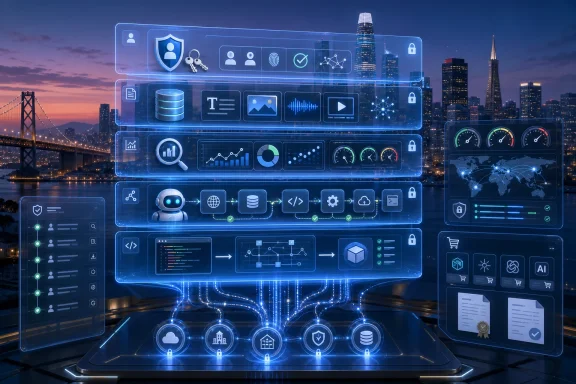 Microsoft Moves Build to Where the AI Stack Is Being Assembled
Microsoft says Build 2026 is leaving Seattle for San Francisco for the first time in nearly a decade, and the symbolism is hard to miss. Seattle remains Microsoft’s home turf, but San Francisco is where much of the current AI infrastructure market has concentrated: model labs, developer-platform companies, database startups, agent-framework shops, and the venture firms funding the whole apparatus. Moving Build there turns the conference from a Microsoft campus ritual into a marketplace conversation.That matters because Build has always been more than a developer conference. It is Microsoft’s annual attempt to tell its ecosystem where the company believes software development is going next. In the Windows 8 era, that meant touch-first apps and a new app model. In the Azure expansion years, it meant cloud-native services and DevOps. In the current cycle, it means production AI systems that sit across Microsoft 365, GitHub, Azure, Windows, and enterprise data estates.
The location shift also reflects a more transactional reality. Microsoft does not merely want startups to build with Azure; it wants them to sell through Azure. The company’s emphasis on Microsoft Marketplace, Azure benefit-eligible procurement, and startup programs such as Pegasus is a reminder that procurement is now part of the product strategy. A tool that can be bought inside an existing Microsoft commercial agreement has a shorter path into the enterprise than one that has to survive a separate vendor onboarding slog.
That is the quiet genius of the Build cohort framing. Microsoft is not saying these startups are cute experiments worth watching from the sidelines. It is saying they are parts of the enterprise AI supply chain, and that supply chain should ideally run through Azure.
The Demo Era Is Giving Way to the Production Hangover
The most important line in Microsoft’s pitch is the distinction between asking whether to build with AI and asking how to make AI work in production. That is the shift every serious engineering organization has felt over the last year. The first wave of generative AI was about possibility; the second is about blast radius.A prototype can tolerate a hallucinated answer, a brittle prompt, or a wildly variable cloud bill. A production system cannot. Once AI software touches customer records, incident response, compliance workflows, internal code, business systems, or employee productivity metrics, the normal rules of enterprise IT reassert themselves. Who can access what? What did the agent do? Why did it do that? How much did it cost? How do we roll it back? Who is accountable when it fails?
That is why the companies in Microsoft’s list are not mainly model companies. They are control-plane companies. They exist because the model itself is only one component in a much larger system made up of identity, context, retrieval, storage, observability, evaluation, orchestration, and governance. The enterprise buyer may still be dazzled by model benchmarks, but the enterprise operator is staring at logs, permissions, latency, and invoices.
This is also where Microsoft has a natural advantage. Its customers already run identity in Entra, collaboration in Microsoft 365 and Teams, development workflows in GitHub, infrastructure in Azure, databases in SQL and Fabric, and endpoint fleets on Windows. If AI agents are going to act across those systems, Microsoft wants the connective tissue to be Azure-native, marketplace-procured, and policy-aware.
The Startup List Reveals Microsoft’s Real AI Priorities
The eleven startups Microsoft highlighted are NeuBird, Replit, Anyscale, Moderne, CoreStory, Faros AI, Arcade.dev, General Robotics, LanceDB, Arize AI, and Tonic AI. On paper, that is a broad group. In practice, it breaks into a small number of priorities: making developers faster, making legacy systems understandable, making AI behavior observable, and making agents safe enough to touch business systems.NeuBird’s Hawkeye is pitched as an agentic site reliability engineer that interprets telemetry and helps resolve incidents. That is a natural target for AI because SRE work is full of pattern matching, repetitive triage, and cross-system reasoning. It is also risky territory, because incident response is where bad automation can turn a small outage into a large one. The interesting question is not whether an AI SRE can summarize alerts; it is whether teams trust it enough to participate in resolution when customers are already affected.
Replit represents the other end of the engineering spectrum: lowering the barrier to software creation. Microsoft’s partnership around Azure Container Apps, Azure Virtual Machines, Neon Serverless Postgres, and Marketplace availability points toward a future in which business users and semi-technical teams can create internal tools without waiting for traditional engineering capacity. That promise has been made before under banners like low-code and no-code, but AI changes the interface from forms and workflows to natural language and generated application logic.
Anyscale brings the compute layer into view. Ray has become a familiar name in distributed AI workloads because training, inference, and data processing rarely fit neatly inside a single machine once organizations move beyond toy problems. A managed Ray service inside Azure Kubernetes Service is exactly the sort of offering Microsoft needs if it wants serious AI builders to stay on Azure rather than assembling their own distributed stack elsewhere.
LanceDB, Arize AI, and Tonic AI fill in the rest of the production picture. Multimodal retrieval needs storage engines built for vectors, images, video, and audio. Production AI needs evaluation and observability because model behavior changes, degrades, and surprises teams in ways conventional application monitoring was not designed to capture. Synthetic data becomes attractive when the most valuable enterprise data is also the hardest to use safely.
Legacy Code Is the AI Market Nobody Can Ignore
The inclusion of Moderne and CoreStory is especially revealing because both focus on existing code rather than new software. That is where the enterprise AI story gets more serious. Most large organizations are not greenfield startups with pristine repositories and a few services. They are collections of old Java applications, brittle integrations, undocumented business logic, abandoned frameworks, and institutional memory walking out the door through retirements and layoffs.Moderne’s pitch is large-scale automated refactoring across many repositories, built around OpenRewrite. This is a pragmatic use case because modernization is not glamorous, but it consumes enormous engineering budgets. If AI-assisted tooling can safely update frameworks, migrate APIs, reduce vulnerabilities, and clean up technical debt across thousands of repositories, it has a clearer return on investment than another chatbot bolted onto a portal.
CoreStory attacks the prior step: understanding what the code does. Its Code-to-Spec platform is meant to turn codebases into living documentation that captures business rules and system relationships. That may sound less exciting than generating a new application from a prompt, but it may be more valuable. Enterprises are full of systems nobody fully understands, and modernization projects often fail because teams discover the real business logic only after breaking it.
This is where AI’s ability to ingest and reason across large bodies of text and code becomes more than a convenience feature. It becomes a way to recover architectural knowledge. The danger, of course, is false confidence. A generated specification is only useful if teams can validate it against runtime behavior, tests, domain experts, and production constraints. But the direction is obvious: AI is moving from writing new code to excavating old systems.
For WindowsForum readers, this should sound familiar. The Windows ecosystem is built on compatibility, layered APIs, decades of enterprise dependencies, and a long tail of applications that cannot simply be rewritten because a strategy deck says “modernize.” AI tooling that helps organizations understand and transform legacy software may end up mattering more to Windows shops than the flashier prompt-to-app demos.
Agent Security Is Becoming the New Identity Problem
Arcade.dev may be the most strategically interesting company in the list because it sits at the uncomfortable boundary between AI agents and enterprise systems. Microsoft’s description frames it as a model context protocol server runtime that provides authorization, reliability, and governance so agents can act across Microsoft 365, GitHub, Teams, Salesforce, Jira, and other tools without exposing credentials to the model. That is not a niche problem. It is the problem that determines whether agentic AI can be more than a controlled demo.The original sin of many agent demos is that they quietly assume access. The agent reads the inbox, queries the CRM, updates a ticket, opens a pull request, schedules a meeting, and perhaps triggers a workflow. In a demo, this feels magical. In production, it raises every identity and compliance alarm in the building.
Agents need the ability to act, but they should not become credential sponges. They need scoped authority, auditable behavior, revocation, policy enforcement, and a clear separation between model reasoning and system permissions. If that sounds like identity and access management reinvented for AI, that is because it is. The enterprise agent is not just a smarter bot; it is a new class of software principal.
Microsoft has every reason to care deeply about this layer. Its own productivity vision depends on agents moving through Microsoft 365, Teams, Outlook, SharePoint, GitHub, and Azure resources. But customers will not allow autonomous or semi-autonomous systems into sensitive workflows unless the authorization model is legible. Arcade.dev’s presence in the cohort is a signal that Microsoft sees agent governance as infrastructure, not as an afterthought.
Observability Has to Learn a New Language
Traditional observability tools were built around logs, metrics, traces, errors, and service dependencies. AI systems need those things too, but they also need evaluation of outputs, prompt behavior, retrieval quality, hallucination rates, context drift, and user-level outcomes. That is why Arize AI and NeuBird both fit the Build narrative even though they operate in different parts of the stack.Arize AI focuses on observability and evaluation for language model behavior. That is becoming essential because AI applications can fail without throwing conventional exceptions. A response can be syntactically valid and operationally disastrous. A retrieval system can return plausible but stale context. A model can perform well in testing and degrade as user behavior changes. These are not the failure modes most dashboards were designed to catch.
NeuBird, meanwhile, applies agentic reasoning to site reliability engineering itself. If it works as advertised, it compresses the time between signal and action by having an AI system interpret telemetry, correlate symptoms, and assist with resolution. That is the sort of tool that will tempt overworked operations teams, especially in environments where alert fatigue has become normalized.
The common thread is that AI both creates new observability needs and becomes part of the observability workflow. That recursive pattern will define the next few years of engineering tools. Teams will use AI to monitor AI, debug AI, and govern AI-generated change. The trick will be preventing those layers from becoming opaque stacks of mutually reinforcing guesses.
This is also where enterprises will demand evidence rather than vibes. It is not enough for a vendor to say a tool reduces incidents or improves developer productivity. Buyers will want baselines, audit trails, controlled deployments, and measurable outcomes. That explains the presence of Faros AI in the cohort.
The Developer Productivity Argument Is Getting More Quantitative
Faros AI is aimed at a question many engineering leaders are now being asked by CFOs and CIOs: are AI coding tools actually making teams faster? The first phase of GitHub Copilot and similar tools was driven by developer enthusiasm, anecdotal wins, and an intuitive sense that autocomplete on steroids should save time. The second phase is less forgiving. If a company is paying for AI tools across thousands of developers, it wants to know whether cycle time, quality, throughput, and delivery predictability are improving.That is a harder measurement problem than it sounds. Developer productivity has always resisted simple metrics. Lines of code are useless. Commit counts can be gamed. Story points are local fiction. Pull request throughput tells only part of the story. AI complicates the picture further because it may speed up code generation while increasing review burden, test failures, or architectural inconsistency.
Faros AI’s pitch is to aggregate data across more than 100 engineering tools, including GitHub Copilot, and give leaders a clearer view of productivity and AI return on investment. If that works, it turns AI adoption from a belief system into an operational discipline. If it works poorly, it could become yet another dashboard that pressures teams to optimize for the measurable at the expense of the meaningful.
Microsoft’s interest is obvious. GitHub Copilot is one of the company’s most important AI products, but large customers need internal justification for seat expansion. A measurement layer that helps executives argue Copilot is paying off indirectly supports Microsoft’s platform strategy. It also nudges engineering organizations toward more centralized visibility over developer workflows.
For developers, that is a double-edged sword. Better measurement can expose bottlenecks and justify investment in better tooling. It can also become surveillance dressed up as productivity science. The difference will depend less on the dashboard than on the culture using it.
Data Is Still the Bottleneck Everyone Pretends Is Solved
The AI industry talks endlessly about models, but enterprise AI projects often stall on data. The relevant information is scattered across databases, documents, tickets, code repositories, chat systems, file shares, and line-of-business applications. Some of it is sensitive, some of it is stale, and much of it was never designed to be retrieved by a model in real time.LanceDB’s inclusion reflects the growing importance of AI-native storage. Multimodal applications are not well served by databases that treat vectors as an afterthought or assume text is the only retrieval target. If teams want to search across images, video, audio, documents, and embeddings at large scale, the storage architecture matters. Compute-storage separation, Azure Storage integration, and compatibility with popular AI frameworks are not marketing details; they are deployment details.
Tonic AI addresses a different but equally stubborn data problem. Developers need realistic data to build, test, and train systems, but production data is often legally or operationally restricted. Synthetic data is appealing because it promises the shape and statistical usefulness of real data without exposing sensitive records. In regulated industries, that can be the difference between an AI project moving forward and dying in a compliance review.
The catch is that synthetic data has to be good enough to matter. If it fails to preserve the edge cases, relationships, and messiness of production data, it can create a false sense of readiness. But the broader trend is sound: enterprises need ways to make data useful without making it dangerous. Microsoft’s reference to Azure OpenAI, Microsoft Fabric, and Azure SQL integration shows how closely this problem sits to the company’s own data platform ambitions.
This is where the AI infrastructure wave becomes inseparable from the cloud platform war. The winning cloud providers will not merely rent GPUs. They will offer the identity, data, storage, governance, observability, and procurement rails that make AI systems acceptable to cautious enterprises. Microsoft’s startup cohort is a preview of that broader bundle.
Physical AI Makes the Cloud Story Less Abstract
General Robotics stands out because it brings physical AI into a list otherwise dominated by software infrastructure. Its GRID platform is described as a cloud-native system for composing AI skills for perception, planning, and action across robot form factors. That sounds ambitious, but its inclusion makes sense. If software agents are hard to govern, robots are harder still because their outputs happen in the physical world.Robotics has long suffered from fragmentation. Hardware platforms, simulation environments, perception stacks, planning systems, and operational tools often do not compose cleanly. The promise of a unified intelligence grid is to make robot intelligence more accessible to developers and operators through APIs and agent-first workflows. That is a natural extension of the same argument Microsoft is making elsewhere: abstraction and integration are the path from prototype to production.
The enterprise angle is not science fiction. Warehouses, factories, logistics providers, healthcare systems, agriculture, and field-service operations are all obvious targets for more adaptable robotics. But the leap from demonstration to deployment is brutal. Physical environments vary. Safety requirements are non-negotiable. Hardware failures are expensive. Simulation helps, but reality remains a harsh integration test.
Microsoft’s interest in physical AI also shows how broad the agent narrative has become. The agent is no longer just a chat window with tools. It can be a software process acting in Microsoft 365, a coding assistant altering repositories, an SRE agent investigating incidents, or a robot skill operating in a physical environment. The governance questions change by domain, but the platform opportunity remains the same.
Marketplace Is the Boring Lever That Could Matter Most
The repeated references to Microsoft Marketplace are easy to skim past, but they may be the most commercially important part of the announcement. Enterprise software adoption is not only a technical decision. It is a procurement decision, a security review, a vendor-risk process, a billing question, and often a cloud-commitment optimization exercise. Microsoft knows this better than almost anyone.By emphasizing that these startups are available through Marketplace, Microsoft is reducing friction for customers that already buy through Azure. If a purchase can count toward a cloud spend commitment, use existing billing relationships, and fit into established procurement workflows, it becomes easier for an internal champion to get approval. That can matter as much as a feature comparison.
This is also a strategic moat. A startup that sells through Microsoft Marketplace is not just acquiring customers; it is aligning itself with Microsoft’s commercial machinery. That can accelerate growth, but it can also increase dependency. The closer a startup’s go-to-market motion is tied to Azure, the more its fate may be shaped by Microsoft’s priorities, incentives, and platform shifts.
For customers, the benefit is convenience and integration. The risk is ecosystem lock-in by accumulation. One AI tool in Azure is a procurement win. Ten AI tools, all wired into Microsoft identity, data, billing, observability, and developer workflows, become an architecture. That may be exactly what many enterprises want. It is also the kind of architecture that is hard to unwind later.
Windows Shops Should Read This as an Enterprise AI Forecast
At first glance, this Build startup list may seem more relevant to cloud architects than Windows administrators. That would be a mistake. Windows estates sit inside the same enterprise environments these startups are targeting, and the operational consequences will eventually land on desktop, endpoint, identity, app compatibility, and support teams.AI-generated internal applications still need authentication, endpoint access policies, data controls, and support models. AI-assisted modernization still has to account for Windows clients, legacy applications, Active Directory dependencies, line-of-business workflows, and user training. Agentic systems that interact with Microsoft 365 and Teams will affect how employees experience the desktop, even if the agent itself runs in Azure.
The Windows endpoint is also becoming one surface among many for AI-driven work. Copilot+ PCs, local AI features, cloud-hosted agents, and enterprise copilots are converging into a hybrid model where some processing happens on-device and much happens in the cloud. That makes governance more complex, not less. IT teams will need to understand which agents have access to which resources, where data flows, and how user actions differ from agent actions.
The real message for WindowsForum readers is that the AI transition is not just a developer story. It is an operations story. It is a procurement story. It is a security story. It is a legacy modernization story. The tools Microsoft is highlighting at Build 2026 are aimed at the seams where those stories meet.
The Eleven-Startup Cohort Says the Quiet Part Out Loud
The strongest signal in Microsoft’s announcement is not any single startup, but the pattern across the group. Microsoft is describing an AI market that has matured from experimentation into infrastructure buying, and that changes what IT leaders should look for.- Microsoft Build 2026 runs June 2–3 in San Francisco and online, with Microsoft using the venue shift to place the event closer to the AI infrastructure ecosystem.
- The featured startups are concentrated in production problems such as observability, authorization, distributed compute, synthetic data, multimodal retrieval, and legacy-code modernization.
- Microsoft Marketplace is central to the strategy because enterprise AI adoption depends on procurement, billing, compliance, and cloud-commitment mechanics as much as technical fit.
- The most important agent problem is becoming permissioned action across business systems, not simply better natural-language responses.
- Developer productivity is moving from anecdote to measurement, which could help justify AI investments but may also intensify workplace surveillance concerns.
- Windows and Microsoft 365 environments will feel the downstream effects as AI tools move from isolated developer experiments into everyday enterprise workflows.
The next year of enterprise AI will be decided in the gap between ambition and operations. Microsoft is betting that startups can help close that gap, provided they build on its cloud, sell through its marketplace, and solve the problems its largest customers now face in production. That is a sensible bet, but also a revealing one: the AI revolution Microsoft wants to showcase at Build is no longer about replacing the old enterprise stack. It is about rebuilding that stack around agents, data, identity, and governance before the prototypes collapse under the weight of real work.
References
- Primary source: Microsoft
Published: Thu, 21 May 2026 16:30:00 GMT
11 Startups to watch at Microsoft Build 2026 - Microsoft for Startups Blog
Meet the startups redefining AI infrastructure, developer tooling, and physical AI at Microsoft Build 2026 in San Francisco. From agentic site reliability engineers to multimodal vector databases, these companies are solving the hard problems between AI prototype and production, and they're...www.microsoft.com - Official source: developer.microsoft.com
Microsoft Developer
Any platform. Any language. Our tools. Develop solutions, on your terms, using Microsoft products and services.developer.microsoft.com - Related coverage: days.to
How Many Days since last Microsoft Build 2026? | Countdown
20 days since Microsoft Build 2026 on Wednesday, 3 June 2026 7:30 PM PDT. Live countdown clock with days, hours, minutes and seconds.days.to - Related coverage: windowscentral.com
Microsoft's first Windows 11 preview build of 2026 brings more Copilot+ PC features to everyone — here's what's new | Windows Central
Microsoft's first new preview build of Windows 11 for 2026 is packing a handful of Copilot additions, along with a new mobile Resume feature and more.www.windowscentral.com - Related coverage: endorlabs.com
- Related coverage: polimetro.com
Microsoft Build 2026: Fechas, sede, novedades y enfoque IA en San Francisco
Descubre todo sobre Microsoft Build 2026: fechas, sede en San Francisco, novedades en IA y cómo participar en el evento más innovador.www.polimetro.com
- Related coverage: sageweekly.com
Microsoft Build 2026 Dates Announced: Developer Event Returns to San Francisco - SageWeekly
Microsoft Build 2026 will take place June 2–3 in San Francisco. Discover what developers can expect from Microsoft’s biggest AI and cloud developer event. sageweekly.com
- Related coverage: reworked.co
Events Calendar - Digital Workplace, Employee Experience, HR Tech Conferences, Webinars, Workshops
The Reworked event calendar brings you an up to date list of relevant digital workplace, knowledge management, employee experience and HR tech conferences, virtual events, webinars and workshops.www.reworked.co - Related coverage: bighatgroup.com
Microsoft's OpenClaw-Inspired Copilot Initiative: Ocean 11 Team and Build 2026 Preview | Big Hat Group Inc.
Microsoft is building OpenClaw-inspired autonomous agents into M365 Copilot. The Ocean 11 team, led by Omar Shahine, is developing always-on proactive AI agents for enterprise. Early preview expected at Microsoft Build 2026 on June 2.www.bighatgroup.com - Related coverage: windowsreport.com
Microsoft Shares the Dates for Its Build 2026 Developer Conference
Build 2026 takes place June 2–3, with free online streaming and in-person tickets, centered on practical AI development and workshops. windowsreport.com
- Related coverage: tomshardware.com
Microsoft announces first test build for Windows 11 26H1, aimed at 'specific silicon' — Rumor mill suggests first "H1" release in Windows 11's history might be reserved for upcoming Arm PCs | Tom's Hardware
It's available for testing right now.www.tomshardware.com - Related coverage: techradar.com
Microsoft signs up Asus and Dell to join the Cloud PC party - powerful new mini PCs and desktops coming later in 2026 | TechRadar
Asus and Dell are launching Windows 365 Cloud PCswww.techradar.com - Official source: cdn-dynmedia-1.microsoft.com
- Related coverage: nextepinvestimentos.com.br
Microsoft Offers Its First Ever Buyouts to Shape Workforce Around AI Push - WSJ
PDF documentnextepinvestimentos.com.br
