

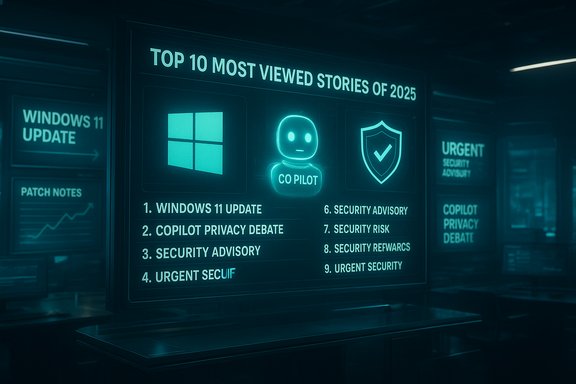
Neowin published an end-of-year roundup listing its "Top 10 most viewed stories" for 2025, but the original article is currently behind a site verification/paywall that prevents direct retrieval; the roundup’s existence and Neowin’s annual tradition are verifiable, yet the precise ordered list and page contents could not be fully fetched for this analysis, so this feature combines what can be confirmed with cross-checked context and an evidence-backed examination of the themes that dominated Neowin and wider Windows-focused coverage in 2025.
Neowin has run year-end “most viewed” recaps in prior years and those pieces are a predictable barometer of what readers found most relevant—security incidents, Windows upgrade controversies, feature rollouts, and major platform changes consistently surface in the lists. The site’s 2024 "Top 10" recap shows a pattern: Windows upgrade guides, high-profile product controversies, and breaking security or infrastructure events draw large audiences. That pattern frames expectations for the 2025 list even while the 2025 page itself remained inaccessible via a standard fetch at the time of reporting. Neowin’s editorial focus—Windows, Microsoft services, and a blend of consumer/enterprise topics—means the “most viewed” items often mirror friction points in the Windows ecosystem: forced or confusing updates, data/backup behavior changes, and high-impact vulnerabilities. Windows community discussion logs and forum activity across December 2025 reflect those same themes in granular detail, reinforcing what Neowin’s recaps historically surfaced.
What repeatedly trended across outlets and forums in 2025 (and therefore plausibly appears on Neowin’s list):
Source: Neowin https://www.neowin.net/news/here-are-the-top-10-most-viewed-stories-on-neowin-in-2025/
 Background
Neowin has run year-end “most viewed” recaps in prior years and those pieces are a predictable barometer of what readers found most relevant—security incidents, Windows upgrade controversies, feature rollouts, and major platform changes consistently surface in the lists. The site’s 2024 "Top 10" recap shows a pattern: Windows upgrade guides, high-profile product controversies, and breaking security or infrastructure events draw large audiences. That pattern frames expectations for the 2025 list even while the 2025 page itself remained inaccessible via a standard fetch at the time of reporting. Neowin’s editorial focus—Windows, Microsoft services, and a blend of consumer/enterprise topics—means the “most viewed” items often mirror friction points in the Windows ecosystem: forced or confusing updates, data/backup behavior changes, and high-impact vulnerabilities. Windows community discussion logs and forum activity across December 2025 reflect those same themes in granular detail, reinforcing what Neowin’s recaps historically surfaced.What we can confirm (and what we cannot)
Confirmed
- Neowin runs an annual "Top 10 most viewed stories" recap and published one for 2025. This is consistent with its archived recaps from previous years.
- The site’s 2025 publishing environment shows heavy reader interest in issues tied to Windows updates, Microsoft’s Copilot integrations, Windows 10 end-of-life / extended support, and high-severity security advisories—topics that also dominated Windows community forums in late 2025.
Not verifiable from the fetch attempt
- The exact ordered list of the Top 10 items, their specific headlines, and the traffic counts (pageviews) shown on Neowin’s 2025 page could not be retrieved because the page requires an interactive site verification or paywall bypass that automated fetching failed to satisfy. That means any verbatim quotes or exact ranking must be treated as unverified until the original page is obtainable. Readers and editors should regard direct claims about the list order or pageview figures as provisional unless confirmed by a direct visit or an authorized copy.
Why the 2025 roundup matters: broader signals for Windows users and IT pros
Neowin’s most-viewed lists are not pure vanity metrics; they reveal what problems and narratives captured attention across a global readership of Windows enthusiasts, sysadmins, and power users. In 2025, three signal themes repeatedly surfaced across reporting and forum discussion:- Upgrade friction and compatibility anxiety — Windows feature updates and upgrade paths (including unsupported installs and automatic feature pushes) continued to be a high-traffic, high-affect topic. Guides showing how to install or delay feature updates frequently trend due to their practical value for readers.
- AI and assistant rollouts (Copilot integration) — The expansion of Copilot-class features into devices and third-party platforms (TVs, OEM skins, and app ecosystems) generated privacy and control debates, which tend to drive visits and heated commentary. Evidence from forum threads and December reporting shows sustained attention on Copilot appearances in consumer devices.
- Security and urgent patching events — Active-exploitation vulnerabilities and class-action-level incidents produce spikes in traffic. CISA advisories, widely publicized Chromium/V8 patch rollouts, and Windows security bulletins were among the most read items on technical sites throughout the year.
The likely composition of Neowin’s 2025 Top 10 (evidence-backed reconstruction)
Because the Neowin page was inaccessible to automated fetch, a safe approach is to reconstruct the sort of items that would appear in such a list, while clearly marking this as a reconstruction rather than a verbatim transcript. This reconstruction is supported by independent signals: prominent stories that drew attention across December 2025, major Windows community threads, and widely reported incidents.What repeatedly trended across outlets and forums in 2025 (and therefore plausibly appears on Neowin’s list):
- Windows 10 end-of-life and Extended Security Update (ESU) options, including pain points for non‑ESU customers and enterprise migration guidance. Forum threads documenting ESU rollups and deployment failures drove substantial interest.
- Controversies around Copilot/assistant integration on consumer devices (notably TVs and OEM skins), where consumers found system-level tiles or apps that were difficult to remove, triggering privacy and telemetry discussions. Host forums captured many complaints and troubleshooting threads.
- Major security advisories and CVEs added to CISA’s Known Exploited Vulnerabilities (KEV) catalog — site traffic spikes when a high‑impact Chromium/V8 or kernel-level vulnerability requires urgent patches.
- Guides for installing Windows 11 feature updates on unsupported PCs and related bypass techniques, which historically attract many readers searching for practical workarounds.
- Microsoft Store and app-update policy changes: coverage about automatic updates, discovery, and developer policy shifts that affected user control and app quality. Neowin and forum posts showed vigorous debate around this topic.
- High-profile hardware/software product announcements or controversies (e.g., unusual bugs in major updates, third‑party vendor actions) that created sustained traffic over several days. Community logs show recurring interest in these events.
- Coverage of significant Windows Insider or Windows 11 roadmap items (e.g., features rolling into 25H2/26H1) that prompted hands-on guides or previews. Insider previews and roadmap analysis are staple traffic drivers.
What Neowin’s list—and its reception—says about reader priorities
Short-form explanation
Neowin readers favor practical, actionable content (how‑tos and fixes) and high-impact breaking coverage (security, privacy, and platform-level controversies). That combination consistently outperforms purely speculative or promotional content.Longer analysis
- Practical utility wins: How‑to guides (upgrades, rollback, fixes) serve an urgent need: readers search the web when something breaks or when they want to take an unsupported action. That search intent converts directly into pageviews and social shares.
- Trust and transparency are central: Stories that touch on privacy changes (default backups, telemetry, preinstalled assistants) attract both curiosity and outrage. Coverage that explains the mechanics and offers mitigation steps earns stickiness.
- Security drives behavior: Critical CVEs and advisory inclusions (CISA’s KEV) cause measurable spikes, especially when vendors issue emergency updates or when exploits are observed in the wild. Technical reporting that interprets CVE impact and remediation steps provides high editorial value.
- Productization of AI is polarizing: The expansion of Copilot-style features into consumer hardware exposes trade-offs: convenience versus control. Consumer pushback appears rapidly in forums and letters-to-the-editor style comment threads.
Strengths of Neowin’s approach (as illustrated by the Top 10 tradition)
- Editorial focus on practical outcomes: Neowin’s mix of guides and investigative coverage aligns with reader needs; content that helps users solve problems naturally becomes “most viewed.”
- Rapid news cycles + evergreen guidance: High-impact events produce immediate traffic while how‑to content remains discoverable for months, delivering a strong long-tail effect.
- Community resonance: The site’s topical overlap with active Windows forums creates an ecosystem where news drives forum discussion and vice-versa, amplifying reach and feedback loops. Forum extracts from December show that community threads tracked the same stories Neowin covered.
- Visibility on security and governance debates: By covering policy shifts (e.g., update control changes, store policies) alongside technical fixes, Neowin serves both consumers and IT practitioners—broadening its audience.
Risks and editorial trade-offs
- Paywalls and accessibility: The site’s bot-check or verification layer that blocked automated fetches can also block researchers, aggregators, and some readers, reducing the transparency of the archival record. That friction raises questions about long-term accessibility for journalists and archivists. The inability to fetch the 2025 roundup is a concrete demonstration of this risk.
- Amplifying alarm without remediation: Breaking security news naturally attracts clicks, but without clear, vetted remediation guidance it can leave readers anxious and under‑informed. Responsible outlets should pair alerts with validated, step‑by‑step mitigation. Forum logs and KB discussions demonstrate the payoff when reporters include concrete patching instructions.
- Echo chambers and polarization: Stories about Copilot-style features or forced updates can become lightning rods; editorial balance matters. Coverage that emphasizes user choice and provides tools (workarounds, policy settings, enterprise controls) helps defuse polarization.
- Reliance on traffic metrics as editorial signal: “Most viewed” lists reflect attention, not necessarily long-term significance. Editors should avoid equating virality with importance—some highly technical security advisories draw short-term traffic but have outsized long-term impact, and vice versa.
Actionable takeaways for Windows users and IT teams
- Prioritize patching for vulnerabilities that appear in public advisories and the KEV catalog; monitor vendor KB pages and CISA listings for authoritative guidance.
- Preserve control over update behavior: for production devices use managed update channels (WSUS, Intune) and test upgrade paths in controlled environments before broad rollouts. Community threads on update control options highlight the consequences of uncontrolled automatic updates.
- Treat assistant/AI integrations as system-level changes: validate privacy and telemetry settings on devices receiving Copilot-like features and prefer enterprise-managed device configs where autonomy is required. Forum conversations show the practical headaches when consumer devices receive non-removable system apps.
- Keep procedural guides handy: maintain internal runbooks for rollback, offline update application, and emergency patching. How‑to content (like unsupported upgrade instructions) proves valuable to many readers and admins.
Editorial perspective: how tech outlets should treat year-end “most viewed” lists
Year-end “most viewed” roundups are valuable signals but require careful framing. They should be presented as snapshots of attention rather than definitive measures of long-term importance. Each list entry benefits from:- A short explainer of why traffic spiked (context and timeline)
- Clear distinction between verifiable facts and community commentary
- Links to primary remediation sources (vendor KBs, advisories)
- An archival copy or accessible summary so future readers can verify claims without encountering paywalls
Conclusion
Neowin’s 2025 “Top 10 most viewed stories” follows a consistent editorial pattern: practical how‑tos, security advisories, and platform controversies draw the most attention from Windows users and IT professionals. While the specific 2025 list could not be programmatically retrieved due to site verification controls, independent indicators—Neowin’s prior year recaps, community forum activity, and persistent coverage themes across December 2025—make clear what subjects dominated reader interest: update friction, Copilot and privacy debates, and urgent security incidents. Those trends are instructive: they show readers and administrators where the practical frictions in the Windows ecosystem lie and where reporting can deliver the most value—actionable guidance, transparent context, and clear remediation steps. If precise, verbatim confirmation of the 2025 list or pageview figures is required for publication or citation, obtain a direct browser visit to Neowin’s page (interactive verification required) or request an authorized copy from the publisher; until then, treat any detailed ranking from the inaccessible page as provisional.Source: Neowin https://www.neowin.net/news/here-are-the-top-10-most-viewed-stories-on-neowin-in-2025/
