

Nerdio launched Nerdio Manager for MSP 7.0 in public preview on May 4, 2026, after reporting that its MSP user base more than doubled in 2025 and that Microsoft 365 usage inside the platform grew more than 300 percent year over year. The announcement is not just another version bump in the crowded managed-services tooling market. It is a bet that the next MSP battleground is not virtual desktops alone, but control of the whole Microsoft cloud estate. For Windows-focused service providers, that makes Nerdio’s release less a product update than a marker of where the channel is being pushed.
For years, Nerdio’s identity was tied tightly to Azure Virtual Desktop and Windows 365. That was a sensible wedge: Microsoft’s virtual desktop stack is powerful, but it has never been famous for operational simplicity, especially when an MSP is trying to manage dozens or hundreds of customers with different budgets, risk profiles, images, policies, and user populations.
Version 7.0 widens the story. Nerdio is now presenting Manager for MSP as a single platform for Microsoft 365, Windows 365, Azure Virtual Desktop, Azure infrastructure, endpoint management, reporting, security posture, and compliance workflows. The pitch is deliberately bigger than “make AVD easier.” It is “make the Microsoft practice governable.”
That distinction matters because MSPs have spent the last decade accumulating portals. Microsoft 365 admin center, Entra, Intune, Defender, Exchange, SharePoint, Teams, Purview, Azure, Partner Center, PSA tools, RMM tools, backup dashboards, ticketing systems, documentation systems: the modern MSP stack is not a stack so much as a tab explosion. Each tool solves a problem, but the aggregate effect is labor drag.
Nerdio’s argument is that this drag has become an economic problem. If a technician must jump between tenants, browsers, admin centers, and manual checklists, every new customer adds more service burden than margin. At small scale, that is annoying. At growth scale, it becomes the difference between a profitable Microsoft cloud practice and a help desk that is permanently one misconfiguration away from a bad quarter.
Microsoft 365 is where MSPs live every day. It is identity, email, collaboration, endpoint policy, data governance, conditional access, phishing defense, retention, device compliance, and increasingly Copilot readiness. AVD and Windows 365 may be higher-complexity services, but Microsoft 365 is the recurring operational substrate of the SMB and midmarket channel.
That makes Nerdio’s growth claim strategically loaded. If MSPs are pulling Microsoft 365 administration into Nerdio, they are not simply buying a convenience layer. They are deciding that Microsoft’s native tools, while essential, are not enough on their own for multi-tenant service delivery at MSP scale.
Microsoft knows this problem exists. Microsoft 365 Lighthouse gives partners a first-party multi-tenant view, with onboarding recommendations, security baselines, and tenant health insights. Azure Lighthouse has long served the service-provider model for Azure. But Microsoft’s native management surfaces still tend to reflect Microsoft’s product boundaries, while MSPs experience the customer environment as a cross-product obligation.
Nerdio is attempting to occupy that gap: not replacing Microsoft’s admin centers, but abstracting the repetitive work across them into templates, workflows, assessments, and reports that map more closely to how MSPs package and sell services.
On paper, these are management features. In practice, several of them are revenue features. The assessment wizard is a pre-sales instrument: it lets an MSP walk into a prospect conversation with evidence rather than vibes. The reporting engine is a retention instrument: it turns invisible background administration into artifacts the customer can understand. Purview baselines are a service-packaging instrument: they help an MSP transform governance from bespoke consulting into repeatable policy deployment.
That is the hidden significance of 7.0. Nerdio is not merely chasing technician efficiency; it is trying to help MSPs productize Microsoft cloud operations. In a channel where customers often struggle to understand why managed services cost what they cost, evidence matters. A report that shows risk reduction, cost changes, usage patterns, and compliance movement can become the story an MSP tells at renewal time.
This is also why PSA integration matters. MSPs do not run on admin consoles; they run on tickets, billing, agreements, labor allocation, and service queues. A Microsoft management tool that does not connect back into the business system of record risks becoming yet another destination. Nerdio’s integration with common PSA platforms is a recognition that operational control has to meet commercial workflow.
That does not make the announcement soft. In managed services, previews often serve a different function: they let vendors recruit their most engaged partners into a feedback loop before packaging the release for broader consumption. MSPs are not passive buyers of this kind of software. Their technicians will find the edge cases, the weird tenant configurations, the licensing inconsistencies, and the places where a workflow breaks because a customer’s environment has five years of historical baggage.
The question for Nerdio is not whether 7.0 can demo well. It is whether it can survive the messy middle of MSP reality. Multi-tenant management sounds elegant until a customer has legacy conditional access policies, an Intune configuration nobody remembers creating, half-migrated SharePoint permissions, unmanaged devices, custom retention requirements, and a finance team that wants cost reports mapped to a contract written three years ago.
That is where Nerdio’s platform argument will be tested. If 7.0 can standardize without flattening necessary customer differences, it strengthens the case for a unified MSP console. If it hides complexity too aggressively, technicians will fall back to Microsoft’s native portals the moment something complicated breaks.
This is why third-party tooling persists even when Microsoft improves its own admin experience. Microsoft optimizes for product capability and broad partner enablement. MSPs optimize for repeatability, margin, delegation, and the ability to service many tenants without hiring an army of senior engineers. Those are adjacent goals, not identical ones.
Nerdio’s rise in AVD was built on that mismatch. Azure Virtual Desktop gave Microsoft and its partners a credible cloud desktop platform, but MSPs needed automation, cost controls, image management, scaling policies, quoting assistance, and easier operations. Nerdio turned that complexity into a managed workflow and, in doing so, became part of how many MSPs made AVD commercially viable.
The same logic is now being applied to Microsoft 365. The difference is that Microsoft 365 is more politically sensitive inside the customer environment. AVD is important, but Microsoft 365 touches nearly every user, every mailbox, every file, every device, and every identity decision. Managing that layer means moving closer to the customer’s actual business risk.
That proximity is lucrative, but it also raises the bar. An MSP platform that applies baselines across tenants must be careful, auditable, and flexible. A single misapplied policy can lock users out, expose data, break workflows, or create compliance headaches. The more Nerdio moves into Microsoft 365 governance, the more it must behave less like a convenience console and more like a control plane.
For MSPs, Purview can be a headache and an opportunity. The headache is that compliance policies are not one-size-fits-all. Retention, data loss prevention, labeling, and governance settings depend on industry, geography, risk appetite, and business process. The opportunity is that many customers now understand they need more than antivirus and mailbox backup to claim they are managing information risk.
By bringing Purview policy management into Nerdio, the company is nudging MSPs toward more mature service bundles. Instead of selling only endpoint hardening or virtual desktop management, a provider can offer standardized compliance baselines, policy deployment, drift detection, and reporting. That is a higher-value motion, and it is exactly where many MSPs want to go as commodity support margins tighten.
But compliance automation is a dangerous place for shallow tooling. If a platform merely makes it easy to push templates, it can create false confidence. The useful version is one that helps MSPs understand policy impact, document exceptions, report on changes, and align baselines with the customer’s actual obligations. Nerdio’s success here will depend less on whether it exposes Purview settings and more on whether it helps partners turn those settings into defensible practice.
A technician managing one company can tolerate depth and specialization. A technician managing 80 tenants cannot spend every task reorienting around a different admin center, browser profile, customer standard, and documentation trail. The cognitive cost becomes a form of operational tax.
Nerdio’s release lands in a moment when that tax is rising. Microsoft 365 administration now involves identity hardening, device compliance, application governance, Teams and SharePoint configuration, mailbox security, Defender alerts, conditional access, MFA, data governance, and preparation for AI features that depend heavily on clean permissions and well-governed data. The job is no longer simply creating accounts and resetting passwords.
That is why multi-tenant consistency has become a competitive issue. MSPs that can standardize faster can onboard customers faster. MSPs that can detect drift faster can reduce risk. MSPs that can produce useful reports faster can defend their value in quarterly business reviews. The tooling layer becomes part of the service provider’s margin structure.
Nerdio is not alone in seeing this. Competitors and adjacent vendors are also chasing Microsoft 365 multi-tenant management, Intune standardization, security baselines, Copilot readiness, and policy drift. The market is moving because the channel’s center of gravity is moving. The old MSP stack was built around devices, tickets, and remote monitoring. The new one is being built around identity, policy, data, and cloud economics.
Those lessons transfer imperfectly but meaningfully to Microsoft 365. MSPs do not want a pretty dashboard that describes problems while leaving the work elsewhere. They want workflows that remove repetitive labor, encode standards, and make junior technicians more effective without handing them uncontrolled power.
Nerdio’s Marketplace listing and product materials emphasize deployment, management, cost savings, auto-scaling, RBAC, customer IT administrator access, and operation from the MSP’s Azure environment. Those details are not incidental. They speak to a channel audience that cares about who controls the platform, where it runs, how permissions are delegated, and how service delivery is monetized.
The company’s claim that it serves more than 23,000 customers worldwide gives the 7.0 release additional weight. This is not a startup testing whether MSPs might like Microsoft automation. It is an established vendor attempting to use its AVD foothold to become a broader Microsoft cloud management layer.
That expansion is not guaranteed to work. Virtual desktop buyers and Microsoft 365 operations buyers may overlap, but they are not always the same persona. A platform that excels at AVD cost optimization must prove it can be equally trusted for tenant security, compliance settings, and lifecycle management. Brand permission has to be earned again when the control plane moves closer to identity and data.
That model clashes with the traditional MSP habit of heroic customization. Many providers grew by saying yes to every customer peculiarity. Over time, that created fragile environments, inconsistent documentation, uneven security, and service teams that could only operate effectively if they remembered the folklore of each account.
Microsoft 365 has made that approach harder to sustain. Conditional access, MFA, endpoint compliance, data retention, guest sharing, Teams governance, Defender policies, and license management all reward consistency. The customer may still need exceptions, but the MSP needs a baseline from which exceptions are deliberate rather than accidental.
Nerdio Manager for MSP 7.0 is built around that premise. Assessment, baselines, reporting, PSA integration, and multi-tenant administration all point in the same direction: make the MSP practice more repeatable. The goal is not to remove expertise. It is to stop wasting expertise on work that should be templated, automated, or surfaced in a single operational view.
That is also why the product’s sales-facing features matter. Standardization is easier to sell when the MSP can show before-and-after evidence. A customer that sees concrete security gaps in an assessment report is more likely to approve remediation. A customer that receives regular white-labeled reporting is more likely to understand the MSP as an operator of business-critical infrastructure rather than a help desk vendor.
The risk is that platforms like this can encourage MSPs to overpromise. A prospect assessment that flags problems is useful, but it is not a substitute for a security program. A Purview baseline can improve consistency, but it is not a legal compliance guarantee. A reporting engine can document service delivery, but it cannot make poor operational practices good.
MSPs adopting 7.0 should therefore treat it as leverage, not magic. The platform can compress repetitive work and expose patterns across tenants. It cannot decide the right standard for every customer, negotiate every exception, or replace the need for governance conversations.
That distinction will separate strong MSPs from weak ones. Strong providers will use Nerdio to operationalize a well-defined Microsoft practice. Weak providers may use it to produce attractive reports over shallow service delivery. The tool will amplify both.
Source: GlobeNewswire Nerdio Launches MSP 7.0 Amid Triple-Digit Microsoft 365 Growth
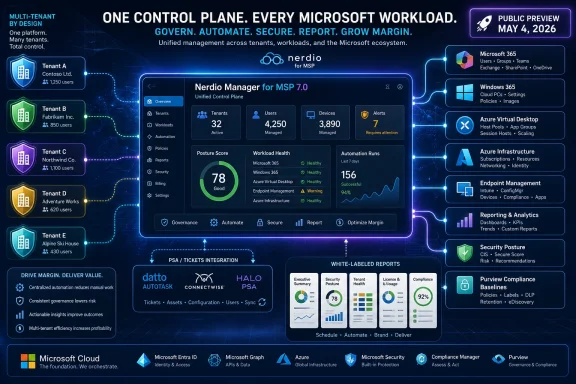 Nerdio Is Trying to Turn Microsoft Sprawl Into an MSP Operating System
For years, Nerdio’s identity was tied tightly to Azure Virtual Desktop and Windows 365. That was a sensible wedge: Microsoft’s virtual desktop stack is powerful, but it has never been famous for operational simplicity, especially when an MSP is trying to manage dozens or hundreds of customers with different budgets, risk profiles, images, policies, and user populations.Version 7.0 widens the story. Nerdio is now presenting Manager for MSP as a single platform for Microsoft 365, Windows 365, Azure Virtual Desktop, Azure infrastructure, endpoint management, reporting, security posture, and compliance workflows. The pitch is deliberately bigger than “make AVD easier.” It is “make the Microsoft practice governable.”
That distinction matters because MSPs have spent the last decade accumulating portals. Microsoft 365 admin center, Entra, Intune, Defender, Exchange, SharePoint, Teams, Purview, Azure, Partner Center, PSA tools, RMM tools, backup dashboards, ticketing systems, documentation systems: the modern MSP stack is not a stack so much as a tab explosion. Each tool solves a problem, but the aggregate effect is labor drag.
Nerdio’s argument is that this drag has become an economic problem. If a technician must jump between tenants, browsers, admin centers, and manual checklists, every new customer adds more service burden than margin. At small scale, that is annoying. At growth scale, it becomes the difference between a profitable Microsoft cloud practice and a help desk that is permanently one misconfiguration away from a bad quarter.
The Microsoft 365 Growth Number Is the Real Headline
The most interesting number in Nerdio’s announcement is not the 100 percent-plus increase in MSP users. It is the more than 300 percent year-over-year growth in Microsoft 365 users managed through Nerdio Manager for MSP. That suggests the company’s expansion beyond virtual desktop management is not just a positioning exercise.Microsoft 365 is where MSPs live every day. It is identity, email, collaboration, endpoint policy, data governance, conditional access, phishing defense, retention, device compliance, and increasingly Copilot readiness. AVD and Windows 365 may be higher-complexity services, but Microsoft 365 is the recurring operational substrate of the SMB and midmarket channel.
That makes Nerdio’s growth claim strategically loaded. If MSPs are pulling Microsoft 365 administration into Nerdio, they are not simply buying a convenience layer. They are deciding that Microsoft’s native tools, while essential, are not enough on their own for multi-tenant service delivery at MSP scale.
Microsoft knows this problem exists. Microsoft 365 Lighthouse gives partners a first-party multi-tenant view, with onboarding recommendations, security baselines, and tenant health insights. Azure Lighthouse has long served the service-provider model for Azure. But Microsoft’s native management surfaces still tend to reflect Microsoft’s product boundaries, while MSPs experience the customer environment as a cross-product obligation.
Nerdio is attempting to occupy that gap: not replacing Microsoft’s admin centers, but abstracting the repetitive work across them into templates, workflows, assessments, and reports that map more closely to how MSPs package and sell services.
The New Features Are Sales Tools Wearing Admin Clothes
Nerdio Manager for MSP 7.0 introduces four capabilities that explain where the company thinks MSP value is shifting. The Prospect Tenant Assessment Wizard scans a prospective customer’s Microsoft 365 environment, identifies security gaps and inefficiencies, and produces a client-ready report. PSA integrations connect Nerdio Manager with platforms including Datto Autotask PSA, ConnectWise PSA, and Halo PSA. Purview Solution Baselines allow MSPs to manage Microsoft Purview policies and apply compliance baselines across Microsoft 365 environments. A new reporting engine produces white-labeled reports across Azure Virtual Desktop, Microsoft 365, and Azure, covering cost, usage, performance, and compliance.On paper, these are management features. In practice, several of them are revenue features. The assessment wizard is a pre-sales instrument: it lets an MSP walk into a prospect conversation with evidence rather than vibes. The reporting engine is a retention instrument: it turns invisible background administration into artifacts the customer can understand. Purview baselines are a service-packaging instrument: they help an MSP transform governance from bespoke consulting into repeatable policy deployment.
That is the hidden significance of 7.0. Nerdio is not merely chasing technician efficiency; it is trying to help MSPs productize Microsoft cloud operations. In a channel where customers often struggle to understand why managed services cost what they cost, evidence matters. A report that shows risk reduction, cost changes, usage patterns, and compliance movement can become the story an MSP tells at renewal time.
This is also why PSA integration matters. MSPs do not run on admin consoles; they run on tickets, billing, agreements, labor allocation, and service queues. A Microsoft management tool that does not connect back into the business system of record risks becoming yet another destination. Nerdio’s integration with common PSA platforms is a recognition that operational control has to meet commercial workflow.
Public Preview Is a Promise, Not a Verdict
Nerdio Manager for MSP 7.0 is available in public preview starting May 4, with general availability expected shortly afterward according to Nerdio’s public roadmap. That timing is worth emphasizing because preview software sits in an awkward zone. It is mature enough to show customers where the vendor is headed, but not yet the version most conservative MSPs will standardize around for production-wide process changes.That does not make the announcement soft. In managed services, previews often serve a different function: they let vendors recruit their most engaged partners into a feedback loop before packaging the release for broader consumption. MSPs are not passive buyers of this kind of software. Their technicians will find the edge cases, the weird tenant configurations, the licensing inconsistencies, and the places where a workflow breaks because a customer’s environment has five years of historical baggage.
The question for Nerdio is not whether 7.0 can demo well. It is whether it can survive the messy middle of MSP reality. Multi-tenant management sounds elegant until a customer has legacy conditional access policies, an Intune configuration nobody remembers creating, half-migrated SharePoint permissions, unmanaged devices, custom retention requirements, and a finance team that wants cost reports mapped to a contract written three years ago.
That is where Nerdio’s platform argument will be tested. If 7.0 can standardize without flattening necessary customer differences, it strengthens the case for a unified MSP console. If it hides complexity too aggressively, technicians will fall back to Microsoft’s native portals the moment something complicated breaks.
Microsoft’s Channel Has a Scale Problem That Microsoft Alone Has Not Solved
The MSP market around Microsoft has always been shaped by a paradox. Microsoft’s cloud suite is broad enough to make partners indispensable, but that same breadth can make partner operations painfully inefficient. Every new Microsoft service creates a potential managed-service offering, and every new admin surface creates another place for drift, error, or duplicated labor.This is why third-party tooling persists even when Microsoft improves its own admin experience. Microsoft optimizes for product capability and broad partner enablement. MSPs optimize for repeatability, margin, delegation, and the ability to service many tenants without hiring an army of senior engineers. Those are adjacent goals, not identical ones.
Nerdio’s rise in AVD was built on that mismatch. Azure Virtual Desktop gave Microsoft and its partners a credible cloud desktop platform, but MSPs needed automation, cost controls, image management, scaling policies, quoting assistance, and easier operations. Nerdio turned that complexity into a managed workflow and, in doing so, became part of how many MSPs made AVD commercially viable.
The same logic is now being applied to Microsoft 365. The difference is that Microsoft 365 is more politically sensitive inside the customer environment. AVD is important, but Microsoft 365 touches nearly every user, every mailbox, every file, every device, and every identity decision. Managing that layer means moving closer to the customer’s actual business risk.
That proximity is lucrative, but it also raises the bar. An MSP platform that applies baselines across tenants must be careful, auditable, and flexible. A single misapplied policy can lock users out, expose data, break workflows, or create compliance headaches. The more Nerdio moves into Microsoft 365 governance, the more it must behave less like a convenience console and more like a control plane.
Purview Baselines Move Nerdio Into the Compliance Conversation
The addition of Purview Solution Baselines is one of the more telling pieces of the release. Microsoft Purview has become the umbrella for a wide range of compliance, data governance, retention, information protection, and risk-management capabilities. It is powerful, but it is also the kind of product area where many SMB customers need help translating capability into usable policy.For MSPs, Purview can be a headache and an opportunity. The headache is that compliance policies are not one-size-fits-all. Retention, data loss prevention, labeling, and governance settings depend on industry, geography, risk appetite, and business process. The opportunity is that many customers now understand they need more than antivirus and mailbox backup to claim they are managing information risk.
By bringing Purview policy management into Nerdio, the company is nudging MSPs toward more mature service bundles. Instead of selling only endpoint hardening or virtual desktop management, a provider can offer standardized compliance baselines, policy deployment, drift detection, and reporting. That is a higher-value motion, and it is exactly where many MSPs want to go as commodity support margins tighten.
But compliance automation is a dangerous place for shallow tooling. If a platform merely makes it easy to push templates, it can create false confidence. The useful version is one that helps MSPs understand policy impact, document exceptions, report on changes, and align baselines with the customer’s actual obligations. Nerdio’s success here will depend less on whether it exposes Purview settings and more on whether it helps partners turn those settings into defensible practice.
The “Single Pane of Glass” Cliché Finally Has Consequences
Every infrastructure vendor eventually promises a single pane of glass. The phrase is so overused that it usually deserves suspicion. Still, in the MSP market, the cliché persists because the underlying pain is real.A technician managing one company can tolerate depth and specialization. A technician managing 80 tenants cannot spend every task reorienting around a different admin center, browser profile, customer standard, and documentation trail. The cognitive cost becomes a form of operational tax.
Nerdio’s release lands in a moment when that tax is rising. Microsoft 365 administration now involves identity hardening, device compliance, application governance, Teams and SharePoint configuration, mailbox security, Defender alerts, conditional access, MFA, data governance, and preparation for AI features that depend heavily on clean permissions and well-governed data. The job is no longer simply creating accounts and resetting passwords.
That is why multi-tenant consistency has become a competitive issue. MSPs that can standardize faster can onboard customers faster. MSPs that can detect drift faster can reduce risk. MSPs that can produce useful reports faster can defend their value in quarterly business reviews. The tooling layer becomes part of the service provider’s margin structure.
Nerdio is not alone in seeing this. Competitors and adjacent vendors are also chasing Microsoft 365 multi-tenant management, Intune standardization, security baselines, Copilot readiness, and policy drift. The market is moving because the channel’s center of gravity is moving. The old MSP stack was built around devices, tickets, and remote monitoring. The new one is being built around identity, policy, data, and cloud economics.
The AVD Heritage Still Gives Nerdio an Edge
Nerdio’s advantage is that it did not begin as a generic SaaS posture tool. It comes from the operationally demanding world of Azure Virtual Desktop, Windows 365, and Azure cost management. That matters because desktop virtualization forces a vendor to confront compute spend, user experience, image lifecycle, session performance, storage choices, and support workflows in one system.Those lessons transfer imperfectly but meaningfully to Microsoft 365. MSPs do not want a pretty dashboard that describes problems while leaving the work elsewhere. They want workflows that remove repetitive labor, encode standards, and make junior technicians more effective without handing them uncontrolled power.
Nerdio’s Marketplace listing and product materials emphasize deployment, management, cost savings, auto-scaling, RBAC, customer IT administrator access, and operation from the MSP’s Azure environment. Those details are not incidental. They speak to a channel audience that cares about who controls the platform, where it runs, how permissions are delegated, and how service delivery is monetized.
The company’s claim that it serves more than 23,000 customers worldwide gives the 7.0 release additional weight. This is not a startup testing whether MSPs might like Microsoft automation. It is an established vendor attempting to use its AVD foothold to become a broader Microsoft cloud management layer.
That expansion is not guaranteed to work. Virtual desktop buyers and Microsoft 365 operations buyers may overlap, but they are not always the same persona. A platform that excels at AVD cost optimization must prove it can be equally trusted for tenant security, compliance settings, and lifecycle management. Brand permission has to be earned again when the control plane moves closer to identity and data.
The MSP Business Model Is Being Rewritten Around Standardization
The deeper story behind Nerdio’s announcement is the industrialization of managed services. The most successful MSPs increasingly look less like break-fix shops and more like operators of standardized service factories. They define a baseline, onboard customers into it, monitor drift, report outcomes, and sell higher-value advisory work around exceptions.That model clashes with the traditional MSP habit of heroic customization. Many providers grew by saying yes to every customer peculiarity. Over time, that created fragile environments, inconsistent documentation, uneven security, and service teams that could only operate effectively if they remembered the folklore of each account.
Microsoft 365 has made that approach harder to sustain. Conditional access, MFA, endpoint compliance, data retention, guest sharing, Teams governance, Defender policies, and license management all reward consistency. The customer may still need exceptions, but the MSP needs a baseline from which exceptions are deliberate rather than accidental.
Nerdio Manager for MSP 7.0 is built around that premise. Assessment, baselines, reporting, PSA integration, and multi-tenant administration all point in the same direction: make the MSP practice more repeatable. The goal is not to remove expertise. It is to stop wasting expertise on work that should be templated, automated, or surfaced in a single operational view.
That is also why the product’s sales-facing features matter. Standardization is easier to sell when the MSP can show before-and-after evidence. A customer that sees concrete security gaps in an assessment report is more likely to approve remediation. A customer that receives regular white-labeled reporting is more likely to understand the MSP as an operator of business-critical infrastructure rather than a help desk vendor.
Customers Will Care Less About the Console Than the Outcome
For end customers, the identity of the management console is mostly invisible. They care whether onboarding is smooth, tickets are resolved quickly, costs are explainable, policies are consistent, devices are secure, and compliance demands are not handled by panic. If Nerdio helps MSPs deliver that, the customer may never know the product name—and that would still be a success.The risk is that platforms like this can encourage MSPs to overpromise. A prospect assessment that flags problems is useful, but it is not a substitute for a security program. A Purview baseline can improve consistency, but it is not a legal compliance guarantee. A reporting engine can document service delivery, but it cannot make poor operational practices good.
MSPs adopting 7.0 should therefore treat it as leverage, not magic. The platform can compress repetitive work and expose patterns across tenants. It cannot decide the right standard for every customer, negotiate every exception, or replace the need for governance conversations.
That distinction will separate strong MSPs from weak ones. Strong providers will use Nerdio to operationalize a well-defined Microsoft practice. Weak providers may use it to produce attractive reports over shallow service delivery. The tool will amplify both.
The Numbers Point to a Channel That Wants Fewer Portals and More Margin
Nerdio’s 7.0 release should be read as a signal from the Microsoft partner ecosystem: MSPs want to consolidate, automate, and package Microsoft cloud operations before complexity overwhelms profit. The product details matter, but the direction matters more.- Nerdio Manager for MSP 7.0 entered public preview on May 4, 2026, with a broader focus on Microsoft 365, Windows 365, Azure Virtual Desktop, Azure, reporting, and compliance workflows.
- Nerdio says its MSP user base grew by more than 100 percent in 2025, while Microsoft 365 users managed through the platform increased by more than 300 percent year over year.
- The new Prospect Tenant Assessment Wizard turns Microsoft 365 environment analysis into a client-facing sales and remediation artifact.
- PSA integrations with Datto Autotask PSA, ConnectWise PSA, and Halo PSA move Nerdio closer to the business workflows MSPs use to run service delivery.
- Purview Solution Baselines and the reporting engine show that Nerdio is pushing beyond desktop management into governance, compliance, and customer-value reporting.
- The release increases Nerdio’s opportunity, but it also raises the trust bar because Microsoft 365 management touches identity, data, policy, and customer risk.
Source: GlobeNewswire Nerdio Launches MSP 7.0 Amid Triple-Digit Microsoft 365 Growth
