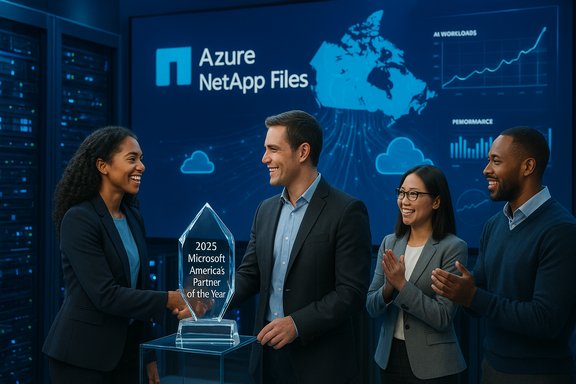
NetApp 2025 Microsoft Americas PoY Claim: Plausible but Unconfirmed

  • Thread Author
NetApp says it won the 2025 Microsoft Americas Partner of the Year award in the ISV/SDC — Canada category, a short Business Wire / Globe and Mail–distributed release that has started circulating in trade feeds — but independent checks of Microsoft’s public winners lists and NetApp’s primary newsroom did not surface a matching official confirmation, leaving the claim plausible but not yet fully verified.

A blue conference room displaying 'Americas Partner of the Year' with NetApp and Microsoft logos.Background​

NetApp is an established player in enterprise data infrastructure with deep integrations into hyperscaler ecosystems, including Azure‑centric services such as Azure NetApp Files and ONTAP variants targeted at multi‑cloud data management. The company regularly publishes partner and awards announcements that highlight joint engineering work with cloud vendors and channel milestones, which makes a recognition from Microsoft plausible on its face.
Microsoft’s Partner of the Year program runs an annual cycle that yields global, regional (Americas), and country‑level winners across solution categories (ISV/SDC, Systems Integrator, Dynamics, Security, etc.. Winners and finalists are typically announced by Microsoft on official Partner blog posts and consolidated lists; partner press releases normally mirror those announcements. The Business Wire / Globe and Mail distribution naming NetApp as the 2025 Americas Partner of the Year — SDC Canada category follows that standard PR pattern, but the canonical Microsoft winners list is the definitive source for verification.

What the announcement says — concise summary​

  • The syndicated press dispatch identifies NetApp (NASDAQ: NTAP) as the winner of the 2025 Microsoft Americas Partner of the Year award in the ISV/SDC — Canada category.
  • The release frames the recognition as validation of NetApp’s collaboration across Microsoft ecosystems and its impact on Canadian customers.
  • The distribution is brief and consistent with many partner award press releases that aim to amplify co‑marketing signals to customers, partners, and investors.
This description of the press dispatch is the claim currently in circulation via Business Wire / Globe and Mail syndication channels.

Verification status — what public records show​

  • Independent checks performed against Microsoft’s publicly accessible Partner of the Year listings and Microsoft Americas blog did not unambiguously confirm NetApp as the named winner for the 2025 Americas ISV/SDC — Canada category at the time of review.
  • Searches of NetApp’s primary newsroom and investor communications similarly did not reveal an obvious matching press release or statement on NetApp’s official channels that mirrors the Business Wire/Globe dispatch.
  • In other words, the claim exists in syndicated press distribution but lacked a corroborating Microsoft winners list or a NetApp newsroom entry during the cross‑checks performed by researchers. Treat the published PR as a reported claim that requires confirmation from Microsoft or NetApp for journalism‑grade certainty.
Why this matters: Microsoft Partner of the Year recognitions are significant market signals. They typically reflect judged submissions that include customer references, measurable outcomes tied to Microsoft technologies, and repeatable delivery patterns — all of which materially influence procurement, co‑sell mechanics inside Microsoft, and partner go‑to‑market motion. Without confirmation, procurement and technology teams should treat the press release as a signal to be validated rather than an automatic procurement justification.

Why a Microsoft PoY win would matter for NetApp and customers​

A confirmed Microsoft Partner of the Year award brings practical and reputational benefits that cut across sales, delivery, and technical influence. If validated, the implications for NetApp and its customers would typically include:
  • Market validation in Canada — stronger credibility for Azure‑centric solutions and regulated‑industry procurements in Canadian accounts.
  • Co‑sell momentum — deeper visibility with Microsoft field sellers, access to co‑sell incentives, and prioritization in Microsoft partner channels.
  • Customer reference leverage — awards are often used in enablement and pipeline acceleration; certified customer outcomes referenced in the submission may be leveraged for new deals.
These are standard, measurable avenues by which Partner of the Year badges convert into commercial outcomes. However, those benefits only materialize when the award is backed by verifiable submission artifacts and repeatable case studies.

Critical analysis — strengths and what to probe​

Strengths that support plausibility​

  • NetApp’s product set (cloud‑native data services and Azure integrations) matches Microsoft’s partner priorities — particularly for Azure NetApp Files, cloud data mobility patterns, and hybrid data services — which makes the company a credible candidate for regional partner awards.
  • NetApp has a history of partner recognitions and frequent press activity around joint hypscaler engineering, making a submitted entry and a resulting recognition plausible on operational grounds.

Weaknesses and verification gaps​

  • The primary weakness in this reporting cycle is the absence of an explicit Microsoft winners list entry or an independent Microsoft press release corroborating the Business Wire / Globe and Mail item. That verification gap is the most important journalistic caveat.
  • Because partner awards often affect procurement decisions, there is a risk that buyers may prematurely rely on marketing badges rather than audited technical evidence. The award itself does not replace reference checks, POCs, or contractual protections.

What procurement and IT teams should ask​

  • Confirm the award on Microsoft’s official winners list or Partner Center entry (the canonical confirmation channel).
  • Request the specific customer references and anonymized metrics used in the award submission.
  • Insist on a live proof of concept (POC) that demonstrates throughput, latency, RTO/RPO, and operational manageability for your actual workload.
  • Negotiate contractual protections — SLAs, documented exit and data egress procedures, and clear escalation paths between NetApp and Microsoft support.
These steps convert badge‑level claims into verifiable, auditable decisions for production deployments.

Technical and operational considerations for Windows/Azure administrators​

Azure NetApp Files and deep Microsoft integrations​

NetApp’s technical story most often centers on services such as Azure NetApp Files, ONTAP cloud offerings, and managed data fabric capabilities that accelerate lift‑and‑shift and modern data pipelines. For operations teams evaluating NetApp because of award claims, the following technical checks are critical:
  • Validate data portability and egress plans: heavy integration brings great operational simplicity but also potential vendor‑lock‑in and egress cost exposure. Explicitly map how data will be exported in open formats and what timelines are contractually guaranteed.
  • Confirm multi‑cloud exit strategies: if ONTAP or Azure NetApp Files becomes a core dependency, document how workloads will be migrated off that platform should strategic needs change.
  • Request architecture diagrams and runbooks: these should detail identity flows (Entra/Azure AD), backup/DR plans, and incident escalation paths that involve both NetApp and Microsoft teams.
  • Measure performance in a POC: use realistic datasets and realistic network topologies to validate throughput, latency, snapshot performance, and recovery time objectives.
These operational validations are standard for any partner selection decision — awards help prioritize a short list but do not replace technical validation.

Marketing vs deliverability — the risk of badge‑driven procurement​

Partner awards are powerful marketing instruments. They open doors and accelerate conversations with field sellers, but they also come with specific risks:
  • Badge inflation: Vendors may emphasize award badges in sales cycles without coupling them to auditable, reproducible customer outcomes. Procurement teams should always ask for the underlying artifacts of the award submission.
  • Timing mismatch: PR syndication often appears faster than corporate newsrooms or vendor partners can update canonical channels. A press distribution may circulate before Microsoft’s consolidated winners list is posted, creating a temporary verification gap. That timing issue can explain the current discrepancy, but requires confirmation to close.
  • Scope ambiguity: Country or regional awards (e.g., ISV/SDC Canada) have limited geographic or solution scope; buyers outside that scope should not infer global leadership from a country‑level prize. Always map the award’s scope to your procurement domain.

Practical verification checklist (short form)​

  • Confirm the award entry on Microsoft’s official winners/finalists pages.
  • Ask NetApp for the Partner Center nomination reference and the anonymized customer metrics that supported the submission.
  • Request three recent, written customer references with similar scale and regulatory posture.
  • Run a POC that measures KPIs relevant to your workloads (throughput, latency, snapshot/time to recovery, manageability).
  • Negotiate SLAs and a tested exit/egress plan in the contract.
This checklist translates the marketing signal into the procurement evidence needed for production commitments.

What partners and competitors should learn from award cycles​

  • Treat awards as business development accelerants: awards increase co‑sell opportunities and can attract top talent, but they must be followed by productized delivery IP and repeatable case studies that withstand procurement scrutiny.
  • Publish auditable artifacts: to reduce friction with enterprise buyers, leading partners publish sanitized Partner Center snapshots, named certified practitioners (role & exam IDs), and redacted ACR evidence where appropriate. These artifacts shorten due diligence timelines and reduce buyer skepticism.
  • Convert awards into measurable outcomes: the partners that scale reliably convert award momentum into packaged PoCs and accelerators that deliver predictable KPIs and measurable business impact.

Broader channel context — why Microsoft PoY awards still matter​

Microsoft’s PoY program is tightly coupled with partner co‑sell mechanics and internal field incentives. Winners often get:
  • Elevated visibility within Microsoft field teams and priority for field introductions.
  • Access to go‑to‑market resources and potential co‑marketing funds.
  • Employer branding benefits that help recruiting for niche Azure skills.
However, the award ecosystem is competitive and noisy: dozens of partners across categories and regions will issue PR; the buyer community must act as gatekeepers to convert awards into real programmatic value. Treat awards as one signal among many: technical fit, security posture, cost governance, and support maturity remain primary procurement determinants.

How to interpret this specific NetApp claim right now​

  • The press dispatch naming NetApp as the 2025 Microsoft Americas Partner of the Year — SDC Canada category is circulating via syndicated channels (Business Wire / Globe and Mail).
  • At the time of the independent review, neither Microsoft’s published winners list nor NetApp’s primary newsroom showed a matching canonical confirmation — creating a verification gap that requires clarity.
  • The gap may be a timing issue (corporate newsrooms and partner pages often post with different latencies) or it could reflect an incomplete syndication, but the prudent response for buyers and journalists is to seek direct confirmation from Microsoft Partner pages or from NetApp’s official communications before relying on the award as procurement evidence.

Bottom line for WindowsForum readers and enterprise IT decision makers​

  • Credible signal, pending confirmation. The Business Wire/Globe and Mail release is consistent with standard partner PR practice and plausible given NetApp’s alignment with Azure. But the independent verification gap means the claim should be treated as reported rather than proven until Microsoft or NetApp’s canonical channels confirm it.
  • Badges accelerate conversations, not final decisions. Use awards to prioritize vendor shortlists and request the submission artifacts, but insist on POC results, named references, and contractual SLAs before making a procurement decision.
  • Operational diligence matters more than headlines. For any Azure‑integrated data platform (including Azure NetApp Files and ONTAP on Azure), validate data portability, egress risk, identity integrations (Entra), backup/DR playbooks, and cost governance with a realistic POC.

Recommended next steps for stakeholders​

  • For journalists: confirm the NetApp claim with Microsoft’s official Partner of the Year winners page and request comment from Microsoft and NetApp to reconcile the timing/verification gap.
  • For procurement teams evaluating NetApp: request the Partner Center nomination reference and anonymized submission materials, run a prioritized POC, and require explicit SLAs covering data egress and incident response.
  • For partners and competitors: use award cycles to publish auditable artifacts (Partner Center snapshots, named certified practitioners, and redacted ACR) that reduce buyer friction and make marketing claims verifiable.

Conclusion​

The distributed press item naming NetApp as the 2025 Microsoft Americas Partner of the Year in the ISV/SDC — Canada category is a plausible and potentially important market signal, given NetApp’s portfolio and Microsoft alignment. However, the absence of an unambiguous Microsoft winners list entry or a corresponding NetApp newsroom posting at the time of verification means the claim remains not yet independently confirmed. Buyers and readers should treat the announcement as a prompt to verify and to convert badge‑level claims into auditable technical evidence — because in enterprise IT, operational outcomes and contractual protections always matter more than marketing headlines.

Source: The Globe and Mail NetApp Recognized as Winner of 2025 Microsoft Americas Partner of the Year for SDC Canada Category
Source: Markets Financial Content https://markets.financialcontent.co...-partner-of-the-year-for-sdc-canada-category/
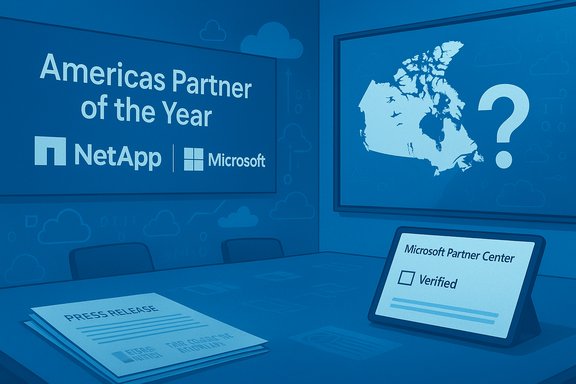
 

NetApp’s announcement that it won the 2025 Microsoft Americas Partner of the Year award in the Software Development Company (SDC) — Canada category arrives as both a strategic marketing victory and a practical signal for enterprises evaluating Azure‑centric data platforms and partner choices.

Smiling team shakes hands as the 2025 Microsoft America's Partner of the Year trophy is awarded.Background / Overview​

NetApp’s November 12, 2025 press release states the company was selected from a competitive field of partner nominations and celebrates deep engineering and go‑to‑market alignment with Microsoft — particularly through Azure NetApp Files and other cloud data services. The announcement quotes Pravjit Tiwana, Senior Vice President and General Manager, Cloud Storage and Services at NetApp, and positions the win as a validation of the companies’ decades‑long collaboration and joint readiness for AI workloads. Microsoft’s own Americas Partner of the Year roundup lists winners and finalists for 2025 across multiple categories and regions and includes NetApp as the Canada winner in the Software Developers (SDC) category — the canonical confirmation that completes the public record. Microsoft’s regional post is dated November 12, 2025. Taken together, the vendor release and Microsoft’s winners list create a clear headline: NetApp is a 2025 Microsoft Americas Partner of the Year winner for the Canada SDC category. The announcement is part of a broader awards cycle that Microsoft says drew thousands of nominations across global and regional categories; Microsoft reported more than 4,600 nominations globally in 2025, while NetApp’s release references a pool of “over 2,000” nominations (a plausible reference to the Americas‑region nomination pool). These two numbers reflect different reporting scopes and should not be conflated.

What the award actually recognizes​

Program mechanics and what judges look for​

Microsoft’s Partner of the Year program evaluates entries on measurable customer impact, technical innovation built on Microsoft technologies, and the ability to scale and replicate customer outcomes across industries. Winners are typically selected from a multi‑thousand nomination pool and are highlighted in global, regional, and country‑level categories. The award is therefore a recognition of both technical integration with Microsoft’s platform and demonstrable business results.

Why NetApp’s portfolio maps to the category​

NetApp’s public messaging emphasizes three elements that map directly to Microsoft’s judging criteria:
  • Deep product integration with Azure through Azure NetApp Files and cloud data services, which reduces friction for lift‑and‑shift migrations and large file workloads.
  • Joint engineering and go‑to‑market collaboration with Microsoft field teams to deliver measurable customer outcomes (for example, migrations of SAP, DB2, HPC, and EDA workloads).
  • Increasing focus on enabling AI workloads through data services, observability, and performance improvements that shorten time to value for GenAI projects.
These points are core to NetApp’s market position and explain why Microsoft’s awards program — which rewards measurable, platform‑informed outcomes — would single out an infrastructure partner like NetApp for recognition in a software‑developer / SDC category at the country level.

The important technical claims — verified and vendor claims to treat cautiously​

Confirmed technical points​

  • Azure NetApp Files is documented by Microsoft as an Azure native, first‑party enterprise file‑storage service. Microsoft’s Learn and product pages describe Azure NetApp Files as a first‑party, high‑performance file service with native Azure portal integration, billing, and SLAs. That makes the service a native Azure product in the sense Microsoft uses that term.
  • Microsoft Ignite dates and relevance: Microsoft Ignite 2025 is scheduled for November 18–21, 2025 at the Moscone Center in San Francisco; Microsoft and multiple partner pages confirm the event schedule, and NetApp’s press materials reference attendance and a booth presence during the conference. The Ignite schedule is the platform Microsoft typically uses to amplify Partner of the Year winners and finalists.

Vendor claims that need context or verification​

  • NetApp’s statement that it is the “only storage company natively embedded in Microsoft Azure as a first‑party service” is a vendor positioning claim. The technical fact that Azure NetApp Files is delivered as an Azure first‑party service is confirmed by Microsoft documentation, but the comparative assertion — that NetApp is the only storage vendor with that status — is a competitive claim and should be treated as NetApp marketing unless independently validated for every competing vendor and every Azure service type. Microsoft documentation supports ANF’s first‑party status, but other cloud‑native storage offerings (for other workload types) are offered directly by Azure teams or in partnership with vendors in different forms; therefore, buyers should accept that ANF is an Azure first‑party service and treat uniqueness claims with measured skepticism.
  • Nomination counts and scale of competition: NetApp’s release refers to a pool of “over 2,000” nominations; Microsoft’s global statement references “more than 4,600 nominations from 100 countries.” Both can be accurate when scoped differently (region vs. global), but the discrepancy highlights the need to carefully read the scope of headline numbers in vendor and platform messaging.

Why the award matters — practical implications for customers and partners​

For customers evaluating NetApp (or any awarded partner)​

Awards like Microsoft’s Partner of the Year are powerful trust signals that can accelerate enterprise short‑listing and open co‑sell conversations. But badges are a starting point—not a procurement decision. The award implies that Microsoft field teams saw positive customer outcomes and repeatable delivery, which typically translates into:
  • Easier cross‑vendor engagements with Microsoft sellers and faster introductions to Microsoft engineering resources.
  • Priority in joint marketing and partner channels, which can shorten procurement and proof‑of‑concept cycles.
  • A better odds profile when evaluating vendors because the entry required verifiable customer references and technical evidence.
However, practical procurement must still insist on measurable proof — POC testing, named references, SLA commitments, and clear migration and exit paths. The award does not guarantee fit for your specific workload or regulatory environment.

For partners and competitors​

  • The recognition raises NetApp’s visibility inside Microsoft and among enterprise account teams; competitors will likely see increased co‑sell friction and should respond with their own validated POCs, published benchmarks, or differentiated IP that addresses gaps NetApp’s approach does not cover.
  • Smaller partners should not interpret vendor awards as final proof of superiority — the playing field in cloud data services is nuanced; partners win by demonstrating measured outcomes, operational readiness, and predictable cost governance, not just badges.

Critical analysis — strengths, practical risks, and what to probe​

Notable strengths in NetApp’s position​

  • Deep engineering integration with Azure. Azure NetApp Files is a first‑party Azure service with native portal, billing, and management integration; that reduces friction for enterprise migrations and operations teams. This is a material advantage when migrating large, file‑intensive workloads.
  • Clear GTM and co‑sell alignment with Microsoft. Partner of the Year recognition typically unlocks greater joint GTM activity, which can materially accelerate deal cycles for enterprise accounts that want tight Microsoft co‑operation.
  • Positioning for AI workloads. NetApp is framing the award around enabling AI workloads (performance, protection, governance). Given demand for data plumbing for GenAI, this alignment is timely and relevant for enterprises building production AI pipelines.

Risks, caveats, and technical concerns to investigate​

  • Vendor lock and portability. Deep, first‑party integrations yield operational simplicity — but can make future porting and hybrid architectures more complex. Buyers should quantify egress costs, data export timelines, and cross‑cloud interoperability in contractual terms. This is particularly critical for regulated or multi‑jurisdiction deployments.
  • Operational assumptions vs. reality. A partner award recognizes repeatable successes, but the scale and technical details of those successes matter. Ask for architecture diagrams, RTO/RPO tests, throughput and latency KPIs under realistic topologies, and evidence for scale claims rather than accepting badge language at face value.
  • Cost governance for AI workloads. Running AI and HPC workloads on cloud‑native storage demands cost controls. Ensure your cost governance and tagging strategy covers both consumption (Azure compute and ANF capacity) and ancillary costs (egress, cross‑region replication).
  • Security and compliance mappings. While Azure NetApp Files supports enterprise certifications, customers must validate the joint NetApp + Azure controls map to compliance frameworks required by their industry (for example, healthcare or financial services). Ask for SOC2/SOC3 artifacts, encryption attestations, and region‑specific data residency guarantees.

A practical verification checklist for procurement and IT teams​

When an award announcement factors into vendor shortlisting, use this checklist to convert a marketing badge into verifiable procurement evidence:
  • Confirm the award on Microsoft’s official winners and finalists list (the canonical public confirmation).
  • Request the exact submission materials and anonymized metrics NetApp used for the nomination (scale, performance, cost outcomes). If confidentiality is an issue, ask for attested summaries or third‑party validation.
  • Obtain at least two named customer references for deployments with comparable scale and compliance posture. Validate the references independently.
  • Run a bounded POC that measures your real workload KPIs: throughput, latency, snapshot frequency and recovery times, and operational manageability. Document the runbook.
  • Negotiate contract terms that include SLAs for performance and recoverability, a tested data export/migration plan, and clear cost governance rules (billing visibility, cost alerting, and tagging).
  • Test the DR and failover playbook across the Azure regions you’ll use; confirm cross‑region replication behaviors and RTO/RPO under failure scenarios.
  • Validate the security controls mapping to your regulatory needs: encryption at rest and in transit, identity flows (Entra ID/Azure AD), and logging/retention policies.
These steps turn a marketing signal into operational confidence.

What this award signals for market dynamics and partners​

Short term: increased co‑sell momentum and GTM amplification​

Microsoft‑recognized partners often receive prioritized visibility in partner listings and co‑sell channels. For NetApp, that can mean more Microsoft field introductions, faster RFP inclusion in Azure‑led deals, and higher joint pipeline conversion rates for storage‑intensive or data‑first projects. For competitors, the immediate effect is increased urgency to publish validated POCs and measurable benchmarks that address customer priorities such as portability and cost transparency.

Medium term: shift in enterprise procurement expectations for data platforms​

The award reinforces a trend buyers are already seeing: hyperscaler‑first services that combine performance, native integration, and enterprise controls will increasingly be the default for mission‑critical, file‑intensive, and AI workloads. Enterprises will demand not just performance but measurable governance, portability, and cost predictability from storage and data services — turning badges into points on a feature checklist rather than the decisive factor.

Long term: market consolidation and the race to productize data operations for AI​

As partners and cloud vendors productize data operations (observability, snapshotting, governance for LLMs and agents), the winners will be those who can operationalize data governance at scale while preserving performance and portability. The award signals NetApp intends to be among those leaders; competitors that cannot demonstrate operationalized governance and POC‑level evidence risk being outcompeted in enterprise engagements where Microsoft is the platform vendor of record.

Quick technical primer: Azure NetApp Files and enterprise use cases​

  • What it is: Azure NetApp Files (ANF) is a first‑party Azure service that offers enterprise file shares with high performance and multi‑protocol support (NFS, SMB), delivered as volumes that integrate with Azure portal, CLI, and billing. It is designed for performance‑sensitive and lift‑and‑shift applications such as SAP HANA, databases, HPC, and large virtual desktop implementations.
  • Key features:
  • Bare‑metal flash performance with sub‑millisecond latency options.
  • Multiple performance tiers (Standard, Premium, Ultra).
  • Native Azure integration for identity, billing, monitoring, and security.
  • Support for enterprise certifications (SAP HANA, HIPAA, GDPR where applicable).
  • Operational implications: ANF simplifies migration for legacy file workloads and reduces the need for on‑premises refactoring. But its tight integration requires buyers to plan for cross‑cloud portability and to include explicit migration/egress terms in contracts to avoid long‑term lock‑in.

Headline takeaways and recommended next steps for readers​

  • NetApp is confirmed as the 2025 Microsoft Americas Partner of the Year winner in the Software Developers (SDC) Canada category according to both NetApp’s press release and Microsoft’s Americas winners list; the award reflects strong product integration and measurable customer outcomes that fit Microsoft’s evaluation criteria.
  • The underlying technical claim that Azure NetApp Files is an Azure first‑party service is accurate per Microsoft documentation, but vendor statements asserting unique exclusivity should be treated as marketing until independently confirmed. Validate these claims in procurement conversations.
  • For procurement and IT teams: treat the award as an important shortlist filter, not a substitute for POC testing, contract protections, and named reference validation. Use the verification checklist in this article to translate the badge into auditable evidence.
  • For partners and competitors: the award raises the stakes in Azure‑native data services. Win by publishing real, repeatable evidence (benchmarks, POCs, and governance playbooks) and by addressing the cost/portability tradeoffs customers worry about.

Conclusion​

NetApp’s 2025 Microsoft Americas Partner of the Year recognition in the SDC Canada category is a meaningful industry signal: it affirms the company’s engineering alignment with Microsoft and strengthens its commercial credibility in Azure‑centric deployments. At the same time, the practical implications for enterprise customers depend on measured follow‑through: named references, technical artifacts, tested POCs, and contractual protections. The award should accelerate conversations and provide better access to Microsoft channels, but procurement and architecture teams must still insist on hard evidence before committing mission‑critical data and AI workloads to any vendor‑specific pattern.
Source: Business Upturn NetApp Recognized as Winner of 2025 Microsoft Americas Partner of the Year for SDC Canada Category - Business Upturn
 

Back
Top