Netwrix Is Selling Speed Because AI Has Made Delay Expensive
The most important phrase in Netwrix’s announcement is not “Agentic AI,” “conversational assistant,” or even “Copilot.” It is “within an hour.” That claim — an initial risk assessment delivered within an hour of deployment — is the commercial center of the release because it speaks to the anxiety now surrounding Microsoft 365 Copilot rollouts.
For years, identity governance projects have had a reputation for being slow, expensive, and politically painful. They force organizations to confront old Active Directory groups, ancient file shares, inherited SharePoint permissions, broken ownership models, and business units that insist every exception is mission-critical. Copilot did not create those problems, but it made them much harder to ignore.
Microsoft’s own Copilot security model is straightforward in principle: Copilot can use data the user is already allowed to access. That is comforting only if the permissions are clean. In many organizations, they are not clean; they are archaeology. A decade of mergers, migrations, emergency access grants, temporary project folders, “Everyone except external users” sharing, and abandoned admin groups has left many Microsoft environments with a permission model that technically works while quietly violating least privilege.
AI changes the cost of that mess. A user who once had to know a confidential document existed can now ask a broad natural-language question and have relevant material surfaced back to them. An attacker with a compromised account can use the same discovery effect. The risk is not that Copilot magically breaks permissions; the risk is that it makes stale permissions newly useful.
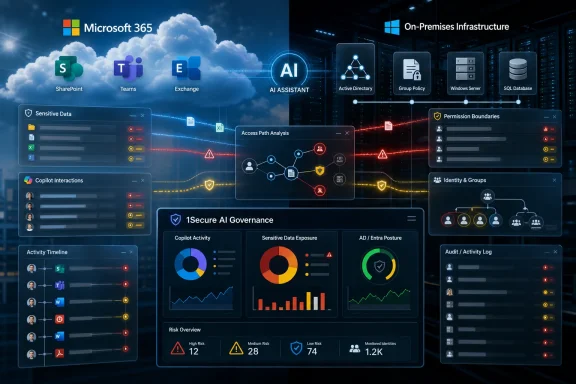
That is the gap Netwrix is trying to occupy. 1Secure is being positioned as a faster way to discover where sensitive data lives, which identities can reach it, what has changed, and where hybrid Microsoft environments are most exposed. In the Copilot era, that is a stronger pitch than traditional compliance reporting because the customer’s fear is immediate: “What will AI reveal that we missed?”
Copilot Turns Old Permission Debt Into a Current Security Problem
The dirty secret of many Microsoft environments is that access governance has often been treated as a periodic clean-up exercise. A company might perform access reviews before an audit, after a breach, during a migration, or when a new CISO arrives with a mandate to impose order. Between those moments, permissions drift.
That drift was tolerable when discovery was manual and fragmented. A user might technically have access to an old finance folder, but if they did not know the path, the business impact could remain theoretical. Search improved discovery, but generative AI compresses discovery and interpretation into a single action. The prompt becomes the new privileged interface.
That is why the current market around Copilot governance is so intense. Security teams are not merely asking whether Copilot respects permissions. They are asking whether their existing permissions deserve to be respected. The distinction matters because Microsoft can correctly say Copilot follows the tenant’s security model while administrators can still conclude that the tenant’s security model is a mess.
Netwrix’s press release leans into this tension by arguing that AI expands the identity footprint and accelerates access changes faster than human reviews can manage. The company cites its own research claiming organizations where AI expanded the identity footprint saw a breach rate of 43 percent, compared with 11 percent where it did not. As with any vendor-supplied statistic, the number should be read as positioning as much as evidence. Still, the direction of the argument is plausible: more agents, more delegated access, more automation, and more data reach create more places for governance to fail.
The practical issue for WindowsForum readers is familiar. Hybrid Microsoft environments are rarely elegant. Active Directory still anchors identity for many organizations, Entra ID governs cloud access, SharePoint Online and Exchange Online hold sensitive business content, Windows file servers remain full of legacy data, and SQL Server contains structured records that may or may not have modern classification. Copilot enters this environment not as a clean-room AI product, but as another consumer of existing identity and data controls.
That is why the hybrid angle matters. A Microsoft-only cloud posture tool can help inside Microsoft 365, but many enterprises and midsize organizations still have critical exposure on-premises. A risk assessment that ignores Windows file servers, Group Policy, DNS, DHCP, or legacy AD paths may miss exactly the systems that attackers use to pivot.
The New 1Secure Features Are Less About Novelty Than Convergence
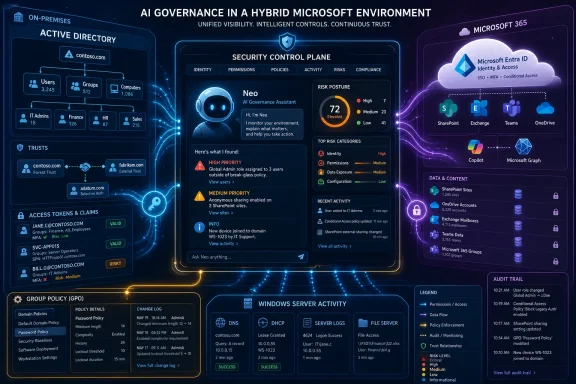
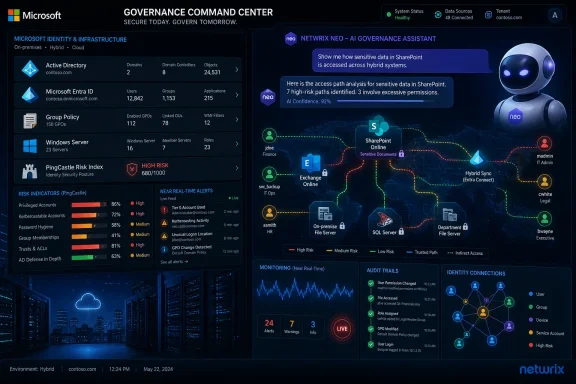
Netwrix’s feature list reads like a greatest-hits compilation of modern Microsoft security headaches. Netwrix Neo is a conversational AI assistant meant to translate alerts into plain-language briefings. The Sensitive Data Posture dashboard centralizes risk views across cloud and on-premises sources. More than 200 PingCastle-powered checks assess Active Directory and data-source exposure. GPO auditing flags risky configuration changes. Windows Server activity reporting adds near real-time records for changes to systems, services, DNS, DHCP, and related infrastructure.
Individually, none of those ideas is shocking. Security products have had dashboards for decades, AI assistants are now a near-mandatory SaaS feature, and AD assessment is a mature discipline. The more interesting claim is convergence. Netwrix is trying to collapse identity risk, sensitive-data visibility, Copilot readiness, and infrastructure change monitoring into a single operating surface.
That matters because Copilot governance is not a single control. It is a chain. A sensitive file in SharePoint may be governed by Microsoft 365 permissions, labels, sharing links, group membership, guest access, and search behavior. A sensitive file on a Windows file server may depend on NTFS permissions, group nesting, stale AD accounts, privileged admin paths, and change monitoring. A privileged identity may exist in both Active Directory and Entra ID, with conditional access and legacy authentication complicating the story. AI does not care that these controls live in different administrative consoles.
The PingCastle connection is also notable. PingCastle has long been associated with Active Directory risk assessment, and Netwrix acquired PingCastle in 2024. Folding those checks into 1Secure gives the platform more credibility in the on-premises identity layer, where many “cloud-first” governance products are thin. In the real world, AD hygiene is still Microsoft security hygiene.
The GPO and Windows Server reporting additions reinforce that point. Group Policy remains one of the most powerful and dangerous configuration mechanisms in Windows environments. A bad GPO change can weaken endpoint security, alter authentication behavior, disable protections, or create operational chaos. DNS and DHCP changes may look boring until they become part of an intrusion path. By tying those events into the same posture conversation as data and identity, Netwrix is saying the Copilot problem is really a Microsoft estate problem.
The AI Assistant Is the Flashiest Feature, but the Data Map Is the Product
Netwrix Neo will probably get the most demo attention because conversational interfaces sell well. A plain-language briefing that explains what happened and where a security team should focus first is easy to understand. It also fits the current boardroom belief that AI should reduce workload, not simply add more alerts.
But the assistant is only useful if the underlying map is trustworthy. In security operations, summarization is not the hard part; context is. A product that says “a risky permission change occurred” is only valuable if it can explain what data is now exposed, which identities are involved, whether the change is anomalous, and how urgent the remediation is.
That is why the Sensitive Data Posture dashboard may be more consequential than Neo. A central view of data risk across cloud and on-premises sources attacks the root of Copilot anxiety: organizations often do not know where sensitive data is, who can access it, or whether access is justified. Heatmaps and trend analysis sound ordinary, but they are useful if they turn sprawling permissions into a prioritized remediation plan.
The phrase “behavioral insights” also deserves attention. Static permissions tell only part of the story. If a group has access to a sensitive folder but no one has touched it in years, that is a cleanup candidate. If a user suddenly accesses a large volume of sensitive files after a role change, that is a different risk. If Copilot activity begins surfacing data from an old SharePoint site, that may reveal a governance failure that was dormant until AI made it discoverable.
This is where AI governance becomes less abstract. The security question is not whether AI is “allowed” in the enterprise. It is whether the enterprise can observe and constrain AI-mediated access in the same way it observes human access. If not, AI adoption becomes a visibility problem disguised as a productivity project.
Microsoft’s Native Stack Is Strong, but It Does Not End the Third-Party Market
Microsoft is not ignoring this problem. Purview, Entra ID, SharePoint Advanced Management, sensitivity labels, Data Loss Prevention, audit logs, access reviews, and Copilot-specific guidance all form part of Microsoft’s answer. The company has been increasingly explicit that organizations should prepare a secure and governed data foundation before broadly deploying Copilot.
That creates a natural question for Netwrix and its competitors: why buy another product if Microsoft already provides governance tools? The answer is not that Microsoft lacks features. The answer is that Microsoft environments are complex, hybrid, and often operated by teams that need cross-domain prioritization rather than another set of portals.
Microsoft’s native tools are deepest inside Microsoft 365 and Azure. They are also the default strategic choice for many enterprise customers because they are integrated with licensing, identity, and compliance workflows. But native breadth can become administrative fragmentation. A security team may have one workflow for Entra ID, another for Purview, another for SharePoint, another for Defender, another for on-prem AD, and another for file-server auditing. The problem is not only detection; it is operational synthesis.
Netwrix is aiming at that synthesis. Its claim is that customers need a way to start with the most urgent security priority and expand coverage over time. That is a managed-services-friendly message, especially for midsize organizations that do not have large identity governance teams. The inclusion of a partner quote from WheelHouse IT is not incidental. MSPs need repeatable services, not bespoke archaeology projects.
There is also a trust dynamic. Some administrators are comfortable relying entirely on Microsoft to secure Microsoft. Others prefer independent visibility, especially when the risk involves Microsoft’s own AI products surfacing data from Microsoft’s own productivity stack. Third-party governance tools can offer a second lens, even if they ultimately depend on Microsoft APIs and logs.
The Price Signals a Midmarket Push, Not Just an Enterprise Play
Netwrix says 1Secure pricing starts at $22 per identity per year. That number matters because it positions the platform as something more accessible than a large enterprise transformation project. For an organization with 1,000 identities, the starting point suggests a software cost in the low tens of thousands annually before services, scope, and add-ons. For an MSP, that can be packaged into a recurring governance offering.
The midmarket angle is important because Copilot is not only an enterprise phenomenon. Microsoft 365 is ubiquitous across small and midsize businesses, and those organizations often have weaker governance practices than heavily regulated enterprises. They may have moved to Microsoft 365 quickly, retained legacy file servers, accumulated years of Teams and SharePoint sprawl, and never performed a serious identity cleanup.
For those customers, “Copilot readiness” can become the first time executives pay attention to access governance. The productivity promise of AI creates budget and urgency. Security teams can use that moment to fix underlying data and identity problems, but only if they can show value quickly.
That explains the one-hour assessment claim. It lowers the psychological barrier to starting. Instead of proposing a months-long discovery phase, Netwrix is offering an initial posture view that can begin a conversation. Whether that first hour produces enough fidelity to drive meaningful remediation will depend on environment size, connector depth, permissions, and data volume. But as a sales motion, it is smart: show risk quickly, then expand.
There is a caution here. Fast assessment should not be confused with fast governance. Finding overexposed data is easier than fixing it. Removing access can disrupt workflows, anger business units, and expose broken ownership models. Classification projects can stall when no one wants to decide what is sensitive. AI can prioritize, but it cannot magically resolve the human politics of least privilege.
Agentic AI Makes Identity Governance Less Optional
The release uses the language of “Agentic AI,” a phrase that is already being stretched by the industry. In the strongest sense, agentic AI refers to systems that can plan, take actions, call tools, and operate with some autonomy. In the weaker marketing sense, it can mean almost any AI assistant that does more than answer a prompt. Either way, the identity implications are real.
An AI assistant that only summarizes documents is one kind of risk. An AI agent that can modify tickets, update records, trigger workflows, create content, or interact with business systems is another. Once AI can act, it needs identity. It needs permissions. It may need service accounts, delegated rights, application registrations, API scopes, connectors, and audit trails. That creates a governance surface that looks less like chatbot management and more like privileged access management.
This is where Netwrix’s framing is strongest. AI governance is often discussed as a content-safety or model-risk problem: hallucinations, bias, prompt injection, data leakage, and regulatory compliance. Those are real concerns. But in Microsoft environments, one of the most immediate problems is brutally practical: which identities, human or non-human, can reach which data and perform which actions?
Non-human identities are already a weak point in many organizations. Service accounts linger for years. Application permissions are overbroad. Secrets are copied into scripts. Break-glass accounts are poorly monitored. AI agents can amplify that pattern unless organizations build governance around them from the start.
The phrase identity footprint deserves to stick. Every new assistant, automation, connector, and agent expands the set of entities that must be inventoried, monitored, and constrained. If that footprint grows faster than review processes, the organization loses control even if every individual permission grant seemed reasonable at the time.
Hybrid Microsoft Environments Remain the Place Where Clean Diagrams Go to Die
The announcement’s supported-environment list is revealing: Active Directory, Entra ID, SharePoint Online, Exchange Online, Windows File Servers, and SQL Server. That is a practical map of where many organizations actually live. It is also a reminder that Microsoft security is not synonymous with Microsoft 365 security.
Active Directory remains the crown jewel in countless environments. Entra ID may be the front door for cloud applications, but AD still controls authentication, authorization, servers, workstations, file shares, and legacy applications. A compromised AD environment can undermine cloud security through synchronization, privileged accounts, and administrative dependencies.
Windows file servers are equally stubborn. Organizations have spent years predicting their disappearance, yet they persist because they are cheap, familiar, fast, and deeply embedded in workflows. They also tend to contain sensitive data with old permissions and weak classification. Copilot may not automatically index every on-prem file server in the same way it works across Microsoft 365 content, but hybrid search, migration projects, connectors, and AI-enabled workflows make those repositories part of the governance conversation.
SQL Server adds another layer. Structured data is often more sensitive than documents because it contains customer records, financial data, operational metrics, or regulated information. Access paths may run through applications, direct database permissions, admin roles, reports, and service accounts. If AI tools are connected to analytics or business systems, database exposure becomes part of AI governance too.
This is why hybrid support is not a checkbox. The risk is cumulative. A user’s effective access may be shaped by AD group nesting, Entra roles, SharePoint sharing links, Exchange permissions, file-server ACLs, SQL roles, and GPO-controlled machine behavior. No human wants to trace that manually. Attackers and AI systems, however, exploit the combined result.
The Security Win Is Prioritization, Not Omniscience
The strongest version of 1Secure is not a product that claims to know everything. That would be marketing fantasy. The strongest version is a product that helps teams decide what to fix first.
Security teams are drowning in findings. Every posture tool can produce red marks. Every audit can identify stale users, risky groups, inherited permissions, unclassified data, weak policies, and questionable admin rights. The bottleneck is not the existence of risk; it is the ability to rank it by business impact and likelihood.
Copilot makes prioritization more urgent. A broadly accessible SharePoint site containing old cafeteria menus is not the same as a broadly accessible SharePoint site containing acquisition plans. A stale AD group with no sensitive access is not the same as a stale group that grants file-server access to payroll data. A GPO change that updates a printer setting is not the same as one that disables a security control.
Netwrix’s dashboard and AI briefing features are valuable only if they help make those distinctions. A plain-language alert that merely paraphrases noise is still noise. A useful alert explains why this identity, this data, this change, and this moment matter together.
There is also an audit angle. Netwrix emphasizes proving compliance to auditors, and that remains a major driver for identity and data governance spending. But audit evidence should be a byproduct of operational control, not a substitute for it. The organizations that will benefit most are those that use continuous monitoring to reduce exposure before the audit, not those that use dashboards to decorate a failed control environment.
The Vendor Pitch Is Timely, but Customers Should Keep Their Skepticism
The AI security market is currently flooded with claims. Every vendor is adding copilots, agents, posture dashboards, and governance language. Some are solving real problems. Some are relabeling old features. Most are doing a bit of both.
Netwrix has a credible foundation because identity, auditing, AD assessment, and data access governance are not new territory for the company. The question is how well 1Secure unifies those disciplines in practice. Buyers should test whether the product can handle messy group nesting, large file shares, multi-tenant MSP scenarios, noisy event streams, and the uncomfortable edge cases that define real Microsoft environments.
They should also test the remediation workflow. Visibility without remediation becomes another source of guilt. If 1Secure identifies overprivileged identities, sensitive-data hotspots, risky GPO changes, or Copilot exposure, the next question is who can fix it, how safely, and with what rollback plan. Mature governance requires not just detection but change management.
The AI assistant deserves particular scrutiny. Security teams should ask what data Neo uses, how its recommendations are generated, whether explanations are traceable, how tenant data is protected, and how hallucination risk is controlled. An AI assistant in a security platform must be held to a higher standard than a productivity chatbot because bad guidance can become operational risk.
None of this invalidates the announcement. It simply places it in the category where it belongs: a timely expansion of a security platform into the Copilot governance problem, not a magic shield against AI risk.
The Copilot Readiness Checklist Is Becoming a Continuous Discipline
The most concrete lesson from Netwrix’s announcement is that Copilot readiness is not a one-time preflight checklist. It is a continuous discipline. Permissions change, data moves, employees join and leave, agents are added, applications are connected, and business units create new collaboration spaces faster than central IT can manually review them.
Near real-time monitoring matters because the risk window has narrowed. If an attacker compromises an account or a misconfigured group suddenly exposes sensitive data, waiting for a quarterly access review is inadequate. If a new AI workflow gains access to a broad repository, the organization needs to know before that access becomes normalized.
This is especially true for MSPs. Managed service providers serving midsize customers need repeatable assessments, recurring evidence, and standardized remediation playbooks. A one-time Copilot readiness engagement may generate revenue once. Continuous governance can become an ongoing service, which explains why Netwrix is explicitly courting that channel.
The more organizations adopt AI inside Microsoft 365, the more governance will look like hygiene rather than project work. The best-run environments will treat data exposure, identity risk, and AI activity as signals in the same control loop. The worst-run environments will deploy Copilot first and discover their permission model through employee prompts.
The Hour-One Promise Sets the Terms of the Netwrix Bet
Netwrix’s June 2026 release should be read as a wager on immediacy. The company is betting that customers do not want another long identity governance journey before they can understand AI risk. They want a fast starting point, then a path to deepen coverage.
That is a reasonable bet because the market is moving faster than traditional governance programs. Microsoft is pushing Copilot deeper into work patterns. Business units are experimenting with AI tools even when IT has not finished policy design. Attackers are using automation to move faster through compromised environments. Regulators and auditors are beginning to ask harder questions about AI access, data handling, and control evidence.
The challenge for Netwrix is to turn urgency into sustained value. Plenty of products can scare administrators with exposure graphs. Fewer can help them clean up access without breaking the business. The distinction will matter as customers move from AI discovery to AI operations.
For Windows administrators, the release is another sign that the center of gravity has shifted. Group Policy, AD hygiene, file-server permissions, Entra governance, SharePoint oversharing, Exchange visibility, and SQL access are no longer separate chores. They are all inputs into whether AI can safely operate inside the Microsoft estate.
The Practical Lesson Is That Copilot Governance Starts Before the Prompt
Netwrix’s announcement leaves administrators with a handful of concrete implications, and they are more useful than the product slogans. The organizations that fare best will be the ones that treat AI as an accelerator of existing access decisions rather than as a separate island of risk.
- Organizations should audit sensitive data locations and effective permissions before expanding Copilot broadly across Microsoft 365.
- Administrators should treat Active Directory hygiene as part of AI governance, not as a legacy infrastructure task.
- Security teams should monitor non-human identities, application permissions, and AI agents with the same seriousness they apply to privileged users.
- MSPs should turn Copilot readiness into a recurring governance service rather than a one-time assessment.
- Buyers evaluating 1Secure should test remediation workflows and explanation quality, not just dashboards and alert summaries.
- Microsoft-native controls remain essential, but hybrid environments often need an additional layer that connects cloud, identity, and on-premises exposure.
Netwrix is not alone in seeing the opening. The Copilot governance market will get more crowded, noisier, and more aggressively branded over the next year. But the underlying issue will not go away because it is not fundamentally a chatbot problem. It is a permissions problem, an identity problem, and a data-location problem that AI has made visible. If Netwrix can help customers move from visibility to controlled remediation, 1Secure’s new capabilities could become more than another AI-era feature bundle; they could become part of the operating model Microsoft shops need as agents move from answering questions to taking action.
References
- Netwrix Unveils New AI Governance Capabilities for Hybrid Microsoft Environments PR Newswire UK · 2026-06-23T12:02:44.098273
- learn.microsoft.com learn.microsoft.com