

Neudesic’s new platform promises to treat fleets of AI agents like employees — provisioning, assigning, auditing, and retiring them — while running them natively on Microsoft’s Azure AI Foundry to deliver a governed, enterprise-ready “digital workforce.”
Neudesic, an IBM Company, on October 29 announced Digital Workforce Management, an Azure-native solution that positions itself as an operational control plane for enterprise-scale AI agents. The vendor frames the product as a centralized way to provision agents, assign roles and responsibilities, monitor behavior, apply compliance packs (GDPR, HIPAA, ISO were explicitly cited), perform version control, and orchestrate agents into durable, multi‑step workflows — effectively a Digital HR for autonomous and semi‑autonomous agents.
This announcement is timed against the broader industry shift toward “agentic” architectures — multi‑agent systems that plan, reason, call tools, and take actions across systems. Microsoft’s Azure AI Foundry (the platform Neudesic builds on) provides a runtime, identity integration, observability, and model catalog designed precisely for these agentic scenarios; Neudesic’s value proposition is to supply the enterprise-grade lifecycle, governance and orchestration layer that many large organizations say they lack.
Neudesic’s offering is squarely aimed at Azure‑first, regulated enterprises that prefer a partner with deep Microsoft experience and packaged compliance artifacts. Competitors will include RPA and orchestration vendors that extend into agentic scenarios, internal platform teams building bespoke control planes, and other systems integrators offering their own catalog templates and lifecycle tooling. The competitive differentiators buyers should evaluate are:
Source: Florida Today Neudesic Unveils Digital Workforce Management for Enterprise-Scale AI Agents on Microsoft Azure AI Foundry
 Background: what Neudesic announced and why it matters
Neudesic, an IBM Company, on October 29 announced Digital Workforce Management, an Azure-native solution that positions itself as an operational control plane for enterprise-scale AI agents. The vendor frames the product as a centralized way to provision agents, assign roles and responsibilities, monitor behavior, apply compliance packs (GDPR, HIPAA, ISO were explicitly cited), perform version control, and orchestrate agents into durable, multi‑step workflows — effectively a Digital HR for autonomous and semi‑autonomous agents.This announcement is timed against the broader industry shift toward “agentic” architectures — multi‑agent systems that plan, reason, call tools, and take actions across systems. Microsoft’s Azure AI Foundry (the platform Neudesic builds on) provides a runtime, identity integration, observability, and model catalog designed precisely for these agentic scenarios; Neudesic’s value proposition is to supply the enterprise-grade lifecycle, governance and orchestration layer that many large organizations say they lack.
Overview: what the product claims to deliver
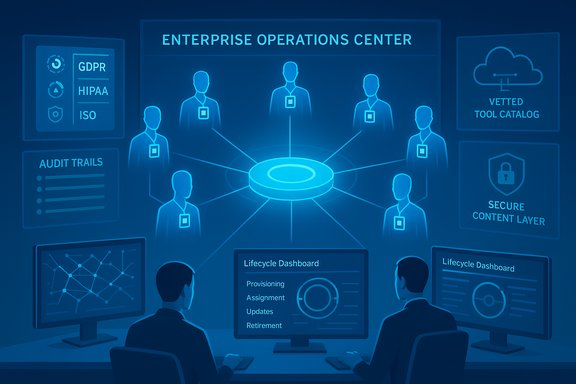
Neudesic’s marketing materials and press release describe a multi‑layer platform that sits on Azure AI Foundry and adds the following capabilities:- A secure content layer that controls what knowledge and data each agent can access.
- A governed catalog of tools and skills, limiting agents to vetted connectors and APIs.
- Built‑in safety and compliance with automated remediation and “compliance packs” aimed at regulated frameworks such as GDPR, HIPAA and ISO.
- Agent lifecycle management (provision, assign, update, retire) with identity binding, telemetry, and version control.
- Dynamic workflow orchestration to coordinate agents with human teams and other agents, with full observability and audit trails.
How this maps to Microsoft’s agent ecosystem
Neudesic’s platform explicitly leverages primitives and services that Microsoft has been rolling into Azure AI Foundry and the broader agent stack:- Agent runtime and model catalog: Azure AI Foundry provides a managed agent and model hosting surface, plus a catalog for model selection and routing, which is the execution layer Neudesic intends to orchestrate.
- Identity-first governance: Microsoft has introduced identity patterns that register agents as directory objects (Microsoft Entra Agent ID) and integrate agents into conditional access and lifecycle processes — the very hook a management plane needs to treat agents as managed entities.
- Tracing and observability: Azure AI Foundry integrates OpenTelemetry-style tracing and telemetry for agents built with Microsoft Agent Framework, Semantic Kernel, LangChain, and others — providing the observability layer Neudesic promises to surface and act upon.
- Agent frameworks and standards: Microsoft’s Agent Framework, along with open protocols like the Model Context Protocol (MCP) and the Agent‑to‑Agent (A2A) protocol, emphasize interoperability, tool discovery, and agent collaboration — all relevant to how Neudesic’s cataloged tools and multi‑agent orchestrations will interact.
Strengths: what Neudesic brings to the enterprise table
- Azure-native integration reduces friction. Building the management plane directly on Azure AI Foundry lets Neudesic reuse Microsoft’s identity, logging, and networking primitives rather than re‑implementing them. This can reduce integration complexity for large Azure customers.
- Partner credibility and Microsoft expertise. Neudesic has an established track record as an Azure partner (and is publicly an IBM company following IBM’s prior acquisition), with multiple Azure specializations and awards that underline operational experience delivering regulated production systems. That partner pedigree matters when the work involves ERP, HR, finance, and other systems where risk and compliance matter.
- Operational and governance focus. The platform explicitly treats agents as lifecycle objects (onboard, assign, monitor, retire), which aligns with the operational disciplines enterprises require to avoid “agent sprawl,” shadow automation, and orphaned identities. The emphasis on version control, telemetry and role‑binding is precisely what production‑grade AI requires.
- Prebuilt compliance accelerators. Packaging regulatory checklists and remediation playbooks (the press release cites GDPR, HIPAA, ISO frameworks) speeds procurement and compliance reviews, which is often the gating factor in regulated sectors. That said, prebuilt packs must be audited and maintained to remain useful in evolving regulatory environments.
- Observability and audit trails. Leveraging Azure’s tracing and Foundry observability means organizations can correlate model calls, tool invocations and downstream system actions — a key capability for incident investigations and regulatory audits.
Risks and open questions organizations must evaluate
Neudesic’s pitch is pragmatic, but moving from controlled pilots to an enterprise fleet of agents creates technical and governance hazards that buyers must assess carefully.- Automated remediation vs. human oversight. Automated remediation workflows can reduce reaction time to policy violations, but they can also create cascading errors if misconfigured. Buyers should insist on clear delineations between automatic remediation and manual, auditable human‑in‑the‑loop checkpoints. The press release claims automated remediation, but enterprise procurement must verify what actions can be auto‑executed and what requires approvals.
- Expanded identity and attack surface. Treating agents as directory objects (Entra Agent ID) makes them manageable — but every directory object increases the identity attack surface. Enterprises need robust identity hygiene: least privilege, credential rotation, conditional access policies, and periodic attestation/review processes. Microsoft’s identity primitives help, but governance processes are still essential.
- Data residency, lineages and compliance proof. Claims of GDPR/HIPAA compliance accelerators are useful, but organizations operating in regulated industries must demand contractual assurances about data locality, processing checkpoints, and where logs and evidence are stored. Azure supports BYOS storage and customer‑managed keys, but implementation details vary by deployment choice. Validate these settings in proof‑of‑concepts.
- Cost and observability overhead. Running many agents with frequent model inferences, tool calls, and telemetry ingestion can generate significant cloud consumption. TCO modeling must include inference costs, logging retention, storage, and network egress under realistic concurrency scenarios. Marketing claims about “effortless scalability” require financial proof in your Microsoft Enterprise Agreement context.
- Portability and vendor lock‑in. A management plane tightly integrated with Azure AI Foundry accelerates time‑to‑value for Azure customers but can make multi‑cloud portability harder. If your long‑term strategy requires vendor neutrality, negotiate portability and open‑standards commitments (MCP, A2A) into contracts and emphasize open interfaces for tool catalogs.
Practical verification: which claims are independently verifiable now
To avoid vendor marketing alone, several of Neudesic’s core claims can (and should) be validated against platform facts and partner evidence:- Microsoft documents confirm that Azure AI Foundry provides an Agent Service, model catalog, identity integration, and observability hooks — the core runtime layer Neudesic says it builds upon. These are platform facts documented by Microsoft.
- Microsoft’s Agent Framework and the Agent2Agent (A2A) discourse show the vendor direction toward open agent protocols and runtime interoperability; Neudesic’s catalog and orchestration approach aligns with those standards, making it plausible and platform‑feasible.
- Neudesic’s positioning as “Neudesic, an IBM Company” is verifiable: IBM acquired Neudesic in 2022 and Neudesic continues to market itself as an IBM Company, reinforcing the company’s scale and integration pedigree.
- The press release’s product availability statement — “available today for qualified enterprise customers” — is a marketing claim that is verifiable only through Neudesic sales engagement. Prospective customers should request a briefing, ask for the current capabilities list, and request proof of concept (PoC) contracts that enumerate SLAs and security boundaries.
A practical adoption playbook for Windows‑centric enterprises
For organizations evaluating Neudesic’s Digital Workforce Management — or any agent management plane — a disciplined, staged approach reduces risk:- Start with a tightly scoped pilot. Pick a high‑value, low‑risk workflow (e.g., ticket triage, document routing, or internal reporting) with clear KPIs (time saved, error rate, mean time to resolution).
- Map data sensitivity and residency. Classify every data input and output the agent will touch, decide BYOS vs. Microsoft‑managed storage, and enforce customer‑managed keys if required.
- Require identity binding. Each agent should have an Entra Agent ID or equivalent identity object, an assigned owner, cost center, and documented SLOs.
- Define escalation and human‑in‑the‑loop rules. For any action with material impact (financial, legal, or personal data), require explicit human approval flows and audit logging before push to production.
- Instrument tracing and red‑teaming. Integrate OpenTelemetry tracing across the stack and run adversarial tests for prompt injection, data exfiltration, and hallucination detection.
- Model cost projection and capacity testing. Run load tests to estimate inference calls and telemetry ingestion; validate pricing with your Microsoft account team.
- Negotiate SLAs, portability clauses and compliance proof. Insist on contractual language that defines data locality, key management, breach notification timelines, and exit portability for tool catalogs and agent definitions.
Where Neudesic’s approach fits in the competitive landscape
The market for agent orchestration and governance is rapidly maturing. Microsoft’s own investments (Copilot Studio, Agent Framework, Foundry Agent Service) create a first‑party option for enterprises; ecosystem partners — systems integrators, RPA vendors, and specialized governance vendors — are building the operational layer that enterprises require.Neudesic’s offering is squarely aimed at Azure‑first, regulated enterprises that prefer a partner with deep Microsoft experience and packaged compliance artifacts. Competitors will include RPA and orchestration vendors that extend into agentic scenarios, internal platform teams building bespoke control planes, and other systems integrators offering their own catalog templates and lifecycle tooling. The competitive differentiators buyers should evaluate are:
- Depth of Azure integration (networking, identity, BYOS storage).
- Breadth and freshness of compliance packs and whether those packs are independently auditable.
- Operational playbooks and support for SRE/DevOps adoption (CI/CD, rollback, long‑running durability).
- Interoperability with open protocols (MCP, A2A) to avoid long‑term lock‑in.
What enterprise buyers should ask Neudesic (minimum due diligence)
- Which parts of the remediation flow are automated vs. require manual approval? Request a demo showing both flows in action.
- Where do logs and audit trails live, and what retention policies can be contracted? Can logs be routed to customer‑managed storage and key vaults?
- How do you map agent roles to Entra identities and corporate RBAC? Ask for the integration architecture and an example provisioning workflow.
- Show cost estimates for a fleet scenario: 100 agents with average X tool calls and Y model inferences per hour. Require a cost model and sensitivity analysis.
- Provide red‑team results and a record of regulatory assessments (GDPR/HIPAA/ISO) your compliance packs map to, plus the process to keep those packs current.
Conclusion: pragmatic step forward, not a turnkey magic bullet
Neudesic’s Digital Workforce Management is a pragmatic industry play: package operational controls, compliance accelerators, and orchestration on top of a rapidly evolving Microsoft agent stack so enterprises can treat agents like accountable digital employees. The approach aligns with Microsoft’s roadmap — identity for agents, open agent protocols, tracing and a hosted agent runtime — and brings tangible operational disciplines many large organizations need. However, the promise of “effortless scalability” and automated remediation must be tested in each enterprise’s context. Technical details about remediation scope, data residency, cost, and SLAs should be verified contractually. For regulated organizations or those with stringent security posture, Neudesic’s accelerators may shorten time‑to‑value — but they are an operational amplifier, not a substitute for governance, identity hygiene, red‑teaming, and financial controls. Enterprises evaluating this class of platform should proceed with disciplined pilots, insist on explicit portability and compliance guarantees, and ensure the human governance structure is established before agents are authorized to take material actions. When properly scoped and governed, a managed digital workforce can deliver measurable efficiency and faster innovation; without the operating discipline, it risks amplifying the very problems it seeks to solve.Source: Florida Today Neudesic Unveils Digital Workforce Management for Enterprise-Scale AI Agents on Microsoft Azure AI Foundry
