New Relic’s latest push to embed observability directly into Azure’s agentic surfaces marks a decisive step toward making AI-driven agents practical, auditable, and — importantly — actionable inside developer and SRE workflows, promising shorter mean time to resolution (MTTR) while raising new governance and cost questions for production deployments.
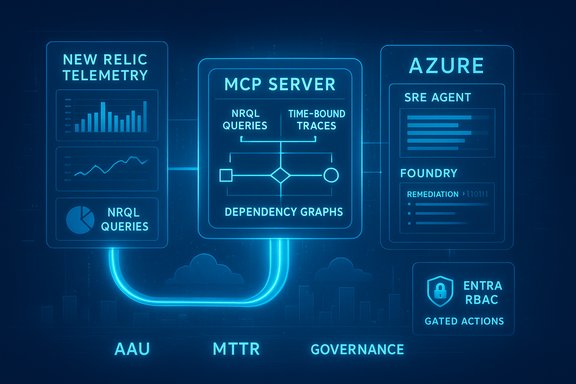
The industry has shifted rapidly from passive monitoring to agentic observability — observability data that not only informs humans but is produced and consumed by AI agents that can recommend or (with controls) execute actions. New Relic’s announcement bundles two connected moves: the public preview of the New Relic AI Model Context Protocol (MCP) Server and a set of integrations that surface New Relic telemetry into Microsoft Azure’s agentic products, notably the Azure SRE Agent and Microsoft Foundry. These integrations aim to let agents and portal-native assistants query high-fidelity telemetry (metrics, traces, logs) and receive structured, time-bound diagnostic payloads for root-cause analysis and remediation suggestions. Why this matters now: Gartner forecasts overall global AI spending will top $2.02 trillion in 2026, accelerating adoption of agentic and generative AI across enterprise stacks and increasing demand for integrated operational controls. Against that backdrop, cloud providers and observability vendors are racing to turn insight into verifiable action within cloud control planes.
That said, success depends less on vendor promises and more on disciplined rollouts: conservative pilots, explicit cost modeling (AAUs + telemetry), strong runbook-as-code practices, and human-in-the-loop controls. The technology is ready for production experiments, but it is not a “set-and-forget” replacement for SRE judgement.
Source: HPCwire New Relic Introduces Agentic AI Integrations with Microsoft Azure - BigDATAwire
 Background
The industry has shifted rapidly from passive monitoring to agentic observability — observability data that not only informs humans but is produced and consumed by AI agents that can recommend or (with controls) execute actions. New Relic’s announcement bundles two connected moves: the public preview of the New Relic AI Model Context Protocol (MCP) Server and a set of integrations that surface New Relic telemetry into Microsoft Azure’s agentic products, notably the Azure SRE Agent and Microsoft Foundry. These integrations aim to let agents and portal-native assistants query high-fidelity telemetry (metrics, traces, logs) and receive structured, time-bound diagnostic payloads for root-cause analysis and remediation suggestions. Why this matters now: Gartner forecasts overall global AI spending will top $2.02 trillion in 2026, accelerating adoption of agentic and generative AI across enterprise stacks and increasing demand for integrated operational controls. Against that backdrop, cloud providers and observability vendors are racing to turn insight into verifiable action within cloud control planes. What New Relic shipped (the essentials)
- MCP Server (Public Preview) — A protocol bridge that exposes New Relic observability as an MCP-compatible toolset so LLM-based agents and orchestration frameworks can:
- Convert plain-language requests into NRQL queries and return structured diagnostic payloads.
- Retrieve causal chains, dependency maps, and traces to speed RCA.
- Package remediation hints and runbook steps as auditable outputs.
New Relic published setup and onboarding docs for the public preview (early November 2025). - Azure SRE Agent integration — When alerts fire or deployments occur in New Relic, Azure’s SRE Agent can call the New Relic MCP Server to fetch evidence, ranked probable causes, and runbook suggestions so portal-native recommendations appear where SREs already operate. This is positioned to reduce context switching and accelerate MTTR.
- Microsoft Foundry (Foundry) support — Foundry-hosted agents, Visual Studio/Copilot surfaces, and GitHub-aligned workflows can surface New Relic telemetry for developers building and managing AI apps and agents. New Relic Monitoring for Microsoft Foundry ingests Azure logs and metrics into New Relic, delivering a nuanced view of agent or app performance.
- Azure Autodiscovery / Dependency mapping — A tailored discovery solution for Azure that overlays configuration changes onto performance graphs and dependency maps to help platform engineers correlate infra changes with telemetry and find blind spots faster.
- New Relic Monitoring for SAP on Microsoft Marketplace — An agentless connector for SAP and non‑SAP systems that aims to minimize business-process interruptions and is being made available through Microsoft Marketplace channels for Azure customers.
How the integration works (technical overview)
MCP as the interoperability layer
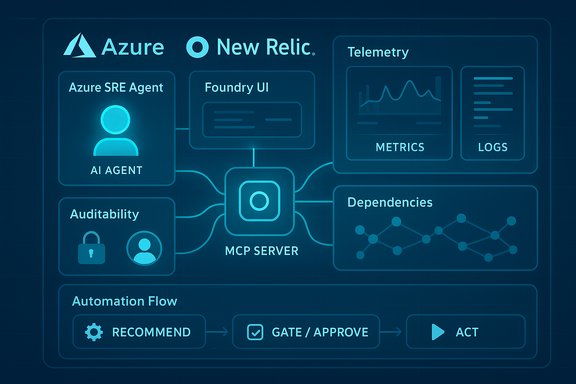
The MCP Server presents New Relic as a structured tool manifest for MCP-capable agents. Agents make MCP calls to request context (for example: “Why did checkout latency spike after the last deployment?”). The MCP Server translates the request into NRQL or other observability queries, returns a time‑bounded diagnostic bundle (traces, implicated services, confidence-scored causes), and packages recommended runbook steps for human review or gated execution. This reduces brittle point-to-point integrations between each agent and each monitoring system.Portal and IDE surfaces
- Azure SRE Agent acts as the portal-native reliability assistant. It can call New Relic’s MCP Server when incidents appear, display evidence and remediation hints, and — depending on tenant governance — execute low-risk actions under approval gates. Microsoft documents the SRE Agent pricing model in Azure Agent Units (AAUs): a baseline always-on component and a usage-based component for active tasks. The technical flow explicitly ties actions to Azure identity (Entra) to maintain auditability.
- Microsoft Foundry and Copilot Studio provide developer-facing surfaces where New Relic telemetry (via MCP) can be surfaced inline in IDEs or multi-agent orchestration environments. That lets devs query production performance with natural language while coding and reviewing.
Telemetry correlation and discovery
New Relic continues to ingest metrics, traces, and logs (APM, OpenTelemetry pipelines). Azure Autodiscovery maps services, overlays configuration changes onto performance graphs, and feeds these causal relationships into the MCP payloads so agents and SRE surfaces receive prioritized, high-confidence signals rather than raw alerts. This is the foundation for converting an alert into an actionable remediation suggestion.Verified claims and what still needs validation
What is verified:- New Relic publicly launched an MCP Server in public preview (early November 2025) and documented onboarding steps.
- New Relic published press materials announcing agentic integrations with Microsoft Azure that reference the Azure SRE Agent, Microsoft Foundry, and Azure Monitor.
- Microsoft documents the Azure SRE Agent product page and AAU billing model (4 AAU/hour baseline; 0.25 AAU/second for active tasks) in its preview pricing materials. These are public and should be used to model expected monthly costs.
- Market context (Gartner AI spending forecast) supports the macroeconomic premise that enterprise AI investment is accelerating and creates pressure to integrate observability into agentic workflows.
- The exact operational contract or joint technical whitepaper that details how Azure SRE Agent calls New Relic’s MCP Server in a production tenant (data flows, egress, encryption, supported payloads, and latency SLAs) is not yet documented as a formal New Relic–Microsoft co-authored technical integration guide in public channels. While vendor materials and demos show the workflow and feasibility, procurement and platform teams should validate the precise integration method and compliance envelope during pilots.
- Availability constraints such as preview region restrictions, compliance constraints for FedRAMP/HIPAA, and marketplace availability may vary by tenant and region; these should be validated against both New Relic account settings and Azure subscription region controls before production rollout.
The operational case: benefits for engineering and SRE teams
When architected carefully, the New Relic + Azure agentic integration can deliver concrete operational value:- Faster MTTR — Agents that fetch causal traces and dependency overlays can surface the likely root cause within minutes instead of hours, because they eliminate manual context assembly across consoles.
- Reduced context-switching — Engineers see telemetry evidence inside the Azure portal, IDE, or Copilot Studio rather than toggling between monitoring dashboards and ticketing systems. That’s a measurable productivity gain in real incident playbooks.
- Auditable automation — Packaging remediation hints as runbook templates and gating execution via identity-bound approvals (Azure Entra, RBAC) preserves human-in-the-loop safety while enabling low-risk automation to be executed reliably.
- Developer feedback loop — Surfacing production telemetry in developer surfaces shortens the feedback loop between code changes and production impact, enabling faster debugging of regressions tied to specific commits or deployments.
- Agentic observability for AI workloads — As organizations run agentic apps and models, the ability to correlate model calls, token usage, latency and downstream service impacts becomes vital; New Relic’s MCP-backed payloads aim to make that correlation first-class.
The risks and trade-offs — what engineering leaders must evaluate
- Cost and consumption modeling
- Azure billing for agentic work uses AAUs. A baseline cost (4 AAU/hour per agent) plus active task costs (0.25 AAU/second per task) can add up quickly under frequent automation or parallel incident activity. Use the published AAU examples to model monthly burn for expected agent count and incident frequency.
- Telemetry volume and observability cost
- High-cardinality telemetry (AKS clusters, machine-learning training workloads, token-level model telemetry) raises ingestion, storage, and query costs in New Relic. Teams must design sampling, retention, and aggregation policies to balance fidelity with predictable cost.
- Operational safety and runaway automation
- Agentic remediation introduces the possibility of cascading actions if runbooks are insufficiently validated. Staging automation as “recommend → gate/approve → act,” with strict approvals and canary rules, is the prudent path. Relying solely on agent confidence scores without human checks risks unintended configuration changes.
- Governance, compliance, and data residency
- Preview availability and compliance exceptions (e.g., FedRAMP, HIPAA) may limit MCP usage. Enterprises with regulatory constraints must demand red-team testing and explicit data-flow diagrams showing what telemetry leaves the tenant, what is stored, and how long contextual snapshots are kept.
- Model and agent governance
- Agents driven by LLMs can produce plausible but incorrect remediation suggestions. Teams must version prompts, track model endpoints, and capture rationale for each suggestion (provenance) to enable audits and post-incident reviews. This is particularly important when agents touch stateful systems or billing-sensitive resources.
- Vendor lock and multi-cloud considerations
- Tight integration where Azure portal surfaces depend on New Relic telemetry (and New Relic depends on Azure Monitor exports) can bake in vendor contracts that complicate multi-cloud portability. Platform teams should codify runbooks as code and ensure observable artifacts can be rehydrated in alternate providers if needed.
Practical rollout checklist (recommended steps)
- Run a scoped pilot:
- Start with one team, a narrow set of services (e.g., a single microservice or job queue), and a limited set of agent actions (read-only diagnostics; no automated writes).
- Model AAU and telemetry costs:
- Use Azure’s AAU pricing examples and New Relic ingestion estimates to build a monthly cost view for expected agent count and incident frequency.
- Codify runbooks as code:
- Convert recommended remediation steps into tested, versioned runbooks in CI/CD with automated tests and playbooks.
- Enforce identity and RBAC:
- Map agent privileges to least-privilege Azure Entra identities and include agents in periodic access reviews.
- Define human-in-the-loop policies:
- Set severity thresholds and action categories that require human approval versus those allowed as safe, automated fixes.
- Validate data residency and compliance:
- Obtain a clear data-flow diagram from vendors showing telemetry egress, retention, and compliance controls for your tenant.
- Measure outcomes:
- Track MTTR, number of human interventions prevented, false-positive automated actions, and realized cost savings from rightsizing recommendations.
Competitive context and market implications
New Relic’s move is part of a broader trend: observability vendors (including Dynatrace, Elastic and others) and cloud providers are racing to populate agentic control planes with high-confidence diagnostics and auditable runbooks so that SRE workloads become more automated and less error-prone. Customers can expect vendor-specific differences in causal modeling approaches (statistical vs. causal-AI), storage models (lakehouses vs. indexed telemetry), and integration depth (export-only vs. bi-directional context exchange). Vendors that provide the most accurate, explainable diagnostics and tightest governance controls will be more successful in enterprise rollouts.Critical analysis — strengths, weaknesses, and what to watch
Strengths
- Practical productivity gains: Eliminating console hopping and surfacing telemetry where engineers work yields immediate, measurable time savings in incident response.
- Standards-forward approach: Embracing MCP lowers integration friction across agent runtimes and reduces custom connector sprawl.
- Auditability baked in: The emphasis on RBAC, Entra identity, and staged approvals aligns with enterprise governance expectations.
Weaknesses / risks
- Cost unpredictability: AAUs plus telemetry ingestion can create unexpected monthly bills without careful modeling. The preview AAU mechanics should be used to create conservative budgets.
- Operational drift and safety: LLM-driven remediation hints can be incorrect; without rigorous runbook testing and approvals, you risk automated misconfiguration at scale.
- Incomplete public integration docs: While demos and press releases show the workflow, a joint, detailed New Relic–Microsoft integration spec (data contracts, SLAs, compliance artifacts) is not yet published; this is a gap teams should validate during pilots.
What to watch next
- Publication of a joint technical integration guide from Microsoft and New Relic that details payload schemas, authentication, telemetry flow controls, and recommended guardrails.
- Case studies showing real MTTR reductions and measurable cost impacts from customers who ran pilots in production.
- Expansion of MCP support across additional observability vendors and agent runtimes, which would broaden interoperability and reduce single-vendor risks.
Verdict for platform engineering and SRE leads
New Relic’s MCP Server plus the Azure integrations deliver a credible evolution in observability: from passive dashboards to agentic, contextualized operations that can speed incident response and reduce toil. The technical building blocks — MCP, Azure SRE Agent, Entra identity, and New Relic telemetry — line up into a sensible operational pattern: high-fidelity telemetry → structured context → auditable actions.That said, success depends less on vendor promises and more on disciplined rollouts: conservative pilots, explicit cost modeling (AAUs + telemetry), strong runbook-as-code practices, and human-in-the-loop controls. The technology is ready for production experiments, but it is not a “set-and-forget” replacement for SRE judgement.
Final takeaways
- New Relic’s MCP Server public preview and Azure integrations materially lower the friction for agentic observability on Microsoft Azure, bringing contextual diagnostics into SRE and developer workflows.
- Microsoft’s Azure SRE Agent pricing and AAU model should be modeled carefully during pilots; baseline and active costs are both significant levers.
- The macro case for agentic observability is strong — Gartner-backed AI spending projections underline enterprise urgency — but operational success requires robust governance, cost controls, and validated runbooks.
- Before wide rollout, engineering teams should validate the precise integration architecture, compliance footprint, and failure modes in a controlled pilot and insist on documented, auditable workflows.
Source: HPCwire New Relic Introduces Agentic AI Integrations with Microsoft Azure - BigDATAwire